[Technical Column] Four Factors That Increase the "Rotational Torque" of Expander Rolls and Total Cost Reduction Measures
 大阪染織機械株式会社
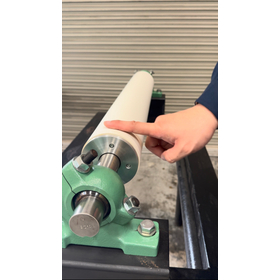
In selecting expander rolls, "rotational torque (the force/weight required to turn)" is a crucial factor that affects quality.
In fact, expander rolls are delicate, and the rotational torque can vary significantly with customization tailored to the site. For example, increasing the rubber hardness by "+10°," reinforcing both ends for dust and water resistance, adjusting bearings, and applying Teflon coating are all factors that can increase the rotational weight.
Due to these characteristics, it is common for standard mass-produced models to assume "with drive units," which can lead to additional costs of nearly 1 million yen for ancillary equipment such as motors.
Our products (with an outer diameter of 125 mm or less) are standardly designed as "non-driven, free-rolling specifications." By closely hearing customer site conditions and designing rolls with optimal lightness, we eliminate the need for expensive ancillary equipment and achieve "total cost reduction for the entire system."
There are many cases where we have successfully reduced costs by changing from a driven to a free-rolling specification. For detailed reasons why the rotation becomes heavier and the effects of cost reduction, please refer to the linked article.
Inquiry about this news
Contact Us OnlineMore Details & Registration
Details & Registration
Related Links
Explaining the four factors that increase the rotational torque of the expander roll (rubber hardness, dust resistance enhancement, bearings, Teflon coating). We will introduce points to reduce the total cost of equipment with a "dragging specification" that excludes the drive unit.
Distributors