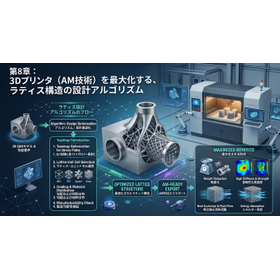
Season 5 [Expansion] Chapter 8: Maximizing 3D Printers (AM Technology) with Lattice Structure Design Algorithms
T3Japan
Once, 3D printers were primarily focused on "rapid prototyping" and shape verification using methods like lost-wax casting, existing in opposition to and as a separate entity from machining, which produces final products. However, after more than a decade, they have overcome challenges related to materials and metal fabrication, evolving into "fabrication machines" for practical parts, and it has become an era where even the machine tool manufacturers, who were once competitors, are entering the market.
The true value of 3D printers lies in their ability to free themselves from the constraints of "subtractive and mold forming" processes like cutting and casting, allowing for the "free design of internal structures" without being limited by external shapes. In particular, lattice structures, which are integrated with topology optimization and algorithms, enable the realization of "programmable materials" that optimize density and shape according to physical properties such as load, heat, and impact. On the other hand, to overcome manufacturing and quality assurance challenges such as support material removal, thermal deformation, and non-destructive testing through CT scans, building a digital ecosystem where CAD, CAE, and CAM work together is key.
Inquiry about this news
Contact Us OnlineMore Details & Registration
Details & Registration
Related Links
Nice to meet you, I’m Takachan, working in sales (which is more like a pre-sales role) at ThinkDesign. Usually, I listen to clients' desires for "the kind of service they want to create" and bridge the gap to turn those into a "concrete blueprint" that engineers and designers can follow without hesitation.
Distributors