The usefulness and application methods of protective base glycerol nucleic acids.
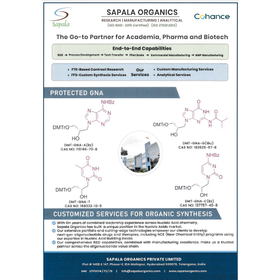
The catalog shows four types of GNA units with protective groups that are essential for oligonucleotide synthesis. • DMT-GNA-A(Bz) (CAS: 115196-70-8) • DMT-GNA-G(iBu) (CAS: 182625-67-8) • DMT-GNA-T (CAS: 168332-12-5) • DMT-GNA-C(Bz) (CAS: 127757-40-8) These have a 5' terminal equivalent OH group protected by a DMTr (dimethoxytrityl) group, and the bases (A, G, C) are also protected by standard Bz (benzoyl) or iBu (isobutyl) groups.
Inquire About This Product
basic information
For inquiries regarding quantity and quality, please contact us.
Price information
It varies depending on the synthesis scale. Please contact us.
Delivery Time
Applications/Examples of results
Technical Utility 1. High Nuclease Resistance GNA has a non-natural, non-cyclic backbone, making it less recognizable by nucleases in the body, thus improving its stability in serum. Suppression of siRNA Off-Target Effects By introducing GNA into the "seed region" of the siRNA guide strand, it has been shown that unintended binding to mRNA (off-target effects) can be suppressed. 2. Unique Thermodynamic Stability GNA-GNA double strands tend to be thermodynamically much more stable (higher Tm value) than natural DNA or RNA. Points to Note in Introduction 3. Decreased Binding Affinity with Complementary Strands (DNA/RNA) While the stability among GNA strands is high, when hybridized with natural DNA or RNA, the Tm value usually decreases. If the position or number of GNA introduced is incorrect, it may impair the binding ability to the target mRNA, necessitating advanced design techniques for optimization. 4. Management of Chirality The carbon at position 2 of the glycerol backbone is a chiral center. The ability to form double strands differs significantly between S and R forms, so it is necessary to select the appropriate optical isomer during synthesis and manage its purity.
catalog(1)
Download All Catalogs
Company information

Ayurveda is well-known, but historically, India has been significantly involved with "medicine." Sapala Organics was established in 2005 in Hyderabad, located in the central part of the Deccan Plateau. The state government is actively investing to make this area a "Pharma City" (a treasure trove of medicine). Sapala has gained recognition from major pharmaceutical companies in the United States and Europe, steadily achieving results. To further provide the technological capabilities developed globally to Japan, Sapala Corporation was established in February 2018 as a local subsidiary in Japan. Recently, the Japanese government has also been focusing on projects that promote advanced pharmaceutical development and drug discovery, including nucleic acid-related drugs. We encourage you to consider the technological expertise of "Sapala," which excels in these fields.