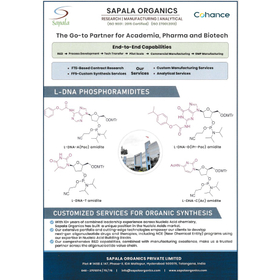
The usefulness and utilization methods of L-DNA phosphoramidites.
★The Main Features and Utility of L-DNA The "L" in L-DNA indicates that the stereochemistry of the sugar component (deoxyribose) is the mirror image isomer (enantiomer) of the naturally occurring D-DNA (D-deoxyribose). This mirror relationship is the source of L-DNA's utility. 1. Stability in Biological Systems (Nuclease Resistance) The greatest advantage is its extremely high resistance to nucleases (nucleic acid degrading enzymes). Enzymes present in the human body have evolved to recognize and degrade D-DNA. Because the enzymes themselves are chiral (asymmetric), they cannot recognize or bind to L-DNA, which is a mirror image isomer. 2. Non-Hybridization with D-DNA/RNA L-DNA does not form Watson-Crick base pairs with D-DNA or D-RNA, nor does it coil into a double helix. However, L-DNA can form a stable double helix (left-handed Z-type structure) with other L-DNA molecules. This property allows for the avoidance of unintended hybridization (binding) with genomic DNA or mRNA in biological systems, which is expected to reduce noise in assay systems and suppress off-target effects.
Inquire About This Product
basic information
For inquiries regarding quantity and quality, please contact us.
Price information
It varies depending on the synthesis scale. Please contact us.
Delivery Time
Applications/Examples of results
★Main Utilization Methods and Applications 1. Development of Spiegelmer This is the most representative and powerful application of L-DNA. Spiegelmer is also referred to as a "mirror-image aptamer." Spiegelmer strategy: First, the mirror-image isomer of the target biomolecule (D-protein) is chemically synthesized. Using a standard D-DNA library, aptamers that bind to this "mirror-image target" are selected (using the SELEX method). The sequences of the obtained D-DNA aptamers are synthesized into their mirror-image isomers (L-DNA) using Sapala's L-DNA amide. This L-DNA aptamer (Spiegelmer) binds with high specificity to the original target biomolecule (D-protein) due to the mirror-image relationship. 2. Stabilization of Oligonucleotides (Capping) By "capping" the 3' or 5' ends of D-DNA (such as antisense nucleic acids or siRNA) with L-DNA (adding a few nucleotides), it is possible to prevent the attack of exonucleases that degrade from the ends. This allows for a significant improvement in the overall stability of the oligonucleotide while maintaining the functionality of the D-DNA portion.
catalog(1)
Download All Catalogs
Company information

Ayurveda is well-known, but historically, India has been significantly involved with "medicine." Sapala Organics was established in 2005 in Hyderabad, located in the central part of the Deccan Plateau. The state government is actively investing to make this area a "Pharma City" (a treasure trove of medicine). Sapala has gained recognition from major pharmaceutical companies in the United States and Europe, steadily achieving results. To further provide the technological capabilities developed globally to Japan, Sapala Corporation was established in February 2018 as a local subsidiary in Japan. Recently, the Japanese government has also been focusing on projects that promote advanced pharmaceutical development and drug discovery, including nucleic acid-related drugs. We encourage you to consider the technological expertise of "Sapala," which excels in these fields.