Roof Greening FAQ: All 310 Questions - Successful Roof Greening - Roof Greening Knowledge Database
FAQ on Rooftop Greening: 310 Questions - Selection of Methods Before Implementation and Maintenance Management Decision Materials. A knowledge database covering the design, construction, and maintenance management of rooftop greening.

To avoid regrets about rooftop greening. Check the rooftop greening FAQ with all 310 questions. A knowledge database covering the design, construction, and maintenance of rooftop greening.
To avoid regrets with rooftop greening, it is important to check not only the appearance immediately after installation but also the maintenance condition several years later. At the Greenery Planning Research Institute, we have organized a total of 310 FAQs regarding pre-introduction checks for rooftop greening, method selection, weed control, soil runoff, soil dispersion, regeneration of existing greenery, and choosing contractors. On this page, we present a selection of 9 representative questions to consider for successful rooftop greening.

Inquire About This Product
basic information
Document Type: Rooftop Greening FAQ and Pre-Implementation Verification Materials Contents: Excerpt of 9 representative questions from a total of 310 rooftop greening FAQs Target Audience: Designers, facility managers, construction companies, and clients considering rooftop greening Verification Items: Perspectives that do not judge solely based on immediate post-construction conditions, weeds, soil erosion, soil dispersion, method comparisons, regeneration of existing rooftop greening, contractor selection, and advertising display precautions Related Information: The full 310 rooftop greening FAQs are available on this site
Price information
There are no price listings. This page is an information page that introduces 9 representative questions from the 310 questions in the rooftop greening FAQ. Please use it as a reference for organizing your thoughts on rooftop greening before comparing prices.
Delivery Time
Applications/Examples of results
**Main Use Cases** This page is intended to be used for the initial consideration of rooftop greening, selection of methods, regeneration of existing rooftop greening, organization of maintenance management risks, and as a reference document before selecting contractors. It can also be utilized when there is a need to share assumptions and decision-making criteria regarding rooftop greening among clients, designers, construction companies, and facility managers. This page extracts nine representative questions from a total of 310 rooftop greening FAQs. The aim is to provide information to organize perspectives that should be confirmed before implementation, such as weeds, soil runoff, dispersion, changes over time after construction, and how to view advertising displays, rather than making judgments based solely on specific successful cases.
Detailed information
-

FAQ: J-30 What should I check to avoid regrets with rooftop greening? A. If you judge rooftop greening solely based on its appearance right after completion, unexpected costs and efforts may arise during future maintenance and updates. When considering it, it is recommended to check in advance: - Maintenance methods - Weed control measures - Drainage plans - Soil runoff measures - Strong wind measures - Repair methods - Renewal methods
-

FAQ: X-1 Should rooftop greening be evaluated only immediately after installation? A. No. It is important to check the long-term maintenance status of rooftop greening, not just immediately after installation. Many rooftop gardens look beautiful right after installation. However, plants are living organisms, and their condition changes over time. In recent years, they have become more susceptible to factors such as: - Extreme heat - Low rainfall - Heavy rain - Typhoons - Invasion of weeds Therefore, it is recommended to check the maintenance status not only immediately after installation but also after: - 1 year - 3 years - 5 years - 10 years Generally, about 3 to 4 years after installation, differences may appear in terms of weeds, plant decline, soil erosion, and poor drainage. It is important to verify not only the appearance at the time of installation but also whether the method is easy to maintain in the long term.
-

FAQ: J-10 Why does the amount of weeds increase with rooftop greening? A. Weed seeds are continuously brought in by wind and birds. Even if there are few weeds immediately after construction, over time, seeds accumulate, making it easier for weeds to grow. Therefore, it is important to check the condition a few years after construction, rather than just immediately after.
-

FAQ: J-12 Is soil runoff control important for green roofs? A. Yes. Soil runoff control is one of the important factors to consider when evaluating green roofs. Unlike ground level, rooftops are more susceptible to strong winds and heavy rain, and if soil washes away, it can lead to clogged drainage, impact on the surrounding environment, and increased maintenance costs. Additionally, soil runoff can deteriorate the growing conditions for plants, potentially causing partial wilting or poor growth. Therefore, when considering green roofs, it is recommended to check: - How soil runoff control is implemented - Whether drainage routes during heavy rain are taken into account - Consideration for the area around the drainage outlets - Whether the structure is designed to minimize soil runoff even after long-term use It is important to verify the condition and maintenance methods after 3 to 4 years post-installation, as issues may not arise immediately but could occur due to heavy rain or typhoons in the following years.
-

FAQ: J-11 Is soil scattering prevention important for rooftop greening? A. Yes. Rooftops are more susceptible to strong winds than ground level, and depending on the height of the building and the surrounding environment, unexpected winds can occur. When soil scatters, it can lead to: - Clogging of drainage outlets - Dirt on exterior walls and surrounding facilities - Increased maintenance burden Therefore, measures against soil runoff and soil scattering, as well as plants, are important points to confirm when selecting a rooftop greening system.
-

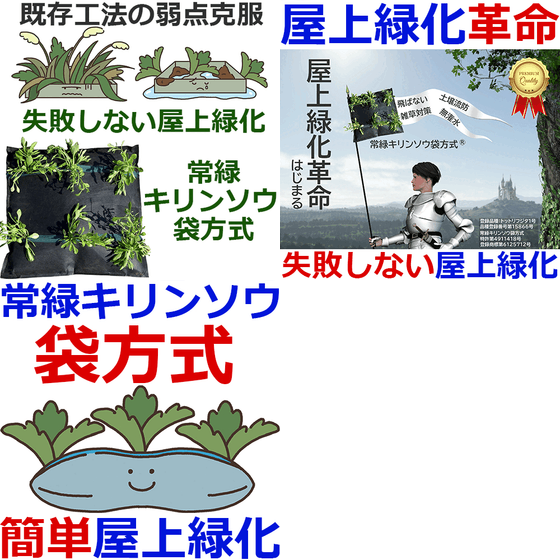
FAQ: J-5 What is the difference between tray-type rooftop greening and bag-type greening? A. The tray-type involves placing plants and soil in trays, while the bag-type integrates plants and soil into a bag-like substrate. The tray-type is easy to standardize and straightforward to install, but it requires checking for surface smoothness, fixation methods, wind resistance, tray degradation, soil runoff, and partial repairs. The bag-type is flexible and can easily adapt to minor surface irregularities. It is also easier to apply for partial repairs and renovations of existing rooftop greening. In both methods, comprehensive design that includes plants, soil, drainage, wind resistance, and maintenance management is essential.
-

FAQ: F-7 Can we install without removing the existing rooftop greening? A. It may be possible to install. The rooftop greening cover method is fundamentally based on installing a new greening system on top of the existing rooftop greening. However, if the existing base is significantly deteriorated, if there are drainage issues, or if inspection of the waterproof layer is necessary, partial or complete removal may be appropriate. The rooftop greening cover method is a technique that allows for the repair, renovation, and regeneration of existing rooftop greening that has experienced deterioration or functional decline, without removing or disposing of it, by installing a new rooftop greening system (evergreen Kiri grass bag method) on top. This method is based on the premise of reconstructing without removing the existing rooftop greening, and it is positioned as one option for considering the regeneration of rooftop greening while minimizing the time and costs associated with removal and the impact on the surrounding environment.
-

FAQ: J-29 What are the key points to consider when choosing a rooftop greening contractor? A. Rooftop greening involves multiple elements, including plants, architecture, waterproofing, drainage, and maintenance. When selecting a contractor, it is recommended to check the following points: - Track record of construction - Reasons for plant selection - Drainage measures - Soil erosion prevention measures - Wind resistance measures - Weed control measures - Maintenance methods - Renewal methods - Warranty details In addition to price, long-term maintainability is also important.
-

FAQ: J-16 Can rooftop greening labeled as "Industry No.1" be trusted? A. When you see a label stating "Industry No.1," it is important to verify the basis for that claim. Here are the points to check: - What is it No.1 in? - Is it based on installation area? - Is it based on the number of installations? - Is it based on sales? - Is it based on customer satisfaction? - What is the survey period? - Which companies were surveyed? - Which organization conducted the survey? - Is it nationwide or limited to a specific region? - Does it only include rooftop greening or does it also encompass other types of greening? A No.1 claim without clear evidence is insufficient for assessing actual quality and long-term stability.
catalog(2)
Download All Catalogs

Company information

In manufacturing, there are people, and in projects, there is drama. The "passion" of three individuals transcends the boundaries of the company to create "co-creation" and "hope." In April 2007, at an exhibition, a certain project team was born. They wanted to create new solutions originating from the field to solve customer problems. Three professionals who shared such a passionate desire met, leading to the establishment of the Evergreen Kiri-Sou Promotion Association. Professionals in plants, architecture, civil engineering, and equipment breathe new life into the city. A series of moving moments. The opportunities to experience moments where the heartbeat never stops are becoming fewer. Why is that? Perhaps it is because the number of fakes and forgeries has increased. We aim to continue being professionals involved in plants, architecture, civil engineering, and equipment, and we operate the Evergreen Kiri-Sou Promotion Association. The professionals have developed new greening methods and greening systems. That is the Evergreen Kiri-Sou bag method.


![Why does rooftop greening fail? [Structural Causes]](https://image.mono.ipros.com/public/default/object/noimage_l.gif?w=280&h=280)