
[Analysis Case] Comparison of Theoretical Solutions for Q Factor (Resonator) Using Electromagnetic Wave Analysis

Evaluating the losses occurring on the inner walls of the resonator! Introducing the successful correlation between Q value and theoretical solutions.
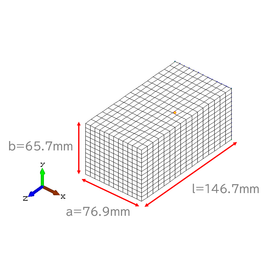
We conducted an electromagnetic field analysis when operating a rectangular cavity in the TE101 mode using our "PHOTO-WAVEjω." We compared the numerical values obtained from the analysis results with theoretical calculations. We created plate elements on the surface of the analysis model, setting the electrical conductivity for these plate elements. We determined the Q value from the internal energy and losses on the inner walls. The values obtained using the analysis software matched well with the theoretical values. 【Case Summary】 ■ Analysis Target: Rectangular Cavity Resonator ■ Resonant Frequency: 2.20651 GHz ■ Software Used: PHOTO-WAVEjω ■ Evaluation Items: Electric Field (Absolute Value) and Magnetic Flux Density (Absolute Value) *For more details, please download the PDF or feel free to contact us.
Inquire About This Product
basic information
【Other Case Overview】 ■ 3D high-frequency electromagnetic field analysis software using finite element method ■ Module for frequency response analysis ■ Analysis considering complex dielectrics is possible ■ The amount of heat generated due to the attenuation of electromagnetic waves (high frequency) in dielectrics can be calculated *For more details, please download the PDF or feel free to contact us.
Price range
Delivery Time
Applications/Examples of results
【Applicable Fields】 ■Microwave ■Cavity Resonator ■Mode Conversion Device ■EMI Related ■RFID Related, etc. *For more details, please download the PDF or feel free to contact us.
catalog(3)
Download All Catalogs![[Analysis Case] Comparison of Theoretical Solutions for Q Value (Resonator) Using Electromagnetic Wave Analysis](https://image.mono.ipros.com/public/catalog/image/354241/IPROS4814954291287528648.jpeg?w=120&h=170)


Company information

At Photon, we are developing "electromagnetic field analysis software" that models and simulates products and components utilizing electromagnetic phenomena on a computer. In traditional design and development environments, the process has primarily revolved around trial and error through prototyping based on the experience of engineers and experiments with prototypes. However, conducting experiments using actual prototypes and analyzing the results requires significant time and cost. Moving forward, transitioning from an experimental and prototyping-based approach to an analysis-based design approach will be a crucial challenge for improving productivity, and establishing simulation technology as the core of analysis-based design techniques will be essential. In this context, Photon is developing and providing "analysis software" focusing on electromagnetic fields, as well as heat, vibration, and sound fields. By utilizing Photon's software, efficient development and design of various industrial products can be achieved. In this way, Photon aims to support users in reducing the number of prototypes, lowering development costs, and shortening development periods in their manufacturing environments, ultimately enhancing their competitiveness.
![[IGOR Pro Case Study] Next-Generation Optical Device Research](https://image.mono.ipros.com/public/product/image/2d7/2001489824/IPROS84051964208859939804.png?w=280&h=280)
![[IGOR Pro Case Study] Application in Animal Behavior Research](https://image.mono.ipros.com/public/product/image/01d/2001489826/IPROS01618376657642636186.png?w=280&h=280)
![[IGOR Pro Case Study] University of Tokyo, Atmosphere and Ocean Research Institute](https://image.mono.ipros.com/public/product/image/0e2/2001491923/IPROS64344024876720016148.png?w=280&h=280)
