

Directly from RF to zero IF. The AD9213 showcases a new frontier of 3.6GHz ultra-wideband reception and FPGA collaboration.
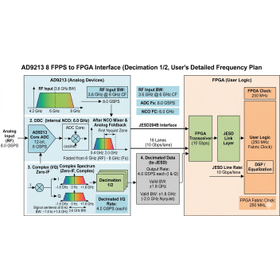
This introduces a system image that downconverts an input center frequency of 6.0 GHz with a bandwidth of 3.6 GHz (frequency range: 4.2 GHz to 7.8 GHz) using the internal NCO (6.0 GHz) of the AD9213 to Zero-IF (Zero-IF / quadrature complex conversion). It is a very advanced and rational frequency plan, illustrating the frequency transition image (spectrum movement) from direct RF sampling to Zero-IF conversion, as well as the consistency of the filter bandwidth for 1/2 decimation in a diagram.
Inquire About This Product
basic information
Input center frequency .......................... 6GHz Input bandwidth ................................... 3.6GBW ADC sampling frequency ........................ 8Gsps NCO frequency .................................... 6GHz Digital complex mixing Decimation ratio .................................. 1/2 JESD lane count ................................... 16Lane Bit depth ............................................. I/Q 32Bit JESD line rate ...................................... 10Gbps
Price range
Delivery Time
Applications/Examples of results
◆RF Input (4.2 ~ 7.8 GHz): An input signal centered at 6 GHz with a bandwidth of 3.6 GHz is mapped to the 1st Nyquist (centered at 2.0 GHz, inverted) through 8 GSPS sampling. ◆Digital Downconversion (NCO @ 6.0 GHz): The signal is pulled down to exactly 0 Hz (Zero-IF) using an internal NCO and mixer, and is restored and converted to a complex baseband (I/Q) signal (-1.8 GHz to +1.8 GHz). ◆1/2 Decimation & JESD Output: After passing through a half-band filter, the I/Q data at 4.0 GSPS is handed over to the FPGA's 250 MHz fabric logic via a 16-lane JESD interface (each 10.0 Gbps). ◆The internal CLK of the FPGA is 250 MHz, but by performing 16 parallel processing, a 4 GSPS digital signal processing system can be constructed.
Company information

We provide comprehensive support from idea and specification proposals to development and manufacturing. We consistently design without interruption from analog front-end to high-speed digital, FPGA logic, and edge AI, building high-bandwidth, low-latency, and highly reliable electronic systems for IoT/communication, industrial equipment, broadcasting, measurement, and next-generation mobility. By integrating high-frequency design, signal processing, and real-time control, we ensure that the required specifications are met while proposing improvements where necessary, achieving a high level of completion in implementation.