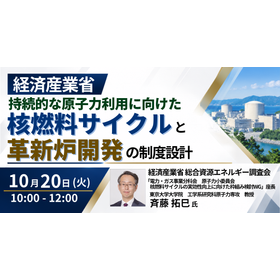
[Seminar] Ministry of Economy, Trade and Industry: Nuclear Fuel Cycle for Sustainable Nuclear Power Utilization

Ministry of Economy, Trade and Industry "Working Group on Framework Examination for Improving the Effectiveness of the Nuclear Fuel Cycle" Chair: Takumi Saito - Regarding the Institutional Design for Innovative Reactor Development -
Our company will hold a business seminar. 【Practical Insights Gained from the Seminar】 - Current status and major issues of the nuclear fuel cycle - Transition points from light water reactor MOX to fast reactors - Institutional design looking towards post-2050 【Target Industries and Departments】 - Management planning and nuclear departments of power and nuclear operators - Business planning and technical departments of nuclear-related manufacturers and engineering companies - Personnel involved in reprocessing, fuel, and spent fuel management - Energy and nuclear policy personnel in government agencies and local governments - Researchers and developers in the energy sector 【Seminar Details】 ■ Date and Time: October 20 (Tuesday) 10:00 - 12:00 (Doors open at 9:30) ■ Venue: JPI Conference Square ■ Address: 5-2-32 Minamiazabu, Minato-ku, Tokyo, Kowa Hiroo Building ■ Participation Method: On-site, live streaming, archived streaming ■ Instructor: Chair of the "Working Group on Framework for Improving the Effectiveness of the Nuclear Fuel Cycle" of the Ministry of Economy, Trade and Industry's Comprehensive Resource and Energy Survey Committee, Professor at the Graduate School of Engineering, University of Tokyo, Mr. Takumi Saito *For more details, please refer to the PDF document or feel free to contact us.
Inquire About This Product
basic information
**Lecture Overview** In order to simultaneously achieve energy security and carbon neutrality by 2050, the effectiveness of the nuclear fuel cycle that supports the sustainable use of nuclear power is being questioned. In this lecture, we will first organize the overall picture of the cycle from the front end to the back end, and outline Japan's two-stage strategy of "transitioning from light water reactor MOX to future fast reactor cycles." Next, we will overview the current challenges, such as the Rokkasho reprocessing and MOX plant, the pressure on the storage of spent fuel, and plutonium management. Based on this, we will discuss the development of innovative reactors as the means to operate the cycle, particularly focusing on the selection of fuel supply and reprocessing technologies and the issues related to MA separation in connection with the fast reactor cycle. More than the superiority of technologies, it is emphasized that institutional design, securing learning opportunities, and intergenerational policy continuity are key factors, and the necessity of integrated institutional design looking beyond 2050 will be proposed. **Lecture Items** ■ Why the nuclear fuel cycle now ■ What is the nuclear fuel cycle ■ Current status of the cycle and pressing issues ■ Reactors that operate the cycle—connection with innovative reactor development ■ Dual-track approach and common challenges post-2050 ■ Summary—three layers supporting a cycle that transcends generations— ■ Related Q&A ■ Business card exchange and networking event (for in-person attendees only)
Price information
【Participation Fee】 1 person: 37,560 yen (including tax) From 2 people onwards: 32,560 yen (including tax / same organization, simultaneous application) *For those affiliated with local public organizations, up to 2 people can participate for 11,000 yen (including tax / venue and live streaming only, same participation format)
Delivery Time
Applications/Examples of results
For more details, please refer to the PDF document or feel free to contact us.
catalog(1)
Download All Catalogs
Company information

JPI Corporation (Japan Planning Institute) has been providing valuable information for executives and senior management involved in the execution of national policies and national projects, supporting the dissemination of state policies as a 'bridge of knowledge' between 'government', 'administration', and 'citizens' in the form of exclusive real seminars for participants for half a century, aiming to create national knowledge.