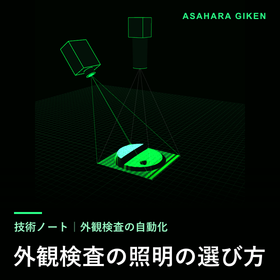
How to Choose Lighting for Visual Inspection | Coaxial, Dome, Low Angle, Transmitted
The lighting for visual inspection is chosen based on whether the defects you want to find stand out brightly against the background or appear dark and recessed. The five typical shapes are coaxial, dome, low angle, transmitted, and bar. As a guideline, coaxial is used for scratches or dents on flat glossy surfaces, dome for dirt or prints on curved glossy surfaces, low angle for shallow scratches or edges of unevenness, and transmitted for contours or holes. [Key Points] - The lighting is selected so that defects stand out from the background. - The five typical shapes are differentiated by the angle of light entry and how the surface reflects light. - You cannot target everything with just one type. There are also methods to take shots by changing conditions. *For detailed explanations, please refer to the technical notes and downloadable materials in the related links.
Inquire About This Product
basic information
**Contents of this Technical Note** - Choose lighting based on the angle of incoming light - Differences between coaxial, dome, low angle, transmission, and bar lighting, and their strengths in detecting defects - Reverse lookup based on types of defects - Further differentiation using light color and polarization - Issues that cannot be resolved with lighting - Common misconception: brighter lighting means better visibility - Approach for selecting lighting using actual objects **Consultation** I will verify whether it can be measured or captured with your work by checking the actual object. Please consult with a single photo.
Price information
The technical notes can be read by anyone from the related links. We will discuss the costs of development and testing based on the details you provide.
Delivery Time
※It varies depending on the content. Please contact us.
Applications/Examples of results
【Frequently Asked Questions】 Q. How many types of lighting should I try to have enough? A. It's quickest to try a representative five types. You can often get a sense of which one will work by testing a few. If there are defects that don't float, you can confirm by adding different colors or angles of light. Q. What is the difference between coaxial lighting and dome lighting? A. Coaxial lighting shines from the same direction as the camera, illuminating flat glossy surfaces brightly. Dome lighting softly illuminates from all directions, reducing reflections on curved surfaces. The choice depends on the shape of the surface and whether you want to retain shadows. Q. If I change the lighting, do I need to redo the judgment mechanism? A. In many cases, you will need to redo it. This is because the appearance of the images changes. Therefore, you should decide on the lighting before creating the judgment.
catalog(1)
Download All Catalogs![[Technical Document] Automation of Visual Inspection: Approach and Common Pitfalls, How to Capture Images and Choose Lighting Before AI](https://image.mono.ipros.com/public/catalog/image/2115800/IPROS9310882243773939791.png?w=120&h=170)
Company information

We specialize in 2D and 3D inspection and measurement technologies using cameras. We possess a wide range of knowledge in optics, mechanics, electronics, and software, enabling us to provide technical support for both hardware and software. Not only do we have personnel with experience working as researchers at image inspection device manufacturers, major electronic component manufacturers, and universities, but we also have numerous successful implementations of developed products in actual production environments, making our ability to adapt advanced technology to on-site needs a strong point. Additionally, we are skilled not only in developing proprietary algorithms but also in using off-the-shelf products such as image processing controllers from Keyence and Omron, allowing us to excel in selecting and utilizing the most suitable equipment for specific needs. In recent years, while AI technology has garnered attention, there are cases where utilizing 2D and 3D technologies can be implemented more easily than AI, and cases where optical devices and mechanical jigs can improve performance and reduce software load. We offer services related to image systems, including "equipment selection," "implementation support," "performance improvement of existing equipment," "technology development," and "joint development," so please feel free to consult with us first.