
Bridge Inspection | Transfer of Crack Development Diagram and Creation of Photo Ledger [Beta Version]
LiDAR Damage Detection

Automatically transcribe the cracks traced on the photo to a DXF layout. You can create a list and photo ledger in your browser.
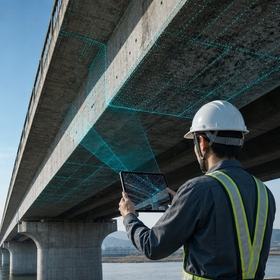
One of the labor-intensive tasks in creating deliverables for regular inspections of structures such as bridges is organizing field photos and transcribing damages onto layout drawings. In "LiDAR Damage Detection," when inspection engineers trace cracks on the photos, those lines are transcribed to the correct positions on the layout drawing in DXF format. The length of the cracks is calculated based on the scale of the photo. The calculation of width will be incorporated while verifying through beta testing, along with methods such as close-up photos or photos that include a scale (currently, values measured with a crack scale can also be input). A list of damages (Excel/CSV) and reports/photo logs (PDF) can also be output in the same flow, supporting the correspondence between photos, drawings, and logs. Crack detection by AI is presented as a "draft" on a separate layer, and the decision to accept it is made by the engineer. Since it runs in a browser, there is no need to install software. Layout drawings can be imported not only in CAD DXF format but also in cases where only PDF is available. Currently, we are seeking companies and organizations to participate in the application of this to drawings and photos and to verify shooting methods as part of a beta version. Trials can begin with anonymized materials.
Inquire About This Product
basic information
【Provision Type】Browser-based (no installation required) / Beta version 【Input】 - Site photos (supports iPhone ProRAW (DNG)) - Layout drawings: DXF or PDF (imported after conversion to CAD) - Acquired LiDAR point cloud (optional) 【Output】 - Layout drawing DXF (transcription of lines and labels to existing layout drawings) - Damage list Excel/CSV - Report and photo ledger PDF, layout drawing PNG 【Main Features】 - Pen input on photos (tracing cracks) and input of width and reference photos - Estimation of photo scale and calculation of crack length (width calculation is under verification in beta) - Automatic extraction of surfaces from layout drawings and assignment to photo surfaces - Drawings without confirmed scale will not be transcribed until selected - AI detection draft display (initially a hidden layer) 【Note】 - Width calculation from photos is under verification (actual measurements of crack scale can also be input) - No guarantee of detection accuracy or automatic health diagnosis - Direct output to client-specified formats will be individually confirmed for compatibility
Price information
The costs, duration, and scope of use for β utilization will be provided before the start, based on the materials in question, the scope of the trial, and the number of users.
Delivery Time
※You can start with the anonymized trial materials to verify their application to drawings and photographs. Please consult regarding the start date.
Applications/Examples of results
【Expected Use Cases】 - Construction consultants and inspection companies: Creation of development diagrams, photo logs, and damage lists for regular inspections of structures such as bridges. - Local governments and road administrators: Organization of inspection results for managed structures and consideration of efficiency improvements in inspection operations. - Construction companies: Recording of damage during completion inspections and maintenance management. 【Tasks to Reduce】 - Manual transcription of positions of cracks onto development diagrams while comparing photos. - Reassigning photo numbers, components, and drawings. - Separate reconstruction of development diagrams, lists, and logs. 【Current Situation】 Currently operating in beta version. Validation is being conducted using actual inspection photos and development diagrams (PDF), and improvements are being made based on the results. The method of capturing images (close-up photos, inclusion of scales) is also being validated in the beta test to allow for measurements of length and width from photos alone.
Detailed information
-
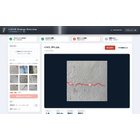
Record cracks for each photo. The technician traces the cracks on the photo and records the width and reference photos. The AI detection results can be overlaid as a draft, allowing you to choose whether to adopt them or not. The screen shows the state with the AI draft displayed.
-
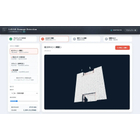
【Check the entire area with the acquired LiDAR point cloud (optional)】 If there is a point cloud, you can view the entire structure by rotating and zooming in on it in the browser. Dents and missing parts are displayed in color. Even without a point cloud, you can start with photos.
-
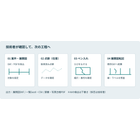
[In four steps, from the layout diagram to the photo ledger] 1. Set up the project and import the layout diagram (DXF/PDF) 2. Check the acquired point cloud (optional) 3. Annotate the photos, aligning the scale and numbers 4. Transcribe lines and labels to the layout diagram DXF The output includes the layout diagram DXF, damage list in Excel/CSV, and report/photo ledger in PDF.
catalog(1)
Download All Catalogs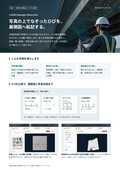
Company information

IZUTSUYA Inc. digitizes real-world spaces and objects by combining 3D/4D scanning, centered on 3D Gaussian Splatting (3DGS), with AI. We adopted 3DGS in our work early, in 2024, and have recorded buildings, traditional crafts, plants, and even human gestures and dance movements as high-fidelity 3D/4D data. We provide an end-to-end service: capture, data optimization and mesh conversion, and publishing, sales and license management on our own 3D data platform, 3Dasset.io. From digital archiving of cultural heritage and infrastructure inspection DX using LiDAR point clouds and AI, to Location XR experiences that combine places with human movement, we help bring 3D technology into culture, construction, tourism and entertainment. We choose between DSLR cameras, 360-degree cameras, LiDAR and markerless motion capture according to each project, and work with research institutions to field-test new equipment and methods. Please feel free to contact us.


