From machine tending to unmanned night operation - Production line Thermix

It is not enough for the robot to be able to attach and detach the workpiece; unmanned operation at night cannot be established.
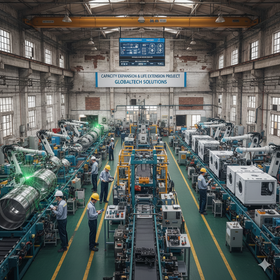
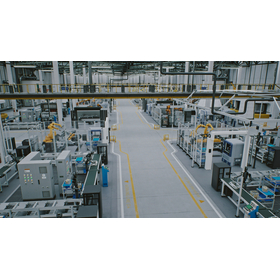
Placing one robot does not automatically lead to unmanned operation at night. Thermix is designed as a production line that continuously handles supply, processing, transportation, cleaning, measurement, quality recording, and anomaly recovery without human intervention. The starting point is defining what processes we want to continue when humans are absent. From the target continuous operation time and production quantity, we backtrack to determine the capacity of the material stocker and finished product buffer. We incorporate variety composition, tool changes, measurement frequency, setup changes, and storage for work-in-progress during downtime. In a multi-machine setup where one robot is responsible for several machine tools, the overall takt balance of the production line is influenced by the robot's maximum speed. "When a robot is installed but operations stop at night" → Backtrack the supply and buffer capacity from the operation time. "When the finished product storage is full and stops" → Buffer design that absorbs takt differences and temporary stops between processes. "When inline measurement is unstable" → Prepare the pre-measurement stage with cleaning, air blowing, liquid draining, and posture alignment. "When small anomalies cause long downtimes" → Categorize retry, retreat and continue, and immediate stop for each type of anomaly. "When one person wants to monitor multiple machines" → Pre-design the priority of transportation requests and manual operation during stops. Please consult us to identify the judgments and recovery tasks performed by personnel on-site.
Inquire About This Product
basic information
【Continuous Flow Without Human Intervention】 - Supply the required quantity of materials and identify the type and orientation. - Confirm loading onto the machine tool, seating, gripping, and door closure. - Unloading, reversing or reintroducing as necessary. - Remove chips and coolant, and prepare the state before measurement. - Check dimensions and appearance, sorting into OK products, NG products, and rework items. - Record processing conditions, measurement results, and work ID, and handle abnormalities. 【PLC Control】 Define states for operational capability, transport requests, handover completion, abnormalities, and stoppage, and determine the equipment that will be the decision-making entity. Classify abnormalities into those that can be retried, those that allow for workpiece evacuation and continuation, and those that require immediate stoppage for safety. 【Features】 - Display the abnormal location, the state just before the issue, and recovery procedures on the screen. - Increasing automatic recovery is not always beneficial. Prioritize equipment protection, quality assurance, and worker safety, and limit the conditions for automatic continuation. - Identification supports barcodes, two-dimensional codes, and RFID. Align operational rules and control for stopping, re-reading, and evacuation in case of reading failures. - When reflecting measurement values into processing conditions, determine the correction range, upper limit for continuous correction, handling of outliers, and approval methods in consultation with machine tool manufacturers and measurement device manufacturers.
Price range
Delivery Time
Applications/Examples of results
Target equipment: Machine tools, presses, injection molding machines, robots, material stockers, finished product buffers, inversion devices, cleaning machines, measuring instruments, PLCs, upper-level systems Applicable processes: Supply, loading, processing, inversion, unloading, cleaning, inline measurement, sorting, discharge Target departments: Production technology department, manufacturing department, quality assurance department Implementation purposes: Machine tending, unmanned operation at night, multi-machine automation, labor reduction, improvement of machine operating rates Data linkage: Linking work ID with processing machines, used programs, processing times, and inspection data. MES linkage will be determined based on necessary search units and recording items on-site. Connection with existing equipment: Signals, doors, chucks, jigs, safety circuits, maintenance space Scope of provision: Conceptual design, integration of signals and operations between equipment, startup as a production line Implementation examples: The following are examples of inquiries. - "I want to decide how many hours, how many pieces, and which varieties can be run unmanned." - "I want to disconnect one machine and continue production when the robot stops." - "Inversion and cleaning are still done manually."
catalog(1)
Download All Catalogs
Company information
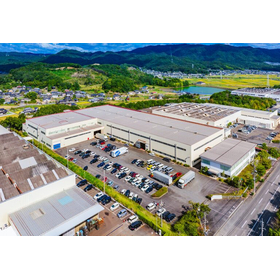
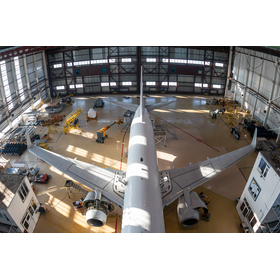
We, Thermix, a top-tier production line builder with proven expertise, handles automation and line construction for production equipment across diverse fields including automobiles and automotive parts, aircraft bodies, and industrial machinery. We provide full turnkey solutions from concept and specification review through design, manufacturing, installation, commissioning, and maintenance, ensuring reliable mass production launch. Leveraging our production technology expertise, we organize and visualize the current state, including process feasibility, integration with existing equipment, and safety. Utilizing industrial robots, image processing, conveyance/inter-process transfer, and material handling, we propose realistic automation roadmaps without unnecessary strain. We address challenges like “We want to reduce staffing on lines that can't be stopped” or “Equipment investment decisions are difficult,” accompanying you from small-scale PoCs to full-scale deployment with our project management expertise. Leveraging our domestic and international launch experience, we collaborate to create the optimal production line.