What is the structure of a cooling tower? The role of packing materials and eliminators [Basic Knowledge]

Watering device, filling material, eliminator, louver. An explanation of the roles of each component of the cooling tower and key inspection points when they are damaged.
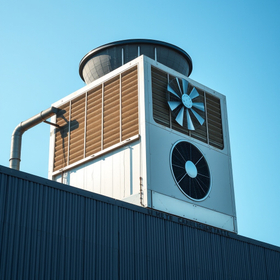
Inside an open cooling tower, warmed cooling water flows down from the top while coming into contact with outside air to be cooled. There are two types of cooling towers: the counterflow type, which directs outside air from bottom to top, and the crossflow type, which directs air at a right angle. In both types, there are components with different roles arranged along the pathways of water and air. ■ What components are there? 1. Spraying device: Distributes water from the upper tank or spray pipes over the packing material. 2. Packing material: Increases the surface area where water and outside air come into contact. 3. Fan: Takes in outside air and expels it outside the tower. 4. Louver: Guides outside air into the tower from the sides. 5. Eliminator: Captures water droplets mixed in the exhaust. 6. Lower tank: Receives cooled water and sends it back via a pump. ■ Does a malfunction in one component affect the whole system?! The counterflow type is typically seen in round cooling towers, while the crossflow type is found in square cooling towers. Despite the different shapes, the components work within a continuous flow of water and air, so any dirt or damage in one area can impact the cooling capacity of the entire tower. ■ Understanding the condition of each component Knowing the condition of each component is a shortcut to maintaining performance. Please feel free to consult us first.
Inquire About This Product
basic information
■What is the purpose of the fill material? The fill material is a component that allows water distributed from the sprinkler system to flow in droplets, increasing the time it spends in contact with the outside air. It is essentially the heart of the cooling tower, responsible for heat exchange. ■Cooling capacity decreases with deposits When scale or slime adheres to or clogs the fill material, the cooling capacity decreases due to reduced contact area between water and outside air, as well as increased airflow resistance. The more dirt accumulates, the narrower the surfaces in contact with outside air and the pathways for airflow become. ■Is the eliminator a checkpoint for water droplets? The eliminator is a component that captures water droplets carried away in the exhaust. The water droplets that exit the tower along with the exhaust are referred to as drift water. The amount of drift water varies depending on the shape of the cooling tower. Checking for damage, deformation, or clogging in the eliminator is one of the inspection items. ■Why suppress drift?! Aerosols (fine water droplets) that exit the cooling tower may enter indoor spaces through outside air inlets or windows. Therefore, national guidelines for preventing Legionnaires' disease require measures to suppress drift during installation and repairs.
Price range
Delivery Time
Applications/Examples of results
■Where do signs of deterioration appear? During the inspection of cooling towers, we check the following points for each component. Signs of wear vary by part. 1. Sprinkler system: Damage, rust, dirt, clogging of spray holes 2. Eliminator: Damage, deformation, clogging 3. Louver: Damage, deformation, clogging 4. Fill media: Accumulation of scale, clogging, buckling, or deformation ■Timing of inspections The timing of inspections is considered in three phases: before starting operations for the season, monthly during operations, and after completing operations for the season. ■Special attention for round cooling towers?! Round cooling towers require special attention for measures to suppress water splash, as they have a higher water splash volume compared to square ones. ■How to remove dirt from fill media? A common method for physical cleaning is to remove dirt from the fill media using high-pressure jet washing. However, since physical cleaning alone does not provide lasting effects, it is desirable to combine it with chemical cleaning or the addition of disinfectants. Our company offers consultations for cooling tower inspections and cleaning, as well as cooling water treatment. Please feel free to contact us.
catalog(1)
Download All Catalogs
Company information

Since our founding, we have continued to provide flexible services with the motto of accurately supplying a diverse range of products that respond to changes in the times and the diversification of consumer needs, tailored to various applications and requirements. With the corporate slogan "Chemical Engineering Partner," we, as a group of experts in chemical technology, actively discover ideas to solve our customers' problems from advanced technologies both domestically and internationally, and propose them.