

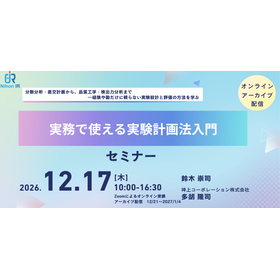
From analysis of variance and orthogonal planning to quality engineering and power analysis - learning methods for experimental design and evaluation that do not rely solely on experience or intuition.
This seminar will explain experimental design methods to efficiently conduct experiments and correctly evaluate the results, from the basics to practical applications. We will use specific examples to explain analysis of variance for evaluating differences between multiple conditions, multiple comparison methods for comparing conditions, orthogonal design for efficiently combining experimental conditions, and power analysis for determining the necessary number of tests in advance. Additionally, we will cover Fisher's three main principles: "replication," "randomization," and "local control," to learn how to construct experiments that minimize the effects of variability. Furthermore, we will introduce the concept of finding conditions that maintain stable performance even when environmental or usage conditions change through parameter design in quality engineering (Taguchi method). Demonstrations using Excel's analysis tools and the free software G*Power will be conducted to explain analysis methods such as analysis of variance, multiple comparisons, evaluation of factor effects, and sample size calculations. *For more details, please check the related links or the seminar details in the catalog.
Inquire About This Product
basic information
<Event Information> Format: Live Streaming (Zoom) / Archive Streaming Date and Time: [Live Streaming] December 17, 2026 (Thursday) 10:00 AM - 4:30 PM [Archive Streaming] December 21, 2026 - January 4, 2027 (Registration until December 25) Tuition Fee: 49,500 yen (including tax) Instructor: Shinichi Kurihara
Price range
Delivery Time
Applications/Examples of results
<Seminar Program (Tentative)> Chapter 1: Evaluation of Experimental Results Using Analysis of Variance Chapter 2: Evaluation of Differences Between Conditions Using Multiple Comparison Methods Chapter 3: Fisher's Three Principles for Successful Experiments Chapter 4: Application of Orthogonal Design and Quality Engineering Chapter 5: Determining the Appropriate Number of Tests Through Power Analysis
catalog(1)
Download All Catalogs
Company information

We support Japan's "monozukuri" (manufacturing) with reliable services ranging from patent research and other intellectual property business solutions to technical translation services and intellectual property/engineer education. We offer high-quality services backed by over 40 years of experience at reasonable prices.


