1~34 item / All 34 items
Displayed results

Added to bookmarks
Bookmarks listBookmark has been removed
Bookmarks listYou can't add any more bookmarks
By registering as a member, you can increase the number of bookmarks you can save and organize them with labels.
Free membership registration
Contact this company
Inquiry Form1~34 item / All 34 items
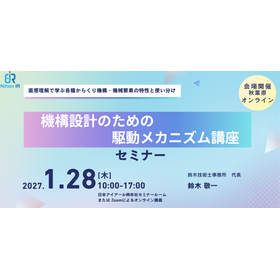
This seminar aims to systematically cover the characteristics and principles of motion of major mechanical drive mechanisms, increasing the "drawer" of ideas necessary for practical work. We will provide a clear explanation in one day, from the basic concepts of mechanical drive mechanisms to mechanical elements such as link mechanisms, cam mechanisms, intermittent mechanisms, friction drive mechanisms, gear drive mechanisms, belt and chain drives, screws, bearings, springs, and clutches. You will be able to organize the operational characteristics of various mechanisms and the criteria for their differentiation, allowing for an intuitive understanding of the essence of drive mechanisms. *Those who apply will receive a copy of the book "Tokoton Yasashii Kikai no Karakuri no Hon" by instructor Keiichi Suzuki (published by Nikkan Kogyo Shimbun) as a gift. *For details, please check the related links or the seminar details in the catalog.
Added to bookmarks
Bookmarks listBookmark has been removed
Bookmarks listYou can't add any more bookmarks
By registering as a member, you can increase the number of bookmarks you can save and organize them with labels.
Free membership registration
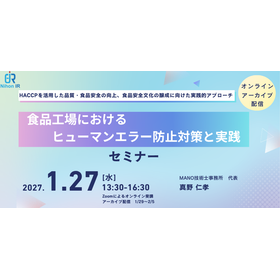
This seminar aims to prevent human errors in food factories by explaining practical measures to incorporate into the existing hygiene management systems in accordance with the current HACCP of each business location. It will cover the current situation and challenges of complaints and product recalls in food factories, the effective operation of HACCP systems as a preventive measure against human errors, how to incorporate human errors into hazard analysis tables, and how to utilize general hygiene management. Additionally, it will explain the mechanisms of human error occurrence, the concept of multiple defenses, M-SHEL analysis, and effective measures against the causes of occurrence. *For more details, please check the related links or the seminar details in the catalog.*
Added to bookmarks
Bookmarks listBookmark has been removed
Bookmarks listYou can't add any more bookmarks
By registering as a member, you can increase the number of bookmarks you can save and organize them with labels.
Free membership registration
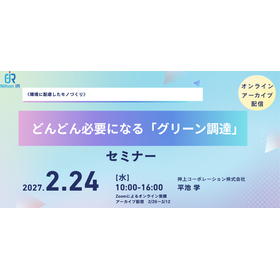
This seminar will explain the necessity and basic principles of green procurement, as well as key points to consider during the procurement process, from the ground up. It will cover the types of regulations in various countries and how to make judgments, investigations using ingredient lists, SDS, and IMDS, the establishment of procurement flows, and the creation of cooperation systems both internally and externally. In the workshop, participants will experience organizing and searching for chemical substance information using Excel and kintone, verifying certificates, and obtaining lists of SVHCs and regulated substances. *For more details, please check the related links or the seminar details in the catalog.*
Added to bookmarks
Bookmarks listBookmark has been removed
Bookmarks listYou can't add any more bookmarks
By registering as a member, you can increase the number of bookmarks you can save and organize them with labels.
Free membership registration
This seminar will introduce trends in packaging technology and future prospects, focusing on packaging-related news and case studies from 2026, while incorporating the situation after the application of the PPWR and the concepts of the ISO 59000 series. It will cover topics such as paperization, barrier technology, monomaterialization, lightweighting, thin film technology, the use of recycled materials, horizontal recycling, and mechanisms for reuse and collection, explaining the background of case studies, the characteristics of technologies, and challenges during implementation. Instructors who have been involved in development, technology, and planning from both the manufacturing and usage sides of packaging will provide hints that can be utilized in packaging development and proposals. *For more details, please check the related links or the seminar details in the catalog.*
Added to bookmarks
Bookmarks listBookmark has been removed
Bookmarks listYou can't add any more bookmarks
By registering as a member, you can increase the number of bookmarks you can save and organize them with labels.
Free membership registration
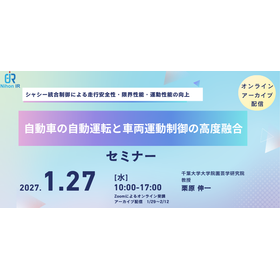
This seminar will explain the technical approaches to highly integrating vehicle motion control and autonomous driving to enhance driving safety, control accuracy, and performance. It will cover vehicle motion control technologies such as four-wheel steering (4WS), multi-link suspension, drive force control for inner and outer wheels, camber angle control, and steer-by-wire control, and introduce methods for improving performance by utilizing tire grip limits. Furthermore, it will discuss assistive control using obstacle detection and lane marking detection from external sensors, as well as the integration of semi-autonomous and fully autonomous driving, incorporating test results from driving simulators and real vehicles. Additionally, it will introduce the evolution of motion control in electric vehicles (EVs), the coexistence of autonomous driving and the enjoyment of driving, desirable autonomous driving similar to professional drivers, and the efforts of automobile manufacturers and future prospects. *For more details, please check the related links or the seminar details in the catalog.*
Added to bookmarks
Bookmarks listBookmark has been removed
Bookmarks listYou can't add any more bookmarks
By registering as a member, you can increase the number of bookmarks you can save and organize them with labels.
Free membership registration
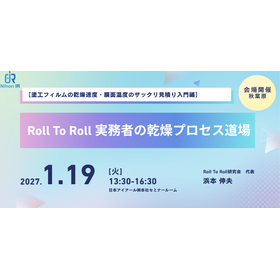
This seminar focuses on the drying process in Roll To Roll coating, explaining how to estimate drying speed and film surface temperature using everyday drying phenomena as examples, along with videos and practical demonstrations. It will cover the contributions of drying equipment and solvents, the basics of constant rate drying and falling rate drying, drying behavior in water-based and organic solvent systems, as well as simple calculation methods for saturation vapor pressure, wet bulb temperature, and drying speed. Additionally, participants will confirm the effects of airflow, humidity, air temperature, and solvents, as well as the required furnace length for different drying methods through exercises. Furthermore, the seminar will explain the configuration and heat transfer characteristics of drying equipment, as well as planar issues and countermeasures such as Benard cells, splashing, airflow unevenness, foaming, whitening, and particle segregation, along with moisture adjustment to control residual solvents in the film. The content is designed to be understandable even without a background in chemical engineering or mathematics. *For more details, please check the related links or the seminar details in the catalog.*
Added to bookmarks
Bookmarks listBookmark has been removed
Bookmarks listYou can't add any more bookmarks
By registering as a member, you can increase the number of bookmarks you can save and organize them with labels.
Free membership registration
This seminar is a comprehensive review course of thermodynamics at a university level, aimed at working professionals in engineering. We will explain the fundamental knowledge necessary for the design and operation of various equipment in the field of thermodynamics, which is one of the more challenging areas to master within mechanical engineering. Specifically, we will start with a review of units, gas properties, common logarithms, and natural logarithms, and then learn about Boyle's and Charles's laws, the first law of thermodynamics, reversible isochoric processes, reversible isobaric processes, reversible isothermal processes, and reversible adiabatic processes. Furthermore, we will cover the second law of thermodynamics, the Carnot cycle, heat conduction and heat transfer, heat exchangers, refrigeration cycles and the performance of refrigerators, as well as refrigerant measures and candidates for next-generation refrigerants. Exercises related to each topic will also be conducted. *For more details, please check the related links or the seminar details in the catalog.
Added to bookmarks
Bookmarks listBookmark has been removed
Bookmarks listYou can't add any more bookmarks
By registering as a member, you can increase the number of bookmarks you can save and organize them with labels.
Free membership registration
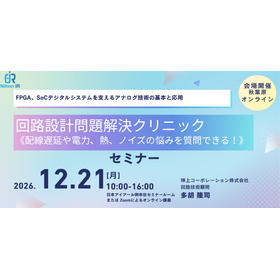
This seminar will explain the fundamentals and applications of analog technology, which are crucial for achieving stable operation in digital circuit design centered around FPGAs and SoCs. In particular, it will focus on high-frequency technology and thermal knowledge, addressing practical techniques that can prevent issues during the early design stages and system conceptual phases, as well as reduce design rework and troubles. Specifically, it will cover topics such as wiring delay, termination, wiring resistance, printed circuit board wiring, inter-board signal transmission, reflections and ringing in digital interfaces, and analog technologies related to I2C, LVDS, and USB. Additionally, it will explain power circuits using transistors and FETs, heat generation and failure, derating, thermal resistance and heat dissipation design, electrostatic discharge, power supply interference, and unwanted radiation. The seminar will also include a Q&A session on the analog technologies used in actual digital system design. *For more details, please check the related links or the seminar details in the catalog.*
Added to bookmarks
Bookmarks listBookmark has been removed
Bookmarks listYou can't add any more bookmarks
By registering as a member, you can increase the number of bookmarks you can save and organize them with labels.
Free membership registration
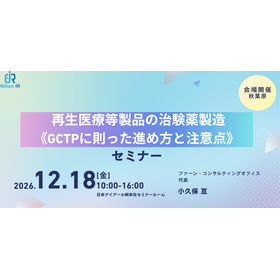
This seminar will provide an overview of the rules regarding the manufacturing of investigational drugs for regenerative medicine products, and will explain common issues that may arise during the actual manufacturing process and their corresponding solutions. It will cover the Pharmaceutical and Medical Device Act, the Act on Securing Quality, Efficacy and Safety of Products, related ministerial ordinances and guidelines, and the role of the Pharmaceuticals and Medical Devices Agency in the development and manufacturing of investigational drugs for regenerative medicine products. Additionally, it will address points of caution for each manufacturing process, including the acceptance and storage of raw cells, bank creation, biological raw materials, aseptic operations and manufacturing, cell proliferation, collection, washing, evaluation, product aliquoting, freezing, storage, and transportation. Furthermore, as key points for manufacturing in accordance with GCTP, it will explain risk management, product specifications, facility design, organizational structure, the operation of standard operating procedures, equipment management, training and education, validation, deviation and change management and CAPA, Quality by Design (QbD), Design Space (DS), process management, environmental management, quality control, quality assurance, and self-inspection. *For more details, please check the related links or the seminar details in the catalog.*
Added to bookmarks
Bookmarks listBookmark has been removed
Bookmarks listYou can't add any more bookmarks
By registering as a member, you can increase the number of bookmarks you can save and organize them with labels.
Free membership registration
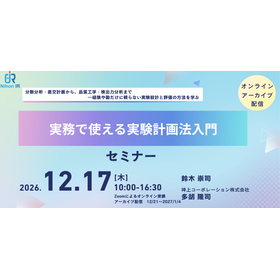
This seminar will explain experimental design methods to efficiently conduct experiments and correctly evaluate the results, from the basics to practical applications. We will use specific examples to explain analysis of variance for evaluating differences between multiple conditions, multiple comparison methods for comparing conditions, orthogonal design for efficiently combining experimental conditions, and power analysis for determining the necessary number of tests in advance. Additionally, we will cover Fisher's three main principles: "replication," "randomization," and "local control," to learn how to construct experiments that minimize the effects of variability. Furthermore, we will introduce the concept of finding conditions that maintain stable performance even when environmental or usage conditions change through parameter design in quality engineering (Taguchi method). Demonstrations using Excel's analysis tools and the free software G*Power will be conducted to explain analysis methods such as analysis of variance, multiple comparisons, evaluation of factor effects, and sample size calculations. *For more details, please check the related links or the seminar details in the catalog.
Added to bookmarks
Bookmarks listBookmark has been removed
Bookmarks listYou can't add any more bookmarks
By registering as a member, you can increase the number of bookmarks you can save and organize them with labels.
Free membership registration
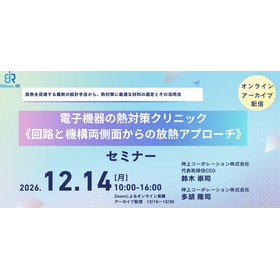
This seminar is a course that explains practical thermal countermeasures for electronic devices from both substrate/circuit design and mechanical/structural design perspectives. First, participants will learn the three principles of heat and the latest trends in thermal design, including the mechanisms of heat generation in electronic circuits, derating, techniques for reducing heat generation through lower resistance, lower voltage, and lower speed, as well as heat dissipation design for semiconductors. Additionally, examples of issues caused by heat generation and cooling in circuits, as well as precautions for temperature measurement in actual devices, will be introduced. Furthermore, the characteristics and differentiation of TIM (thermal interface materials) such as thermal conductive sheets and grease will be discussed, along with the selection of heat dissipation materials and considerations for insulation, heat resistance, and heat shielding. Case studies of issues arising from thermal structural design, methods for utilizing thermal simulation (CAE), and ways to analyze results will also be explained. *For more details, please check the related links or the seminar details in the catalog.*
Added to bookmarks
Bookmarks listBookmark has been removed
Bookmarks listYou can't add any more bookmarks
By registering as a member, you can increase the number of bookmarks you can save and organize them with labels.
Free membership registration
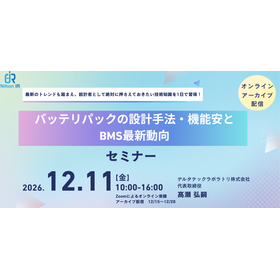
This seminar is a course that explains the basics and latest trends in battery management systems (BMS) and battery pack design from the perspectives of functional safety and application examples. First, participants will learn about the precautions for using lithium-ion batteries, the functions and components of BMS, cell voltage and temperature measurement, methods for calculating state of charge (SOC) and state of health (SOH), as well as basic technologies such as cell balancing and fail-safe control. Next, the current status and challenges of BMS, the latest technology trends, and market outlook will be introduced. Additionally, design methods for battery pack specification design, selection of components, control sequences, enclosure design, and thermal management will be explained. Furthermore, participants will learn about the basic concepts of functional safety, safety risks and countermeasures for battery packs, and specific design methods for functional safety. *For more details, please check the related links or the seminar details in the catalog.
Added to bookmarks
Bookmarks listBookmark has been removed
Bookmarks listYou can't add any more bookmarks
By registering as a member, you can increase the number of bookmarks you can save and organize them with labels.
Free membership registration
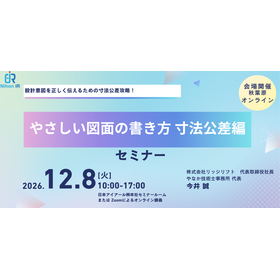
This seminar is a course focused on learning how to appropriately express design intentions on drawings, particularly regarding dimension tolerances, fit tolerances, and the depiction of surface texture symbols. It will explain the differentiation between size tolerances and geometric tolerances as per the revised JIS of 2016, the rules for expressing size tolerances, how to determine and think about tolerance values, and design techniques for typical mechanical elements. Additionally, participants will learn the meanings of fit tolerance symbols, the relationship between tolerance grades and tolerance zone classes, as well as the meanings and representations of surface texture symbols. Furthermore, the seminar will introduce the basic concepts of tolerance calculations within a single part and between multiple parts, as well as reasons why tolerance calculations may not yield effective results. *For more details, please check the related links or the seminar details in the catalog.*
Added to bookmarks
Bookmarks listBookmark has been removed
Bookmarks listYou can't add any more bookmarks
By registering as a member, you can increase the number of bookmarks you can save and organize them with labels.
Free membership registration
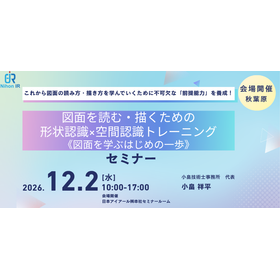
This seminar is a course designed to develop the "shape recognition ability" and "spatial awareness" necessary for reading and drawing blueprints, as well as to cultivate logical thinking skills for correctly understanding and utilizing drawings. First, participants will understand the differences between 2D and 3D in design, the relationship between projection drawings and three-dimensional objects, the use of sketches for conceptual expression, the importance of hand-drawing, and logical thinking methods based on principles and fundamentals. In the basic exercises, participants will engage in activities such as dividing and assembling shapes, grasping depth and space, wireframe and three-dimensional representation, optical illusion paper crafts, three-dimensional drawing from projection drawings, and creating development diagrams. Additionally, as an advanced exercise, unique model assembly will be conducted to enhance shape recognition and spatial awareness. *For more details, please check the related links or the seminar details in the catalog.
Added to bookmarks
Bookmarks listBookmark has been removed
Bookmarks listYou can't add any more bookmarks
By registering as a member, you can increase the number of bookmarks you can save and organize them with labels.
Free membership registration
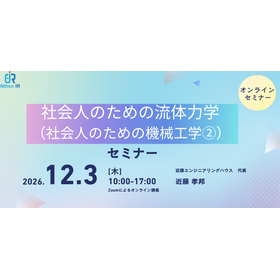
This seminar is a course designed to teach the necessary theories of fluid dynamics for designers and engineers dealing with liquids and gases through lectures and exercises. We will review fundamental theories such as Archimedes' principle and Bernoulli's theorem, and explain buoyancy and its stability, flow terminology, the continuity equation, and energy equations along streamlines. Additionally, we will cover viscosity and the coefficient of viscosity, laminar and turbulent flow in pipes, boundary layer attachment and detachment, and Reynolds number. Using examples from aviation, we will explain STOL and VTOL aircraft, vortices and circulation, lift, the wake vortices of aircraft and their effects, and the control of wake vortices. While thoroughly reviewing the theories of fluid dynamics, we will also learn about phenomena caused by viscosity and the principles of the Venturi meter used as a flow meter. *For more details, please check the related links or the seminar details in the catalog.
Added to bookmarks
Bookmarks listBookmark has been removed
Bookmarks listYou can't add any more bookmarks
By registering as a member, you can increase the number of bookmarks you can save and organize them with labels.
Free membership registration
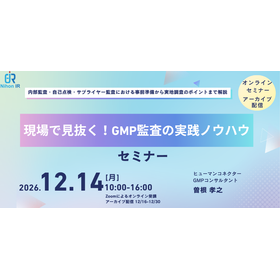
This seminar is aimed at GMP auditors and those responsible for self-inspections, explaining the key points to observe in manufacturing sites, signs of potential issues, and precautions to avoid receiving criticisms. Participants will learn how to identify risks at manufacturing sites in advance within the limited audit time and how to concentrate audit resources based on risk. Topics covered include an overview of GMP, key points of administrative audits, legal requirements for supplier management, examples of audit checklists, supplier management flow, points for on-site tours, and QC/QA operations. Additionally, the seminar will discuss case studies based on the instructor's over 40 years of experience in manufacturing, actual instances of misconduct, 12 important matters to know in GMP operations, GMP audit manuals, the principle of "three realities," and organization and tidiness. *For more details, please check the related links or the seminar details in the catalog.*
Added to bookmarks
Bookmarks listBookmark has been removed
Bookmarks listYou can't add any more bookmarks
By registering as a member, you can increase the number of bookmarks you can save and organize them with labels.
Free membership registration
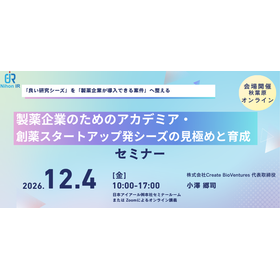
This seminar will systematically explain how to discover and screen early-stage seeds from academia and drug discovery startups from the perspective of pharmaceutical companies, and how to evaluate the feasibility and business potential based on the Target Product Profile (TPP) through Scientific/Translational Drug Development (DD). It will cover the process of filling data gaps with additional tests and validations, nurturing seeds while sharing roles with academia and startups, and making decisions on re-evaluation or postponement after acquiring additional data. *For more details, please check the related links or the seminar details in the catalog.*
Added to bookmarks
Bookmarks listBookmark has been removed
Bookmarks listYou can't add any more bookmarks
By registering as a member, you can increase the number of bookmarks you can save and organize them with labels.
Free membership registration
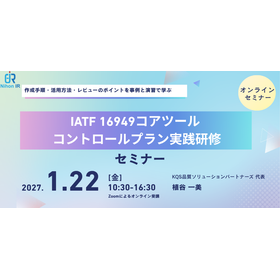
This seminar will explain the creation procedures, key points, considerations, and utilization methods of control plans required by IATF 16949, using specific examples. Leveraging knowledge from the CP Reference Manual and taking into account the contents of the CP Manual issued in 2024, we will introduce the concepts, creation methods, and utilization methods of control plans that are useful for managing manufacturing processes. The program will cover an overview of control plans, the requirements of IATF 16949, creation procedures, interpretation, an overview of the first edition of the CP Manual, and exercises on creation and interpretation. *For details, please check the related links or the seminar details in the catalog.*
Added to bookmarks
Bookmarks listBookmark has been removed
Bookmarks listYou can't add any more bookmarks
By registering as a member, you can increase the number of bookmarks you can save and organize them with labels.
Free membership registration
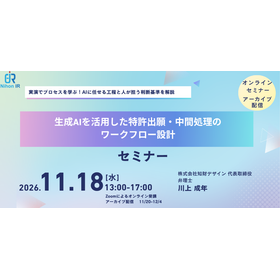
This seminar will explain how to incorporate generative AI into the workflow, using a fictional patent case as a subject, covering everything from preparing a patent application to creating application documents and handling intermediate processes. It will address the division of roles between generative AI and humans, workflow design, organizing the invention content, prior art searches, drafting claims, specifications, and drawings, responding to rejections, and integrating these practices into business, through lectures and demonstrations. *For more details, please check the related links or the seminar details in the catalog.*
Added to bookmarks
Bookmarks listBookmark has been removed
Bookmarks listYou can't add any more bookmarks
By registering as a member, you can increase the number of bookmarks you can save and organize them with labels.
Free membership registration
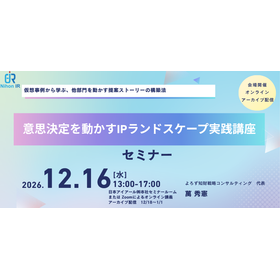
This seminar will clarify who needs what information to make judgments as a starting point for IP landscape analysis and explain how to set appropriate questions. It will introduce methods for incorporating dialogue with relevant departments, organizing discussion points using generative AI, designing searches, forming hypotheses, comparing technologies and companies, conducting scenario analysis, and creating potential winning strategies. Through multiple hypothetical cases, it will demonstrate how to derive winning strategies from analysis results and how to rearrange proposal stories according to the audience. *For more details, please check the related links or the seminar details in the catalog.*
Added to bookmarks
Bookmarks listBookmark has been removed
Bookmarks listYou can't add any more bookmarks
By registering as a member, you can increase the number of bookmarks you can save and organize them with labels.
Free membership registration
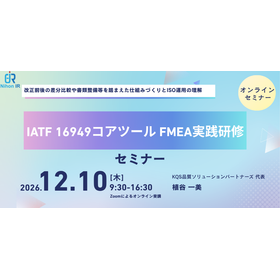
This seminar will explain the creation procedures, key points, considerations, and utilization methods of FMEA, which are required for the automotive industry's QMS standard IATF 16949 and the European automotive industry's VDA standard, through specific examples. It will cover the concept of FMEA, its history and development, the D/P-FMEA creation procedures based on case studies, evaluation criteria, considerations and key points when applying it, and the integrated FMEA of AIAG & VDA, along with practical exercises. *For more details, please check the related links or the seminar details in the catalog.*
Added to bookmarks
Bookmarks listBookmark has been removed
Bookmarks listYou can't add any more bookmarks
By registering as a member, you can increase the number of bookmarks you can save and organize them with labels.
Free membership registration
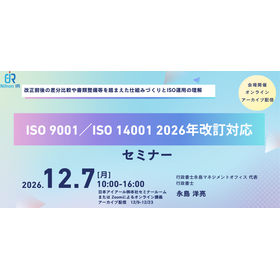
This seminar will cover the 2026 revisions of ISO 9001 and ISO 14001, explaining the key points of the revisions and practical aspects of the transition. We will compare the differences with the 2015 version point by point, discuss alignment with Annex SL, address climate change and sustainability responses, outline the planning for changes, and explain the shifts in the approach to documented information. Additionally, we will provide specific examples to explain how to create a gap analysis sheet, key points for revising manuals, regulations, and forms, internal audit checklists, and how to reflect these in management review minutes. *For more details, please check the related links or the seminar details in the catalog.*
Added to bookmarks
Bookmarks listBookmark has been removed
Bookmarks listYou can't add any more bookmarks
By registering as a member, you can increase the number of bookmarks you can save and organize them with labels.
Free membership registration
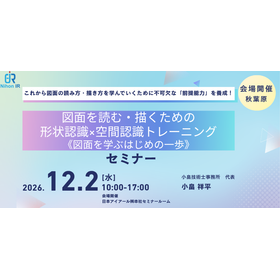
This seminar is a course designed to cultivate logical thinking skills by training "shape recognition" and "spatial awareness," enabling participants to correctly understand and utilize drawings. It covers the differences between 2D and 3D in design, methods for representing three-dimensional shapes in two-dimensional plans, and expressing ideas using sketches. Participants will engage in exercises such as sketching three-dimensional images, dividing and combining shapes, and assembling three-dimensional models. *For more details, please check the related links or the seminar details in the catalog.*
Added to bookmarks
Bookmarks listBookmark has been removed
Bookmarks listYou can't add any more bookmarks
By registering as a member, you can increase the number of bookmarks you can save and organize them with labels.
Free membership registration
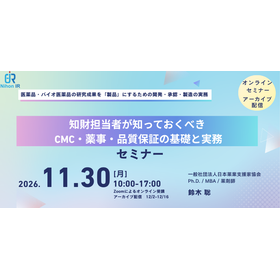
This seminar is aimed at intellectual property personnel and will provide a practical explanation of the overall picture of pharmaceutical development, including the basics of CMC, quality assurance, PMDA review, how to read CTD, technology transfer, comparability, and the distinction between trade secrets and patents. It will also cover advanced modalities, competitive analysis using public CTDs and PMDA review reports, and the role of the intellectual property department in technology transfer and licensing agreements with CDMOs. *For details, please check the related links or the seminar details in the catalog.*
Added to bookmarks
Bookmarks listBookmark has been removed
Bookmarks listYou can't add any more bookmarks
By registering as a member, you can increase the number of bookmarks you can save and organize them with labels.
Free membership registration
This seminar is aimed at individuals newly assigned to departments related to pharmaceutical GMP and those responsible for pharmaceutical manufacturing operations. It will explain what regulations (GMP) need to be complied with and what their objectives are. The seminar will cover the basic elements of GMP regulations necessary to grasp the overall picture of GMP, including pharmaceuticals, the Japanese legal system, the origins of GMP, GMP compliance inspections, and the management tasks stipulated by GMP regulations. *For more details, please check the related links or the seminar details in the catalog.*
Added to bookmarks
Bookmarks listBookmark has been removed
Bookmarks listYou can't add any more bookmarks
By registering as a member, you can increase the number of bookmarks you can save and organize them with labels.
Free membership registration
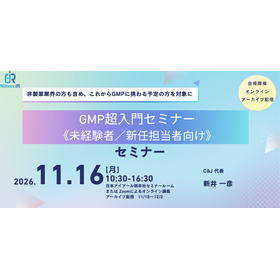
This seminar is aimed at those who have recently been assigned to departments related to pharmaceutical GMP or those who are responsible for businesses related to pharmaceutical manufacturing, even if they are not part of a pharmaceutical company. It will explain what the regulations that must be complied with (GMP) require and what their purpose is. The seminar will cover the basic matters of GMP regulations necessary to grasp the overall picture of GMP, including pharmaceuticals, Japan's legal system and GMP, the origins of GMP, GMP compliance inspections, and the management tasks stipulated by GMP regulations. *For more details, please check the related links or the seminar details in the catalog.*
Added to bookmarks
Bookmarks listBookmark has been removed
Bookmarks listYou can't add any more bookmarks
By registering as a member, you can increase the number of bookmarks you can save and organize them with labels.
Free membership registration
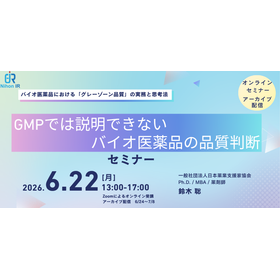
This seminar is a course that organizes practical thinking about "gray zone quality" in biopharmaceuticals such as antibody drugs, regenerative medicine products, and nucleic acid drugs, which cannot be judged solely by GMP and standards/procedures. It explains the differences between scientific rationality and regulatory rationality in situations where manufacturing results and quality data cannot be clearly defined, the roles of GMP documents and CTD (Module 3), and the differences in judgment among departments such as QA, CMC, research, and clinical. Participants will learn to view quality judgment as a responsibility of the entire company rather than just individuals, and will acquire perspectives that can be utilized for explainable judgment criteria and medium- to long-term quality strategies.
Added to bookmarks
Bookmarks listBookmark has been removed
Bookmarks listYou can't add any more bookmarks
By registering as a member, you can increase the number of bookmarks you can save and organize them with labels.
Free membership registration
We offer a translation service called 'Chinese Translation PRO,' which boasts industry-leading achievements. Our team mainly consists of individuals with study abroad experience in science and engineering graduate schools in Japan and Western countries, as well as those who have been involved in advanced technology research and development at Japanese and Western companies, focusing on the translation of technical documents such as patents. Additionally, we have implemented an advanced translation management system that includes tool-based checks, terminology unification, and the construction of client-specific specialized dictionaries, all aimed at maintaining high and stable quality. **Features** - Overwhelming achievements that are top-class in the industry - Translators with a level that sets us apart from other companies - Reliable quality management system *For more details, please download the PDF or feel free to contact us.*
Added to bookmarks
Bookmarks listBookmark has been removed
Bookmarks listYou can't add any more bookmarks
By registering as a member, you can increase the number of bookmarks you can save and organize them with labels.
Free membership registration
When considering the Chinese character representation of products and services for business development in China, it is important to note that the meanings of kanji can differ between Japanese and Chinese. Our naming service offers three suggested Chinese names (in kanji) that are deemed suitable by native brand naming specialists, while conducting prior trademark searches to avoid similarities. When making our suggestions, we will also report on the pronunciation, meaning, and reasons for selection of the trademark name (Chinese kanji representation), which can serve as a reference for your trademark selection process. 【Features】 ■ Proposing three naming options (kanji representation) while conducting prior trademark searches ■ Reporting on the pronunciation, meaning, and reasons for selection of the trademark name (Chinese kanji representation) ■ Can be used as a reference for trademark selection work *For more details, please refer to the PDF materials or feel free to contact us.
Added to bookmarks
Bookmarks listBookmark has been removed
Bookmarks listYou can't add any more bookmarks
By registering as a member, you can increase the number of bookmarks you can save and organize them with labels.
Free membership registration
At Japan I.R., we offer a "China Trademark Survey" service, which includes a research report detailing comments in Japanese on the extracted prior trademarks. When manufacturing and selling products or services in China under a trademark, it is necessary to conduct a preliminary investigation to ensure that you are not infringing on others' trademark rights, regardless of whether you plan to file an application yourself. Naturally, trademark infringement in China can lead to injunctions and claims for damages, which can cause significant harm to business operations. It is also important to conduct a prior trademark search at the time of application. If there are existing prior trademarks, the application may be rejected, resulting in wasted application costs. [Services Offered] ■ Trademark Search (Word Marks) ■ Trademark Search (Design Marks) *For more details, please refer to the PDF materials or feel free to contact us.
Added to bookmarks
Bookmarks listBookmark has been removed
Bookmarks listYou can't add any more bookmarks
By registering as a member, you can increase the number of bookmarks you can save and organize them with labels.
Free membership registration
At Japan IR, we provide services entirely in Japanese, from pre-application guidance, application preparation, intermediate processing, to registration, allowing for smooth communication even with complex procedures. In China, comprehensive designations of goods and services and the description of class headings are not permitted, requiring careful judgment. We also support the description (designation) methods and expressions for designated goods, so please rest assured. Additionally, our company achieves extremely high cost performance by having professionals in Chinese trademark practice who are fluent in Japanese handle everything in a one-stop manner. 【Features】 ■ Quick and accurate response ■ Achieving overwhelming cost performance ■ Providing all services in Japanese ■ One-stop support by professionals in Chinese trademark practice who are fluent in Japanese *For more details, please refer to the PDF materials or feel free to contact us.
Added to bookmarks
Bookmarks listBookmark has been removed
Bookmarks listYou can't add any more bookmarks
By registering as a member, you can increase the number of bookmarks you can save and organize them with labels.
Free membership registration
The Japan IR Corporation's comprehensive catalog for Chinese trademarks introduces the "Total Solution for Chinese Trademarks," which supports Chinese trademark strategies quickly and accurately. It features "Chinese Trademark Applications" that achieve rapid and precise responses with overwhelming cost performance, "Chinese Trademark Investigations" that deliver high-precision research results, and "Chinese Trademark Watching (SDI)" that emphasizes the importance of early responses through regular monitoring, among many others. 【Featured Products】 ■ Chinese Trademark Applications ■ Chinese Trademark Investigations ■ Chinese Trademark Watching (SDI) ■ Chinese Trademark Naming Services ■ Designated Goods Compliance Check Service, etc. *For more details, please contact us or download the catalog.
Added to bookmarks
Bookmarks listBookmark has been removed
Bookmarks listYou can't add any more bookmarks
By registering as a member, you can increase the number of bookmarks you can save and organize them with labels.
Free membership registration
In this course, we will introduce the basics of rapidly advancing vacuum technology and thin film technology, as well as the principles of various thin film techniques. We will explain important points from thin film design to quality enhancement and defect countermeasures. In the public session, we will present the latest application examples of thin film technology, focusing on fields that are expected to gain attention in the future, such as medical devices, home appliances, building materials, automobiles, and aerospace, along with explanations of the technical principles. The application areas are expanding endlessly, including the substitution of plastics for metals and glass, the addition of surface functions through biomimetics, and the use of thin film potentials, sensors, and devices in IoT. We hope you find this information useful for the development and utilization of thin film technology, which is essential for manufacturing in the new era.
Added to bookmarks
Bookmarks listBookmark has been removed
Bookmarks listYou can't add any more bookmarks
By registering as a member, you can increase the number of bookmarks you can save and organize them with labels.
Free membership registration
Revolutionary low cost starting from 9,800 yen per month at one company! The educational content of Japan IR, which continues to be utilized by many large corporations, is created with a focus on friendliness and clarity, using a lot of illustrations. The course content can be switched on a monthly basis upon request from the education personnel. By dynamically selecting learning content according to your company's intellectual property education plan, you can continuously utilize e-learning without waste and at a low cost. Furthermore, customization of the courses is also possible. By using content tailored specifically for your company that reflects internal circumstances, even more effective education can be achieved.
Added to bookmarks
Bookmarks listBookmark has been removed
Bookmarks listYou can't add any more bookmarks
By registering as a member, you can increase the number of bookmarks you can save and organize them with labels.
Free membership registration