

Desalination of seawater to produce fresh water. This explains why the RO membrane method is mainstream, detailing the processes of one of the largest facilities in the country, as well as the handling of two-stage RO membranes and concentrated seawater.
■Technology for Extracting Fresh Water from Seawater Seawater desalination is a technology that obtains fresh water by removing salt and other impurities from seawater. It is also used for removing impurities from groundwater that contains salt and other substances. The methods that have already been put into practical use include evaporation, reverse osmosis (RO membrane method), and electrodialysis. ■Why is the RO membrane method increasing? The reverse osmosis method is gaining popularity because it consumes less energy compared to other methods, leading to an increase in the number of plants. As of the end of March 2025, the desalination capacity for residential facilities (those producing more than 10 cubic meters per day) is approximately 87% for reverse osmosis and about 13% for electrodialysis. It has been used as a source of water for daily living in areas with scarce water resources, such as remote islands. ■Are Japanese facilities mostly small? As of the end of March 2025, domestic freshwater desalination plants have a total desalination capacity of about 110,000 cubic meters per day. Many seawater desalination plants for municipal water supply are small-scale, producing several dozen to several hundred cubic meters per day, with large-scale facilities of 50,000 cubic meters per day in Fukuoka Prefecture and 40,000 cubic meters per day in Okinawa Prefecture. Please feel free to consult with us first.
Inquire About This Product
basic information
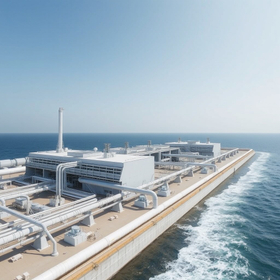
■Do you take in water after filtering through sand on the seabed? At the Fukuoka Regional Water Supply Authority's seawater desalination center, intake pipes are buried in the sand on the seabed, and seawater is taken in through a process called "infiltration intake," which allows seawater to pass through the layer of sand. The sand layer acts as a filter, providing seawater with fewer debris and impurities. Fish eggs and other organisms, such as barnacles that might attach to the pipes, are also filtered out by the sand layer. ■How much pressure is applied? The operating pressure of the high-pressure RO membranes at the center is up to about 8.2 MPa, generated by a high-pressure RO pump with a capacity of 2,450 kW. Of the seawater sent to the high-pressure RO membranes, about 60% is recovered as fresh water, while the remainder is discharged as seawater with increased salinity. ■Two-stage RO membranes! At the center, a portion of the permeate from the high-pressure RO membranes is further processed using low-pressure RO membranes operating at a pressure of 1.5 MPa. This water is then mixed with the permeate from the high-pressure RO membranes to adjust the water quality. ■Mixing fresh water and purified water for distribution The water produced at the center is not sent directly to households; instead, it is mixed with regular tap water treated at a water purification facility before being distributed.
Price range
Delivery Time
Applications/Examples of results
■What happens to the concentrated seawater? At the center, approximately 100,000 cubic meters of seawater is taken in to produce 50,000 cubic meters of fresh water per day. After extracting fresh water, seawater with a salinity concentration about twice as high remains. The center mixes this with treated water from a nearby sewage treatment plant to bring it to a salinity level close to that of normal seawater before discharging it into Hakata Bay. ■There are also facilities to recover energy! In the RO membrane process, electricity is used to apply high pressure to the seawater. The main equipment at the center includes high-pressure RO pumps and low-pressure RO pumps, along with a Pelton turbine as an energy recovery device. ■What if we take water directly from the sea?! When taking water directly from the ocean, a method of sand filtration with added coagulants is used as a pretreatment. The center simplifies this pretreatment by passing the seawater through a layer of sand at the point of intake. ■Where are chemicals used? At the center's chemical injection facility, sodium hypochlorite and calcium hydroxide are used. We offer consultations regarding water treatment chemicals used in desalination and membrane treatment facilities. Please feel free to reach out to us.
catalog(2)
Download All Catalogs

Company information

Since our founding, we have continued to provide flexible services with the motto of accurately supplying a diverse range of products that respond to changes in the times and the diversification of consumer needs, tailored to various applications and requirements. With the corporate slogan "Chemical Engineering Partner," we, as a group of experts in chemical technology, actively discover ideas to solve our customers' problems from advanced technologies both domestically and internationally, and propose them.


