
What is the timing for replacing cartridge filters? How to read differential pressure [Basic Knowledge]

The clue to knowing when to replace the filter is the pressure difference between the inlet and outlet, known as "differential pressure." I will explain how to interpret this and the points that cannot be judged by differential pressure alone.
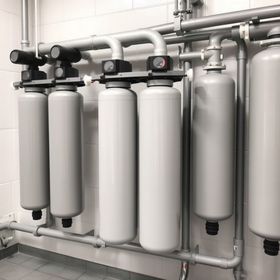
A cartridge filter is a type of filter that consists of a cylindrical filtering material (cartridge) placed inside a container known as a housing, which removes foreign substances from liquids. When foreign substances accumulate and cause clogging in the filtering material, it is replaced with a new cartridge. There are two types: surface filtration, which captures foreign substances on the surface of the filtering material, and depth filtration (depth type), which captures them within the material itself. There are also two types of filtration accuracy indicators: nominal and absolute, and it is important to check the type of indicator when selecting a replacement. ■ What determines the replacement timing? The lifespan of a liquid cartridge filter is determined by "differential pressure lifespan," which is based on clogging, and "time-dependent degradation lifespan," which is based on the deterioration of the filtering material itself. The shorter of the two determines the replacement timing. ■ What is differential pressure? Differential pressure is the difference in pressure between the inlet (primary side) and outlet (secondary side) of the filter. It is also referred to as pressure loss. Pressure gauges are attached to both the inlet and outlet of the housing, and the difference in values is monitored to manage the progression of clogging. As foreign substances accumulate in the filtering material, it becomes more difficult for water to pass through, causing the differential pressure to rise. Please feel free to consult us first.
Inquire About This Product
basic information
■What is the differential pressure that serves as a guideline for replacement? The recommended replacement differential pressure is determined for each product. The guideline is approximately 0.1 to 0.2 MPa. However, the values may vary depending on the product and usage conditions, so it is essential to verify this with the documentation of the cartridge being used. In addition to the recommended replacement differential pressure, a maximum differential pressure is also specified as the upper limit that the filter media can withstand, with some products having a maximum of 0.35 MPa at 20°C. ■Record the differential pressure when new! To observe how the differential pressure increases, it is necessary to know the initial value (initial differential pressure) when the product is new. For low-viscosity liquids like water, the initial differential pressure is designed to be kept below 0.015 MPa or 0.02 MPa. A high initial differential pressure reduces the margin before replacement is needed. ■Differential pressure also changes with flow rate The relationship between flow rate and pressure loss can be verified using the graphs specific to each product. Even with the same cartridge, a higher flow rate results in a higher differential pressure. In the case of high-viscosity liquids, there may be different graphs compared to water. When comparing differential pressures, it is important to compare values at the same flow rate.
Price range
Delivery Time
Applications/Examples of results
■What happens if you postpone the replacement? If you continue to use it under high differential pressure, there is a risk that the fibers of the filter media may come loose, or gaps may widen, leading to a decrease in filtration accuracy. Accumulated foreign substances may also blow through to the outlet side. The maximum differential pressure specified for each product should not be exceeded during operation. ■Is low differential pressure safe? Just because the differential pressure does not increase does not mean the filter media is in good condition. The filter media itself may deteriorate due to heat or chemicals, potentially reaching the end of its lifespan before the differential pressure lifespan. It is necessary to monitor the differential pressure records along with the usage period, liquid temperature, and types of chemicals. ■In what order should the replacement be done? During the replacement process, first relieve the pressure inside the housing and drain the liquid before opening it. Ensure that the new cartridge is installed correctly by checking the inlet and outlet indicated on the housing and paying attention to the orientation. After installation, flush it with water before use to wash out the inside of the housing and piping. This is because there is a risk of foreign substances entering the housing or piping during the work. Our company also offers filtration systems tailored to the source water and required water quality. Please feel free to consult with us first.
catalog(3)
Download All Catalogs

Company information

Since our founding, we have continued to provide flexible services with the motto of accurately supplying a diverse range of products that respond to changes in the times and the diversification of consumer needs, tailored to various applications and requirements. With the corporate slogan "Chemical Engineering Partner," we, as a group of experts in chemical technology, actively discover ideas to solve our customers' problems from advanced technologies both domestically and internationally, and propose them.


