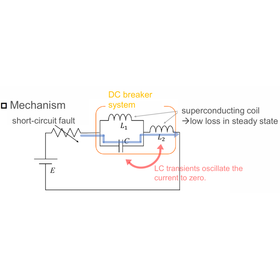
Arc-free, reliable interruption that eliminates shutdown failure, arc damage, noise and space problems.
Conventional DC circuit breakers interrupt short-circuit faults by opening their contacts and generating an explosive arc. But the current may rise faster than it can be limited, and interruption sometimes fails. The arc damages the breaker and nearby equipment and generates noise, and their large size makes installation sites hard to secure. This invention combines a superconducting coil and a capacitor to make the fault current oscillate and create a point where the current becomes zero, at which the contacts open. Powered by the fault current itself, it needs no supply for detection, control or driving (passive), and interrupts reliably without an arc. For 1.5-kV railway DC power supply, the required coil size has been determined numerically for each supply area (urban 130–145 mH, suburban 565–680 mH, rural 230–235 mH), together with the condition for the current to reach zero. Experiments confirm the current reaches zero and can be interrupted there.
Inquire About This Product
basic information
For details, please contact us or refer to the PDF.
Price range
Delivery Time
Applications/Examples of results
For details, please contact us or refer to the PDF.
catalog(1)
Download All Catalogs
Company information
The revenue generated from technology transfer is reinvested into universities and researchers as new research funding, which is used to create further research outcomes. To ensure the smooth operation of this cycle, known as the "Intellectual Creation Cycle," we will actively promote technology transfer. The types of seeds we handle include patents, know-how, databases, and programs. We have established a collaborative framework by concluding basic technology transfer agreements with the following universities (as of April 1, 2026): - Tohoku University - Hirosaki University - Iwate University - Akita University - Fukushima University - Yamagata University - Tohoku Gakuin University - Iwate Medical University - Fukushima Medical University - Aizu University - Miyagi University - Hokkaido University - Muroran Institute of Technology - Showa Medical University - Asahikawa Medical University