Comparison of Heat Treatment of Steel Materials: Explanation of Four Types of Purposes and Differences, including Quenching and Tempering.
Hardening, tempering, stress relieving, annealing.

A comparison of four types: hardening, tempering, annealing, and normalizing. We will provide a detailed explanation of each purpose and difference for those in charge of examining the hardness and workability of steel materials.
Heat treatment of steel is a technique that changes the internal structure through heating, holding, and cooling, adjusting properties such as hardness, strength, and toughness. If treated under conditions that do not match the intended purpose, it may result in insufficient hardness, cracking, or deformation. 【Recommended for these concerns】 - Not understanding the difference between quenching and tempering - Unsure how to adjust hardness and toughness - Wanting to know methods for hardening only the surface <What you can learn from the article> - The relationship between heating, holding, cooling, and structure - The purposes of processes like quenching and annealing - An overview of carburizing, high-frequency quenching, and nitriding In the first part, we will organize the basics of heat treatment and the types of representative processes. Quenching is a process that hardens steel by cooling it after heating, while tempering is performed to adjust hardness and toughness after quenching. Annealing and normalizing are considered when adjusting structure and properties in anticipation of processing or subsequent steps. The properties required for the entire part may not necessarily be the same as the wear resistance required for the surface. Please refer to this when considering heat treatment, taking into account usage conditions and processing steps. Inquiries about steel selection are welcome.
Inquire About This Product
basic information
Heat treatment changes the structure and properties of steel depending on the heating temperature, holding time, and cooling method. The main purposes and characteristics are as follows: - Quenching: This process involves heating the steel and then cooling it to obtain a hard structure. The resulting hardness and the risks of cracking and deformation vary depending on the cooling method, such as water, oil, or gas. - Tempering: This process involves reheating after quenching to adjust hardness and toughness. It is considered in combination with quenching. - Annealing: This is performed to soften the steel, making it easier to process. It is considered when taking into account subsequent processes like cutting. - Normalizing: This process involves air cooling after heating to refine the structure. It differs from annealing in terms of cooling method and purpose. - Carburizing: This is a surface hardening treatment that involves diffusing carbon into the surface of the steel followed by quenching. - High-frequency quenching: This process heats the surface of components and then cools them to harden. The required properties inside the material are also considered. - Nitriding: This process involves diffusing nitrogen into the surface of the steel to harden it. It is characterized by minimal deformation during treatment since it does not involve quenching. The actual treatment conditions vary depending on the type of steel, dimensions, shape, and required performance. Our company will propose the optimal solution.
Price range
Delivery Time
Applications/Examples of results
In the manufacturing of mechanical parts and molds, heat treatment is considered to achieve the necessary hardness, strength, toughness, and wear resistance of the materials. It is important to confirm not only the properties required during the design phase but also the processing stages such as cutting and bending, as well as the areas where forces will be applied during use. For example, in mechanical structural components like shafts and bolts, the overall strength and toughness of the parts are taken into account, and tempering through quenching and tempering is considered. If the steel material is hard and difficult to cut before processing, annealing may be considered for subsequent processes. For parts that experience repeated contact, where wear and fatigue are concerns, surface hardening treatment becomes an option. High-frequency quenching is a method that heats the surface to harden it, and if internal properties are required, prior heat treatment should also be considered. Nitriding is examined when there is a need for surface hardness while wanting to minimize deformation during processing. In all cases, it is necessary to not judge solely by the name of the treatment, but to confirm the steel type, part dimensions, the depth to be hardened, and the processing after treatment. If the current steel material and application are determined, consultations can be made based on those conditions.
Detailed information
-
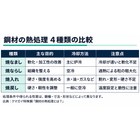
A simple comparison table of the four main types of heat treatment.
Line up(7)
| Model number | overview |
|---|---|
| Quenching | This is a process of heating steel and then cooling it to obtain a hard structure. The hardness achieved and the risks of cracking or deformation vary depending on the cooling method used, such as water, oil, or gas. |
| Reheating | This is a process of reheating after quenching to adjust hardness and toughness. It will be considered in combination with quenching. |
| Annealing | It is done for purposes such as softening steel to make it easier to process. It is considered when taking into account subsequent processes like cutting. |
| Baking or roasting. | This is a surface hardening treatment that involves quenching after carbon has been diffused into the surface of the steel. |
| High-frequency hardening | It is a process of heating the surface of the part, cooling it, and hardening it. Consideration is also given to the properties required internally. |
| Nitriding | It is a treatment that diffuses nitrogen into the surface of steel to harden it. A characteristic feature is that it involves little deformation during the treatment, as it does not include quenching. |
| Carbonitriding | This is a surface hardening treatment that involves quenching after carbon has been diffused into the surface of the steel. |
catalog(1)
Download All Catalogs
Company information
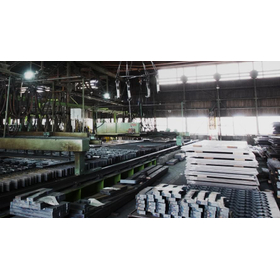
**Expanding Our Global Steel Business!** We support both **CIF and EX Works (EXW)** terms. **Delivering Japanese Specialty Steel to the World.** Since our establishment in 1913, we have been a specialized trading company of special steel for nearly a century, listening to the needs of many customers and building an ideal relationship between customers and steel manufacturers as a conductor of steel distribution. As a trading company with various processing equipment, including cutting machines and laser cutting machines, we also contribute to reducing our customers' capital investment. Please feel free to contact us if you have any requests.