
Efficient magnet cooling for higher motor power output
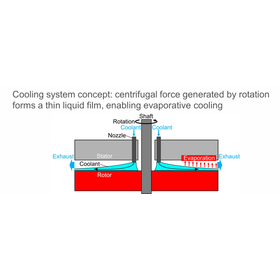
Axial-gap motors can achieve both compact size and high power output, making them promising for applications such as electric aircraft and electric vehicles. However, as motors operate at higher speeds and power levels, heat generation due to losses becomes a concern. Magnets are particularly difficult to cool because of their low thermal conductivity. In addition, neodymium magnets may lose magnetic strength when their temperature exceeds 80°C. Therefore, effectively cooling the magnets is essential to improving motor performance. Conventional cooling methods include efficiently drawing in air and spraying liquid onto the rotor. However, both rely on single-phase flow and have limitations in cooling performance. Two-phase cooling methods that use fluid evaporation have also been proposed, but they do not target the magnets, which are a key concern when increasing motor power output. The present invention relates to a method and system for effectively cooling magnets that rotate and generate heat. Liquid is supplied from the stator to the rotor, and the rotor’s rotation spreads the liquid into a thin film over a heated surface. Because the thin film evaporates readily and removess heat effectively from the heated surface, it can substantially reduce the temperature inside the magnets.
Inquire About This Product
basic information
For details, please contact us or refer to the PDF.
Price range
Delivery Time
Applications/Examples of results
For details, please contact us or refer to the PDF.
catalog(1)
Download All Catalogs
Company information
The revenue generated from technology transfer is reinvested into universities and researchers as new research funding, which is used to create further research outcomes. To ensure the smooth operation of this cycle, known as the "Intellectual Creation Cycle," we will actively promote technology transfer. The types of seeds we handle include patents, know-how, databases, and programs. We have established a collaborative framework by concluding basic technology transfer agreements with the following universities (as of April 1, 2026): - Tohoku University - Hirosaki University - Iwate University - Akita University - Fukushima University - Yamagata University - Tohoku Gakuin University - Iwate Medical University - Fukushima Medical University - Aizu University - Miyagi University - Hokkaido University - Muroran Institute of Technology - Showa Medical University - Asahikawa Medical University