
List of Materials products
- classification:Materials
7336~7350 item / All 37550 items


Reduce the workload from handling heavy objects! Here are five case studies that solved customer challenges! We are also accepting free consultations and tests tailored to your work!

- Other conveying machines


Ideal for micro-machining! Achieves deburring of holes and double-sided machining in one pass, which was difficult with conventional tools!

- Other machine tools

We will be exhibiting at Mecatronics Tech Japan 2021 from October 20 (Wednesday) to October 23 (Saturday)!
Our company will exhibit at "Mechatrotech Japan 2021," which will be held at Portmesse Nagoya from Wednesday, October 20 to Saturday, October 23, 2021. We will introduce our tools, including the 'Bar Off Tool' capable of chamfering and deburring from a diameter of 0.8 mm, and the 'FEM' tool breakage detection device that reliably detects breakage. We look forward to your visit. (Booth number: 2B12)


We provide immediate solutions to your foaming problems.
- Chemicals

We are your chemical assistant for solving challenges at the production site.
- Chemicals


Our company imports and sells copper plates, copper strips, and copper foils from Aurubis in Germany.
- Non-ferrous metals


A simple mattress that can be laid down. It can be washed with water, making it clean to use. (Has a track record of being adopted for disaster preparedness.)
- Other polymer materials
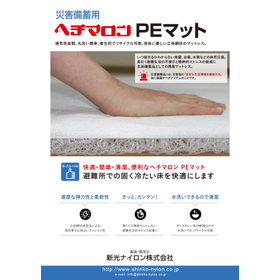
★Emergency shelter living supplies★ 'Hecimaron PE mat' can be washed and reused.
- It comes with a waterproof cover, so it can be easily turned into a simple mattress just by laying it down. - With moderate elasticity and flexibility, it protects your body from hard floors. - The core material is made of polyethylene, allowing for easy cleaning and reuse by washing it thoroughly. There is a proven track record for disaster preparedness supplies. For more details, please contact Sanko Techno. *As of May 2023, Shinko Nylon has become a member of the Sanko Techno Group.

Weight capacity of about 1000kg! Cost reduction is achievable with the introduction of used plastic pallets.
- palette
- palette
- plastic
![[Data] Case Study of SnS Ultra-Thin...](https://image.mono.ipros.com/public/product/image/3be/2000693470/IPROS83556541564481186514.png?w=280&h=280)

Graphs and photos are published according to film thickness! We also introduce the resistivity of each.
- Organic Natural Materials
- Other polymer materials
- Other semiconductors

Published in the Chemical Industry Daily (February 4, 2026).
Our company was featured in the Chemical Industry Daily (February 4, 2026). 'CalcoGenic Expands Sulfurized Tin for Secondary Batteries'


Recycled plastic products made possible by unique raw material management technology and molding technology that enable high strength and durability!
- plastic

We can also accommodate large timber (example size: 3m)! We will create molds according to your desired shape and introduce some examples of products made using these molds.
- plastic