List of Mixing and Stirring Equipment products
- classification:Mixing and Stirring Equipment
46~90 item / All 536 items
We provide comprehensive support from design to manufacturing and maintenance!
- Contract manufacturing
It won't break even after 1 million repetitions! A mat switch with reliable operation, high durability, and low price. Suitable for options in machine tools as well. Please consult us about delivery t...
- Sensors
Capable to select proper rotation speed based on the materials via non-step speed change system
- Other mixing and mixing equipment
- Other powder equipment
- Mixer
This series of machines features high-performance mixers equipped with a non-step speed changer that is ideal for production testing.
- Other powder equipment
- Other mixing and mixing equipment
- Mixer
A medium-sized store mill grinder that combines excellent durability with quiet operation and a simple structure.
- Coffee machines
- Crusher/Mill
- Other kitchen equipment and products
Espresso grinder with weighing function
- Crusher/Mill
- Other kitchen equipment and products
- Coffee machines
The introduction of Eureka's high-end single dose grinder developed in pursuit of ideals.
- Coffee machines
- Crusher/Mill
- Other kitchen equipment and products
A vibrating screen that performs the work of two machines in one is perfectly suited for sifting salt.
- Grain size sorting machine (sieving)
- Classifier
When manufactured using the turbo-dry method, the functional components of vegetables are not degraded and are concentrated into a powder. Transform unused food (agricultural and marine products) into...
- Crusher/Mill
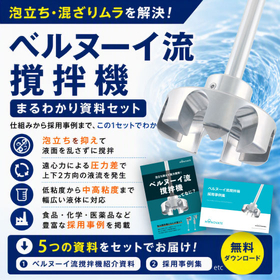
By eliminating the rotating part, it allows for stirring and mixing without creating bubbles! It also contributes to reducing processing time.
- Other mixing and mixing equipment
- Other powder equipment
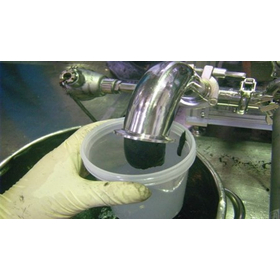
We will be exhibiting for the first time at FOOMA JAPAN 2026! (June 2-5)
FOOMA JAPAN is one of the largest comprehensive exhibitions for food manufacturing in the world, aimed at the exchange and dissemination of technology and information related to food machinery, equipment, and associated devices. Many companies from a wide range of exhibition and display fields will participate, covering the entire food manufacturing process from upstream to downstream. We encourage you to visit for information gathering, and please stop by our booth as well! At this exhibition, we will showcase the "NanoVator," which can emulsify, disperse, defiber, and crush with a single unit, as well as the "Damatri," which can mix and dissolve materials that tend to clump together using just one pipe, along with other processing samples. We look forward to your visit!
Improvement of particle residue during application, prevention of clumping, and effective for viscous powder/liquid mixtures! Furthermore, it can be processed in an overwhelmingly shorter time than wi...
- Other mixing and mixing equipment
- Piping parts
- Other powder equipment
We will be exhibiting for the first time at FOOMA JAPAN 2026! (June 2-5)
FOOMA JAPAN is one of the largest comprehensive exhibitions for food manufacturing in the world, aimed at the exchange and dissemination of technology and information related to food machinery, equipment, and associated devices. Many companies from a wide range of exhibition and display fields will participate, covering the entire food manufacturing process from upstream to downstream. We encourage you to visit for information gathering, and please stop by our booth as well! At this exhibition, we will showcase the "NanoVator," which can emulsify, disperse, defiber, and crush with a single unit, as well as the "Damatri," which can mix and dissolve materials that tend to clump together using just one pipe, along with other processing samples. We look forward to your visit!
Introducing a product equipped with a mechanism that allows for diverse applications and easy internal cleaning!
- Mixer/agitator
- mixer
- mixer
Quality changes with dispersion. Pre-validation of the reproducibility of resin materials through testing.
- Emulsifier/Disperser
- Vacuum degassing machine
- Dispersion/emulsification equipment/homogenizer
What are the reasons for changes in results from the lab to mass production? Causes and countermeasures for the deterioration of distributed quality during scale-up.
Despite obtaining good dispersion results in the lab, the challenge of unstable quality upon mass production occurs in many settings. The main cause of this is that the dispersion conditions are not replicated due to differences in scale. In lab equipment, the smaller size leads to higher energy density, making shear and flow more uniform, while in mass production equipment, the larger scale often results in insufficient dispersion energy at the same rotational speed and processing time. Additionally, differences in equipment structure and flow patterns can cause variations in the shear history and residence time experienced by particles, leading to differences in the dispersion state. Furthermore, simple scale-up does not ensure that critical parameters such as flow rate, residence time, and shear intensity match, making it difficult to reproduce the same results as in the lab. To address these challenges, it is essential to focus on process design based on dispersion energy density and flow conditions rather than merely increasing equipment size. By designing the system so that particles pass through the processing area under consistent conditions, it is possible to achieve reproducible dispersion quality even when the scale changes, as seen in inline continuous processing.
The strength is determined by the variance. Visualize quality variations through testing before mass production.
- Emulsifier/Disperser
- Vacuum degassing machine
- Dispersion/emulsification equipment/homogenizer
What are the reasons for changes in results from the lab to mass production? Causes and countermeasures for the deterioration of distributed quality during scale-up.
Despite obtaining good dispersion results in the lab, the challenge of unstable quality upon mass production occurs in many settings. The main cause of this is that the dispersion conditions are not replicated due to differences in scale. In lab equipment, the smaller size leads to higher energy density, making shear and flow more uniform, while in mass production equipment, the larger scale often results in insufficient dispersion energy at the same rotational speed and processing time. Additionally, differences in equipment structure and flow patterns can cause variations in the shear history and residence time experienced by particles, leading to differences in the dispersion state. Furthermore, simple scale-up does not ensure that critical parameters such as flow rate, residence time, and shear intensity match, making it difficult to reproduce the same results as in the lab. To address these challenges, it is essential to focus on process design based on dispersion energy density and flow conditions rather than merely increasing equipment size. By designing the system so that particles pass through the processing area under consistent conditions, it is possible to achieve reproducible dispersion quality even when the scale changes, as seen in inline continuous processing.
Resolve issues of not dissolving and clumping in advance. Test the dispersibility of the protein.
- Emulsifier/Disperser
- Vacuum degassing machine
- Dispersion/emulsification equipment/homogenizer
What are the reasons for changes in results from the lab to mass production? Causes and countermeasures for the deterioration of distributed quality during scale-up.
Despite obtaining good dispersion results in the lab, the challenge of unstable quality upon mass production occurs in many settings. The main cause of this is that the dispersion conditions are not replicated due to differences in scale. In lab equipment, the smaller size leads to higher energy density, making shear and flow more uniform, while in mass production equipment, the larger scale often results in insufficient dispersion energy at the same rotational speed and processing time. Additionally, differences in equipment structure and flow patterns can cause variations in the shear history and residence time experienced by particles, leading to differences in the dispersion state. Furthermore, simple scale-up does not ensure that critical parameters such as flow rate, residence time, and shear intensity match, making it difficult to reproduce the same results as in the lab. To address these challenges, it is essential to focus on process design based on dispersion energy density and flow conditions rather than merely increasing equipment size. By designing the system so that particles pass through the processing area under consistent conditions, it is possible to achieve reproducible dispersion quality even when the scale changes, as seen in inline continuous processing.
From October 29 (Tuesday) to 31 (Thursday), 2024! We will be exhibiting small ultrasonic dispersion devices and ultrasonic generators!
- Emulsifier/Disperser
- Powder Supply Device
- Dispersion/emulsification equipment/homogenizer
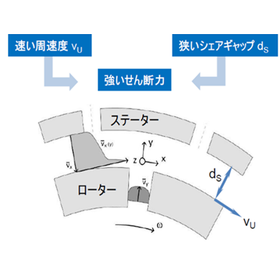
What is decentralized process design? Key points for stabilizing quality.
In dispersion engineering, stable quality cannot be achieved solely based on the performance of the equipment. What is important is the overall design of the process, taking into account material properties and process conditions. This is referred to as dispersion process design. Dispersion quality is determined not only by the strength of shear but also by multiple factors such as flow state, residence time, and method of input. If these conditions are not properly designed, localized agglomeration or variation can occur, making it difficult to maintain stable quality. For example, poor wetting during powder input or the occurrence of stagnant areas due to flow bias can lead to clumping or dispersion issues. Additionally, even if the shear energy is sufficient, if it does not act uniformly on all particles, differences in dispersion state will arise. Therefore, in dispersion processes, it is crucial to design "flow," "shear," and "processing time" as an integrated system. This allows for all particles to receive the same dispersion history, achieving uniform and highly reproducible dispersion quality. In particular, inline continuous processing has the advantage of maintaining consistent conditions within the flow, making it easier to ensure reproducibility in process design. Dispersion process design is a key concept for stabilizing quality and successfully scaling up.
The problem of light powder and heavy particles separating has been solved! Strong vertical convection reduces quality variation.
- Mixer/agitator
- mixer
- mixer
The issue of the input being too high and manual work being labor-intensive is also resolved! We optimize the height and direction of input and output.
- Mixer/agitator
- mixer
- mixer
The risk of worn gaskets and bearing oil mixing with the powder has also been resolved! We have eliminated the routes for foreign matter contamination from the structure.
- Mixer/agitator
- mixer
- mixer
The concern of not being able to wash thoroughly and the anxiety about contamination is resolved! It dramatically shortens cleaning time.
- mixer
- Mixer/agitator
- mixer
We want to increase production, but we also have the concern that ready-made products are too large! We achieve both space-saving and high productivity.
- Mixer/agitator
- mixer
- mixer
Consolidating impact and cutting crushing into one machine. Uniformly processing a variety of materials such as plastics and food, solving preprocessing challenges for analysis.
- Crusher/Mill
Automatic monitoring of temperature and system load! One device for research, quality control, and other applications.
- Crusher/Mill
Suppressing sedimentation and evenly dispersing the protein.
- Dispersion/emulsification equipment/homogenizer
- Powder Supply Device
- Beverage Production Equipment
What are the causes of dispersion troubles? An explanation of the reasons for aggregation, sedimentation, and variation, as well as design points to reconsider in the dispersion process.
In dispersion engineering, issues such as unresolved agglomeration, sedimentation, and unstable particle size distribution occur frequently at many sites. These problems are caused not only by the performance of the equipment but also by inconsistencies in particle characteristics, dispersion conditions, and process design. For example, when there is insufficient dispersion energy, particles do not break down to primary particles, and agglomeration remains. Additionally, if the shear conditions or flow state are not appropriate, uniform dispersion cannot be achieved, leading to sedimentation and variations in quality. Particularly in high-viscosity systems or high solid content slurries, even slight differences in conditions can significantly impact the results. Furthermore, in batch processing, variations in mixing uniformity and residence time make it difficult to ensure reproducibility. To resolve these dispersion issues, it is important to optimize the entire process, including particle characteristics, dispersion energy, and flow design, rather than simply changing the equipment. By maintaining consistent conditions, as in inline continuous processing, stable dispersion quality and reproducibility can be achieved.
Pacific Machinery | Consolidating mixing, heating, drying, cooling, and reactions into one machine. Efficiently controlling the amount of circulating superheated steam. We will unveil new technology f...
- Mixer/agitator
- mixer
- Other Mixers
[Exhibiting at FOOMA @ Tokyo Big Sight] Disinfection, oil removal, and uniform drying all in one machine! The new specification of the Pam Apex Mixer "Superheated Steam Drying" makes its debut.
Our company will be exhibiting at "FOOMA JAPAN 2026," which will be held at Tokyo Big Sight from June 2 (Tuesday) to June 5 (Friday). ● Date: June 2 (Tuesday) to June 5 (Friday), 2026, 10:00 AM to 5:00 PM ● Venue: Tokyo Big Sight, West Exhibition Hall, East Exhibition Hall 4th Floor, Hall 3 W3-33-36 <Exhibited Equipment: "Pam Apex Mixer with Superheated Steam Drying Specification"> While drying, it also disinfects, degreases, and prevents oxidation. At this FOOMA, we will introduce the new specification of the mixer featuring superheated steam drying. By combining the high thermal conductivity of superheated steam with uniform stirring from internal blades, we efficiently process the drying of food powders and food residues. The effects of disinfection, degreasing, and oxidation prevention can also be expected simultaneously. Please pay attention to our mixer, which accommodates a wide range of applications such as mixing, dispersion, fiber separation, humidification coating, heating, cooling, reaction, and drying. We sincerely look forward to your visit.
We are a specialized manufacturer of high-shear high-speed dispersers!
- Mixer/agitator
- mixer
- Mixer
High cleaning performance, suitable for advanced sanitary environments! It stirs powerfully even with a small opening!
- Mixer/agitator
- mixer
- Mixer
Quickly wet powders such as gum and thickeners! Innovative integrated dynamic mixing head.
- Mixer/agitator
- mixer
- Mixer
Large solids such as polymers can be instantly crushed, dissolved, and dispersed!
- Mixer/agitator
- mixer
- Mixer
From the disintegration of solid materials to the stirring of high-viscosity liquids! Technical documentation on bottom entry mixers.
- Mixer/agitator
- mixer
- Mixer
Disperse and mix the powder while sucking it into the liquid! Ideal for dissolving gelling agents and thickeners.
- Mixer/agitator
- mixer
- Powder Mixer
If you want to achieve both high hygiene standards and versatility of use, the Ultra Sanitary Series is the way to go!
- Mixer/agitator
- mixer
- Mixer
Process efficiency improvement! Reduction of processing time possible! Many models available according to processing volume!
- Mixer/agitator
- mixer
- Mixer
This one machine is easy to operate and high-performance for research, development, and small-scale production!
- Mixer/agitator
- mixer
- Mixer
The power of in-line mixing and advanced sanitation shines even in small-scale production at the pilot scale!
- Mixer/agitator
- mixer
- Mixer
Achieve powerful in-line mixing even on a lab scale! The range of small mixers expands!
- Mixer/agitator
- Mixer
- mixer
Unchanging stirring power, even in a narrow test tube!
- Mixer/agitator
- mixer
- Mixer
A reliable device for working in sterile environments, mixing hazardous substances, and operating under vacuum!
- mixer
- Mixer/agitator
- Mixer
Dispersion is not determined by the equipment. It is determined by the process design of the resin dispersion system.
- Emulsifier/Disperser
- Vacuum degassing machine
- Dispersion/emulsification equipment/homogenizer
What is decentralized process design? Key points for stabilizing quality.
In dispersion engineering, stable quality cannot be achieved solely based on the performance of the equipment. What is important is the overall design of the process, taking into account material properties and process conditions. This is referred to as dispersion process design. Dispersion quality is determined not only by the strength of shear but also by multiple factors such as flow state, residence time, and method of input. If these conditions are not properly designed, localized agglomeration or variation can occur, making it difficult to maintain stable quality. For example, poor wetting during powder input or the occurrence of stagnant areas due to flow bias can lead to clumping or dispersion issues. Additionally, even if the shear energy is sufficient, if it does not act uniformly on all particles, differences in dispersion state will arise. Therefore, in dispersion processes, it is crucial to design "flow," "shear," and "processing time" as an integrated system. This allows for all particles to receive the same dispersion history, achieving uniform and highly reproducible dispersion quality. In particular, inline continuous processing has the advantage of maintaining consistent conditions within the flow, making it easier to ensure reproducibility in process design. Dispersion process design is a key concept for stabilizing quality and successfully scaling up.
The quality of the battery slurry is determined by the process. A dispersion design that can be reproduced from research to mass production.
- Emulsifier/Disperser
- Vacuum degassing machine
- Dispersion/emulsification equipment/homogenizer