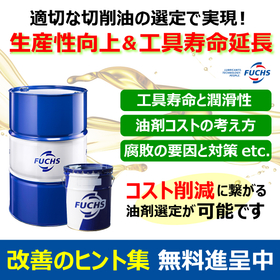
List of Lubricants products

  • classification:Lubricants

361~375 item / All 1742 items

Displayed results

Reduce the workload from handling heavy objects! Here are five case studies that solved customer challenges! We are also accepting free consultations and tests tailored to your work!

  • PRエリア.png
  • Other conveying machines

Added to bookmarks

Bookmarks list

Bookmark has been removed

Bookmarks list

You can't add any more bookmarks

By registering as a member, you can increase the number of bookmarks you can save and organize them with labels.

Free membership registration

Strong cold wind from room temperature to -13°C! Depending on the usage environment, you can choose between the combo type or the separate type!

  • Cooling system

Added to bookmarks

Bookmarks list

Bookmark has been removed

Bookmarks list

You can't add any more bookmarks

By registering as a member, you can increase the number of bookmarks you can save and organize them with labels.

Free membership registration
image_66.png

April 10, 2024 (Wednesday) to April 12, 2024 (Friday) Notice of Participation in Nagoya Manufacturing World 2024

Sanwa Shiki Ventilator Co., Ltd. will be exhibiting at the 2024 Monozukuri World (Nagoya) held at Port Messe Nagoya. We will also be showcasing our large cooling fans and cool/warm ambient products. Date: April 10, 2024 - April 12, 2024 Opening: 10:00 AM Location: Nagoya Port Messe (Exhibition Hall 1) *Our booth: 19-1 We would be grateful if you could visit us if you have the time.

We will visit for lubricant testing! Experience the differences compared to the lubricant you are currently using.

  • 潤滑剤の性能試験 画像2.png
  • 潤滑剤の性能試験 画像3.png
  • 潤滑剤の性能試験 画像4.png
  • 潤滑剤の性能試験 画像5.jpg
  • 潤滑剤の性能試験 画像6.jpg
  • 潤滑剤の性能試験 画像7.jpg
  • 潤滑剤の性能試験 画像8.png
  • 潤滑剤の性能試験 画像9.png
  • Lubricants

Added to bookmarks

Bookmarks list

Bookmark has been removed

Bookmarks list

You can't add any more bookmarks

By registering as a member, you can increase the number of bookmarks you can save and organize them with labels.

Free membership registration

Ideal for lubricating rack and pinion! We have prepared three types of spray.

  • gear
  • Lubricants

Added to bookmarks

Bookmarks list

Bookmark has been removed

Bookmarks list

You can't add any more bookmarks

By registering as a member, you can increase the number of bookmarks you can save and organize them with labels.

Free membership registration

A strong ally in equipment management. A single tool that works for any material or application.

  • Lubricants
  • Plastic bearings
  • Lubricants and additives

Added to bookmarks

Bookmarks list

Bookmark has been removed

Bookmarks list

You can't add any more bookmarks

By registering as a member, you can increase the number of bookmarks you can save and organize them with labels.

Free membership registration
fluorine-grease-vs-silicone-grease.jpg

What is the difference between fluorine grease and silicone grease?

Fluorine grease and silicone grease are both lubricants with excellent heat resistance and chemical resistance, but there are clear differences in their applications and performance. Fluorine grease is primarily composed of PFPE (fluorinated oil) and PTFE, characterized by its excellent stability in high-temperature and chemical environments. For example, it maintains stable performance over a wide temperature range of -25°C to 280°C and is less affected by chemicals and solvents, making it suitable for lubricating sliding parts of molds and precision components. On the other hand, silicone grease is based on silicone oil and is characterized by its low tendency to damage rubber and resin, as well as its excellent waterproofing and insulation properties. Therefore, it is suitable for areas where material protection is important, such as O-rings, gaskets, and waterproof applications. In summary: - High temperature, chemical resistance, long lifespan → Fluorine grease - Waterproof, rubber protection, insulation → Silicone grease It is important to differentiate between them based on their uses. Selecting the appropriate lubricant according to the usage environment leads to trouble prevention and improved maintenance efficiency.

Next-generation PTFE-based lubricants that challenge high temperature, high vacuum, and corrosive environments.

  • Engineering Plastics
  • Plastic bearings
  • Lubricants

Added to bookmarks

Bookmarks list

Bookmark has been removed

Bookmarks list

You can't add any more bookmarks

By registering as a member, you can increase the number of bookmarks you can save and organize them with labels.

Free membership registration
fluorine-grease-vs-silicone-grease.jpg

What is the difference between fluorine grease and silicone grease?

Fluorine grease and silicone grease are both lubricants with excellent heat resistance and chemical resistance, but there are clear differences in their applications and performance. Fluorine grease is primarily composed of PFPE (fluorinated oil) and PTFE, characterized by its excellent stability in high-temperature and chemical environments. For example, it maintains stable performance over a wide temperature range of -25°C to 280°C and is less affected by chemicals and solvents, making it suitable for lubricating sliding parts of molds and precision components. On the other hand, silicone grease is based on silicone oil and is characterized by its low tendency to damage rubber and resin, as well as its excellent waterproofing and insulation properties. Therefore, it is suitable for areas where material protection is important, such as O-rings, gaskets, and waterproof applications. In summary: - High temperature, chemical resistance, long lifespan → Fluorine grease - Waterproof, rubber protection, insulation → Silicone grease It is important to differentiate between them based on their uses. Selecting the appropriate lubricant according to the usage environment leads to trouble prevention and improved maintenance efficiency.

Just right is the best. The optimal solution for the cost of mold grease.

  • Plastic Mould
  • Other molds
  • Lubricants

Added to bookmarks

Bookmarks list

Bookmark has been removed

Bookmarks list

You can't add any more bookmarks

By registering as a member, you can increase the number of bookmarks you can save and organize them with labels.

Free membership registration

Stable lubrication compatible with 280℃! Ideal for slide pins and ejectors.

  • Plastic Mould
  • Mold
  • Lubricants

Added to bookmarks

Bookmarks list

Bookmark has been removed

Bookmarks list

You can't add any more bookmarks

By registering as a member, you can increase the number of bookmarks you can save and organize them with labels.

Free membership registration

The real reason why "maintenance frequency does not decrease" in high-temperature environments and the shortest route to take on-site (with checklist included).

In high-temperature environments, grease does not simply diminish; its "state" deteriorates due to hardening, separation, and carbonization. Even if there is some remaining, the lubrication function decreases, leading to increased sliding resistance, poor return, and fine seizure. If these warning signs are ignored, it will eventually progress to seizing or burning. Therefore, the idea that "using high-performance grease eliminates the need for reapplication" does not hold true in high-temperature areas. What is important is to visualize the signs of abnormalities and to establish rules for inspection, cleaning, and reapplication. Especially in die-casting molds, temperature changes, high surface pressure, and dust contamination overlap, causing lubrication conditions to fluctuate constantly. Maintaining a stable operational state takes precedence over reducing maintenance frequency. 【High-Temperature Sliding Component Checklist】 □ Is the return of the pin sluggish? □ Are there any signs of seizure or dust accumulation? □ Is the grease hardened or film-formed? □ Is there any catching when starting to move? □ After cleaning, is the appropriate amount reapplied? Rather than forcibly reducing maintenance frequency, the realistic approach is to operate in a way that prevents stoppage accidents before they occur.

High temperature × water resistance × high adhesion. A versatile grease compatible with all machines.

  • Lubricants
  • Chains and sprockets
  • Metal bearings

Added to bookmarks

Bookmarks list

Bookmark has been removed

Bookmarks list

You can't add any more bookmarks

By registering as a member, you can increase the number of bookmarks you can save and organize them with labels.

Free membership registration

Differentiation through adhesion - High-performance grease specifically for O-rings and packings.

  • Plastic Mould
  • Press Dies
  • Lubricants

Added to bookmarks

Bookmarks list

Bookmark has been removed

Bookmarks list

You can't add any more bookmarks

By registering as a member, you can increase the number of bookmarks you can save and organize them with labels.

Free membership registration
fluorine-grease-vs-silicone-grease.jpg

What is the difference between fluorine grease and silicone grease?

Fluorine grease and silicone grease are both lubricants with excellent heat resistance and chemical resistance, but there are clear differences in their applications and performance. Fluorine grease is primarily composed of PFPE (fluorinated oil) and PTFE, characterized by its excellent stability in high-temperature and chemical environments. For example, it maintains stable performance over a wide temperature range of -25°C to 280°C and is less affected by chemicals and solvents, making it suitable for lubricating sliding parts of molds and precision components. On the other hand, silicone grease is based on silicone oil and is characterized by its low tendency to damage rubber and resin, as well as its excellent waterproofing and insulation properties. Therefore, it is suitable for areas where material protection is important, such as O-rings, gaskets, and waterproof applications. In summary: - High temperature, chemical resistance, long lifespan → Fluorine grease - Waterproof, rubber protection, insulation → Silicone grease It is important to differentiate between them based on their uses. Selecting the appropriate lubricant according to the usage environment leads to trouble prevention and improved maintenance efficiency.

Food container-specific grease that balances safety and performance.

  • Plastic Mould
  • Mold
  • Lubricants

Added to bookmarks

Bookmarks list

Bookmark has been removed

Bookmarks list

You can't add any more bookmarks

By registering as a member, you can increase the number of bookmarks you can save and organize them with labels.

Free membership registration

Aiming for a First Class Company

  • Lubricants
  • Contract manufacturing

Added to bookmarks

Bookmarks list

Bookmark has been removed

Bookmarks list

You can't add any more bookmarks

By registering as a member, you can increase the number of bookmarks you can save and organize them with labels.

Free membership registration

Eco-friendly biodegradable release agent. It is pre-mixed, so you can use it immediately upon arrival!

  • Lubricants
  • Other consumables

Added to bookmarks

Bookmarks list

Bookmark has been removed

Bookmarks list

You can't add any more bookmarks

By registering as a member, you can increase the number of bookmarks you can save and organize them with labels.

Free membership registration

Sumiko's "new products," "new developments," and "new technologies"! With a comprehensive lineup, customization to meet customer needs is also possible!

  • Lubricants

Added to bookmarks

Bookmarks list

Bookmark has been removed

Bookmarks list

You can't add any more bookmarks

By registering as a member, you can increase the number of bookmarks you can save and organize them with labels.

Free membership registration

Protecting molds, supporting the workplace. A selection of high-performance grease lineup.

  • Press Dies
  • Plastic Mould
  • Lubricants

Added to bookmarks

Bookmarks list

Bookmark has been removed

Bookmarks list

You can't add any more bookmarks

By registering as a member, you can increase the number of bookmarks you can save and organize them with labels.

Free membership registration
グリースサンプル.png

[Free Sample Start] We have started offering free samples of various greases!

We have launched a campaign offering a free trial of M&M's high-temperature grease for those struggling with mold burning and release troubles. With a heat resistance of 800°C, it significantly improves lubrication and release properties when directly applied to molds. Please take this opportunity to experience the effectiveness of our high-performance grease. It is ideal for addressing issues with mold equipment and sliding parts used in high-temperature environments.

High heat resistance, high pressure resistance, and excellent chemical resistance universal fluorine grease.

  • Lubricants
  • Plastic Mould
  • Mold

Added to bookmarks

Bookmarks list

Bookmark has been removed

Bookmarks list

You can't add any more bookmarks

By registering as a member, you can increase the number of bookmarks you can save and organize them with labels.

Free membership registration
fluorine-grease-vs-silicone-grease.jpg

What is the difference between fluorine grease and silicone grease?

Fluorine grease and silicone grease are both lubricants with excellent heat resistance and chemical resistance, but there are clear differences in their applications and performance. Fluorine grease is primarily composed of PFPE (fluorinated oil) and PTFE, characterized by its excellent stability in high-temperature and chemical environments. For example, it maintains stable performance over a wide temperature range of -25°C to 280°C and is less affected by chemicals and solvents, making it suitable for lubricating sliding parts of molds and precision components. On the other hand, silicone grease is based on silicone oil and is characterized by its low tendency to damage rubber and resin, as well as its excellent waterproofing and insulation properties. Therefore, it is suitable for areas where material protection is important, such as O-rings, gaskets, and waterproof applications. In summary: - High temperature, chemical resistance, long lifespan → Fluorine grease - Waterproof, rubber protection, insulation → Silicone grease It is important to differentiate between them based on their uses. Selecting the appropriate lubricant according to the usage environment leads to trouble prevention and improved maintenance efficiency.

Added to bookmarks

Bookmarks list

Bookmark has been removed

Bookmarks list

You can't add any more bookmarks

By registering as a member, you can increase the number of bookmarks you can save and organize them with labels.

Free membership registration

Filter

classification
Delivery Time
Location