We have compiled a list of manufacturers, distributors, product information, reference prices, and rankings for Pretreatment.
ipros is IPROS GMS IPROS One of the largest technical database sites in Japan that collects information on.

Pretreatment Product List and Ranking from 20 Manufacturers, Suppliers and Companies | IPROS GMS

Last Updated: Aggregation Period:May 27, 2026~Jun 23, 2026
This ranking is based on the number of page views on our site.

Pretreatment Manufacturer, Suppliers and Company Rankings

Last Updated: Aggregation Period:May 27, 2026~Jun 23, 2026
This ranking is based on the number of page views on our site.

  1. null/null
  2. 永和工芸 Osaka//Ferrous/Non-ferrous metals
  3. バイオタージ・ジャパン Tokyo//Testing, Analysis and Measurement
  4. 4 DIAM Chiba//Manufacturing and processing contract
  5. 4 三進製作所 Aichi//Industrial Machinery

Pretreatment Product ranking

Last Updated: Aggregation Period:May 27, 2026~Jun 23, 2026
This ranking is based on the number of page views on our site.

  1. The Importance of Sample Preparation in Polymer Analysis: ICP and Atomic Absorption
  2. Oil-water separator pre-treatment (degreasing) total system "Filtretao" 三進製作所
  3. [Case Study of Conductive Diamond Technology] Pre-treatment for Plating on PPS Resin DIAM
  4. 4 Automatic press machine, maximum 35 tons, fluorescent X-ray analysis, pretreatment. 西進商事
  5. 5 Importance of Sample Preparation in Ceramic Analysis: ICP and Atomic Absorption

Pretreatment Product List

31~53 item / All 53 items

Displayed results

The iron coating was causing "red rust" to peel off.

Explanation of the causes of paint peeling due to red rust and substrate corrosion of iron materials, and methods for improvement.

Many of the causes of paint peeling on iron materials are due to red rust. When surface corrosion progresses, the paint film cannot adhere properly. Even fine rust can lead to corrosion beneath the paint film. If blast treatment or rust prevention primer is omitted, peeling can occur within a few months. Proper substrate treatment is particularly important for iron materials. We also provide detailed examples of improvements in publicly available documents.

  • others
  • Pretreatment

Added to bookmarks

Bookmarks list

Bookmark has been removed

Bookmarks list

You can't add any more bookmarks

By registering as a member, you can increase the number of bookmarks you can save and organize them with labels.

Free membership registration

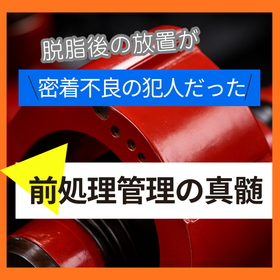
The culprit of poor adhesion after degreasing was leaving it unattended: the essence of pre-treatment management.

Have you not waited after defatting? That "waiting time" may be causing the paint to peel.

Even if the degreasing process is carried out properly, the quality of the paint can vary significantly due to subsequent management. The longer the time after degreasing that the surface of the parts is contaminated again with oil or dust, the lower the adhesion of the paint film will be. Time management from pre-treatment to painting is the key to preventing painting defects.

  • others
  • Pretreatment

Added to bookmarks

Bookmarks list

Bookmark has been removed

Bookmarks list

You can't add any more bookmarks

By registering as a member, you can increase the number of bookmarks you can save and organize them with labels.

Free membership registration

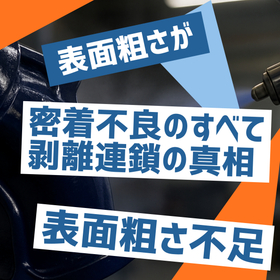
Surface roughness is the cause of all adhesion failures and the truth behind delamination chains.

The peeling of paint and poor adhesion are relentless. The cause may not be the paint itself, but rather a decrease in the adhesion area due to insufficient surface roughness.

Surface roughness is an important pre-treatment condition that affects the adhesion of the paint film. However, in the field, there are many cases where it is judged that "there is no problem because it looks nice." In reality, if the surface is too smooth, the paint may not penetrate sufficiently, leading to poor adhesion or peeling. This is especially significant with stainless steel and aluminum materials, where it may manifest as paint film lifting months later. This is actually a point that is often overlooked. Insufficient roughness can be difficult to assess visually. Furthermore, it is sometimes recommended to aim for a surface roughness of about Ra 1.0 to 2.0 micrometers before painting. Insufficient roughness increases the likelihood of pinholes and paint film peeling. A common misconception in the field is the belief that "a mirror finish is better." By managing surface roughness numerically, there are cases where adhesion can be greatly improved. Actual improvement cases are also detailed in publicly available materials.

  • others
  • Pretreatment

Added to bookmarks

Bookmarks list

Bookmark has been removed

Bookmarks list

You can't add any more bookmarks

By registering as a member, you can increase the number of bookmarks you can save and organize them with labels.

Free membership registration

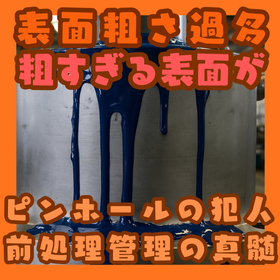
The overly rough surface was the culprit of the pinholes; the essence of pre-treatment management.

Are you noticing an increase in pinholes and film thickness variation after blast treatment? The excessive management of surface roughness may actually be the cause.

Surface roughness is important for improving adhesion, but being rough is not necessarily good. Excessive roughening can, on the contrary, lead to poor painting results. Particularly when the blasting pressure is too high, deep irregularities can form on the surface, preventing the paint from spreading evenly. As a result, air or solvents may remain trapped within the paint film, leading to pinholes or uneven film thickness. This is actually a point that is often overlooked. Excessive roughness affects not only adhesion failure but also appearance defects. Furthermore, it is common to manage blasting pressure at around 0.3 to 0.5 megapascals as a standard. Excessive projection can also lead to material deformation. A common misunderstanding in the field is the belief that "the rougher, the better the adhesion." By optimizing surface roughness, quality can often be stabilized. Actual improvement cases are also detailed in publicly available materials.

  • others
  • Pretreatment

Added to bookmarks

Bookmarks list

Bookmark has been removed

Bookmarks list

You can't add any more bookmarks

By registering as a member, you can increase the number of bookmarks you can save and organize them with labels.

Free membership registration

Insufficient surface treatment was the culprit behind the recurrence of rust, a warning of decreased adhesion.

Has rust reappeared after painting? The cause may not be the paint, but rather a decrease in adhesion due to insufficient surface treatment.

Surface treatment is a crucial process that affects the adhesion of the paint film and its corrosion resistance. However, in practice, there are many cases where it is judged that "there is no problem because cleaning is done before painting." In reality, insufficient degreasing or inadequate chemical treatment can lead to reduced adhesion of the paint film, allowing moisture and oxygen to infiltrate through tiny gaps, which can cause corrosion to progress within the paint film. This is particularly true for iron materials and zinc-coated materials, where insufficient surface treatment can easily lead to re-rusting. This is actually a point that is often overlooked. Poor adhesion may not be visible immediately after painting. Furthermore, in chemical treatment, there are cases where management is based on a liquid temperature of 35 to 50 degrees Celsius and a film weight of about 1 to 3 grams per square meter. Insufficient treatment can lead to peeling or pinholes. A common misconception on site is the belief that "rust prevention can be achieved solely through paint performance." By reviewing surface treatment conditions, there are many cases where re-rusting can be improved. Actual improvement cases are also detailed in publicly available materials.

  • others
  • Pretreatment

Added to bookmarks

Bookmarks list

Bookmark has been removed

Bookmarks list

You can't add any more bookmarks

By registering as a member, you can increase the number of bookmarks you can save and organize them with labels.

Free membership registration

Shredding Machine Series for Incineration Pretreatment and Biomass Raw Material Pretreatment

A series of crushers designed for general household waste, biomass materials, sewage sludge, industrial waste, bulky waste, etc. Selection can be made based on the type of material and processing volume.

At Helios Co., Ltd., we introduce a series of low-speed, high-torque crushers as a specialized manufacturer of crushing machines. You can choose from a wide range of products, including crushers adopted by most fluidized bed furnace manufacturers, industrial waste and bulky waste crushers, and small crushers for sewage sludge designed to be waterproof and dustproof. 【Product Lineup】 ■ Small dual-shaft crusher ■ Particle size adjustable crusher ■ Industrial waste and bulky waste crusher ■ Small single-shaft crusher ■ Bulky waste cutting machine ■ Dust feeding machine Please let us know the materials to be crushed, processing volume, and any challenges your company is considering. We will also provide information on equipment selection, customization, and optional products. Feel free to consult with us first.

  • Crusher
  • Pretreatment

Added to bookmarks

Bookmarks list

Bookmark has been removed

Bookmarks list

You can't add any more bookmarks

By registering as a member, you can increase the number of bookmarks you can save and organize them with labels.

Free membership registration

Revive Inline Sample Preprocessing (ILSP)

A rapid approach to the analysis of multi-residue pesticides in food! Reducing errors associated with manual procedures.

"Revive Inline Sample Preparation (ILSP)" utilizes the capabilities of LC-MS/MS to streamline and automate sample extract cleanup. By using the Revive ILSP pesticide cartridge, a 6-port valve, and an independent isocratic pump, it is possible to combine sample cleanup and separation detection into one efficient method, transforming the equipment into a mainstay of analysis. By integrating this into multi-residue pesticide analysis methods in food, it reduces sample preparation time, cuts costs associated with disposable sample preparation products, and minimizes errors related to manual procedures. [Features] ■ Significantly reduces preparation time ■ Conducts analysis and ILSP cartridge cleaning simultaneously, eliminating downtime between samples ■ A rapid and simple alternative to preparation methods such as QuEChERS and SPE ■ Minimizes costs associated with disposable preparation products and related waste ■ Reduces causes of errors and variability associated with manual cleanup *For more details, please refer to the PDF document or feel free to contact us.

  • Separation device
  • Pretreatment

Added to bookmarks

Bookmarks list

Bookmark has been removed

Bookmarks list

You can't add any more bookmarks

By registering as a member, you can increase the number of bookmarks you can save and organize them with labels.

Free membership registration

Inkjet Print Pre-treatment & Cleaning Machine 'DPW-1900'

For the fabric ironing finish required during printing! A 2-way design that performs two roles with one device.

The "DPW-1900" is a pre-treatment and cleaning machine suitable for fabric materials such as banners for inkjet printing. It features a 2WAY design that performs two functions in one unit, and can be freely customized according to the equipment environment. Please note that while this product is a model for pre-treatment + cleaning, we also offer models with only pre-treatment functionality or only cleaning functionality. Please inquire for more details. 【Features】 ■ Freely customizable according to the equipment environment ■ Capable of ironing finish required for the fabric during printing ■ Made-to-order product (90-day delivery after order) *For more details, please refer to the PDF materials or feel free to contact us.

  • Other cleaning machines
  • Pretreatment

Added to bookmarks

Bookmarks list

Bookmark has been removed

Bookmarks list

You can't add any more bookmarks

By registering as a member, you can increase the number of bookmarks you can save and organize them with labels.

Free membership registration

[Application Note] Chromosome Analysis Preprocessing HANABI Series

The HANABI series chromosome analysis pre-processing device can automate the chromosome analysis pre-processing steps that are currently performed manually, from cell harvesting to staining.

The HANABI series of chromosome analysis preprocessing devices from AD Estec Co., Ltd. automates the preprocessing steps in chromosome analysis, contributing to increased productivity in the inspection process and the prevention of human errors. Harvester: Automation of the cell harvesting process Spreader: Automation of the spreading process Stainer: Automation of the staining process We provide application notes (free) summarizing cases where the HANABI series has been used for chromosome analysis. If you are interested, we would appreciate it if you could contact us using the inquiry form below. Thank you very much.

  • Other bio-related products and services
  • Pretreatment

Added to bookmarks

Bookmarks list

Bookmark has been removed

Bookmarks list

You can't add any more bookmarks

By registering as a member, you can increase the number of bookmarks you can save and organize them with labels.

Free membership registration

Blast (Pearl finish processing - Satin finish processing)

Prevents color unevenness and poor adhesion! It can remove small scratches from metal surfaces.

"Blast" is a treatment primarily performed as a pre-treatment for anodizing, which can remove small scratches from metal surfaces. It enhances the luxurious finish of anodizing and can also prevent poor adhesion of the coating and color unevenness. Additionally, it may be performed for various purposes such as rust removal, cleaning, and polishing. [Features] ■ Prevents color unevenness and poor adhesion *For more details, please refer to the related links or feel free to contact us.

Added to bookmarks

Bookmarks list

Bookmark has been removed

Bookmarks list

You can't add any more bookmarks

By registering as a member, you can increase the number of bookmarks you can save and organize them with labels.

Free membership registration

How to prevent paint peeling? All about adhesion.

Preprocessing is everything about adhesion.

This explains the key points for improving poor adhesion, insufficient pre-treatment, degreasing, and drying conditions that can cause paint to peel. The reasons for peeling occurring some time after painting are not only due to insufficient pre-treatment but also due to trace amounts of moisture and oxidation films. Adhesion can vary significantly depending on humidity and the condition of the materials. It is important to understand the reasons why results differ even with the same process and to review the process accordingly. Poor painting cannot be improved with vague measures. Our company has published case study materials on improvements. Please take a look.

  • others
  • Pretreatment

Added to bookmarks

Bookmarks list

Bookmark has been removed

Bookmarks list

You can't add any more bookmarks

By registering as a member, you can increase the number of bookmarks you can save and organize them with labels.

Free membership registration

[Case Study of Conductive Diamond Technology] Pre-treatment for Plating on PPS Resin

Chrome-free, heavy metal-free resin plating pre-treatment technology

We would like to introduce a case study of conductive diamond technology that has realized an alternative to chromic acid used in the plating process of automotive parts. PPS is a super engineering plastic that is lightweight and excels in heat resistance, durability, and chemical resistance. However, since plastic transmits electromagnetic waves, when used for enclosures of electronic devices, it is necessary to form a metallic thin film on the surface to provide a shielding effect and prevent malfunctions caused by electromagnetic interference. Due to its high chemical resistance, PPS is a material that is very difficult to plate using conventional processes. However, by using an electrolytic treatment with a sulfuric acid solution as a pre-plating treatment, it is possible to achieve the formation of a highly adhesive plating layer. This technology uses a solution electrolyzed with a diamond electrode in sulfuric acid, making it a clean and environmentally friendly alternative technology that does not involve toxicity or waste. Additionally, since the sulfuric acid solution can be reused, it helps reduce wastewater. *For more details, please download the PDF or feel free to contact us.

  • Company:DIAM
  • Price:Other
  • Plating Equipment
  • Other surface treatment equipment
  • Electrical equipment parts
  • Pretreatment

Added to bookmarks

Bookmarks list

Bookmark has been removed

Bookmarks list

You can't add any more bookmarks

By registering as a member, you can increase the number of bookmarks you can save and organize them with labels.

Free membership registration

[Contracted Processing Service] Preprocessing

We provide MEMS contract processing services with our extensive knowledge and experience cultivated in semiconductor processing!

We would like to introduce the processing contract services offered by M.T.C Corporation. With our extensive knowledge and experience gained from semiconductor processing, we provide MEMS contract processing services, and we offer RCA cleaning in the pre-treatment process. Additionally, we also perform film deposition, photolithography, etching, electroplating, and bonding. Please feel free to contact us if you have any requests. 【Processing Details】 ■ Pre-treatment ■ Film deposition ■ Photolithography ■ Etching ■ Electroplating ■ Bonding *For more details, please download the PDF or feel free to contact us.

  • Company:M.T.C
  • Price:Other
  • Processing Contract
  • Pretreatment

Added to bookmarks

Bookmarks list

Bookmark has been removed

Bookmarks list

You can't add any more bookmarks

By registering as a member, you can increase the number of bookmarks you can save and organize them with labels.

Free membership registration

Pre-treatment for plating ABS resin with electrolytic sulfuric acid

Chrome-free, heavy metal-free resin plating pre-treatment technology

ABS resin is widely used for plating applications due to its excellent mechanical strength, impact resistance, and moldability, as well as its ability to achieve a beautiful metallic luster on the surface. In the conventional plating process for ABS resin, the resin surface is chemically etched with a solution containing hexavalent chromium as a pretreatment, which provides an essential anchor effect for strong adhesion of the plating layer. This hexavalent chromium is highly toxic and has significant environmental impact, leading to global regulatory restrictions on its use. In this technology, by using an electrolytic treatment with a sulfuric acid solution applied with a conductive diamond electrode as a pretreatment for plating, a fine uneven structure (anchor effect) is formed on the surface of the ABS resin, enabling the formation of a plating layer with high adhesion. This technology is expected to be a clean and environmentally friendly alternative that does not use any highly toxic chromic acid, thereby reducing the burden on both the working environment and the global environment. Additionally, since the sulfuric acid solution can be reused through repeated electrolytic treatment, it can significantly reduce wastewater compared to conventional processes.

  • Company:DIAM
  • Price:Other
  • Plating Equipment
  • Other surface treatment equipment
  • Pretreatment

Added to bookmarks

Bookmarks list

Bookmark has been removed

Bookmarks list

You can't add any more bookmarks

By registering as a member, you can increase the number of bookmarks you can save and organize them with labels.

Free membership registration

Biomass: Environmentally Friendly Biomass Pretreatment

No chemicals are used at all, and no solvents or dispersants, including water, are needed!

At Amorfast, we do not use any chemicals such as acids or alkalis, and since solvents and dispersants are also unnecessary, there are no waste liquids or by-products generated from the amorphization process. Amorphization can be achieved solely through grinding, making it an environmentally friendly biomass treatment compared to conventional methods. *For more detailed information, you can view the related links. For further details, please download the PDF or feel free to contact us.*

  • others
  • Pretreatment

Added to bookmarks

Bookmarks list

Bookmark has been removed

Bookmarks list

You can't add any more bookmarks

By registering as a member, you can increase the number of bookmarks you can save and organize them with labels.

Free membership registration