
![[RMA Type] Lead-Free Solder Paste](https://image.mono.ipros.com/public/product/image/68f/306759011/IPROS_11198596757090275000.jpg?w=280&h=280)
[RMA Type] Lead-Free Solder Paste
The use of a newly developed surfactant allows for sufficient wetting even in N2 reflow atmosphere.
Lead-free solder paste with reduced occurrence of solder balls.
- Company:松尾ハンダ 本社大和工場
- Price:Other
Last Updated: Aggregation Period:Sep 23, 2026~Oct 20, 2026
This ranking is based on the number of page views on our site.
Last Updated: Aggregation Period:Sep 23, 2026~Oct 20, 2026
This ranking is based on the number of page views on our site.
Last Updated: Aggregation Period:Sep 23, 2026~Oct 20, 2026
This ranking is based on the number of page views on our site.
121~150 item / All 291 items
The use of a newly developed surfactant allows for sufficient wetting even in N2 reflow atmosphere.
Lead-free solder paste with reduced occurrence of solder balls.

We have reduced the solder balls to the absolute minimum!!
Lead-free solder paste FLF01-BZ is developed based on the concept of achieving an excellent total balance, particularly aiming to bring the occurrence of solder balls as close to zero as possible. It demonstrates good wetting properties even on difficult substrates such as nickel, and provides a smooth texture similar to whipped cream, allowing for easy release from the squeegee and achieving good printability. For more details, please contact us or refer to the catalog.

This is a paste with three viscosity variations tailored to the target circuit width.
The conductive Ag paste "LS-453 series/LS-455-1" is designed for screen printing and can accommodate small quantities and a variety of products. There are three viscosity variations tailored to the desired circuit width. The polymer-type conductive paste can be used on ITO/PET films and has a wide range of applications, including touch panel switches, membrane circuit formation, and EL elements. 【Features】 ○ Suitable for screen printing with small quantities and a variety of products ○ Three viscosity variations tailored to the desired circuit width ○ Low resistance value For more details, please contact us or download the catalog.

We have a lineup of both high insulation types and high concealment types.
Asahi Chemical Research Institute Co., Ltd. provides electronic materials such as resist inks for printed circuit boards and silver and carbon pastes for touch panels and membrane substrates. The high insulation and high opacity black paste "CR-18CSL-CK/CCR-232C-S1" is available in both high insulation and high opacity types. 【Features】 ○ Available in both high insulation and high opacity types ○ CR-18CSL-CK ○ CCR-232C-S1 For more details, please contact us or download the catalog.

We have over 20 years of experience in carbon paste for contact points of rigid substrates and FPC, as well as for automotive sensor resistors.
Asahi Chemical Research Institute Co., Ltd. provides various carbon paste materials for rigid substrates and FPCs. The TU series meets various required characteristics according to applications and resistance values, such as contact resistors and internal resistors. The FTU series achieves low resistance and high adhesion for low-temperature and flexible substrates. The BTU series has numerous achievements as sliding sensor materials for automobiles that require high reliability.

This is a special report on "Wasabi Paste SPME-GCxGC-TOFM."
At LECO Japan, we will pick up samples that are expected to enhance the precision, efficiency, and safety of your analysis operations using LECO's analytical instruments and present them as a special report. Please take a look. If you would like to know whether similar samples can be applied, please feel free to contact us.

Silicone-based binder with stretchable functionality! Introducing the low elasticity stretch and molding series.
This document introduces the conductive paste "Dotaite" stretchable and moldable series. It includes "silicone-based stretchable paste" and "Ag/AgCl silicone-based stretchable paste" for medical devices, presented with charts and diagrams. Please feel free to download and take a look. [Contents] ■ Silicone-based stretchable paste ■ Ag/AgCl silicone-based stretchable paste ■ Polyurethane-based stretchable paste ■ Stretching characteristics ■ Paste for in-mold forming *For more details, please refer to the PDF document or feel free to contact us.
![Rust prevention coating "ZAP Paste" application example [Main body of transmission towers]](https://image.mono.ipros.com/public/product/image/79d/360201018/IPROS_16800720880553798000.jpg?w=280&h=280)
Coating-type anti-corrosion paste "ZAP Paste" Application example [Main body of transmission towers]
Coating-type anti-corrosion paste "ZAP Paste" that achieves a thick film and also has sacrificial corrosion protection properties. Application example: [Main body of transmission towers].
![Rust preventive coating "ZAP Paste" usage example [Piping in underground facilities]](https://image.mono.ipros.com/public/product/image/ff8/360201022/IPROS_10863027523144174000.jpg?w=280&h=280)
Coating-type anti-corrosion paste "ZAP Paste" application example [Piping in underground facilities]
A coating-type anti-corrosion paste that achieves a thick film and also possesses sacrificial corrosion protection properties.

Jet dispense paste compatible with high-speed ejection at a dot diameter of Φ150μm.
"winDot-F005-NP303" is a solder paste for fine jet dispensing that simultaneously achieves both fine application and meltability. It realizes one of the smallest application diameters in the world, with no clogging issues. It is suitable for components that cannot be printed, such as three-dimensional structures, as well as for fine components during simultaneous mounting of large and small parts, and for substrates that are difficult to print (such as those that warp or shrink). 【Application Products】 ■ MID components ■ Component mounting on cavity substrates ■ High-functionality modules ■ Component mounting on flexible substrates, etc. *For more details, please download the PDF or contact us.

Improved joint reliability compared to SAC305!
"SAB433-LHS-GQ-1" is a high-strength solder paste that suppresses crack propagation due to the addition of Bi and Sb, while maintaining melting characteristics and improving joint reliability compared to SAC305, thanks to the effects of the added elements. Please feel free to contact us if you have any inquiries. 【Basic Properties】 ■ Solder Composition: Sn-4Ag-3.3Sb-3Bi-1Cu-Ni-Ge ■ Melting Point (°C): 209–233 ■ Halide Content (wt%): ≦0.01 ■ Powder Type: Type 4 *For more details, please download the PDF or contact us.

Achieving an ultra-low void of 5% or less!
The "NP303-CQV-1K" is a solder paste that achieves ultra-low voiding compared to conventional pastes by significantly enhancing the fluidity of the flux. It is compatible with a variety of components and atmospheric reflow. Please feel free to contact us if you have any requests. 【Basic Characteristics】 ■Solder Composition: Sn-3.0Ag-0.5Cu ■Melting Point (°C): 217–219 ■Halide Content (wt%): 0.06±0.02 ■Powder Type: Type 4 *For more details, please download the PDF or contact us.

It enables the manufacturing of power modules with a Tjmax of over 200℃, contributing to improved reliability of chip bonding and overall cost reduction.
The lack of suitable solder materials has previously excluded high melting point lead-free solder from serious consideration, but this is finally changing. At the same time, there is a demand for bonding materials that can maximize the capabilities of next-generation power semiconductors. Alpha Argomax sinter paste is a bonding material that can meet both of these challenging requirements. We are also focusing on the development of high thermal conductivity epoxy paste. The demand for improved reliability and cost-effective high-volume manufacturing (HVM) of die attach has never been higher. With environmentally friendly Argomax technology, it is possible to create low-pressure sintered die attachments based on highly engineered particles. Argomax creates silver bonds with very high thermal and electrical conductivity, providing high reliability and flexible bonding lines. It enables the manufacturing of SiC/GaN power modules/devices with a Tjmax of over 200°C, contributing to improved reliability of chip bonding and reduced total costs. It can also accommodate the lead-free transition for high-reliability bonds. We offer a variety of pastes, films, and preforms tailored to specific applications.


In paint, in printing, in gunpowder.
Aluminum paste is an aluminum pigment made by crushing and grinding high-purity aluminum powder or foil into very thin, flake-like particles. Toyo Aluminum's aluminum paste has a flake shape and particle size that are well controlled, allowing for uniform distribution within the coating, which provides excellent protection against rust and other damages while also achieving a beautiful appearance, making it ideal as a pigment for paints and printing inks. In high-end metallic automotive coatings, a deep luster is achieved.

Can form an aluminum layer without selecting a substrate! For electrode formation! For heat dissipation!
This is a conductive paste (aluminum paste, aluminum ink) using aluminum powder. It can be printed or coated on various substrates where aluminum adhesion has been difficult until now! By firing, an aluminum layer can be formed, exhibiting excellent conductivity and heat dissipation. Recommended firing temperature: 550°C to 610°C [Features] ◆ Adheres to ceramics, glass, metals, MMD/CMC, and everything else. (Examples: alumina, aluminum nitride, barium titanate, etc.) ◆ Easily applicable by screen printing, dip coating, etc. ◆ Can be fired in the atmosphere. ◆ Lead-free and silver-free. It is friendly to both the human body and cost. [Search Keywords] #ExternalElectrode #AtmosphericEnvironment #ScreenPrinting #DipCoating #ConductiveAluminumPaste #FormationOfAluminumLayerOnCeramics #FormationOfAluminumLayerOnCeramics #Firing #Sintering #WithCeramics #WithMetals #WithMMC #WithCMC #WithGlass #AluminumInk
![[In Progress] Column: Brazing "The Science and Aesthetics of Joining"](https://image.mono.ipros.com/public/product/image/1eb/2001526726/IPROS13785055470274568367.png?w=280&h=280)
[Currently Serializing!] A Casual Column on Brazing
"About brazing" - Brazing is one of the methods for joining metals. - It uses a filler material with a lower melting point than the base metal, allowing the filler to be melted and joined without melting the base metal. - In the case of aluminum, due to its lightweight and high thermal conductivity, it is widely used in many components in fields such as aerospace and automotive, including heat exchangers and heat sinks. As professionals in aluminum, we provide materials suitable for aluminum brazing. We are currently publishing a series of columns on brazing that you can read casually! Enjoy it as a companion during your coffee break♪
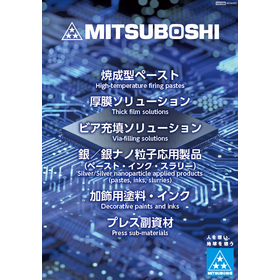
Introducing a rich lineup from sintered molded paste to silver/silver nanoparticle application products and press auxiliary materials!
This catalog introduces the product lineup of the Electronic Materials Division of Mitsuboshi Belt Co., Ltd. It features a variety of sintered pastes, including conductor pastes (Ag-based/Cu-based) and CuNi resistance pastes, as well as thick film solutions such as laminated copper printed circuit boards (TPC) and via filling solutions. Each product is clearly summarized with its features, reliability data, specifications, and substrate composition. We encourage you to download and take a look. [Contents] ■ Sintered pastes ■ Thick film solutions ■ Via filling solutions ■ Silver/silver nanoparticle application products (pastes, inks, slurries) ■ Decorative paints and inks ■ Press auxiliary materials *For more details, please download the PDF or feel free to contact us.

Excellent heat resistance and corrosion resistance, making it ideal for complex shapes such as heat exchangers!
It can be used in a wide range of fields such as aviation, automobiles, home appliances, and various heat exchangers! It has excellent heat resistance, corrosion resistance, and high-temperature strength, maintaining stable properties with minimized separation and alteration. Additionally, it is suitable for vacuum furnaces and hydrogen furnaces, and is compatible with dispensers and automatic coating devices. Furthermore, we also respond to automation needs. ● For more details, please download the catalog or contact us.
![[Video Available] Graphite-based Stretchable Conductive Paste](https://image.mono.ipros.com/public/product/image/679/2000247270/IPROS6242917343556154563.jpg?w=280&h=280)
Graphite-based stretchable conductive paste combines stretchable resin with graphite and CNT, allowing for repeated stretching.
We have developed a conductive paste that combines stretchable resin with graphite and CNT, which maintains conductivity through repeated stretching and changes its electrical resistance with stretching. ◎ Volume resistivity: 30Ω·cm² At a length of 2 cm, width of 3 mm, and thickness of 0.2 mm, it has a resistance of about 5 kΩ. ※ Viscosity: 3–5 PS (Not suitable for inkjet printing; intended for dispenser or screen printing) ※ Resistance change rate is approximately three times, and the coefficient of variation is undetermined. ※ The maximum operating temperature currently is 120°C. ⇒ Applications include resistance change sensors, contact sensors, etc. ● Advantages of using graphite-based materials: Conductive inks and paste materials such as nano-metal-based, carbon nanotube (CNT) based, and carbon microparticle-based materials: 1. High performance is expected, but processing and manufacturing methods are expensive, making it difficult for material prices to be low. 2. If graphite-based powder, which is produced in large quantities as a byproduct of carbon fiber, can be used as a conductive material, it would enable the creation of inexpensive pastes. 3. Our company has developed a conductive paste with a basic structure where long CNTs are wrapped around graphite-based fibers. 4. By intertwining both materials in a state that allows for continuous stretching and contracting, the stretchable conductor function is maintained.

The latest version of the Paint Improvement Series SCP-3 is now on sale. Contributes to energy saving!
We have successfully formulated SCP-2 with safer and more reliable ingredients while maintaining its functional performance. Simply applying it to your current cartridge heaters, space heaters, and band heaters will improve their lifespan. If heaters last longer, waste will be reduced. It is also possible to fill gaps for heat conduction. If you want to transfer heat from copper to iron, inserting SCP-3 (thermal conductive paste) will facilitate heat transfer. There seem to be various other potential uses as well...

Improving the issues of conventional lead-free paste from every aspect!
"TM-HP" is a solder paste that improves upon various issues of conventional lead-free pastes, such as continuous printability, flux spattering, and high-temperature preheating. It offers excellent continuous printability, minimizes viscosity increase over time, and ensures stable supply. Additionally, the reliability of the flux is high, allowing for safe use even without cleaning. Furthermore, it features improved thermal resistance of the flux, preventing incomplete melting and the occurrence of solder balls on very small lands, among other characteristics. 【Features】 - Compatible with high-temperature preheating - Improved thermal resistance of the flux - Prevents incomplete melting and solder ball formation on very small lands - High reliability of the flux, safe for use without cleaning *For more details, please refer to the catalog or feel free to contact us.

Solder paste that improves continuous printability and wettability!
The "LFM-48 SUC" is a solder paste that provides excellent wetting on components even in atmospheric reflow, forming stable fillets. By reducing the use of N2, it can significantly lower running costs and power consumption, contributing to CO2 reduction. It is ideal for switching from Sn-Ag-Cu/N2 reflow to atmospheric reflow, especially for components and substrates with poor wettability. 【Features】 ■ Stable continuous printability ■ Good wetting on metals such as Ni, effective for preventing non-wetting in BGA ■ Ensures reliability of the flux ■ Can be safely used without cleaning in a wide range of products *For more details, please refer to the catalog or feel free to contact us.

This is a halogen-free solder paste that significantly improves wettability!
The "LFM-48 NH Series" is a non-halogen solder paste that does not compromise the workability of conventional lead-free solder. It significantly improves the wettability issues that have been problematic with halogen-free products, ensuring wettability comparable to traditional halogen-based products. Additionally, it addresses the issue of unmelted particles due to oxidation during preheating with fine powders, enabling stable soldering. 【Features】 ■ Non-halogen ■ Significantly improved wettability ■ Excellent meltability ■ Enables stable soldering ■ Environmentally considerate product *For more details, please refer to the catalog or feel free to contact us.

Solder paste that supports high-difficulty printing, achieving improved production efficiency!
The "LFM-48 SSK-V" is a solder paste designed for high-difficulty printing. It suppresses clogging of the metal mask and bleeding on the backside, significantly reducing the number of cleaning cycles. It enables high-speed printing on flexible substrates, improving the quality and production efficiency of the assembly line. 【Features】 ■ Supports high-difficulty printing ■ Excellent printing characteristics ■ Improved production efficiency *For more details, please refer to the catalog or feel free to contact us.

A sticky paste made from Kishu plums.
"Ume Paste A" is a viscous paste made from the flesh of plums that have been salted after extracting the juice through frozen pressing. It uses plums from Kishu. The capacity is 20kg, available in a one-gallon can or cardboard box with dimensions of 23.4cm (length) x 23.4cm (width) x 35.0cm (height). In addition to this product, we offer a wide variety of ume juice and processed products. Please feel free to contact us. 【Features】 ■ Uses Kishu or domestically produced plums ■ Juice extracted using a unique method and concentrated to 1/13 ■ Paste *For more details, please refer to the catalog or feel free to contact us.
