We have compiled a list of manufacturers, distributors, product information, reference prices, and rankings for Construction method.
ipros is IPROS GMS IPROS One of the largest technical database sites in Japan that collects information on.

Construction method Product List and Ranking from 113 Manufacturers, Suppliers and Companies | IPROS GMS

Last Updated: Aggregation Period:Jan 28, 2026~Feb 24, 2026
This ranking is based on the number of page views on our site.

Construction method Manufacturer, Suppliers and Company Rankings

Last Updated: Aggregation Period:Jan 28, 2026~Feb 24, 2026
This ranking is based on the number of page views on our site.

  1. 三和グランド Tokyo//Building materials, supplies and fixtures
  2. 第一カッター興業 本社 Kanagawa//others
  3. メインマーク 【全国対応】/東京・大阪・札幌・仙台・新潟・金沢・名古屋・福岡 Tokyo//Building materials, supplies and fixtures
  4. 4 E&Dテクノデザイン Aichi//Testing, Analysis and Measurement
  5. 4 シャープ化学工業 大阪本社 Osaka//Chemical

Construction method Product ranking

Last Updated: Aggregation Period:Jan 28, 2026~Feb 24, 2026
This ranking is based on the number of page views on our site.

  1. Sticking Prevention TOP Treatment Series ツー・ナイン・ジャパン
  2. Dry peel-off service スリーエーシステム
  3. No paint leaks from the gaps in the protective covering! Edge painting protective method LCL method. シャープ化学工業 大阪本社
  4. Flare welding 北陸ガス圧接
  5. 4 "Net Barrier Method P1" that requires less effort than conventional pin nets. リノテック

Construction method Product List

241~270 item / All 351 items

Displayed results

Support for seismic reinforcement and pier construction! "Temporary Closure LPF Method" *Case study collection available.

Construction is possible even with a headroom limit of 1.5m or less! Achieves excellent water stopping performance with simplicity and speed!

The "Temporary Closure LPF Method" is a construction method for building temporary closures for underwater structures such as rivers, seas, and dams using liner plates. It addresses the issues of conventional closure methods and supports bridge pier reinforcement with "simplicity, speed, and excellent water-stopping capability." It can be implemented using only manual labor. This groundbreaking NETIS-registered method can be used in environments with a headroom restriction of 1.5 meters or less! Please feel free to contact us for more information! *Currently, we are offering a collection of case studies featuring the construction results of the "Temporary Closure LPF Method" for free exclusively to Ipros users! 【Features】 ■ Composed of liner plates (waterproof specifications), water-stopping rubber gaskets, H steel (reinforcement rings), and cutting beams ■ Can be constructed using only manual labor! ■ Construction is possible with a headroom restriction of approximately 1.5 meters! ■ Vibration-free, allowing construction close to existing structures (gas, electricity, water pipes, etc.)! ■ NETIS registration: CB-110010-VE (patented) *For more details, please refer to the catalog. Feel free to contact us as well.

  • others
  • Construction method

Added to bookmarks

Bookmarks list

Bookmark has been removed

Bookmarks list

You can't add any more bookmarks

By registering as a member, you can increase the number of bookmarks you can save and organize them with labels.

Free membership registration

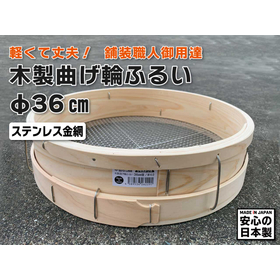
Wooden bending sieve 36cm

It is a lightweight and durable sieve improved for paving work.

■ Anyway, it's lightweight! Weighs only 600g. ■ Durable and long-lasting! Reinforcements have been added in various places to withstand heavy use. ■ Handmade by artisans Specialized craftsmen carefully handcraft each piece with dedication.

  • Other work tools
  • Construction method

Added to bookmarks

Bookmarks list

Bookmark has been removed

Bookmarks list

You can't add any more bookmarks

By registering as a member, you can increase the number of bookmarks you can save and organize them with labels.

Free membership registration

Telescopic gauge rod

Adjustable telescopic with freely adjustable length.

You can measure the pavement thickness while remaining on the finisher! It is conveniently portable and can be extended up to a maximum of 126 cm, allowing you to measure the pavement thickness from above the finisher.

  • Other work tools
  • Construction method

Added to bookmarks

Bookmarks list

Bookmark has been removed

Bookmarks list

You can't add any more bookmarks

By registering as a member, you can increase the number of bookmarks you can save and organize them with labels.

Free membership registration

Permeable soil-based slag paving material "Eternal Sand"

Earth-based slag pavement that solves the weaknesses of earth-based pavement.

By using blast furnace crushed slag as the main aggregate, we have eliminated the peeling and flaking that were seen in the initial stages of conventional earth pavements. The durability is also excellent due to the slag's "latent hydraulicity" (a characteristic where strength increases over time due to hydration reactions). It has a natural color and texture similar to soil, without the artificial impression often seen in asphalt or resin-based materials. It also excels in functions such as permeability, water retention, and slip resistance. 【Features】 ■ Main composition of blast furnace crushed slag mixed with sandy soil ■ Resistant to water overflow on the surface, accommodating heavy rainfall of 30mm/h ■ Mitigates the heat island effect through evaporation from the surface ■ Provides moisture to trees and flowers through evaporation, promoting growth ■ Universal design that is easy for anyone to walk on ■ Extended lifespan compared to conventional paving materials ■ Reduces the extraction of natural materials by using artificial aggregates (recycled materials) *For more details, please refer to the PDF document or feel free to contact us.

  • others
  • Construction method

Added to bookmarks

Bookmarks list

Bookmark has been removed

Bookmarks list

You can't add any more bookmarks

By registering as a member, you can increase the number of bookmarks you can save and organize them with labels.

Free membership registration

Environmentally-friendly high furnace slag weed control method "Glassless Sand"

The characteristics of blast furnace slag provide long-lasting weed control! A rich variety of colors harmonizes with the landscape!

"Glassless Sand" is a weed control method that involves spreading a pavement material made by mixing blast furnace water-quenched slag as aggregate with cement and admixtures within a formwork, and then compacting it to a specified thickness. By utilizing the latent hydraulic properties of blast furnace slag, it can sustain weed control effects in a long-term and stable manner, ensuring a good landscape and visibility, as well as preventing the occurrence of pests, thereby maintaining a comfortable living environment. Additionally, by allowing rainwater to permeate through the surface of the weed control work and return to the ground, it contributes to the prevention of global warming and the reduction of environmental impact. [Features] ■ Contributes to the sanitary environment for residents living in the area through weed control work ■ Environmentally oriented with a rich variety of color options, considering landscape aesthetics ■ Contributes to the prevention of global warming and the reduction of environmental impact *For more details, please refer to the PDF materials or feel free to contact us.

  • others
  • Construction method

Added to bookmarks

Bookmarks list

Bookmark has been removed

Bookmarks list

You can't add any more bookmarks

By registering as a member, you can increase the number of bookmarks you can save and organize them with labels.

Free membership registration

[Case Study] Color Sand (Famous Cherry Blossom Spot)

Introducing a case where permeable and water-retaining paving material "Color Sand" has been adopted at a famous cherry blossom spot!

Our permeable and water-retentive paving material "Color Sand" has been adopted in many famous cherry blossom spots. At the "Chidorigafuchi Greenway" in Chiyoda Ward, Tokyo, our product's high permeability and water retention provide moisture to approximately 260 cherry trees planted along the 700-meter-long promenade. Additionally, at "Gongendo Park" in Satte City, Saitama Prefecture, our light brown product enhances the natural color contrast between the pink cherry blossoms and yellow rapeseed flowers. [Examples] - Gongendo Park (Satte City, Saitama Prefecture) - Sagami River (Atsugi City, Kanagawa Prefecture) - Karasumori Park (Fujisawa City, Kanagawa Prefecture) - Kashio River (Yokohama City, Kanagawa Prefecture) - Akamagawa Irrigation (Iruma City, Saitama Prefecture) - Chidorigafuchi Greenway (Chiyoda Ward, Tokyo) *For more details, please refer to the PDF materials or feel free to contact us.

  • others
  • Construction method

Added to bookmarks

Bookmarks list

Bookmark has been removed

Bookmarks list

You can't add any more bookmarks

By registering as a member, you can increase the number of bookmarks you can save and organize them with labels.

Free membership registration

[Case Study] Color Sand (Tohoku Reconstruction)

Introducing a case where permeable and water-retaining pavement material "Color Sand" was adopted in the Tohoku reconstruction group relocation site!

The permeable and water-retaining paving material "Color Sand" is playing an active role in the "Tohoku Reconstruction." In the Tamaupa West area of Iwanuma City, Miyagi Prefecture, the land development work for the reconstruction group relocation site has been completed, and the construction of new homes is progressing. Approximately 4,000 m² of this product has been used for pathways in parks and sidewalks around retention basins. The paving of this product provides a comfortable and safe walking experience for the elderly and those with disabilities, excelling in barrier-free design. Additionally, it is resistant to freeze damage (freeze-thaw cycles), and there are sites in the Tohoku region that have been in use for over 10 years without any issues. [Case Study] ■ Reconstruction group relocation site (Tamaupa West area, Iwanuma City, Miyagi Prefecture) ■ Approximately 4,000 m² used for pathways in parks and sidewalks around retention basins ■ Paving that excels in barrier-free design *For more details, please refer to the PDF materials or feel free to contact us.

  • others
  • Construction method

Added to bookmarks

Bookmarks list

Bookmark has been removed

Bookmarks list

You can't add any more bookmarks

By registering as a member, you can increase the number of bookmarks you can save and organize them with labels.

Free membership registration

[Case Study] Sumida Hokusai Museum

Introducing examples of the use of the paving material "Color Sand."

The Sumida Hokusai Museum, which exhibits works by Katsushika Hokusai associated with Sumida Ward in Tokyo, has adopted the permeable and moisture-retaining paving material "Color Sand." In conjunction with the silver-glimmering exterior walls of the museum, the Color Sand on the museum side is a custom gray color. Please refer to the catalog for other case studies. 【Features】 ■ The Color Sand on the museum side is a custom gray color ■ Consistency with the cool impression of the museum *For more details, please refer to the PDF document or feel free to contact us.

  • others
  • Construction method

Added to bookmarks

Bookmarks list

Bookmark has been removed

Bookmarks list

You can't add any more bookmarks

By registering as a member, you can increase the number of bookmarks you can save and organize them with labels.

Free membership registration

[Case Study] Color Sand (Tsukishima River Greenway)

A bright promenade where you can enjoy the scenery and cherry blossoms! Introducing a case study on the use of permeable and water-retaining paving material "Color Sand."

In Chuo Ward, Tokyo, our permeable and moisture-retaining paving material 'Color Sand' has been adopted for the "Tsukishima River Greenway." The "Tsukishima River Greenway," which used to be dark and somewhat worn, has been transformed into a bright promenade where visitors can enjoy the riverside scenery and cherry blossoms after renovation. 【Benefits of Adoption】 ■ Disperses direct heat, reducing glare even on hot days ■ The fine texture of the surface makes it less slippery even in the rain ■ No water splashing, making it easy to walk on even when the surface is wet ■ Provides a soft walking sensation, reducing strain on the legs and back ■ Color options that harmonize with the surrounding landscape can be chosen *For more details, please refer to the PDF materials or feel free to contact us.

  • others
  • Construction method

Added to bookmarks

Bookmarks list

Bookmark has been removed

Bookmarks list

You can't add any more bookmarks

By registering as a member, you can increase the number of bookmarks you can save and organize them with labels.

Free membership registration

[Case Study] Color Sand (Yokosuka Shobu Park)

Introducing examples of the use of permeable and water-retaining paving material "Color Sand" for creating garden paths that are less prone to puddles and easy to walk on!

In Yokosuka City, Kanagawa Prefecture, our permeable and water-retaining paving material "Color Sand" has been adopted at the "Yokosuka Iris Garden." Opened in 1988, the "Yokosuka Iris Garden" had severe deterioration of its existing path paving, and it has now been renewed with our products. It is utilized as a path that is easy to walk on, even on rainy days, as it is less prone to puddles. In addition to irises, the garden also features wisteria, rhododendrons, and water lilies, providing enjoyment throughout the year. 【Benefits of Adoption】 ■ Disperses direct heat, reducing glare even in hot weather ■ The fine texture of the surface makes it less slippery even when it rains ■ No water splashes, making it easy to walk on even when the surface is wet ■ Provides a soft walking sensation, reducing strain on the legs and back ■ Color options that harmonize with the surrounding landscape can be selected *For more details, please refer to the PDF materials or feel free to contact us.

  • others
  • Construction method

Added to bookmarks

Bookmarks list

Bookmark has been removed

Bookmarks list

You can't add any more bookmarks

By registering as a member, you can increase the number of bookmarks you can save and organize them with labels.

Free membership registration

[Case Study] Color Sand (Shakujii River)

Bright and comfortable walkways even on rainy days! Introducing examples of the use of permeable and water-retaining paving material "Color Sand."

The walking path along the "Shakujii River" in Tokyo has adopted our permeable and water-retaining paving material, "Color Sand." Before the installation, when it rained, many people walked on the roadway due to poor footing, raising safety concerns. After the installation, even when it rains, puddles do not form, allowing for comfortable walking. As a result, the number of people walking on the roadway has decreased, which has pleased the local government officials. 【Benefits of Adoption】 ■ Disperses direct heat, reducing glare even on hot days ■ The surface has fine bumps, making it less slippery even in the rain ■ No water splashes, making it easy to walk on even when the surface is wet ■ Provides a soft walking sensation, reducing strain on the legs and back ■ Color options that harmonize with the surrounding landscape can be chosen *For more details, please refer to the PDF document or feel free to contact us.

  • others
  • Construction method

Added to bookmarks

Bookmarks list

Bookmark has been removed

Bookmarks list

You can't add any more bookmarks

By registering as a member, you can increase the number of bookmarks you can save and organize them with labels.

Free membership registration

Reasons why colored sand is strong against "freeze-thaw" cycles.

Introducing technical information about permeable blast furnace slag pavement "Color Sand"!

This document explains the reasons why "permeable and water-retaining pavement materials (color sand)" are strong against "freeze-thaw" cycles. Color sand is a pedestrian pavement material that possesses permeable and water-retaining functions while being sufficiently resistant to the repeated effects of freeze-thaw cycles during winter, making it "strong against frost damage." Among our pavement composition, the "filter layer" made from high furnace slag pavement, when used alone, has a significant effect in suppressing "frost heave phenomena." Furthermore, in freeze-thaw tests conducted at the Central Testing Laboratory of the Building Materials Testing Center, no cracking or destruction occurred even after completing 200 cycles. 【Excellent Features of the Aggregate (High Furnace Slag)】 ■ Porous Structure - Numerous fine voids release pressure caused by volume expansion during freezing. ■ Potential Hydraulic Properties - The main components of water-cooled slag (silica, alumina, lime, magnesia) solidify over time due to repeated water penetration. ◎ Sufficiently resistant to the repeated effects of freeze-thaw cycles. *For more details, please refer to the PDF materials or external link pages, or feel free to contact us.

  • others
  • Construction method

Added to bookmarks

Bookmarks list

Bookmark has been removed

Bookmarks list

You can't add any more bookmarks

By registering as a member, you can increase the number of bookmarks you can save and organize them with labels.

Free membership registration

The technical basis of "permeable blast furnace slag pavement" that balances permeability and water retention.

Introducing technical information about permeable and water-retaining blast furnace slag pavement "Color Sand"!

We will explain the technical basis of the "Permeable and Water-retaining Blast Furnace Slag Pavement (Color Sand)" that achieves both permeability and water retention. All of our paving materials use "water-quenched blast furnace slag" as the main aggregate. The aggregate itself has a fine porous structure, allowing it to provide both permeability and water retention. While typical permeable paving materials allow water to pass through at "points," our paving materials enable permeability across "surfaces" due to the nature of the aggregate itself, resulting in less clogging and maintaining permeability performance over a long period. Additionally, by cleaning with high-pressure washers, the permeability can be restored to about 80%. Further explanations regarding "permeability performance" and "water retention performance" can be found through external links. 【Introduction to Technical Information】 ■ Reasons for achieving both permeability and water retention ■ Permeability performance ■ Water retention performance ■ Our product lineup *For more details, please refer to the PDF materials or external link pages, or feel free to contact us.

  • others
  • Construction method

Added to bookmarks

Bookmarks list

Bookmark has been removed

Bookmarks list

You can't add any more bookmarks

By registering as a member, you can increase the number of bookmarks you can save and organize them with labels.

Free membership registration

About the characteristics and benefits of blast furnace crushed slag used in colored sand.

Introducing technical information about permeable blast furnace slag pavement "Color Sand"!

This document explains the characteristics and benefits of the blast furnace crushed slag used in "permeable blast furnace slag pavement (color sand)." The "blast furnace crushed slag" used as aggregate in our paving materials is a byproduct generated simultaneously when producing pig iron from a blast furnace at major steel manufacturers. It can be easily separated as it floats on top of the molten pig iron. In addition to contributing to environmental load reduction, it has characteristics such as excellent gradation balance due to its uniform particle size. Further explanations on topics such as "What is steel slag?" and "Characteristics and general uses of blast furnace slag" can be found through external links. 【Technical Information Introduction】 ■ What is "steel slag"? ■ Characteristics and general uses of "blast furnace slag" ■ Reasons for adopting "blast furnace crushed slag" - Environmental load reduction, porous shape, latent hydraulicity, high internal friction angle, uniform particle size, safety *For more details, please refer to the PDF materials or external link pages, or feel free to contact us.

  • others
  • Construction method

Added to bookmarks

Bookmarks list

Bookmark has been removed

Bookmarks list

You can't add any more bookmarks

By registering as a member, you can increase the number of bookmarks you can save and organize them with labels.

Free membership registration

Permeable pavement and water-retaining pavement materials [Case study: Nishitokofun group]

Introducing examples of the adoption of permeable and water-retaining pavement material "Color Sand"! <Nishitokofun Group (Saitama Prefecture)> *Constructed in 1998

One of the three burial mound groups in Moroyama Town, Saitama Prefecture, is the Nishito Burial Mound Group, where permeable and water-retaining colored sand paving materials have been adopted for the Nishito No. 2 mound. A quarter of a century has passed since the construction, but there has not been significant damage, and it is still in use as an active pavement.

  • others
  • Construction method

Added to bookmarks

Bookmarks list

Bookmark has been removed

Bookmarks list

You can't add any more bookmarks

By registering as a member, you can increase the number of bookmarks you can save and organize them with labels.

Free membership registration

Permeable pavement and water-retaining pavement materials [Case study: Wadahori Greenway, Nerima Ward]

Introducing examples of the adoption of permeable and water-retaining pavement material "Color Sand"! <Wadahori Greenway, Nerima Ward (Tokyo)> *Constructed in 2023

In the Wadahori Greenway located in Nerima Ward, Tokyo, permeable pavement and water-retaining colored sand have been adopted. Previously, the greenway had a dark atmosphere, but with the complete renewal, it has transformed into a bright and easy-to-walk path.

  • others
  • Construction method

Added to bookmarks

Bookmarks list

Bookmark has been removed

Bookmarks list

You can't add any more bookmarks

By registering as a member, you can increase the number of bookmarks you can save and organize them with labels.

Free membership registration

Solar panel mounting anchor "Land Stitch Bear" *Exhibited at the trade show

No need for large tools! Securely anchors screw piles even on soft ground, reaching the support layer.

The "Land Stitch Anchor" is an anchor developed for wildlife damage prevention fences. This anchor, boasting exceptional tensile strength, is now being proposed for securing solar equipment foundation piles (ground screw piles)! It is driven into the supporting layer with a dedicated driving rod, and when the wire is pulled, the anchor rotates horizontally underground and secures itself, allowing for use regardless of the depth of the supporting layer. We are also offering <pull-out strength experimental data> available for download in PDF format. 【Features】 ■ Usable regardless of soil hardness or depth of supporting layer ■ More securely anchors screw piles to the ground ■ Suitable for soft ground and sloped areas ■ Low cost with high performance ■ Utility model registered [No. 3187753] ★ We will be exhibiting at the Kansai Solar Power Generation System Construction Exhibition! * For more details on the "Land Stitch Anchor," please refer to the PDF. Feel free to contact us with any inquiries.

  • others
  • Construction method

Added to bookmarks

Bookmarks list

Bookmark has been removed

Bookmarks list

You can't add any more bookmarks

By registering as a member, you can increase the number of bookmarks you can save and organize them with labels.

Free membership registration

Land Stitch Anchor for securing air conditioning outdoor units.

First adoption in typhoon-prone Okinawa! Prevents outdoor unit from tipping over while allowing for removal during inspection and repair!

The "Land Stitch Anchor" is a product that firmly secures objects to the ground by driving anchors down to the support layer. After driving the anchor to the support layer, pulling the wire causes the anchor to rotate horizontally, increasing the contact resistance with the soil, ensuring a secure fixation. It has excellent pull-out strength and can be considered for various applications where measures against strong winds, such as typhoons, are essential! 【Features of the Air Conditioner Fixing Proposal】 ■ The outdoor unit is secured with two wires. → A protective tube is used at the contact points with the outdoor unit to prevent burden on the unit itself. ■ Flexibly accommodates the need to open the cover during repairs or maintenance of the outdoor unit. → The component configuration that allows for the removal of the wire is a must-see. ■ First adopted in Okinawa, which frequently experiences typhoons, and has become a topic in the Okinawa Construction Newspaper.

Added to bookmarks

Bookmarks list

Bookmark has been removed

Bookmarks list

You can't add any more bookmarks

By registering as a member, you can increase the number of bookmarks you can save and organize them with labels.

Free membership registration

Construction method "ECOKE"

Moss will become a new insulation material for buildings! There’s still time for green energy-saving measures!

"ECOKE" is a moss greening and insulation system method that allows for the greening of various buildings such as factories, apartments, and public facilities at a low cost. It exhibits numerous excellent features, including high heat resistance and ultra-lightweight properties. It can be easily installed in various locations such as roofs and rooftops, and maintenance is also simple. It contributes to indoor temperature control, reduction of air conditioning costs, and inclusion of green space in factory location laws. [Features] - Enhancement of corporate image through greening - Reduction of air conditioning costs - Prevention of heatstroke - Prevention of building deterioration - Creation of a calming space *For more details, please refer to the catalog or feel free to contact us.

  • Other environmental measures and recycling
  • Construction method

Added to bookmarks

Bookmarks list

Bookmark has been removed

Bookmarks list

You can't add any more bookmarks

By registering as a member, you can increase the number of bookmarks you can save and organize them with labels.

Free membership registration

Improved Ground Improvement Method "WIB Method" [Helpful Materials Available!]

Simultaneously achieve environmental vibration reduction and liquefaction prevention in transportation, factories, and construction! Reliable technology for safety measures! Our company's unique improved ground construction method.

E&D Tech Design Co., Ltd.'s "WIB Method" is an improved ground construction technique that reduces environmental vibrations from traffic, factories, and construction, as well as seismic shaking, while addressing liquefaction issues and enhancing and stabilizing the bearing capacity of weak ground. By using a rigid cell-type plate or wall structure, it simultaneously achieves liquefaction prevention and differential settlement prevention, allowing for overall cost reduction. Additionally, it can also address micro-vibrations that interfere with the operation of precision machinery and medical devices in high-tech industries. 【Features】 ■ Liquefaction prevention through strain suppression of the ground using a cell-form structure ■ Differential settlement prevention through improved horizontal bearing capacity of the ground using a plate structure ■ Prediction and design of vibration reduction values based on ground surveys, achieving set targets ■ Recipient of the Minister of Education, Culture, Sports, Science and Technology Award for Scientific and Technological Achievement in 2011 ■ Capable of addressing micro-vibrations that affect medical devices *For more details, please refer to the catalog or feel free to contact us.

  • Other services
  • others
  • Construction method

Added to bookmarks

Bookmarks list

Bookmark has been removed

Bookmarks list

You can't add any more bookmarks

By registering as a member, you can increase the number of bookmarks you can save and organize them with labels.

Free membership registration

Vibration Control WIB Method

Eliminate vibration issues and create a comfortable living environment! Here are some examples of our achievements in vibration control.

Various vibrations from road traffic, railways, factories, and construction work exist around us. These vibrations are often perceived as unpleasant and can negatively impact daily life. The "Vibration Mitigation WIB Method" addresses these vibration issues and creates a comfortable living environment. Additionally, the installation location and shape can be selected according to each property. 【Summary of Achievements (Partial)】 ■ Vibration Source: Road Traffic Vibration ■ Installation Location: Directly beneath the vibration source ■ WIB Method Type: Plate-type WIB Method (Honeycomb Cell Type) ■ Issue: Vibrations from large vehicles passing on the road propagate to nearby residences, leading to vibration complaints ■ Response: Road improvement work was carried out, and a honeycomb cell type plate WIB method was installed directly beneath the road. *For more details, please refer to the PDF document or feel free to contact us.

  • Other services
  • others
  • Construction method

Added to bookmarks

Bookmarks list

Bookmark has been removed

Bookmarks list

You can't add any more bookmarks

By registering as a member, you can increase the number of bookmarks you can save and organize them with labels.

Free membership registration

[WIB Construction Method Case Study] Measures Against Machine Vibration in Manufacturing Plants

Improvement of the working environment! Introduction of a construction case where tire shred made of high-damping material was filled in the cell.

At Mitsui Sumitomo Construction in Ehime Prefecture, vibrations caused by machinery operation within the manufacturing plant were propagating to the adjacent office building (a four-story steel structure), resulting in significant vertical vibrations accompanied by a rumbling phenomenon on the 3rd and 4th floors, necessitating environmental improvements. As a solution, a passageway for transport vehicles was constructed between the manufacturing plant and the office building, and the 'WIB method' was implemented directly beneath it. Vibration measurements conducted before and after the countermeasures showed a reduction of 10 dB on the 1st floor, while the rumbling phenomenon was eliminated on the 3rd and 4th floors, resulting in a reduction of 15 to 17 dB. Additionally, the vibration level, which exceeded 70 dB before the countermeasures, dropped to below 60 dB afterward, improving the working environment. 【Case Summary】 ■ Location: Ehime Prefecture ■ Client: Mitsui Sumitomo Construction ■ Vibration Source: Factory vibrations ■ Target for Preservation: Adjacent office building ■ Countermeasure Method: Plate-type WIB (honeycomb cell type) ■ Installation Position: Vibration propagation path *For more details, please refer to the PDF document or feel free to contact us.

  • Other services
  • others
  • Construction method

Added to bookmarks

Bookmarks list

Bookmark has been removed

Bookmarks list

You can't add any more bookmarks

By registering as a member, you can increase the number of bookmarks you can save and organize them with labels.

Free membership registration

[WIB Construction Method Case Study] Vibration Control Measures for Medical Facilities

Filling tire shred with high damping material between the underground vibration barrier and the improved column row! A case where the work environment has been improved.

At SEIHA in Chiba Prefecture, vibrations from trains passing near medical facilities were interfering with operations involving precision equipment in medical rooms. In response, a 'WIB method' was implemented between the railway and the medical facility. A composite WIB design was created by utilizing existing underground vibration isolation walls, combining wall-like and slab-like structures. Based on the micro-vibration tolerance curve for precision equipment, target vibration reduction amounts and target reduction frequency bands were established. After the measures were implemented, vibrations in the target reduction frequency band were reduced to less than half, improving the operational environment. 【Case Summary】 ■ Location: Chiba Prefecture ■ Client: SEIHA Co., Ltd. ■ Vibration Source: Railway vibrations ■ Preservation Target: Precision equipment in medical facilities ■ Countermeasure Work: Wall-like WIB + Slab-like WIB ■ Construction Position: Vibration propagation path *For more details, please refer to the PDF document or feel free to contact us.

  • Other services
  • others
  • Construction method

Added to bookmarks

Bookmarks list

Bookmark has been removed

Bookmarks list

You can't add any more bookmarks

By registering as a member, you can increase the number of bookmarks you can save and organize them with labels.

Free membership registration

[WIB Construction Method Case Study] Vibration Control Measures for the Construction of New Expressways (1)

Measures were implemented between the construction area and the residential area! It was confirmed that ground vibrations are approximately 6dB lower, reducing vibrations by half!

In Mie Prefecture, there were concerns that the construction vibrations from the new highway would propagate to nearby residences. Therefore, the 'WIB method' was implemented between the construction area and the houses. After the measures were taken, a running test with a backhoe was conducted, comparing the vibrations at the unprotected and protected locations. As a result, it was confirmed that the ground vibrations at the protected location were approximately 6dB lower than those at the unprotected location, effectively halving the vibrations. 【Case Overview】 ■ Location: Mie Prefecture ■ Client: Tenox Co., Ltd. ■ Vibration Source: Construction work vibrations ■ Protected Target: One nearby residence ■ Countermeasure: Wall-type WIB method (folding screen type) ■ Installation Position: Vibration propagation path *For more details, please refer to the PDF document or feel free to contact us.

  • Other services
  • others
  • Construction method

Added to bookmarks

Bookmarks list

Bookmark has been removed

Bookmarks list

You can't add any more bookmarks

By registering as a member, you can increase the number of bookmarks you can save and organize them with labels.

Free membership registration

[WIB Construction Method Case Study] Traffic Vibration Mitigation for New Roads

Confirmed a reduction of more than 10dB, with vibrations reduced to one-third or less! Measures have been implemented directly beneath the road!

In Yamanashi Prefecture, with the establishment of new embankment roads, it became necessary to preserve the environment of residential areas along the route after the road opened. Therefore, the 'WIB method' was implemented directly beneath the road. A running test using a backhoe was conducted before and after the countermeasures (before road construction). As a result, a reduction of more than 10 dB was confirmed in both horizontal and vertical directions near the boundary between public and private land, and vibrations were reduced to less than one-third. [Case Summary] ■ Construction Location: Yamanashi Prefecture ■ Vibration Source: Road traffic vibrations ■ Preservation Target: Several residential buildings along the road ■ Countermeasure Work: Plate-type WIB (honeycomb cell type) ■ Construction Position: Directly beneath the vibration source *For more details, please refer to the PDF document or feel free to contact us.

  • Other services
  • others
  • Construction method

Added to bookmarks

Bookmarks list

Bookmark has been removed

Bookmarks list

You can't add any more bookmarks

By registering as a member, you can increase the number of bookmarks you can save and organize them with labels.

Free membership registration

[WIB Construction Method Case Study] Road Traffic Vibration Countermeasures for Residential Areas Along National Highways

Vibration measurements were conducted before and after the measures were implemented! A reduction of 4 to 5 dB in the vertical direction was confirmed!

In Saitama City, Saitama Prefecture, traffic vibrations from the national highway were affecting the living environment along the route, leading to complaints from residents. As a countermeasure, tire shred with high damping material was filled in the grid. Renovation work was carried out on the side road that runs between the national highway and residential areas, and the 'WIB method' was implemented directly beneath the road. Vibration measurements were conducted before and after the countermeasures, confirming a reduction of 4-5 dB in the vertical direction near the boundary between public and private properties. 【Case Overview】 ■ Construction Location: Saitama Prefecture ■ Client: Saitama City ■ Vibration Source: Road traffic vibrations ■ Preservation Target: Several residential buildings along the national highway ■ Countermeasure Work: Wall-type WIB method (grid type) ■ Construction Position: Vibration propagation path *For more details, please refer to the PDF document or feel free to contact us.

  • Other services
  • others
  • Construction method

Added to bookmarks

Bookmarks list

Bookmark has been removed

Bookmarks list

You can't add any more bookmarks

By registering as a member, you can increase the number of bookmarks you can save and organize them with labels.

Free membership registration

[WIB Construction Method Case Study] Vibration Control Measures for the Construction of New Expressways (2)

Compared to areas without measures, the ground vibration in areas with measures is about 6dB to 7dB lower! Vibration reduced to less than 1/2!

In Mie Prefecture, there were concerns that the construction vibrations from the new highway would propagate to nearby public facilities. As a countermeasure, the 'WIB method' was implemented directly beneath the construction vehicle road. After the measures were taken, running tests and impact tests using a backhoe were conducted, comparing the vibrations at the unprotected and protected locations. As a result, it was confirmed that the ground vibrations at the protected locations were approximately 6dB to 7dB lower than those at the unprotected locations, reducing the vibrations to less than half. 【Case Summary】 ■ Location: Mie Prefecture ■ Client: Tenox Co., Ltd. ■ Vibration Source: Construction work vibrations ■ Preservation Target: Nearby public facilities ■ Countermeasure: Plate-type WIB method (honeycomb cell type) ■ Installation Position: Directly beneath the vibration source *For more details, please refer to the PDF document or feel free to contact us.

  • Other services
  • Construction method

Added to bookmarks

Bookmarks list

Bookmark has been removed

Bookmarks list

You can't add any more bookmarks

By registering as a member, you can increase the number of bookmarks you can save and organize them with labels.

Free membership registration

[WIB Construction Method Case Study] Traffic Vibration Mitigation for Existing Roads

Conducted driving tests with a 10-ton truck before and after the measures! We were able to achieve vibration reduction effects!

In Shizuoka Prefecture, vibration countermeasures were required in areas where complaints about vibrations had been occurring during road renovation work. As a result, the 'WIB method' was implemented directly beneath the road. Before and after the countermeasures, driving tests were conducted using a 10-ton truck. Vibration responses were measured and compared at the boundary between public and private properties along the road, on the ground within the site, and on the second floor of buildings. It was found that vibrations around the dominant frequency of 6Hz were reduced, achieving an average reduction of 10dB in the horizontal direction and 20dB in the vertical direction. [Case Summary] ■ Location: Shizuoka Prefecture ■ Client: Imamura Group Co., Ltd. ■ Vibration Source: Road traffic vibrations ■ Preservation Target: Several houses along the road ■ Countermeasure Method: Plate-type WIB method (honeycomb cell type) ■ Construction Position: Directly beneath the vibration source *For more details, please refer to the PDF document or feel free to contact us.

  • Other services
  • others
  • Construction method

Added to bookmarks

Bookmarks list

Bookmark has been removed

Bookmarks list

You can't add any more bookmarks

By registering as a member, you can increase the number of bookmarks you can save and organize them with labels.

Free membership registration

[WIB Construction Method Case Study] Pre-construction Vibration Simulation for Pile Driving Work

The impact of vibrations on residential areas and commercial facilities was found to be almost nonexistent, except for a very small range!

During the construction of a temporary platform for the sluice gate work, a vibro hammer was used to install the pile bridge pier. The impact of vibrations on surrounding residential and commercial facilities was evaluated through simulation analysis using the two-dimensional finite element method (2DFEM). Based on these results, the client conducted explanations of the vibration impact to nearby residents and surrounding commercial facility owners before the construction began. Some vibration effects were observed in residential areas close to the vibration source at the start of the pile driving, but the overall impact on residential and commercial facilities was minimal, with only a very limited area affected. 【Case Overview】 ■ Client: A certain construction consultant ■ Analysis Period: January 2020 ■ Cost: 1.77 million yen (excluding consumption tax, analysis fee for five measurement lines) ■ Vibration Source: Pile driving vibrations from a vibro hammer ■ Analysis Content: Evaluation of vibration impact on residential areas around the sluice gate *For more details, please refer to the PDF document or feel free to contact us.

  • Other services
  • others
  • Construction method

Added to bookmarks

Bookmarks list

Bookmark has been removed

Bookmarks list

You can't add any more bookmarks

By registering as a member, you can increase the number of bookmarks you can save and organize them with labels.

Free membership registration

[WIB Construction Method Case Study] Road Traffic Vibration Countermeasures for Model Houses (2)

Traffic vibrations transmitted from the ground have been reduced! An environment has been created that falls below regulatory standards after the measures were implemented!

At the model house along the main road in Chiba Prefecture, there were concerns about the impact of traffic vibrations on the living environment due to the proximity of a busy main road after the model house was newly constructed. The 'WIB method' was implemented directly beneath the model house, achieving a vibration reduction level of 12dB (about 1/4 of the original vibration). This model house is planned along a busy main road due to its appealing characteristics, but thanks to this construction, the traffic vibrations transmitted from the ground have been reduced, creating an expected quiet indoor environment suitable for the model house. 【Case Overview】 ■ Construction Location: Chiba Prefecture ■ Client: Tokyo Sekisui Heim Co., Ltd. ■ Vibration Source: Road traffic vibrations ■ Preservation Target: Model house along the main road ■ Countermeasure Method: Plate-type WIB (honeycomb cell type) ■ Construction Position: Directly beneath the receiving side *For more details, please refer to the PDF materials or feel free to contact us.

  • Other services
  • Construction method

Added to bookmarks

Bookmarks list

Bookmark has been removed

Bookmarks list

You can't add any more bookmarks

By registering as a member, you can increase the number of bookmarks you can save and organize them with labels.

Free membership registration