We have compiled a list of manufacturers, distributors, product information, reference prices, and rankings for MS analysis device.
ipros is IPROS GMS IPROS One of the largest technical database sites in Japan that collects information on.

MS analysis device Product List and Ranking from 7 Manufacturers, Suppliers and Companies

Last Updated: Aggregation Period:Dec 03, 2025~Dec 30, 2025
This ranking is based on the number of page views on our site.

MS analysis device Manufacturer, Suppliers and Company Rankings

Last Updated: Aggregation Period:Dec 03, 2025~Dec 30, 2025
This ranking is based on the number of page views on our site.

  1. サーモフィッシャーサイエンティフィック株式会社/Thermo Fisher Scientific K.K. Tokyo//Testing, Analysis and Measurement
  2. アイテス Shiga//Electronic Components and Semiconductors
  3. 一般財団法人材料科学技術振興財団 MST Tokyo//Testing, Analysis and Measurement
  4. アジレント・テクノロジー株式会社 Tokyo//Testing, Analysis and Measurement
  5. 5 Kyoritsu Electric Corporation Shizuoka//Industrial Electrical Equipment

MS analysis device Product ranking

Last Updated: Aggregation Period:Dec 03, 2025~Dec 30, 2025
This ranking is based on the number of page views on our site.

  1. Laser Ablation ICP-MS System サーモフィッシャーサイエンティフィック株式会社/Thermo Fisher Scientific K.K.
  2. Watch past semiconductor webinar videos and download materials! アジレント・テクノロジー株式会社
  3. Agilent 7850 ICP-MS Kyoritsu Electric Corporation
  4. Technical Information Magazine 202401-02 Analysis of Metal Particles in Photoresist 東レリサーチセンター
  5. 4 Data: Outgassing analysis using headspace GC-MS analysis method. アイテス

MS analysis device Product List

1~15 item / All 16 items

Displayed results

[Information] Liquid Crystal Materials and Their Analytical Techniques

Easily explain the technical capabilities of Aites by analyzing molecular structures with diagrams and tables!

This document introduces an example of analytical methods for molecular structure analysis. It includes structural analysis using IR and Raman for liquid crystal polymers (LCP), TIC data from GC-MS analysis of low molecular weight liquid crystals (for LCD), and detected substances, along with figures and tables. For analysis at the quantum level, please consult the technical group "Aites," which has extensive expertise. [Contents (excerpt)] ■ Liquid Crystal Polymers (LCP) ■ Structural analysis of LCP (fully aromatic polyamide) ■ Structural analysis using IR ■ Structural analysis using Raman ■ Structural analysis using XPS (ESCA) *For more details, please refer to the PDF document or feel free to contact us.

  • Analysis Services
  • Structural Analysis

Added to bookmarks

Bookmarks list

Bookmark has been removed

Bookmarks list

You can't add any more bookmarks

By registering as a member, you can increase the number of bookmarks you can save and organize them with labels.

Free membership registration

[Information] GC-MS Analysis Device Guide

Introducing the sample introduction device and the types of analytical samples and analysis content that each device specializes in!

GC-MS analysis is a method commonly used for the analysis of organic components and organic structure analysis. With auxiliary devices, it is capable of a wide range of analyses, from low molecular substances like solvents to high molecular substances like plastics. In this document, we will introduce the sample introduction devices owned by Aites, as well as the types of analysis samples and analysis content that each device specializes in. We invite you to read it. 【Contents】 ■ Overview ■ Conditions ■ Samples ■ Data Obtained ■ Analysis Examples *For more details, please refer to the PDF document or feel free to contact us.

  • GCMS_HS.png
  • GCMS_liquid.png
  • GCMS_thermal.png
  • Analytical Equipment and Devices

Added to bookmarks

Bookmarks list

Bookmark has been removed

Bookmarks list

You can't add any more bookmarks

By registering as a member, you can increase the number of bookmarks you can save and organize them with labels.

Free membership registration

[Analysis Case] Composition Analysis of Sheet-Like Active Material for Lithium-Ion Secondary Batteries

Quantitative analysis of the main components of sheet-like active substances is possible.

Lithium-ion secondary batteries have excellent characteristics among secondary batteries, but there are various challenges in their development, such as increasing output, capacity, and lifespan. This time, we will introduce a case where the composition of sheet-like active materials for the positive electrode was evaluated with high precision using ICP-MS analysis.

  • Contract Analysis
  • Contract measurement

Added to bookmarks

Bookmarks list

Bookmark has been removed

Bookmarks list

You can't add any more bookmarks

By registering as a member, you can increase the number of bookmarks you can save and organize them with labels.

Free membership registration

[Analysis Case] LC/MS/MS Analysis of Vitamin C

Simultaneous analysis of D, L-ascorbic acid and dehydroascorbic acid.

The vitamin C contained in food refers to the total amount of reduced L-ascorbic acid and oxidized dehydroascorbic acid. Its applications include not only nutritional enhancement but also use as an antioxidant. When measuring vitamin C using HPLC, it is common to convert the oxidized form after noting that dehydroascorbic acid has no UV absorption, and then derivatize it for measurement. By quantifying dehydroascorbic acid using LC/MS/MS, it becomes possible to simplify the pretreatment and analyze with high sensitivity.

Added to bookmarks

Bookmarks list

Bookmark has been removed

Bookmarks list

You can't add any more bookmarks

By registering as a member, you can increase the number of bookmarks you can save and organize them with labels.

Free membership registration

[Analysis Case] Evaluation of Blood Lithium Concentration

It can be analyzed over a wide range from low concentrations to toxic levels.

Lithium carbonate, widely used in the treatment of mania and bipolar disorder, must be administered while maintaining an appropriate blood concentration to prevent lithium toxicity. Therefore, regular measurement of blood concentration (therapeutic drug monitoring: TDM) is required. Analysis using ICP-MS (inductively coupled plasma mass spectrometry) allows for the quantification of lithium concentrations in the blood across a wide range, from subtherapeutic levels to toxic levels.

Added to bookmarks

Bookmarks list

Bookmark has been removed

Bookmarks list

You can't add any more bookmarks

By registering as a member, you can increase the number of bookmarks you can save and organize them with labels.

Free membership registration

Agilent 7850 ICP-MS

Achieve an efficient workflow! Productivity increases, and the reliability of analysis results improves.

The "Agilent 7850 ICP-MS" can detect a wide dynamic range from trace levels to high concentrations. It allows for easy setup of conditions for high matrix samples and complex applications. This not only smooths daily operations but also improves productivity and enhances the reliability of analytical results. Additionally, the ICP-MS MassHunter software is optimized for routine workflows, enabling quick mastery of new equipment. 【Features】 ■ Smartly reduce time wastage in ICP-MS analysis ■ Quickly learn new equipment ■ User-friendly, simple interface ■ Reduce the effort of method development and documentation ■ Simplify sample pretreatment *For more details, please refer to the PDF materials or feel free to contact us.

  • Analytical Equipment and Devices

Added to bookmarks

Bookmarks list

Bookmark has been removed

Bookmarks list

You can't add any more bookmarks

By registering as a member, you can increase the number of bookmarks you can save and organize them with labels.

Free membership registration

Technical Information Magazine 202401-02 Analysis of Metal Particles in Photoresist

This paper introduces the principle of sspICP-MS and presents a case study on the measurement of metal particles in photoresist.

The technical information magazine The TRC News provides the latest information on analytical techniques that are useful for research and development, solving production troubles, and quality control. **Abstract** Single Particle ICP-MS (hereafter spICP-MS) is a method that utilizes the high sensitivity and elemental selectivity of ICP-MS to detect tiny and trace particles containing specific metals, allowing for the acquisition of their concentration and particle size distribution. This article introduces the principles of spICP-MS and presents a case study measuring metal particles in photoresist. **Table of Contents** 1. Introduction 2. Principles and Features of spICP-MS 3. Direct Introduction Method for Organic Solvents 4. Analysis of Al, Fe, and Cu Particles in Photoresist 5. Conclusion

  • Contract Analysis
  • Contract measurement
  • Technical and Reference Books

Added to bookmarks

Bookmarks list

Bookmark has been removed

Bookmarks list

You can't add any more bookmarks

By registering as a member, you can increase the number of bookmarks you can save and organize them with labels.

Free membership registration

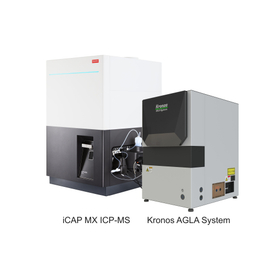
Laser Ablation ICP-MS System

Direct qualitative, quantitative, and imaging analysis of elements down to trace amounts in solid samples.

The laser ablation (LA) system equipped with a high repetition frequency laser and a galvanometric optical system, connected to the robust Thermo Scientific iCAP MX series ICP-MS, enables the acceleration, high precision, and expansion of elemental analysis capabilities. ■ Simplification and acceleration of elemental analysis - Solid sample surfaces are sampled using laser irradiation and analyzed directly with ICP-MS. - Complicated operations such as cleaning of instruments for traditional solution pre-treatment, and management of reagents and waste are no longer necessary, reducing costs, workload, and environmental impact. ■ Achieving sensitivity and precision equal to or greater than solution ICP-MS - Elimination of weighing errors and contamination during traditional pre-treatment, as well as interferences caused by acids or solvents during measurement, enhances precision. - High sensitivity is achieved through rapid ablation. - Flexible and highly precise quantification methods can be applied, allowing for quantitative analysis even without standard samples of the same material as the sample. ■ Expansion of ICP-MS analytical capabilities - Analysis of a wide range of samples, including difficult-to-dissolve samples, powder samples, and non-conductive samples, is possible. - Wide-area 2D/3D elemental imaging is achievable, covering areas of several square centimeters and depths of several hundred micrometers. - Accurate analysis is possible through imaging based on quantitative concentrations.

Added to bookmarks

Bookmarks list

Bookmark has been removed

Bookmarks list

You can't add any more bookmarks

By registering as a member, you can increase the number of bookmarks you can save and organize them with labels.

Free membership registration

Watch past semiconductor webinar videos and download materials!

Please take a look at the latest case studies and analytical know-how utilizing Agilent's technology.

Agilent's cutting-edge semiconductor and electronics analysis solutions You can view videos and download materials from past semiconductor webinars. Please take a look at the latest technology use cases and analysis know-how. <Please access the "Related Links" below for viewing and downloads!!> ============= Webinar Videos Recent needs for trace metal impurity analysis in the semiconductor field Fundamentals for lowering DL and BEC of ICP-MS to the extreme Current status and challenges of trace Si analysis using ICP-MS Data integrity compliance and operational efficiency utilizing data management systems GC/MS solutions for the semiconductor industry Latest information on PFAS analysis in materials using LC/MS Introduction to Agilent's elemental analysis instrument portfolio ============= PDF Materials OpenLab ECM XT addresses the challenges of "analytical work efficiency," "accuracy management," and "data tampering" in material analysis Tips for ICP-MS analysis that material manufacturers should know

  • Analytical Equipment and Devices
  • Spectroscopic Analysis Equipment

Added to bookmarks

Bookmarks list

Bookmark has been removed

Bookmarks list

You can't add any more bookmarks

By registering as a member, you can increase the number of bookmarks you can save and organize them with labels.

Free membership registration

Data: Outgassing analysis using headspace GC-MS analysis method.

Publication of headspace GC-MS analysis method and case study of outgassing component analysis of liquid crystal panel polarizers!

If solvents, low molecular organic substances, or unreacted materials remain in the constituent materials, packaging materials, or cushioning materials of a product, they may outgas, diffuse, or permeate into the constituent materials, potentially affecting the product's lifespan, characteristics, and the environment or human health. The headspace method of GCMS is effective for qualitative and quantitative analysis of trace residual substances. This document presents a case study of the qualitative analysis of outgassing components from polarizers used in liquid crystal panels. We encourage you to read it. [Contents] ■ Headspace GC-MS analysis method ■ Analysis of outgassing components from polarizers in liquid crystal panels *For more details, please refer to the PDF document or feel free to contact us.

  • Contract Analysis
  • Contract measurement
  • Contract Inspection

Added to bookmarks

Bookmarks list

Bookmark has been removed

Bookmarks list

You can't add any more bookmarks

By registering as a member, you can increase the number of bookmarks you can save and organize them with labels.

Free membership registration

[Data] Analysis of Polycarbonate Degradation by Reaction Thermal Decomposition

For material evaluation and defect analysis! We will discuss the applied load and degradation mechanisms based on the differences in decomposition products.

Polycarbonate is a material that excels in impact resistance, weather resistance, and transparency, making it widely used in everything from industrial materials to everyday products. However, even polymers with excellent properties can undergo chemical changes, commonly referred to as degradation, due to the usage environment and the passage of time. This document presents examples of degradation analysis of polycarbonate materials subjected to UV irradiation and constant temperature and humidity testing. [Contents] ■ Thermal decomposition GC-MS analysis of polycarbonate *For more details, please refer to the PDF document or feel free to contact us.*

  • reaction pyrolysis_mechanism.png
  • Contract Analysis

Added to bookmarks

Bookmarks list

Bookmark has been removed

Bookmarks list

You can't add any more bookmarks

By registering as a member, you can increase the number of bookmarks you can save and organize them with labels.

Free membership registration

[Analysis Case] LC/MS Analysis of Ergothioneine

Evaluation of the yield and purification level of amino acids derived from natural sources.

Ergothioneine, an amino acid homologue found abundantly in edible mushrooms of the Pleurotaceae family, is gaining attention in the fields of food, medicine, and beauty as a natural substance with high antioxidant properties. Recently, chemical synthesis techniques have also been established, but there is still a need for the development of high-efficiency separation and purification techniques from natural food resources, and it is required to accurately measure the yield and evaluate the level of purification.

Added to bookmarks

Bookmarks list

Bookmark has been removed

Bookmarks list

You can't add any more bookmarks

By registering as a member, you can increase the number of bookmarks you can save and organize them with labels.

Free membership registration

[Analysis Case] Ginseng - LC/MS/MS Analysis of Herbal Components

Simultaneous analysis of six types of ginsenosides (Rb1, Rc, Rd, Re, Rg1, Rg3)

The main component of Korean ginseng, which is widely used as a herbal medicine, is a saponin called ginsenoside. Ginsenosides are classified based on the way sugars are attached, and currently, about 30 types have been discovered. In this case, we will introduce an example of analyzing ginsenosides using LC/MS/MS. With LC/MS/MS, we confirmed that the double filtering effect of MRM allows for the separation of peaks from six structurally similar compounds, enabling simultaneous qualitative and quantitative analysis.

Added to bookmarks

Bookmarks list

Bookmark has been removed

Bookmarks list

You can't add any more bookmarks

By registering as a member, you can increase the number of bookmarks you can save and organize them with labels.

Free membership registration

[Analysis Case] LC/MS/MS Analysis of Catechin Metabolites in Urine

Qualitative analysis of catechin metabolites in urine, as well as investigation of temporal changes and individual differences.

By using high-sensitivity LC-MS (Q-TOF type), qualitative analysis of low-concentration components such as metabolites in biological samples is possible. It allows for the search for components that have undergone metabolism such as addition or conjugation in the body, as well as inter-sample comparisons aimed at investigating temporal changes and individual differences. After consuming a high-concentration catechin beverage and collecting urine, both unchanged catechin and the metabolite catechin-glucuronide conjugate were confirmed. The amounts of catechin and metabolites in the urine of eight individuals were plotted for excretion over 0.5 to 8 hours post-consumption, and comparisons were made.

Added to bookmarks

Bookmarks list

Bookmark has been removed

Bookmarks list

You can't add any more bookmarks

By registering as a member, you can increase the number of bookmarks you can save and organize them with labels.

Free membership registration

[Analysis Case] Impurity Analysis of FeCoNi Alloy

It is possible to simultaneously analyze 77 elements using GDMS.

When impurities are mixed into metallic materials, depending on the combination of elements, it can affect the reduction of toughness and corrosion resistance. Therefore, it is important to understand the amount of impurities in metallic materials for quality control. GDMS can simultaneously analyze 77 elements without standard samples, making it effective for impurity analysis of samples with unknown contained elements, regardless of the matrix. This document presents a case study of impurity analysis of FeCoNi alloys using GDMS. Measurement method: GDMS Product field: Manufacturing equipment and parts Analysis purpose: Trace concentration evaluation For more details, please download the document or contact us.

Added to bookmarks

Bookmarks list

Bookmark has been removed

Bookmarks list

You can't add any more bookmarks

By registering as a member, you can increase the number of bookmarks you can save and organize them with labels.

Free membership registration