

Visual Sensing Products Comprehensive Catalog
The tools we create are limited to those that fit the user's specifications.
This is a notice from Fit Co., Ltd. regarding the comprehensive catalog of VISUAL SENSING PRODUCTS.
- Company:フィット
- Price:Other
Last Updated: Aggregation Period:Aug 19, 2026~Sep 15, 2026
This ranking is based on the number of page views on our site.
Last Updated: Aggregation Period:Aug 19, 2026~Sep 15, 2026
This ranking is based on the number of page views on our site.
Last Updated: Aggregation Period:Aug 19, 2026~Sep 15, 2026
This ranking is based on the number of page views on our site.
181~210 item / All 362 items
The tools we create are limited to those that fit the user's specifications.
This is a notice from Fit Co., Ltd. regarding the comprehensive catalog of VISUAL SENSING PRODUCTS.

Function in the wavelength range of 2~16μm; high durability design to meet demanding applications; excellent spherical aberration correction.
The TECHSPEC germanium meniscus lens is designed for demanding infrared applications such as infrared imaging, surveillance, remote sensing, and infrared spectroscopy. The TECHSPEC germanium meniscus lens offers superior spherical aberration characteristics compared to TECHSPEC germanium plano-convex lenses with the same focal length, producing images with a smaller spot size. This meniscus lens is available with no coating or with anti-reflective (AR) coatings that enhance performance in specific wavelength ranges. For the product lineup of standard specifications, their details, and pricing, please visit the relevant product page on the official website of Edmund Optics Japan (accessible via the product homepage link above). *You can download the catalog from Edmund Optics Japan that includes this product from the link below.

Adoption of AR coating with Ravg <1.75% (@400~700nm; per side); designed for an incidence angle of 0°.
This is a lens designed to correct chromatic aberration along the optical axis and improve spherical aberration by bonding two lenses with different optical characteristics. The two surfaces of the lens are coated with a single MgF2 anti-reflective coating. It features an infinite conjugate ratio design. For the product lineup, specifications, and sales prices of standard products, please refer to the relevant product page on the official website of Edmund Optics Japan (accessible from the product homepage linked above). *You can download the catalog from Edmund Optics Japan that includes this product from the link below.

Achieving diffraction-limited performance at the design wavelength. Large-diameter achromatic lens with MgF2 anti-reflective coating.
TECHSPEC large-diameter achromatic lenses can achieve performance close to the diffraction limit across the designed wavelength range. These achromatic lenses, which have corrected chromatic aberration, feature long focal lengths and come in both resin-bonded and air-space designs. The framed version facilitates integration into optical systems due to the adoption of a gold frame with male threads for easy screwing in. The frameless version with air-space design includes metal shim spacers with adhesive tape and instructions for installation. ■ Resin bonding and air-space design ■ Framed version available for easier integration ■ Features MgF2 anti-reflective coating *You can download the catalog from Edmund Optics Japan below.

All products are sold individually as standard specification items. We offer short delivery times due to complete stock sales.
■Design for visible range ■BBAR multi-coat version also available *You can download the catalog from Edmund Optics Japan that features this product below.

All products are sold individually as standard specifications. We offer short delivery times due to complete stock sales.
■All-glass aspherical lens that corrects chromatic aberration ■Low F-number design ■Ideal for imaging and biotechnological applications *You can download the catalog from Edmund Optics Japan that features this product from the link below.*

All products are sold individually as standard specification items. We provide supply with short lead times due to complete stock availability.
■Designed to achieve improved resolution and smaller spot sizes in the range of 750~1100nm ■Improves spherical aberration for monochromatic light usage up to a wavelength of 2μm ■Achieves low reflectance up to 1700nm with options for two types of broadband AR coatings *You can download the catalog from Edmund Optics Japan that features this product below.

All products are sold individually as standard specification items. We offer quick delivery due to complete stock availability.
■C-mount design that facilitates integration into imaging applications ■Equipped with an iris diaphragm for further control of light throughput ■Ideal for relay and projection applications *You can download the catalog from Edmund Optics Japan featuring this product below.*

N-BK7 manufactured ball lens. It is ideal for focusing light into optical fibers and for fiber coupling!
The TECHSPEC N-BK7 ball lens is a glass sphere commonly used in fiber optics applications. The ball lens is ideal for focusing light into fiber optics and for fiber coupling. - Suitable as a lens for fiber coupling and collimators - Perfect for preforms for aspheric lenses - Available in various sizes - Hemispherical lenses are also available *You can download the catalog from Edmund Optics Japan that features this product from the link below.

Scratch-resistant and ideal for use under harsh conditions! Sapphire and ruby ball lenses.
Sapphire and ruby, made of hard materials, are resistant to scratches and are ideal for use under harsh conditions. Both are composed of alumina (Al2O3), and the red color of ruby is due to trace amounts of chromium oxide (generally over 0.5% by content). Unlike common optical glass, which has an upper transmission wavelength limit of about 2.3μm, they are transparent up to about 5.5μm. Sapphire and ruby have fundamentally the same physical and chemical properties, but there are slight differences in their optical characteristics. Sapphire is colorless and transparent with high light transmission, while ruby is colored, making it highly visible and easy to handle, which is why it is preferred for mechanical applications. ■ Ideal for use under harsh conditions ■ High strength and hardness ■ Excellent chemical resistance ■ Superior transmission in the IR wavelength range ■ Sapphire & ruby hemispherical lenses are also available *You can download the catalog from Edmund Optics Japan, which features this product, from the link below.

Adopts premier grade zinc selenide (ZnSe) optical elements from II-VI Corporation. Beam expander for CO2 lasers.
The beam expander for CO2 lasers is designed to collimate high-power CO2 laser beams and improve energy distribution. It utilizes premium-grade zinc selenide (ZnSe) optical elements from II-VI, achieving minimal beam deviation and over 99.4% transmittance at 10.6μm. A high-efficiency anti-reflective coating is applied to the ZnSe substrate, resulting in less than 0.2% reflectance and less than 0.1% absorption at 10.6μm. It also features a compact housing with an M25 mount on the incident side. ■ Designed for CO2 lasers at 10.6μm ■ Compact housing for easy system integration ■ Uses infrared zinc selenide optical elements from II-VI *The catalog from Edmund Optics Japan can be downloaded from the link below.

[Free Offer] Contains dense technical information over more than 50 pages. It is useful for knowledge enhancement and product selection.
The "Optics Application Notes Collection" is a technical document that carefully selects information useful for enhancing knowledge in the field of optics from the numerous application notes provided by our company. It includes explanations of theories and terminology, as well as practical examples of optical applications, presented with formulas, diagrams, and illustrations. [Contents] - Examples of optical applications (such as optical detector systems) - Five tips for designing with stock optics - Correct materials for use in infrared (IR) applications - Why use achromatic lenses? - Benefits of using meniscus lenses in infrared applications... and more *This document can be viewed immediately via "PDF Download." Please feel free to contact us with any inquiries.

![[NEW] 2026 Edition of the "Optics & Photonics Catalog"](https://image.mono.ipros.com/public/product/image/2000425304/IPROS3846485976290570942.jpg?w=280&h=280)
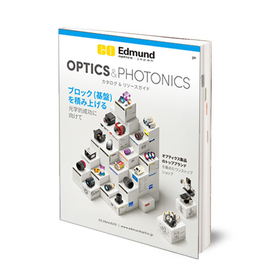
Comprehensive catalog of optical components, a total of 468 pages! It includes a wide range of optical elements such as lenses, mirrors, and filters, as well as cameras and lighting.
We are currently distributing the "2026 Edition Optics & Photonics Catalog," which focuses on our new and popular products! With a substantial total of 468 pages, it introduces over 20,000 items. In addition to product features and pricing information, it also includes selection guides for lenses and mirrors, as well as technical guides throughout. This catalog is packed with useful information for researchers, designers, and OEM users in the field of optics. 【Featured Products】 ■ Optics (Optical Elements) ■ Optomechanics ■ Imaging Lenses ■ Laser-related ■ Microscope-related ■ Test Targets ■ Cameras ■ Lighting *The digital version of this catalog can be viewed immediately via "PDF Download." Please feel free to contact us with any inquiries.



Laser beam expander with a rotating beam spread adjustment mechanism. Available for laser lines and broadband lasers.
The TECHSPEC Vega beam expander enables compatibility with high-power lasers through an optical design that does not create ghost images within the optical system. It can be used for demanding applications such as material processing and medical use with laser lines, and for highly tunable thulium and holmium laser sources with broadband lasers. - For laser lines: Designed for fundamental and harmonic wavelengths of YAG - For broadband lasers: Compatible with broadband tunable lasers - Available in fixed magnifications from 2X to 20X - Features a rotating beam expansion adjustment mechanism *You can download the catalog from Edmund Optics Japan that features this product from the link below.

Short delivery time with stock sales! All items available for sale from just one piece.
For details, please check the official Edmund Optics website via the link below.

Short delivery time with stock sales! All items available for sale from just one piece.
Camera-related accessories are used to add functionality to various types of imaging cameras available on the market or as optional replacements. Camera-related accessories consist of a range of products that are essential for use with specific cameras or in specific environments, including cables, power supplies, and capture cards for laptops. Camera-related accessories are suitable for many replacement part needs and for purchasing parts that were not included when buying the camera. For use with dedicated computer systems, various models of LCD monitors are also available. ■ For more details, please check the official website of Edmund Optics via the link below.
![[Information] Five Tips for Optical System Mechanical Design, Assembly, and Positioning](https://image.mono.ipros.com/public/product/image/201/2001246631/IPROS41836331751525781142.png?w=280&h=280)
Here are five tips for designing using stock optics, further expanded for your reference!
This document introduces several important considerations regarding assembly that should be taken into account when performing optical design. It explains the need to consider overall size and weight, whether the design is based on reassembly, and the understanding of movement and positioning requirements. By incorporating such mechanical design and positioning considerations from the optical design stage, unnecessary effort can be avoided, and costs associated with later changes or redesigns of components can be reduced. [Contents] ■1 Consider overall size and weight ■2 Is the design based on reassembly? ■3 Understand movement and positioning requirements ■4 Avoid stray light ■5 Be aware of environmental influences *For more details, please refer to the PDF document or feel free to contact us.
![[Information] Chromatic Aberration and Monochromatic Optical Aberration](https://image.mono.ipros.com/public/product/image/e74/2001246639/IPROS42585742984283188324.png?w=280&h=280)
An explanation of optical aberrations, which are named and categorized in several different ways!
In this document, optical aberrations are introduced by dividing them into two groups. "Chromatic aberration," which is further classified into two types: lateral chromatic aberration and longitudinal chromatic aberration, and "monochromatic aberration," which can sometimes be identified using wavefront coefficients. To construct an optical system, it is essential to understand the various optical aberrations and to correct them. [Contents] ■ Chromatic Aberrations ■ Monochromatic Aberration ■ Introduction of related products and technical materials *For more details, please refer to the PDF document or feel free to contact us.
![[Information] Cleaning of optical components](https://image.mono.ipros.com/public/product/image/c70/2001246659/IPROS47638439424358498148.png?w=280&h=280)
Here are six tips for handling all optical components and keeping them in good condition!
This document provides several tips for starting the cleaning of optical components. It explains the advantages of various types of cleaning products such as pickup tools and tweezers, as well as general cleaning methods for lenses, mirrors, and filters. For special optics, materials, coatings, and applications, please contact us for recommended cleaning methods. [Contents] ■ Cleaning Products ■ General Cleaning Methods ■ Six Tips for Handling All Optical Components and Keeping Them in Good Condition ■ Introduction of Related Products and Technical Materials *For more details, please refer to the PDF document or feel free to contact us.
![[Data] Understanding surface quality specifications based on U.S. standards.](https://image.mono.ipros.com/public/product/image/bbb/2001246679/IPROS53693607524461081133.png?w=280&h=280)
A general method for evaluating surface quality! Introduction to the U.S. military standard MIL-PRF-13830B.
This document is intended to help understand the surface quality specifications based on the U.S. standard MIL-PRF-13830B. It explains the surface quality of optical elements and the appearance defects caused during the manufacturing and handling processes. Our standard optical components available for stock sale conform to the U.S. military standard MIL-PRF-13830B, which is a generic method for evaluating surface quality. [Contents] ■ Surface quality of optical elements ■ Standard optical components available for stock sale from Edmund Optics ■ Scratch ■ Dig ■ Introduction of related products and technical materials *For more details, please refer to the PDF document or feel free to contact us.
![[Data] Ink Coating Process for Lens Edge Surface](https://image.mono.ipros.com/public/product/image/311/2001246696/IPROS35836564713863149636.png?w=280&h=280)
Introducing the test results measuring the scattered light amount from one side of frosted glass and the same glass that has been treated with a black paint finish!
This document introduces a method for successfully mitigating stray light, specifically the application of black coating on the edges of lenses. It includes measurements conducted by projecting a laser light source onto a scattering target at a specific angle (other than vertical incidence) and the results obtained. Edmund Optics offers a wide range of standard products that have undergone black coating. [Contents] - Stray Light - Measurement of BRDF (Bidirectional Reflectance Distribution Function) - Results - Introduction of related products and technical documents *For more details, please refer to the PDF document or feel free to contact us.
![[Information] Benefits of Using Meniscus Lenses in Infrared Applications](https://image.mono.ipros.com/public/product/image/ef3/2001246723/IPROS18130243824515551373.png?w=280&h=280)
The use of meniscus lenses, which can be expected to significantly improve performance! Introducing spherical aberration and benefits.
This document introduces the benefits of using meniscus lenses in infrared applications. It covers explanations about spherical aberration and highlights the advantages in infrared applications where the refractive index often exceeds 2.0. Meniscus lenses provide excellent cost and performance benefits in many infrared applications, including spectral analysis and thermal imaging. [Contents] ■ Spherical Aberration ■ Advantages of Meniscus Design ■ Introduction of Related Products and Technical Materials *For more details, please refer to the PDF document or feel free to contact us.
![[Information] Correct materials for use in infrared (IR) applications](https://image.mono.ipros.com/public/product/image/bbe/2001349574/IPROS12423944450916839083.png?w=280&h=280)
Here are three simple points to consider when selecting the right infrared transmission material!
This document introduces "the correct materials to use for infrared (IR) applications." It explains the overview of infrared, the importance of using the correct materials, how to select the right materials, and compares infrared transmission materials. Since the physical properties of infrared transmission materials are not uniform, understanding the characteristics of each material enables the proper selection of materials for IR applications. 【Contents】 ■ Overview of infrared ■ Importance of using the correct materials ■ How to select the right materials ■ Comparison of infrared transmission materials ■ Introduction of related products and technical documents *For more details, please download the PDF or feel free to contact us.

Good performance, good durability, good cost.
High performance used for cutting-edge research applications. A reassuring 10-year quality guarantee. Achieving prices comparable to conventional soft coat filters through mass production. 【Features】 ○ High performance ○ High durability ○ Low price For more details, please contact us or download the catalog.

We offer high-performance sputtering hard coat filters and mirrors at low prices.
The sputtering hard coat prevents scattering, absorption, and reflection losses, making it possible to produce filters with the highest standards of high transmittance, wavelength accuracy, steep cut-on and cut-off, and excellent S/N ratio. Additionally, it comes with an exceptional 10-year warranty for optical components. The variation between manufacturing lots is extremely small, allowing for stable supply according to the planned delivery schedule. 【Features】 ○ OEM-oriented and low price → High-performance sputtering hard coat filters and mirrors can be offered at prices comparable to conventional soft coat filters. ○ High performance ○ Optical characteristics: high transmittance, wavelength accuracy, steep cut-on and cut-off, excellent S/N ratio ○ Extremely small variation between manufacturing lots, allowing for stable supply according to the planned delivery schedule ○ High durability: reassuring 10-year warranty *For more details, please contact us or download the catalog to view.

Suitable for the inspection of foreign substances, bubbles, surface scratches, polishing marks, and polishing unevenness such as orange peel!
The "LSC-5100" is a suitable texture inspection device for quality control of optical components. With the dedicated software Clear Back, it eliminates patterns caused by optical elements within the device. This makes it easier to determine defects at the acceptable quality limit level, leading to a reduction in sample inspection time. In our showroom, you can closely view various products and experience demonstrations of inspection and measurement. 【Features】 ■ Eliminates patterns caused by optical elements within the device using the dedicated software Clear Back ■ Easy determination of defects at the acceptable quality limit level ■ Leads to a reduction in sample inspection time *For more details, please refer to the PDF materials or feel free to contact us.

One side is concave, and the other side is convex! We can also process shapes with bands and hole machining.
The "Meniscus Lens" is a lens with one concave surface and one convex surface. We can accommodate various custom specifications ranging from approximately Φ3mm to around Φ150. We can also handle dimensions outside of the above range, so please contact us separately. In addition, we can process shapes other than standard circular ones, such as band shapes and those with hole processing. 【Features】 ■ A lens with one concave surface and one convex surface ■ Custom specifications available from approximately Φ3mm to around Φ150 (We can also accommodate dimensions outside of the above range) ■ Processing possible for shapes other than standard circular ones, including band shapes and those with hole processing *For more details, please refer to the PDF document or feel free to contact us.

It can be used as a diffusion plate made of milky white phase separation glass.
The "CW-01" is a glass that has no variation due to wavelength and uniformly diffuses light. It is a milky white phase-separated glass that can be used as a diffusion plate. The transmission light distribution has a Lambertian characteristic, with a flat transmission rate curve extending from the visible to the infrared range. Shapes and dimensions can be approximately square with sizes from 5 to 100 mm, and round with sizes from 5 to 150 mm. 【Features】 ■ No variation due to wavelength, uniformly diffuses light ■ Usable as a diffusion plate ■ Flat transmission rate curve from the visible to the infrared range *For more details, please refer to the PDF document or feel free to contact us.
