1~45 item / All 556 items
Displayed results
Filter by category

Added to bookmarks
Bookmarks listBookmark has been removed
Bookmarks listYou can't add any more bookmarks
By registering as a member, you can increase the number of bookmarks you can save and organize them with labels.
Free membership registration
Contact this company
Inquiry FormBefore making an inquiry
Download Profile1~45 item / All 556 items
Filter by category

With the expansion of AI demand, the high operation and high precision of semiconductor manufacturing equipment are progressing, making it increasingly important to suppress surface-related troubles such as corrosion, adhesion, wear, and charging. Fluororesin coatings solve a wide range of challenges in processes such as transport, cleaning, etching, photomasks, CMP, plating, and inspection due to their five characteristics: chemical resistance, non-stick properties, slip properties, insulation, and purity. Yoshida SKT, as a pioneer in Teflon(TM) coatings, has a track record of over 2,000 companies and offers customized proposals that are optimal for customers' processes and equipment from hundreds of surface treatment technologies. Please download the materials to check specific application examples for each process.
Added to bookmarks
Bookmarks listBookmark has been removed
Bookmarks listYou can't add any more bookmarks
By registering as a member, you can increase the number of bookmarks you can save and organize them with labels.
Free membership registration
In semiconductor manufacturing, the leaching of metal ions is a significant issue that directly affects product quality. Fluororesin coatings form a very stable film and can suppress the leaching of metal ions to an extremely low level. Because the coating film itself is less likely to undergo chemical reactions, it maintains its performance even after long-term use, providing highly reliable protection. Yoshida SKT, as a pioneer in Teflon(TM) coatings, has extensive experience in the semiconductor manufacturing field, where high purity is required. We can select the optimal grade and provide customization according to our customers' process conditions. For detailed technical information, please download the materials for confirmation.
Added to bookmarks
Bookmarks listBookmark has been removed
Bookmarks listYou can't add any more bookmarks
By registering as a member, you can increase the number of bookmarks you can save and organize them with labels.
Free membership registration
In semiconductor manufacturing processes, the generation of static electricity can adversely affect wafers and electronic components. Fluororesin coatings have excellent electrical insulation properties and contribute to maintaining the performance and longevity of electronic components and equipment. On the other hand, conductive materials can impart antistatic properties, suppressing the generation of static electricity and maintaining a high-precision manufacturing environment. Yoshida SKT, as a pioneer in Teflon(TM) coatings, addresses both insulation and antistatic needs. We provide optimal customization proposals tailored to our customers' applications. For detailed technical information, please download the materials and check them.
Added to bookmarks
Bookmarks listBookmark has been removed
Bookmarks listYou can't add any more bookmarks
By registering as a member, you can increase the number of bookmarks you can save and organize them with labels.
Free membership registration
In semiconductor manufacturing processes, the adhesion of materials and deposits can lead to increased maintenance burdens on equipment and a decline in product quality. Fluororesin coatings, with their low surface energy, allow for easy removal of adhered dirt and substances, significantly contributing to the simplification of maintenance. They also excel in water repellency, improving liquid drainage and cleaning efficiency. Yoshida SKT is a leading company in fluororesin processing with a track record of over 2,000 companies. We offer optimal grades tailored to the adhered objects and environmental conditions from hundreds of surface treatment technologies. For more details, please download the materials or contact us.
Added to bookmarks
Bookmarks listBookmark has been removed
Bookmarks listYou can't add any more bookmarks
By registering as a member, you can increase the number of bookmarks you can save and organize them with labels.
Free membership registration
In semiconductor manufacturing processes, various chemical solutions, including acidic and alkaline ones, are used, making corrosion of equipment parts a significant challenge. Fluoropolymer coatings form chemically very stable films and exhibit high resistance to a wide range of chemical environments. They also accommodate temperature ranges according to the grade, maintaining stable performance over long periods. This contributes to the longevity of equipment, reduction of maintenance costs, and realization of stable operations. Yoshida SKT, as a pioneer in Teflon(TM) coatings, has extensive experience in the semiconductor field and offers optimal grade selection and customization proposals based on chemical conditions and usage environments. For more detailed information, please download the materials and check.
Added to bookmarks
Bookmarks listBookmark has been removed
Bookmarks listYou can't add any more bookmarks
By registering as a member, you can increase the number of bookmarks you can save and organize them with labels.
Free membership registration
In the semiconductor manufacturing inspection process, issues such as wafer scratching, adhesion to the chuck stage, and the generation of metal powder from sliding components arise. Fluororesin coating, when applied to the chuck stage, serves as a physical protective film for the wafer, preventing scratches, and its non-stick properties prevent adhesion of the wafer, contributing to an efficient inspection process. Additionally, applying it to sliding components reduces the generation of metal powder, maintaining a clean inspection environment. Yoshida SKT is a customization specialist that offers optimal proposals from hundreds of surface treatment technologies. For more details, please download the materials or contact us.
Added to bookmarks
Bookmarks listBookmark has been removed
Bookmarks listYou can't add any more bookmarks
By registering as a member, you can increase the number of bookmarks you can save and organize them with labels.
Free membership registration
In the cleaning process of semiconductor manufacturing, the use of various chemical solutions poses serious challenges such as corrosion of equipment parts and the leaching of metal ions. By applying fluororesin coating to moving parts, chemical resistance is provided, preventing corrosion. The application in cleaning tanks helps suppress the leaching of metal ions, maintaining a high-purity cleaning process. Furthermore, the application to the wafer stage can also address the prevention of wafer scratches. Yoshida SKT, as a pioneer in Teflon(TM) coating, has extensive experience in the semiconductor field and excels in customizing solutions according to customer equipment specifications and chemical conditions. For detailed technical information and case studies, please download the materials for review.
Added to bookmarks
Bookmarks listBookmark has been removed
Bookmarks listYou can't add any more bookmarks
By registering as a member, you can increase the number of bookmarks you can save and organize them with labels.
Free membership registration
In semiconductor manufacturing, wafer transport devices play an extremely important role. By applying a fluororesin coating to the surface of the transport hand, we can prevent chipping and scratching of the wafers, contributing to improved yield. Additionally, applying the coating to the body and metal screws exposed to chemical environments helps suppress rust and corrosion, achieving longer equipment lifespan and stable operation. Yoshida SKT, as a pioneer in Teflon(TM) coating, has a track record of over 2,000 companies and can offer optimal grade selection and customization proposals tailored to the shape of transport parts and their usage environments. We will propose the best solution from hundreds of surface treatment technologies to address your challenges. For detailed technical information and case studies, please download the materials for review.
Added to bookmarks
Bookmarks listBookmark has been removed
Bookmarks listYou can't add any more bookmarks
By registering as a member, you can increase the number of bookmarks you can save and organize them with labels.
Free membership registration
Due to the strengthening of PFAS regulations, there is an increasing demand for alternatives to fluoropolymer coatings. The "FFLC Series," developed exclusively by Yoshida SKT, is PFAS-free (non-fluorinated) and demonstrates excellent lubrication performance, achieving low friction and wear resistance for sliding and conveying components. It is ideal for semiconductor manufacturing equipment manufacturers who want to balance environmental compliance with performance maintenance. Yoshida SKT is one of the few authorized processors of Teflon(TM) coatings, with a track record of over 2,000 companies and hundreds of surface treatment technologies. We also welcome inquiries about switching from currently used fluorinated coatings. Detailed specifications, case studies, and selection guides can be found in our materials. Please download the materials and make use of them.
Added to bookmarks
Bookmarks listBookmark has been removed
Bookmarks listYou can't add any more bookmarks
By registering as a member, you can increase the number of bookmarks you can save and organize them with labels.
Free membership registration
Static electricity causes many problems in semiconductor manufacturing processes, such as particle adhesion, ESD damage, and powder attachment. Yoshida SKT's unique electrostatic prevention fluororesin coating "Safron(R)" achieves both static electricity prevention and non-stick properties through the addition of conductive materials. It supports a wide range of surface resistivity from 10^5 to 10^11 ohms/sq, and custom settings can be tailored to meet process needs. Yoshida SKT is one of the few authorized processors of Teflon(TM) coatings, with over 2,000 achievements and hundreds of surface treatment technologies as specialists. Please share your desired level of static electricity prevention and usage environment. Detailed specifications, case studies, and selection guides can be found in the materials. We encourage you to download the materials and make use of them.
Added to bookmarks
Bookmarks listBookmark has been removed
Bookmarks listYou can't add any more bookmarks
By registering as a member, you can increase the number of bookmarks you can save and organize them with labels.
Free membership registration
In semiconductor manufacturing, contamination by metal ions at the ppb level directly reduces yield. Fluororesin coatings cover metal surfaces with a stable chemically inert film, greatly suppressing the leaching of metal ions. This contributes to the stability of high-purity process quality and improved yield rates. Yoshida SKT is a specialist with over 2,000 achievements and hundreds of surface treatment technologies as one of the few authorized processors of Teflon(TM) coatings. Please let us know the chemicals you will use and the desired purity level. We will suggest the optimal grade. You can check detailed specifications, case studies, and selection guides in our materials. Please download the materials and make use of them.
Added to bookmarks
Bookmarks listBookmark has been removed
Bookmarks listYou can't add any more bookmarks
By registering as a member, you can increase the number of bookmarks you can save and organize them with labels.
Free membership registration
This is a fluororesin coating that protects equipment parts from corrosive chemicals such as acids, alkalis, and organic solvents used in semiconductor manufacturing processes. We offer a wide range of grades tailored to applications, including PTFE, PFA, and FEP, allowing for the selection of the optimal treatment based on the type of chemical, temperature, and substrate. Yoshida SKT is one of the few authorized processors of Teflon(TM) coatings, with over 2,000 achievements and hundreds of surface treatment technologies. Please provide details about the type of chemical, concentration, and usage environment. We will suggest the optimal grade for you. You can check detailed specifications, case studies, and selection guides in our materials. Please download the materials and make use of them.
Added to bookmarks
Bookmarks listBookmark has been removed
Bookmarks listYou can't add any more bookmarks
By registering as a member, you can increase the number of bookmarks you can save and organize them with labels.
Free membership registration
Metal ions leaching from the inner walls of the plating tank change the composition of the plating solution, leading to quality defects. By completely covering the inner walls of the tank with fluororesin lining, we prevent metal leaching and the formation of deposits. This contributes to long-term stability of the plating solution's quality and cost reduction. Yoshida SKT's MY Lining® boasts a lifespan more than ten times that of conventional products. As one of the few authorized processors of Teflon(TM) coatings, Yoshida SKT is a specialist with over 2,000 achievements and hundreds of types of surface treatment technologies. We propose optimal linings tailored to the size, shape, and type of plating solution of the tank. You can check detailed specifications, case studies, and selection guides in our materials. Please download the materials and make use of them.
Added to bookmarks
Bookmarks listBookmark has been removed
Bookmarks listYou can't add any more bookmarks
By registering as a member, you can increase the number of bookmarks you can save and organize them with labels.
Free membership registration
The FFCC series FFCC1-S014 is a transparent antistatic coating that is PFAS-free (non-fluorinated) and can simultaneously provide three functions: antistatic performance, dirt resistance, and release properties. - High transparency with a transmittance of 90% (550nm) - Antistatic performance with a surface resistivity of 10^5 to 10^7 Ω/sq - Dirt resistance (excellent rating for resistance to marker contamination) - Release properties (pass in melt PP sheet release test) - Processing temperature of 160 to 220 degrees Celsius - Suitable for processing on glass. *The values are measured values and not guaranteed values. For more details, please click the URL to check.
Added to bookmarks
Bookmarks listBookmark has been removed
Bookmarks listYou can't add any more bookmarks
By registering as a member, you can increase the number of bookmarks you can save and organize them with labels.
Free membership registration
The "FFCC Series" FFCC1-000 is a transparent antistatic coating that contains no fluorine (PFAS-free). It was developed as a new alternative to fluoropolymer products in industries and products that require compliance with PFAS regulations. - Compatible with low-temperature processing at 60 to 80 degrees Celsius - Applicable not only to glass but also to general-purpose transparent resins (such as PC and acrylic) - High transparency with a transmittance of 86% (at 550nm) - Exhibits antistatic performance with a surface resistivity of 10^5 to 10^7 Ω/sq - Pencil hardness of 9H or higher. *The values are measured values and not guaranteed values. For more details, please click the URL to check.
Added to bookmarks
Bookmarks listBookmark has been removed
Bookmarks listYou can't add any more bookmarks
By registering as a member, you can increase the number of bookmarks you can save and organize them with labels.
Free membership registration
The "Safron CC+" CCC1-F200 is a transparent, static-resistant fluororesin coating that enables low-temperature processing at 60 to 80 degrees Celsius. It is compatible with general-purpose transparent resins (such as PC and acrylic) that may have concerns about heat resistance, significantly broadening the range of applicable substrates. - Transmittance: 86% (550nm) - Antistatic performance with surface resistivity of 10^5 to 10^8 Ω/sq - Dirt resistance (anti-magic contamination rating: ◎◎) - Achieves water and oil repellency (contact angle: 105 to 115 degrees) - Pencil hardness: 9H or higher This multifunctional coating can be applied to both glass and general-purpose transparent resins. For more details, please click the URL to check.
Added to bookmarks
Bookmarks listBookmark has been removed
Bookmarks listYou can't add any more bookmarks
By registering as a member, you can increase the number of bookmarks you can save and organize them with labels.
Free membership registration
The "Safron CC+" CCC1-F100 is a fluorine-based transparent antistatic coating developed exclusively by Yoshida SKT, which can impart antistatic properties without compromising the transparency of glass substrates. Traditionally, the addition of conductive fillers was necessary for antistatic properties, which inevitably led to discoloration and reduced transparency of the coating film. This product addresses that issue, achieving antistatic performance with a surface resistivity of 10^5 to 10^7 Ω/sq while maintaining a transmittance of 85% (at 550nm). - Dirt resistance (resistance to marker contamination rated ○) - Water and oil repellency (contact angle 105 to 115 degrees) - Pencil hardness: 9H or higher - Processing temperature: 260 to 300 degrees Celsius - Suitable for processing on glass. For more details, please click the URL to check.
Added to bookmarks
Bookmarks listBookmark has been removed
Bookmarks listYou can't add any more bookmarks
By registering as a member, you can increase the number of bookmarks you can save and organize them with labels.
Free membership registration
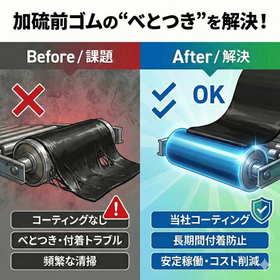
In the rubber manufacturing industry, the issue of "stickiness," where uncured rubber adheres to conveying equipment, is a factor that decreases production efficiency. Particularly when the formulation of rubber materials is changed for environmental measures or to improve durability, processing at higher temperatures than before becomes necessary, making adhesion more likely. Yoshida SKT's coating prevents the adhesion of uncured rubber for an extended period, contributing to the stable operation of manufacturing lines. 【Usage Scenarios】 - Conveying rolls after rubber extrusion - Conveying equipment in curing ovens - Weather strip manufacturing lines - S-SBR (solution polymerized styrene-butadiene rubber) manufacturing equipment - Hose curing fixtures 【Benefits of Implementation】 - Prevention of uncured rubber adhesion - Reduction in cleaning and maintenance frequency - Stable operation of manufacturing lines - Reduction in costs and working time *For more details, please refer to the PDF document or feel free to contact us.
Added to bookmarks
Bookmarks listBookmark has been removed
Bookmarks listYou can't add any more bookmarks
By registering as a member, you can increase the number of bookmarks you can save and organize them with labels.
Free membership registration
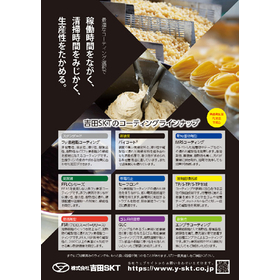
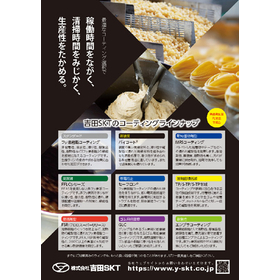
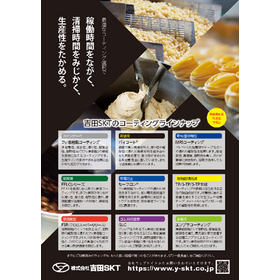
In the confectionery manufacturing industry, ensuring the quality and safety of food is the most important challenge. Adhesion of dough during the manufacturing process can lead to a decline in product quality and complaints, potentially damaging the company's reputation. It is essential to use coatings that comply with food sanitation laws for equipment that comes into direct contact with food. Yoshida SKT's food sanitation law-compliant coating series addresses these challenges and supports safe and efficient confectionery manufacturing. [Usage Scenarios] - Manufacturing of cookies, cakes, bread, etc. - Food transport lines - Packaging machine components [Benefits of Implementation] - Improved yield due to prevention of adhesion - Increased work efficiency by reducing cleaning frequency
Added to bookmarks
Bookmarks listBookmark has been removed
Bookmarks listYou can't add any more bookmarks
By registering as a member, you can increase the number of bookmarks you can save and organize them with labels.
Free membership registration
We introduce coatings that comply with food sanitation laws to enhance safety and production efficiency in food manufacturing and processing equipment. Our lineup includes coatings that meet the food sanitation law (positive list system) and can be used in applications that come into direct contact with food, covering essential functions required in manufacturing environments such as slip resistance, non-stick properties, release properties, heat resistance, anti-static properties, and high durability. 【Applications】 Our coatings are suitable for a wide range of food manufacturing environments, including bread and bakery, confectionery, meat processing, dairy products, frozen foods, noodles, seafood processing, rice and bento, side dishes and school meals, beverage manufacturing, and packaging machine components. 【Features】 ■ Coatings with slip resistance, non-stick properties, and release properties reduce line stoppages and cleaning frequency due to adhesion. ■ Multifunctional specifications including anti-static properties, heat resistance (maximum operating temperature class of 260°C), chemical resistance, and corrosion resistance. ■ We also offer the FFLC series, which is free from PFAS, demonstrating our commitment to environmental considerations. If you are considering improving the efficiency of your manufacturing line, please download our materials and contact us.
Added to bookmarks
Bookmarks listBookmark has been removed
Bookmarks listYou can't add any more bookmarks
By registering as a member, you can increase the number of bookmarks you can save and organize them with labels.
Free membership registration
In the food manufacturing industry, maintaining hygiene management of manufacturing equipment is crucial to ensure food safety. The occurrence of contaminants and the effort required for cleaning not only hinder hygiene management but also lead to decreased production efficiency. Coatings that comply with food sanitation laws address these challenges and support safe food production. Our series of coatings compliant with food sanitation laws contribute to hygiene management and efficiency in manufacturing sites through functions such as slip resistance, non-stick properties, and release characteristics. **Application Scenarios** * Bread and bakery, confectionery * Meat processing, dairy products, frozen foods * Noodles, seafood processing, rice and bento, prepared foods and school lunches * Beverage manufacturing, packaging machine components **Benefits of Implementation** * Reduction in line stoppages and cleaning frequency due to adhesion * Decreased risk of foreign matter contamination * Increased productivity * Stabilization of product quality For more details, please download the materials or contact us.
Added to bookmarks
Bookmarks listBookmark has been removed
Bookmarks listYou can't add any more bookmarks
By registering as a member, you can increase the number of bookmarks you can save and organize them with labels.
Free membership registration
PES (Polyether Sulfone) is one of the super engineering plastics and is utilized for the following properties and applications. ■ Main Properties - High strength - Heat resistance - Chemical resistance, etc. ■ Main Applications - Medical devices - Automotive parts - Office automation equipment, etc. At Yoshida SKT, we offer PES coating as an engineering plastic coating. *For more details, please download the materials or feel free to contact us.
Added to bookmarks
Bookmarks listBookmark has been removed
Bookmarks listYou can't add any more bookmarks
By registering as a member, you can increase the number of bookmarks you can save and organize them with labels.
Free membership registration
PAI (Polyamide Imide) is one of the super engineering plastics and is utilized for the following performance characteristics and applications. ■ Main Performance - Low creep - Heat resistance - Chemical resistance, etc. ■ Main Applications - Aircraft components - Automotive parts - Electrical and electronic components - Bearings, etc. At Yoshida SKT, we offer PAI coatings as engineering plastic coatings. *For more details, please download the materials or feel free to contact us.
Added to bookmarks
Bookmarks listBookmark has been removed
Bookmarks listYou can't add any more bookmarks
By registering as a member, you can increase the number of bookmarks you can save and organize them with labels.
Free membership registration
As regulations on PFAS are being strengthened, particularly in Europe, the likelihood of fluoropolymer resins becoming subject to regulation is increasing. In response to this movement, we are offering a kit that allows you to physically compare the performance of various non-fluorinated coatings for free. 【Features】 - Includes six types of non-fluorinated coatings, such as silicone-based, graphite-based, and ceramic-based. - A fluoropolymer coating board is also included for comparison, making the differences immediately clear. - Comes with adhesive tape, allowing you to experience "stickiness" on-site. - Some products comply with the positive list of the Food Sanitation Act, making them suitable for the food industry. 【Applications】 - Consideration of material substitution from fluorinated materials. - Technical evaluation of non-fluorinated coatings. - Lubrication and release measures in manufacturing lines. * We are offering the "PFAS-Free Coating Experience Sample Kit" for free. * A "PFAS Countermeasure Guide for the Manufacturing Industry" is also included! * Please apply via the link.
Added to bookmarks
Bookmarks listBookmark has been removed
Bookmarks listYou can't add any more bookmarks
By registering as a member, you can increase the number of bookmarks you can save and organize them with labels.
Free membership registration
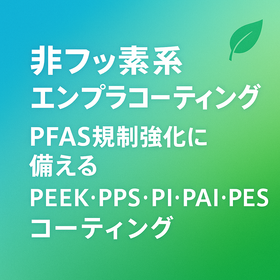
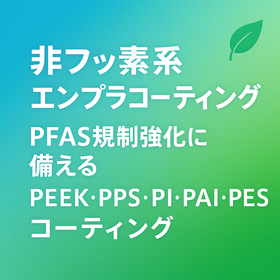
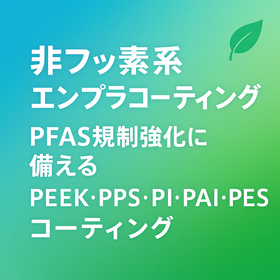
Introducing the "Non-Fluorinated Engineering Plastic Coating" provided by Yoshida SKT. In preparation for the recent strengthening of PFAS regulations, we have started new contract processing using engineering plastics (EPL) as an alternative coating technology that does not use fluororesins. We offer five types of engineering plastic materials, including PEEK, PPS, PI, PAI, and PES, and will propose the most suitable coating for your application. 【Features】 ■ Proactive response to PFAS regulations ■ Excellent properties such as high strength, heat resistance, and chemical resistance ■ Five types of engineering plastic materials: PEEK, PPS, PI, PAI, PES ■ A lineup of our uniquely developed PFAS-free coatings (FFLC series, CAS) ■ Free coating technology consultation by technical sales representatives 【Applications】 Surface treatment for manufacturing equipment and parts such as aircraft components, automotive parts, medical devices, semiconductor manufacturing equipment, electronic substrates, and electrical connectors. *We will listen to your challenges and propose the optimal coating. For more details, please download the materials or feel free to contact us.
Added to bookmarks
Bookmarks listBookmark has been removed
Bookmarks listYou can't add any more bookmarks
By registering as a member, you can increase the number of bookmarks you can save and organize them with labels.
Free membership registration
PPS (Polyphenylene Sulfide) is one of the super engineering plastics and is used for the following properties and applications. ■ Main Properties - High strength - Heat resistance - Chemical resistance, etc. ■ Main Applications - Electrical connectors - Automotive parts - Electronic device components, etc. At Yoshida SKT, we offer PPS coating as an engineering plastic coating. *For more details, please download the materials or feel free to contact us.
Added to bookmarks
Bookmarks listBookmark has been removed
Bookmarks listYou can't add any more bookmarks
By registering as a member, you can increase the number of bookmarks you can save and organize them with labels.
Free membership registration
In the production line, troubles such as the following can occur at any time: ■ Line stoppage ■ Delay in takt time ■ Increase in defects etc... While prompt response and investigation of the causes are important when such issues arise, learning preventive measures in advance can help avert emergencies. By imparting "release properties and slip properties" through surface treatment, we are currently offering free "trial sets" of surface treatments that have actually improved production processes, as well as a "case study collection on process improvement." For more details on the cases, please download and check the "case study collection on process improvement." You can apply for a free trial set of surface treatment samples from the "related links." We encourage you to apply for this opportunity.
Added to bookmarks
Bookmarks listBookmark has been removed
Bookmarks listYou can't add any more bookmarks
By registering as a member, you can increase the number of bookmarks you can save and organize them with labels.
Free membership registration
The technical document "Differences Between PTFE and PFA" provides a detailed explanation of PTFE, PFA, FEP, and ETFE, covering everything from molecular structure to properties. Fluoropolymers are well-known for their functionality, such as being non-stick and slippery, but many people may not be aware of their types and differences. This single volume allows you to thoroughly understand the differences and characteristics of each. If you are interested, please feel free to download it. [Contents (excerpt)] ■ Types and properties of fluoropolymers ■ Differences between PTFE and PFA / Overview of FEP and ETFE ■ Differences among four types of fluoropolymer coatings
Added to bookmarks
Bookmarks listBookmark has been removed
Bookmarks listYou can't add any more bookmarks
By registering as a member, you can increase the number of bookmarks you can save and organize them with labels.
Free membership registration
Yoshida SKT offers fluororesin coatings that comply with the revised Food Sanitation Act and the Positive List system, which will be fully implemented on June 1, 2025. The revised Food Sanitation Act, which came into effect on June 1, 2020, introduced a Positive List (PL) system that allows only substances evaluated for safety to be used in food-related utensils and packaging. As a result of this revision, synthetic resins, excluding rubber (thermosetting elastomers), are now subject to the PL system, affecting some coatings used in the food industry. Yoshida SKT's fluororesin coatings have achieved excellent functionality while complying with these new regulations. They provide high-level performance required in food manufacturing environments, such as non-stick properties, water repellency, oil repellency, and slip properties. 【Features】 ■ Complies with the Positive List system of the revised Food Sanitation Act ■ Coating products aimed at full implementation in June 2025 ■ Achieves excellent non-stick, water-repellent, oil-repellent, and slip properties ■ Coatings with superior non-stick, slip, and heat resistance ■ Suitable for a wide range of applications, including food factories and packaging machines For more details, please check the document download or contact us.
Added to bookmarks
Bookmarks listBookmark has been removed
Bookmarks listYou can't add any more bookmarks
By registering as a member, you can increase the number of bookmarks you can save and organize them with labels.
Free membership registration
■The "non-stick property" of fluoropolymer… Non-stick property refers to the characteristic of being easy to release and not adhere, or to adhere less, even to strongly adhesive substances. For example, fluoropolymers have excellent water and oil repellency, a large contact angle, and due to their molecular structure, they possess a property of being difficult to wet. The measure of wettability, "critical surface tension (γc)," is extremely low for fluoropolymers, making it easy for liquids to be repelled and difficult to wet. Coatings that utilize such functions are effective for release applications, applications where adhesion needs to be minimized, and for simplifying cleaning. 【Reference data on non-stick properties】 ■Surface free energy of solids (dyn/cm) PTFE…18.5 PFA…17.8 FEP…17.8 ETFE…22.1 Fluoropolymers have low surface treatment free energy and possess properties that make them difficult to bond with various liquids and solids. By coating with fluoropolymer, dirt is less likely to stick and becomes easier to clean. *For detailed information on fluoropolymer coatings and non-stick properties, please download the PDF or contact us.
Added to bookmarks
Bookmarks listBookmark has been removed
Bookmarks listYou can't add any more bookmarks
By registering as a member, you can increase the number of bookmarks you can save and organize them with labels.
Free membership registration
In on-site conveyor transport, troubles caused by product adhesion and sticking are common. These issues can lead to decreased productivity and deterioration of product quality. Yoshida SKT's "CAS (Ceramic Alloy Coating)" is a revolutionary coating technology that combines high durability and excellent release properties. It achieves the formation of rounded convex surfaces, which was difficult with conventional thermal spraying techniques, thereby improving the release properties of adhesives and resins. 【Usage Scenarios】 - Conveyor transport in logistics sites - Decreased productivity due to adhesion and sticking of products - Deterioration of product quality - Increased cleaning burden 【Benefits of Implementation】 - Increased productivity by resolving adhesion troubles - Stabilization of product quality - Reduction in cleaning time - Decrease in maintenance costs
Added to bookmarks
Bookmarks listBookmark has been removed
Bookmarks listYou can't add any more bookmarks
By registering as a member, you can increase the number of bookmarks you can save and organize them with labels.
Free membership registration
**Features** CAS is a coating technology that achieves both high hardness and excellent release properties. It enables the formation of rounded convex surfaces, which was difficult with conventional coating technologies, thereby improving the release properties of adhesives and resins. Additionally, unlike traditional thermal spraying, it can be reprocessed without damaging the substrate, making it highly maintainable. **Differences Between CAS and Thermal Spraying** ■ Characteristics of Conventional Thermal Spraying Technology - Forms convex surfaces by spraying melted metals or ceramics at high temperatures, resulting in a jagged surface shape. ■ Characteristics of CAS Technology - Capable of forming rounded ceramic convex surfaces. **Five Features of CAS** - Excellent release properties - Wide processability - Selection of convex surfaces tailored to applications - Diverse lineup of release materials - Easy reprocessing This is a groundbreaking coating technology that realizes these features. For more details, please check the related links.
Added to bookmarks
Bookmarks listBookmark has been removed
Bookmarks listYou can't add any more bookmarks
By registering as a member, you can increase the number of bookmarks you can save and organize them with labels.
Free membership registration
By forming a unique fine convex surface structure on the fluororesin coating, we solve challenges in high-temperature and high-load environments that conventional smooth coatings struggle to address. This is an innovative surface treatment technology that does not require processes like spraying or blasting and can be applied to thin plates and delicate components. 【Features】 ■ Reduces contact area with fine convex surface structure, achieving excellent release and lubricating properties ■ Durability over 10 times greater than conventional fluororesin coatings (based on case studies) ■ No need for spraying or blasting, suitable for thin plates and delicate components ■ Three series available to choose from according to application (TP-3○○ series, TP-4○○ series, TP-7○○ series)
Added to bookmarks
Bookmarks listBookmark has been removed
Bookmarks listYou can't add any more bookmarks
By registering as a member, you can increase the number of bookmarks you can save and organize them with labels.
Free membership registration
**Features** CAS is a coating technology that achieves both high hardness and excellent release properties. It realizes the formation of rounded convex surfaces, which was difficult with conventional coating technologies, thereby improving the release properties of adhesives and resins. Additionally, unlike traditional thermal spraying, it allows for reprocessing without damaging the substrate, making it highly maintainable. **Differences Between CAS and Thermal Spraying** ■ Characteristics of Conventional Thermal Spraying Technology - Forms convex surfaces by spraying melted metals or ceramics at high temperatures, resulting in a jagged surface texture. ■ Characteristics of CAS Technology - Capable of forming rounded ceramic convex surfaces. **Five Features of CAS** - Excellent release properties - Wide processability - Selection of convex surfaces tailored to applications - Diverse lineup of release materials - Easy reprocessing This is a groundbreaking coating technology that realizes these features. For more details, please check the related links.
Added to bookmarks
Bookmarks listBookmark has been removed
Bookmarks listYou can't add any more bookmarks
By registering as a member, you can increase the number of bookmarks you can save and organize them with labels.
Free membership registration
In manufacturing sites, "prevention of adhesive material adhesion" and "smooth mold release" are emphasized for improving productivity and stabilizing quality. The solution to this challenge is the newly developed 'CAS (Ceramic Alloy Coating).' CAS is a groundbreaking coating technology that combines a unique convex surface made of ceramic-based materials with various release agents to achieve: ■ Overwhelming improvement in release properties ■ High durability and extended lifespan ■ Customization according to application For more details, please check the related links.
Added to bookmarks
Bookmarks listBookmark has been removed
Bookmarks listYou can't add any more bookmarks
By registering as a member, you can increase the number of bookmarks you can save and organize them with labels.
Free membership registration
The "Urethane Coating CD9100" is a room temperature curing type coating that excels in wear resistance and soundproofing, and can be processed onto any material except for liquids and gases. ■ Specifications Usable temperature ... -30℃ to 100℃ Hardness ... approximately 45D Friction coefficient ... 1.43μ (measured value) ■ Applications Higher hardness than CD9000. Ideal for transporting sharp-shaped objects and areas requiring slip resistance. Additionally, if you need a specific color, please feel free to consult us. 【Features】 ■ Excellent wear resistance and soundproofing ■ Can be applied in various locations ■ Protects materials and equipment with coating ■ Cures at room temperature, making it suitable for various materials *For more details, please refer to the PDF document or feel free to contact us.
Added to bookmarks
Bookmarks listBookmark has been removed
Bookmarks listYou can't add any more bookmarks
By registering as a member, you can increase the number of bookmarks you can save and organize them with labels.
Free membership registration
"Urethane coating" is a resin coating that does not use PFAS. It excels in abrasion resistance and soundproofing, and is a room temperature curing type that can be processed onto any material, excluding liquids and gases. The usable temperature range is -30°C to 100°C, and depending on the grade, there are types that can be used for surface treatment of various transport equipment, as well as types that enhance slip performance and include static electricity countermeasures. Additionally, if you require a specific color, we are open to consultations. 【Features】 ■ Excellent abrasion resistance and soundproofing ■ Can be processed in various locations ■ Protects materials and equipment with coating ■ Cures at room temperature, making it suitable for various materials *For more details, please refer to the PDF document or feel free to contact us.
Added to bookmarks
Bookmarks listBookmark has been removed
Bookmarks listYou can't add any more bookmarks
By registering as a member, you can increase the number of bookmarks you can save and organize them with labels.
Free membership registration
The "2026 Edition PFAS Countermeasure Guide for the Manufacturing Industry" is a guidebook that consolidates essential information on the latest trends in PFAS and alternative technologies that you should know by 2026. It clearly explains the differences between PTFE, PFOS, and PFOA, which are surprisingly not well-known, using comparison tables for their structures, properties, and toxicity. If you are interested, please feel free to download it. [Contents (excerpt)] ■ What are PFAS? ■ Latest trends in PFAS regulations as of 2026 ■ What should be done? Responding to regulations
Added to bookmarks
Bookmarks listBookmark has been removed
Bookmarks listYou can't add any more bookmarks
By registering as a member, you can increase the number of bookmarks you can save and organize them with labels.
Free membership registration
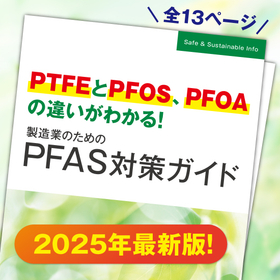
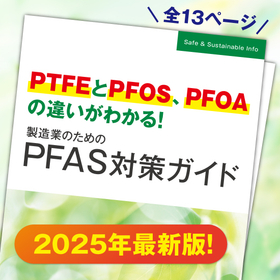
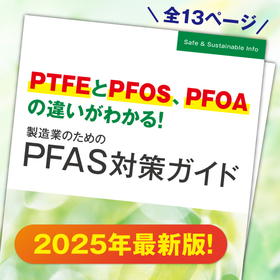
The "PFAS Countermeasure Guide for the Manufacturing Industry" is a guidebook that compiles essential information you should know about the latest trends in PFAS and alternative technologies as of 2025. It clearly explains the differences between PTFE, PFOS, and PFOA, which are surprisingly not well known, through comparison tables detailing their structures, properties, and toxicity. If you are interested, please feel free to download it. [Contents (excerpt)] ■ What is PFAS? ■ Latest trends in PFAS regulations ■ What should be done? Responding to regulations
Added to bookmarks
Bookmarks listBookmark has been removed
Bookmarks listYou can't add any more bookmarks
By registering as a member, you can increase the number of bookmarks you can save and organize them with labels.
Free membership registration
The technical document "Differences Between PTFE and PFA" provides a detailed explanation of PTFE, PFA, FEP, and ETFE, covering everything from molecular structure to properties. Fluoropolymers are well-known for their functionality, such as being non-stick and slippery, but many people may not be aware of their various types and differences. This single book allows you to thoroughly understand the differences and characteristics of each. If you are interested, please feel free to download it. [Contents (excerpt)] ■ Types and properties of fluoropolymers ■ Differences between PTFE and PFA / Overview of FEP and ETFE ■ Differences among four types of fluoropolymer coatings
Added to bookmarks
Bookmarks listBookmark has been removed
Bookmarks listYou can't add any more bookmarks
By registering as a member, you can increase the number of bookmarks you can save and organize them with labels.
Free membership registration
The "PFAS Countermeasure Guide for the Manufacturing Industry" is a comprehensive guidebook that consolidates essential information on the latest trends in PFAS regulations and alternative technologies that you should know as of 2025. It also clearly explains the differences between PTFE, PFOS, and PFOA, which are surprisingly not well-known, by summarizing their structures, properties, and toxicity in a comparison table. If you are interested, please feel free to check it out by clicking the catalog download button! 【Contents (excerpt)】 ■ What are PFAS? ■ Latest trends in PFAS regulations ■ What should be done? Responding to regulations
Added to bookmarks
Bookmarks listBookmark has been removed
Bookmarks listYou can't add any more bookmarks
By registering as a member, you can increase the number of bookmarks you can save and organize them with labels.
Free membership registration
The "PFAS Countermeasure Guide for the Manufacturing Industry" is a guidebook that consolidates essential information you need to know about the latest trends in PFAS and alternative technologies as of 2025. It clearly explains the differences between PTFE, PFOS, and PFOA, which are surprisingly not well known, through comparison tables that cover their structures, properties, and toxicity. If you are interested, please feel free to download it. [Contents (excerpt)] ■ What are PFAS? ■ Latest trends in PFAS regulations ■ What should be done? Responding to regulations
Added to bookmarks
Bookmarks listBookmark has been removed
Bookmarks listYou can't add any more bookmarks
By registering as a member, you can increase the number of bookmarks you can save and organize them with labels.
Free membership registration
The technical document "Differences Between PTFE and PFA" provides a detailed explanation of PTFE, PFA, FEP, and ETFE, covering everything from molecular structure to properties. Fluoropolymers are well-known for their functionality, such as being non-stick and slippery, but many people may not be aware of their various types and differences. This single volume allows for a thorough understanding of the differences and characteristics of each. If you are interested, please feel free to download it. [Contents (excerpt)] ■ Types and properties of fluoropolymers ■ Differences between PTFE and PFA / Overview of FEP and ETFE ■ Differences among four types of fluoropolymer coatings
Added to bookmarks
Bookmarks listBookmark has been removed
Bookmarks listYou can't add any more bookmarks
By registering as a member, you can increase the number of bookmarks you can save and organize them with labels.
Free membership registration
PTFE (polytetrafluoroethylene) is the most widely used fluoropolymer and is also known by the brand name "Teflon." It is a material with properties such as non-stickiness, low friction, chemical resistance, weather resistance, excellent electrical characteristics, and high heat resistance (maximum operating temperature of 260°C). In response to trends in PFAS regulation, we are advancing the development of coatings using alternatives such as silicone and other engineering plastics as substitutes for PTFE (fluoropolymer). By appropriately adopting these alternatives according to their applications, it is expected that desirable functions can be achieved. 【Characteristics】 ■ Alternative technologies utilizing super engineering plastics such as silicone, PEEK, and PI ■ Non-fluorinated coatings optimized for specific applications ■ Functionality tailored to applications, such as release properties, non-stickiness, and chemical resistance 【Non-Fluorinated Coating Product Lineup】 Yoshida SKT continues to develop products in collaboration with customers, offering new non-fluorinated coating products as options to address next-generation challenges. Together with conventional products, we are realizing a diverse lineup of PFAS-free options. For more details, please download the materials or check the related links.
Added to bookmarks
Bookmarks listBookmark has been removed
Bookmarks listYou can't add any more bookmarks
By registering as a member, you can increase the number of bookmarks you can save and organize them with labels.
Free membership registration
"The PFAS Countermeasures Guide for the Manufacturing Industry" is a comprehensive guidebook that consolidates essential information on the latest trends in PFAS and alternative technologies for 2025. It clearly explains the differences between PTFE, PFOS, and PFOA, which are surprisingly not well-known, through comparison tables detailing their structures, properties, and toxicity. Feel free to download it if you are interested. [Contents (excerpt)] ■ What are PFAS? ■ Latest trends in PFAS regulations ■ What should be done? Responding to regulations
Added to bookmarks
Bookmarks listBookmark has been removed
Bookmarks listYou can't add any more bookmarks
By registering as a member, you can increase the number of bookmarks you can save and organize them with labels.
Free membership registration