1~7 item / All 7 items
Displayed results

Added to bookmarks
Bookmarks listBookmark has been removed
Bookmarks listYou can't add any more bookmarks
By registering as a member, you can increase the number of bookmarks you can save and organize them with labels.
Free membership registration
Contact this company
Inquiry FormBefore making an inquiry
Download Profile1~7 item / All 7 items
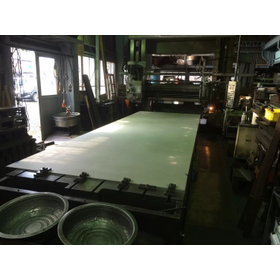
■Features of Planer Machining The "cutting tool" used in planer machining has the advantage of significantly reducing distortion and warping after processing compared to "rotating tools" like milling machines. Therefore, it is a suitable cutting method for workpieces that tend to accumulate processing stress, as described below. □ Long Workpieces With rotating tools, "warping" and "twisting" are more likely to occur. □ Difficult-to-Cut Materials High hardness materials tend to accumulate internal stress with rotating tools (such as stainless steel, Inconel, Hastelloy, titanium, etc.). □ Large Plates Workpieces measuring 6000mm x 2200mm Due to the gradual accumulation of stress according to size, the flatness and parallelism precision after processing is strict. □ Aging Changes Since it does not require straightening after processing, warping and bending are less likely to occur over time. □ Upper Structures, Avoidance Machining Workpieces with structures on top By tilting the tool holder, it is possible to perform cutting on areas where tools cannot enter from above. □ Thin-Walled Workpieces Thickness of 2mm Due to the linear motion of the tool itself not rotating, it is possible to perform cutting in the thickness direction of thin plates (approximately 2mm).
Added to bookmarks
Bookmarks listBookmark has been removed
Bookmarks listYou can't add any more bookmarks
By registering as a member, you can increase the number of bookmarks you can save and organize them with labels.
Free membership registration
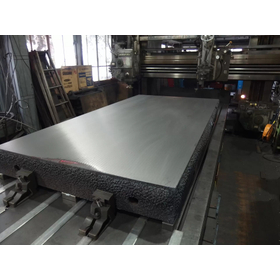
1. Recovery of Flatness The surface plate gradually deteriorates in flatness due to long-term use. Through regeneration processing, the flatness of the surface plate can be accurately restored, enabling high-precision machining. 2. Improvement of Surface Condition With long-term use, scratches and small unevenness occur on the surface of the surface plate. Regeneration processing can correct these defects and maintain a good surface condition of the surface plate. 3. Extension of Lifespan By applying appropriate regeneration, the lifespan of the surface plate can be significantly extended. Regular regrinding prevents early replacement of the surface plate and leads to cost savings. 4. Improvement of Machining Accuracy Improvements in flatness and surface condition enhance the accuracy of work performed on the surface plate. This enables the manufacturing of higher precision parts. 5. Simplification of Maintenance Regrinding makes daily maintenance easier. The frequency of required regular cleaning and adjustments decreases. By properly managing the surface plate and regularly regrinding it, long-term use becomes possible, leading to improvements in machining accuracy and work efficiency.
Added to bookmarks
Bookmarks listBookmark has been removed
Bookmarks listYou can't add any more bookmarks
By registering as a member, you can increase the number of bookmarks you can save and organize them with labels.
Free membership registration
For those struggling with warping, bending, or twisting after machining difficult materials in the meter class ■ Our unique technology Achieving flatness and parallelism within 0.3mm 1. Machining of non-warping base plates 2. Achieved through large-scale machining (up to 2200x6000) 3. Compatible with various steel types (stainless steel, Inconel, Hastelloy)
Added to bookmarks
Bookmarks listBookmark has been removed
Bookmarks listYou can't add any more bookmarks
By registering as a member, you can increase the number of bookmarks you can save and organize them with labels.
Free membership registration
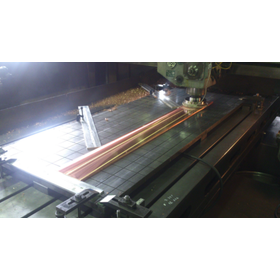
Proposal for Use Our company is engaged in large metal processing, but we have been troubled by the handling of metal shavings generated during processing. In particular, removing shavings that get lodged in the "T-slot" used to secure the workpiece takes a lot of effort and time. By covering and sealing only the T-slot, we have completely prevented the intrusion of shavings, resulting in a significant improvement in productivity (reducing the time for removing cutting debris to one-third).
Added to bookmarks
Bookmarks listBookmark has been removed
Bookmarks listYou can't add any more bookmarks
By registering as a member, you can increase the number of bookmarks you can save and organize them with labels.
Free membership registration
Our "gantry machining center" equipment has a gate width of 2100mm, allowing for the processing of large sputtering targets for semiconductors (over Φ660mm) and for LCD manufacturing (up to 2000x4000mm). Additionally, it features NC control with multi-axis AI correction capabilities, ensuring high repeatability and enabling the use of 3D measurement functions on the machine to guarantee the precision of processed products for all units. It is suitable for processing lots of approximately 1000 pieces per month. Furthermore, we have built a track record of processing various materials such as tin, aluminum, and copper in collaboration with multiple partner factories. 【Examples of Implementation】 ■ Silver sputtering target cutting processing ■ Copper sputtering target cutting processing (6N) ■ Tin sputtering target cutting processing (6N) - All measurement data attached - Mass production support - Degreasing, packaging, and nationwide transportation support *For more details, please visit our website or feel free to contact us.
Added to bookmarks
Bookmarks listBookmark has been removed
Bookmarks listYou can't add any more bookmarks
By registering as a member, you can increase the number of bookmarks you can save and organize them with labels.
Free membership registration
Our company specializes in precision machining of bases (platforms) for machine tools and paper-making machines, as well as large components used in these machines and parts for semiconductor manufacturing equipment. In particular, we can handle strict dimensional tolerances with difficult-to-machine materials such as heat-resistant alloys like Hastelloy, Inconel, and SUS304, which are widely used in semiconductor manufacturing equipment. We also utilize 3D CAD/CAM and simulations to ensure high-efficiency cutting. If you are facing challenges with large-scale machining or difficult-to-machine workpieces, please feel free to consult us. 【Features】 ■ Multiple machining centers equipped with high-torque spindles ■ Capable of meeting strict dimensional tolerances with difficult-to-machine materials ■ Utilizing 3D CAD/CAM and simulations for high-efficiency cutting *For more details, please refer to the PDF document or feel free to contact us.
Added to bookmarks
Bookmarks listBookmark has been removed
Bookmarks listYou can't add any more bookmarks
By registering as a member, you can increase the number of bookmarks you can save and organize them with labels.
Free membership registrationOur company processes using "backing plates" that are weaker in rigidity and hardness compared to other metals and non-ferrous metals, and are prone to oxidation. To further enhance the heat dissipation and heat resistance of the backing plates, we form water channels within them. In December 2016, we introduced a new 3D CAD/CAM system to expand our production capacity. By shortening the manufacturing process, we are able to achieve shorter delivery times and lower costs. 【Available Sizes】 ■ Up to 2000mm × 4000mm *Please contact us for more details.
Added to bookmarks
Bookmarks listBookmark has been removed
Bookmarks listYou can't add any more bookmarks
By registering as a member, you can increase the number of bookmarks you can save and organize them with labels.
Free membership registration