- Publication year : 2026
1~10 item / All 10 items
Displayed results
Added to bookmarks
Bookmarks listBookmark has been removed
Bookmarks listYou can't add any more bookmarks
By registering as a member, you can increase the number of bookmarks you can save and organize them with labels.
Free membership registrationContact this company
Inquiry Form1~10 item / All 10 items
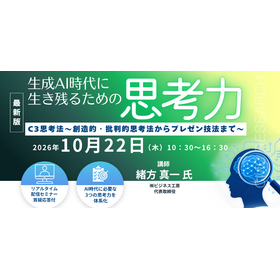
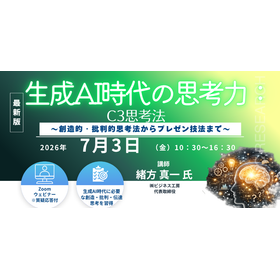
■Title: "Thinking Skills in the Age of Generative AI: C3 Thinking Method" --- What is the "human thinking ability" required in the age of generative AI? This seminar explains the "C3 Thinking Method," which systematizes creative thinking that expands ideas using AI, critical thinking that discerns AI results, and expressive skills that effectively communicate. ■Date and Time: April 21, 2026 (Tuesday) 10:30 AM - 4:30 PM ■Venue: Chiyoda Platform Square (tentative) 3-21 Kanda Nishikicho, Chiyoda-ku, Tokyo 101-0054 ■Target Audience for the Seminar - Planning, technical, and research professionals who want to utilize generative AI in their work - Individuals looking to enhance their thinking and presentation skills - Those who want to appropriately evaluate and utilize AI outputs ■Knowledge Gained from the Seminar - An overview of the thinking skills necessary in the age of generative AI - Specific methods and applications of creative thinking - Verification methods for AI results through critical thinking - Structuring and expression techniques for effective communication - Practical application skills of the C3 Thinking Method
Added to bookmarks
Bookmarks listBookmark has been removed
Bookmarks listYou can't add any more bookmarks
By registering as a member, you can increase the number of bookmarks you can save and organize them with labels.
Free membership registration
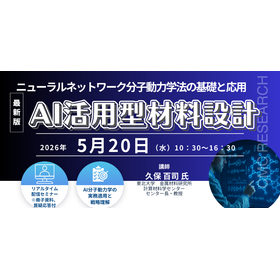
■Title: "Fundamentals and Applications of Neural Network Molecular Dynamics: AI-Driven Material Design" ――Solving issues of "calculations not working" and "uncertainty about applicability." This seminar organizes the fundamentals, strengths, limitations, and countermeasures of NNMD, providing a concrete explanation of implementation strategies for material development. ■Date and Time: May 20, 2026 (Wednesday) 10:30 AM – 4:30 PM ■Target Audience - Those who want to introduce NN molecular dynamics - Those who want to understand the differences and advantages compared to traditional MD - Those who want to acquire troubleshooting skills from the basics - Those who want to understand their strengths and weaknesses in applicable areas - Those who want to know the utilization strategies and directions for companies ■Knowledge Gained from the Seminar - Successful case studies of NN molecular dynamics - Comparison with traditional MD (features and advantages) - Fundamentals, methods, and computational procedures - Countermeasures for computational issues - Understanding of strengths and weaknesses in applicable areas - Direction and strategy for corporate utilization
Added to bookmarks
Bookmarks listBookmark has been removed
Bookmarks listYou can't add any more bookmarks
By registering as a member, you can increase the number of bookmarks you can save and organize them with labels.
Free membership registration
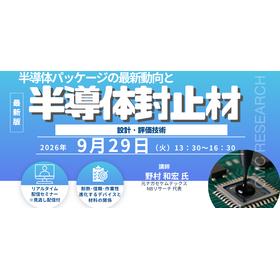
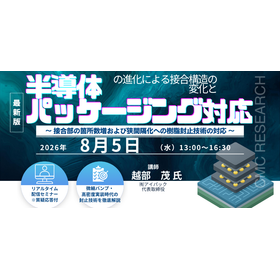
■Title: "Latest Trends in Semiconductor Packaging and Design/Evaluation Techniques for Semiconductor Encapsulation Materials" ――As chipletization and 3D packaging advance in semiconductors, more sophisticated material design for encapsulants is required than ever before. This seminar will provide a detailed practical perspective on the latest trends in semiconductor packaging, covering raw material selection, design techniques, and reliability evaluation of encapsulants. ■Date and Time: April 17, 2026 (Friday) 13:30–16:30 ■Target Audience: Designers of semiconductor encapsulation materials, engineers using semiconductor encapsulation materials, designers of epoxy resins and hardeners for semiconductor encapsulation materials ■Knowledge Gained from the Seminar: - Trends in semiconductor packaging - Knowledge about raw materials for semiconductor encapsulation materials - Design techniques for semiconductor encapsulation materials and evaluation techniques for semiconductor encapsulation materials
Added to bookmarks
Bookmarks listBookmark has been removed
Bookmarks listYou can't add any more bookmarks
By registering as a member, you can increase the number of bookmarks you can save and organize them with labels.
Free membership registration
■Title: "Latest Regulatory Trends and Requirements for Per- and Polyfluoroalkyl Substances (PFAS)" ―― PFAS responses cannot be dismissed with "I didn't know." Systematically organizing the latest developments such as the POPs Treaty, European PFAS restriction proposals, and state regulations in the United States. Providing specific explanations on practical responses that companies should take! ■Date and Time: April 16, 2026 (Thursday) 13:30 – 16:30 ■Target Audience for the Seminar Individuals in quality control, production, and development departments of various companies who wish to obtain the current status and latest information on PFAS regulations. ■Knowledge Gained from the Seminar - Basic properties and applications of PFAS - PFAS regulations and the latest developments in the UN, Europe, and the United States - Current status of chemical analysis related to PFAS - Past movements regarding mandatory measures for companies - Initiatives for PFAS management within companies
Added to bookmarks
Bookmarks listBookmark has been removed
Bookmarks listYou can't add any more bookmarks
By registering as a member, you can increase the number of bookmarks you can save and organize them with labels.
Free membership registration
A systematic explanation from the basics of semiconductor packaging to the design and evaluation of encapsulation materials. A leading expert thoroughly organizes practical perspectives from WLP/PLP to high thermal conductivity materials. ■ Title: Basic Information on Semiconductor Packaging Technology: Comprehensive Explanation ■ Date and Time: April 10, 2026 (Friday) 10:30 AM - 4:30 PM ■ Target Audience for the Seminar - Individuals involved in semiconductor packaging (sales, technology) - Those interested in semiconductor packaging technology - Those interested in semiconductor resin encapsulation and encapsulation materials ■ Knowledge Gained from the Seminar - Development history of semiconductor packaging (PKG) - Development history of semiconductor packaging technology (methods, materials) - Specifications of semiconductor encapsulation materials (raw materials, composition, manufacturing equipment, evaluation methods, etc.)
Added to bookmarks
Bookmarks listBookmark has been removed
Bookmarks listYou can't add any more bookmarks
By registering as a member, you can increase the number of bookmarks you can save and organize them with labels.
Free membership registration
■Title: "Flexible Substrates and FPC Formation Technology for 5G/6G - LCP-FCCL and Its Development" ――A must-see for developers of high-frequency FPCs. Provides knowledge useful for future FPC substrate design, from the key technologies for LCP multilayering to examples of new low-dielectric films. ■Date and Time: April 15, 2026 (Wednesday) 13:30 - 16:30 ■Target Audience for the Seminar Development engineers engaged in the development of high-frequency FPCs and their substrates ■Knowledge Gained from the Seminar ・Basic properties required for FPC substrates ・Reasons for using LCP and polyimide films in FPCs ・Key technologies for LCP multilayering ・Points to consider when processing LCP films ・Examples of hybridization methods between LCP and low-dielectric materials
Added to bookmarks
Bookmarks listBookmark has been removed
Bookmarks listYou can't add any more bookmarks
By registering as a member, you can increase the number of bookmarks you can save and organize them with labels.
Free membership registration
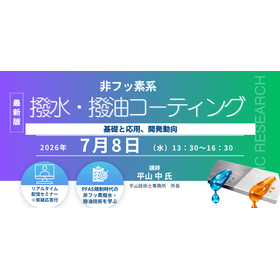
■Title: "Fluorine-Free Water and Oil Repellent Treatment Technology Achievable - Guidelines and Examples for Surface Design to Improve Wetting Fundamentals and Liquid Sliding Properties" As PFAS regulations accelerate, surface designs that achieve water and oil repellency without fluorine are gaining attention. This seminar will systematically explain the fundamentals of wetting, dynamic wettability evaluation, design guidelines for improving sliding properties, and the latest examples of fluorine-free surface treatments by leading researchers. ■Date and Time: April 14, 2026 (Tuesday) 13:30 - 16:30 ■Target Audience for the Seminar - Individuals engaged in surface treatment and modification operations - Those involved in research and development related to imparting water and oil repellency, stain resistance, and anti-adhesion properties to various substrate surfaces - Individuals engaged in research and development of fluorine (PFAS) alternative technologies and fluorine-free surface treatment and modification technologies ■Knowledge Gained from the Seminar - Fundamental knowledge/theory regarding wettability - Correct knowledge of wettability evaluation techniques (static/dynamic contact angle, contact angle hysteresis, sliding/falling angle) - Know-how for creating surfaces/interfaces with excellent water and oil repellency, stain resistance, and anti-adhesion properties without fluorine
Added to bookmarks
Bookmarks listBookmark has been removed
Bookmarks listYou can't add any more bookmarks
By registering as a member, you can increase the number of bookmarks you can save and organize them with labels.
Free membership registration
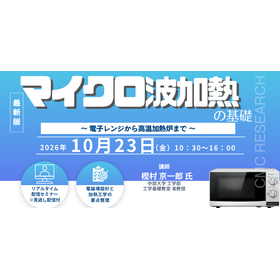
■Title: Basics of Microwave Heating - From Microwave Ovens to High-Temperature Furnaces - ■Date and Time: April 9, 2026 (Thursday) 10:30 AM - 4:00 PM ■Target Audience for the Seminar ・Engineers and researchers from companies considering the application of microwave chemistry ・Engineers and researchers considering adopting microwave heating technology for their own technologies ・Individuals engaged in chemical engineering processes such as heating and drying who wish to overcome current challenges ・Those looking to reduce process costs by accelerating firing and chemical reactions ■Knowledge Gained from the Seminar ・Basics of microwave heating ・Basics of microwave chemistry (fundamentals of chemical reactions using microwave ovens) ・Applications of microwave processes ・Design of microwave heating furnaces
Added to bookmarks
Bookmarks listBookmark has been removed
Bookmarks listYou can't add any more bookmarks
By registering as a member, you can increase the number of bookmarks you can save and organize them with labels.
Free membership registration
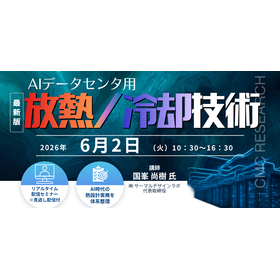
■Title: Heat Dissipation/Cooling Technology for AI Data Centers ■Date and Time: April 8, 2026 (Wednesday) 10:30 AM - 4:30 PM ■Target Audience for the Seminar Electronic equipment designers (assembly design, mechanical design, circuit design, board design), heat dissipation device/material developers, quality assurance, and quality control departments ■Knowledge Gained from the Seminar - Basic knowledge of heat transfer - Knowledge of heat dissipation in component and board design - Common methods for thermal design of forced air cooling and natural air cooling equipment - Thermal design methods for heat sinks, etc.
Added to bookmarks
Bookmarks listBookmark has been removed
Bookmarks listYou can't add any more bookmarks
By registering as a member, you can increase the number of bookmarks you can save and organize them with labels.
Free membership registration
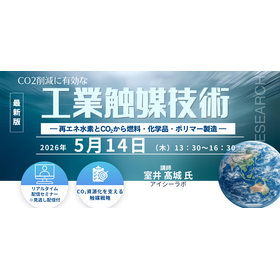
To effectively promote CO2 reduction, it is essential to develop catalytic processes that are not limited to laboratory-level reactions but can operate stably over the long term and be industrialized. The synthesis technologies for fuels, chemicals, and polymers using hydrogen derived from renewable energy and CO2 are crucial technologies for breaking away from dependence on fossil resources, and research, development, and implementation are accelerating globally. In the fuel sector, e-methanol and e-fuels synthesized from CO2 and hydrogen are gaining attention as decarbonization measures in the shipping and aviation industries, and the development of highly active and durable methanol synthesis catalysts and compact FT synthesis processes is underway. In the chemical sector, advancements are being made in reaction pathways, such as the reverse shift reaction that converts CO2 to carbon monoxide and the direct conversion to oxygen-containing compounds with two or more carbon atoms. Furthermore, in the polymer sector, the practical application of polycarbonate and polyurethane derived from CO2 is progressing, with molecular weight control and property enhancement through catalyst design becoming competitive factors. This overview aims to organize and introduce these technological trends from the perspective of industrial catalysts, hoping to contribute to the social implementation of future CO2 utilization technologies.
Added to bookmarks
Bookmarks listBookmark has been removed
Bookmarks listYou can't add any more bookmarks
By registering as a member, you can increase the number of bookmarks you can save and organize them with labels.
Free membership registration