136~180 item / All 285 items
Displayed results
Filter by category

Added to bookmarks
Bookmarks listBookmark has been removed
Bookmarks listYou can't add any more bookmarks
By registering as a member, you can increase the number of bookmarks you can save and organize them with labels.
Free membership registration
Contact this company
Inquiry FormBefore making an inquiry
Download Profile136~180 item / All 285 items
Filter by category

The direct current power circuits for monitoring and communication equipment in road and tunnel communication, emergency phones, and information display systems support equipment operation, but due to the dispersed installation locations, routine status checks can be cumbersome. The "iDC-SVS4" is a sensor that continuously measures direct current with options for 30A, 50A, 100A, 250A, and 500A, and sends the measurement data to a monitoring server. You can remotely check the current value, load fluctuations, and past history, and in combination with monitoring software, it can also respond to notifications based on set thresholds. It supports initial installation in our distribution boards and helps reduce on-site work through load testing and equipment settings before shipment. Usage scenarios: - Monitoring direct current for communication, emergency phones, and information display systems in roads and tunnels - Checking current values and history of direct current power circuits for monitoring and communication equipment - Confirming inspection targets and notification status before on-site visits Expected benefits from implementation: - Understanding current changes over time outside of patrols - Consolidating measurement information from multiple circuits for review - Organizing inspection targets and confirmation details in advance to streamline equipment management We will propose configurations based on monitoring targets, number of circuits, cable diameter, and installation environment.
Added to bookmarks
Bookmarks listBookmark has been removed
Bookmarks listYou can't add any more bookmarks
By registering as a member, you can increase the number of bookmarks you can save and organize them with labels.
Free membership registration
In monitoring direct current, it is important to select appropriate ratings for the target circuit and to have a configuration that can manage a large number of measurement points without difficulty. This is particularly true for observation stations on rivers and dams, as well as remote observation facilities in mountainous areas, where an increase in the number of circuits complicates the verification process. The "iDC-SVS4" continuously measures direct current with sensors that support 30A, 50A, 100A, 250A, and 500A, and sends the measurement data to a monitoring server. Current values, load fluctuations, and past history can be checked remotely, and in combination with monitoring software, it can also respond to notifications based on set thresholds. A single relay device can accommodate up to 1,024 points, allowing for an expansion of the monitoring range from important circuits to numerous circuits. Usage scenarios: - Monitoring direct current in observation stations on rivers and dams, and remote observation facilities in mountainous areas - Checking current values and history of direct power supply circuits for telemetry and communication devices - Confirming inspection targets and notification status before on-site visits Expected effects from implementation: - Understanding current changes over time outside of patrols - Consolidating measurement information from multiple circuits for review - Organizing inspection targets and confirmation details in advance to streamline equipment management We will propose configurations based on monitoring targets, number of circuits, cable diameter, and installation environment.
Added to bookmarks
Bookmarks listBookmark has been removed
Bookmarks listYou can't add any more bookmarks
By registering as a member, you can increase the number of bookmarks you can save and organize them with labels.
Free membership registration
Are you able to continuously monitor the direct current of government buildings, public facilities, and remote public equipment, not just during inspections? Relying solely on instantaneous measurements may overlook changes due to time of day or load conditions. The "iDC-SVS4" is a sensor that supports 30A, 50A, 100A, 250A, and 500A, allowing for continuous measurement of direct current and sending measurement data to a monitoring server. You can remotely check current values, load fluctuations, and past history, and in combination with monitoring software, it can also provide notifications based on set thresholds. In the event of communication failure, data is temporarily stored in a relay device and sent after communication resumes to help prevent loss of history. Usage scenarios: - Monitoring direct current in government buildings, public facilities, and remote public equipment - Checking current values and history of direct load circuits for emergency and backup power supplies - Verifying inspection targets and notification status before on-site visits Expected benefits from implementation: - Understanding current changes over time outside of patrols - Consolidating measurement information from multiple circuits - Organizing inspection targets and verification content in advance to streamline facility management We will propose configurations based on monitoring targets, number of circuits, cable diameter, and installation environment.
Added to bookmarks
Bookmarks listBookmark has been removed
Bookmarks listYou can't add any more bookmarks
By registering as a member, you can increase the number of bookmarks you can save and organize them with labels.
Free membership registration
Are you able to continuously monitor the direct current of mobile phone base stations and communication facilities, not just during inspections? Relying solely on instantaneous measurements may overlook changes due to time of day or load conditions. The "iDC-SVS4" is a sensor that supports 30A, 50A, 100A, 250A, and 500A, allowing for continuous measurement of direct current and sending measurement data to a monitoring server. You can remotely check the current value, load fluctuations, and past history, and in combination with monitoring software, it can also provide notifications based on set thresholds. It is compatible with initial installation in our distribution boards and supports the reduction of on-site work through load testing and equipment settings before shipment. Usage Scenarios: - Monitoring direct current of mobile phone base stations and communication facilities - Checking current values and history of direct load circuits for backup power supplies - Confirming inspection targets and notification status before on-site visits Expected Benefits from Implementation: - Understanding current changes over time outside of patrols - Consolidating measurement information from multiple circuits - Organizing inspection targets and confirmation details in advance to streamline facility management We will propose configurations based on monitoring targets, number of circuits, cable diameter, and installation environment.
Added to bookmarks
Bookmarks listBookmark has been removed
Bookmarks listYou can't add any more bookmarks
By registering as a member, you can increase the number of bookmarks you can save and organize them with labels.
Free membership registration
At disaster prevention bases and important facilities, measuring and recording the direct current circuit from the emergency power supply to the load equipment on-site takes time, making it difficult to grasp changes that occur between patrols. The "iDC-SVS4" continuously measures direct current with sensors that support 30A, 50A, 100A, 250A, and 500A, and sends the measurement data to a monitoring server. Current values, load fluctuations, and past history can be checked remotely, and in combination with monitoring software, it also supports notifications based on set thresholds. In the event of communication failure, data is temporarily stored in a relay device and sent after communication resumes to prevent loss of history. Usage scenarios: - Monitoring direct current at disaster prevention bases and important facilities - Checking current values and history of the direct current circuit from the emergency power supply to the load equipment - Confirming inspection targets and notification status before on-site visits Expected benefits from implementation: - Understanding current changes over time outside of patrols - Aggregating numerous measurement points into a common monitoring environment - Utilizing normal operation history as reference information for inspections and BCP verification We will propose configurations based on monitoring targets, number of circuits, cable diameter, and installation environment.
Added to bookmarks
Bookmarks listBookmark has been removed
Bookmarks listYou can't add any more bookmarks
By registering as a member, you can increase the number of bookmarks you can save and organize them with labels.
Free membership registration
The DC power supply circuits for telemetry and communication devices at observation stations for rivers and dams, as well as remote observation equipment in mountainous areas, support equipment operation but require considerable effort for regular status checks due to the dispersed installation locations. The "iDC-SVS4" continuously measures DC current with sensors that support 30A, 50A, 100A, 250A, and 500A, and sends the measurement data to a monitoring server. Current values, load fluctuations, and past histories can be checked remotely, and in combination with monitoring software, it can also provide notifications based on set thresholds. During communication outages, data is temporarily stored in a relay device and sent after communication resumes to prevent history loss. Usage scenarios: - Monitoring DC current at observation stations for rivers and dams and remote observation equipment in mountainous areas - Checking current values and history of the DC power supply circuits for telemetry and communication devices - Confirming inspection targets and notification statuses before on-site visits Expected benefits from implementation: - Understanding current changes over time outside of patrols - Consolidating measurement information from multiple circuits for review - Organizing inspection targets and confirmation details in advance to streamline equipment management We will propose configurations based on monitoring targets, number of circuits, cable diameter, and installation environment.
Added to bookmarks
Bookmarks listBookmark has been removed
Bookmarks listYou can't add any more bookmarks
By registering as a member, you can increase the number of bookmarks you can save and organize them with labels.
Free membership registration
When wireless relay stations in mountainous areas are distributed across multiple locations, the methods of verification and recording formats differ from site to site, making it time-consuming to grasp the overall status. The challenge is to consolidate numerous DC circuits into a common monitoring environment. The "iDC-SVS4" is a sensor that continuously measures DC current with support for 30A, 50A, 100A, 250A, and 500A, and sends the measurement data to a monitoring server. It allows remote confirmation of current values, load fluctuations, and past history, and in combination with monitoring software, it can respond to notifications based on set thresholds. In the event of communication failure, the relay device temporarily stores the data and sends it after communication resumes to prevent loss of history. Usage Scenarios: - Monitoring DC current at wireless relay stations in mountainous areas - Checking current values and history of DC circuits from emergency power supplies to communication equipment - Confirming inspection targets and notification status before on-site visits Expected Benefits from Implementation: - Understanding current changes over time outside of patrols - Consolidating measurement information from multiple circuits for review - Utilizing normal operation history as reference information for inspections and BCP verification We will propose configurations based on the monitoring targets, number of circuits, cable diameter, and installation environment.
Added to bookmarks
Bookmarks listBookmark has been removed
Bookmarks listYou can't add any more bookmarks
By registering as a member, you can increase the number of bookmarks you can save and organize them with labels.
Free membership registration
Before implementation, it is necessary to visit disaster prevention wireless base stations and wireless relay stations to measure current and manually record the results. After implementation, direct current for each circuit can be checked remotely, and the history can be treated as common data. The "iDC-SVS4" is a sensor that continuously measures direct current with support for 30A, 50A, 100A, 250A, and 500A, and sends the measurement data to a monitoring server. Current values, load fluctuations, and past history can be checked remotely, and in combination with monitoring software, it can also respond to notifications based on set thresholds. It supports initial installation in our distribution boards and assists in reducing on-site work through load testing and equipment settings before shipment. Usage scenarios: - Monitoring direct current at disaster prevention wireless base stations and wireless relay stations - Checking current values and history of direct circuits supplying power to communication equipment - Notifications based on set thresholds and checking history before and after notifications Expected effects from implementation: - Understanding current changes over time outside of patrols - Early detection of current changes that differ from normal conditions - Utilizing normal history as reference information for inspections and BCP verification We will propose configurations based on monitoring targets, number of circuits, cable diameter, and installation environment.
Added to bookmarks
Bookmarks listBookmark has been removed
Bookmarks listYou can't add any more bookmarks
By registering as a member, you can increase the number of bookmarks you can save and organize them with labels.
Free membership registration
At disaster prevention bases and important facilities, changes in current during inspection intervals and data loss during communication outages can complicate the understanding of conditions. If there are no remaining values from normal times, it becomes difficult to compare changes. The "iDC-SVS4" is a sensor that continuously measures direct current with support for 30A, 50A, 100A, 250A, and 500A, and sends the measurement data to a monitoring server. Current values, load fluctuations, and past histories can be checked remotely, and in combination with monitoring software, it can also respond to notifications based on set thresholds. A single relay device can accommodate up to 1,024 points, allowing the monitoring range to be expanded from important circuits to multiple circuits. Usage scenarios: - Monitoring direct current at disaster prevention bases and important facilities - Checking current values and histories of direct circuits from emergency power supplies to load equipment - Confirming inspection targets and notification statuses before on-site visits Expected effects from implementation: - Understanding current changes over time outside of patrols - Consolidating measurement information from multiple circuits for review - Utilizing normal time histories as reference information for inspections and BCP verification We will propose configurations based on monitoring targets, number of circuits, cable diameter, and installation environment.
Added to bookmarks
Bookmarks listBookmark has been removed
Bookmarks listYou can't add any more bookmarks
By registering as a member, you can increase the number of bookmarks you can save and organize them with labels.
Free membership registration
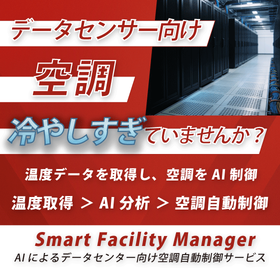
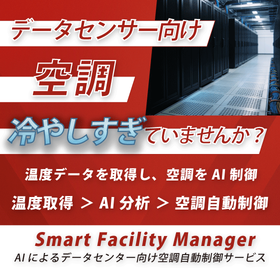
In server rooms and communication equipment rooms within buildings, temperature management is essential based on the addition of equipment and usage conditions. "Smart Facility Manager" is a service that supports the efficiency of air conditioning operations by automatically controlling air conditioning based on temperature data from the facility environment using AI, leading to energy savings through reduced air conditioning power and alleviating the burden of manual adjustments through AI-driven automatic control. We will check the status of the target equipment and provide individual proposals for feasibility and configuration. For more details, please download the materials and check.
Added to bookmarks
Bookmarks listBookmark has been removed
Bookmarks listYou can't add any more bookmarks
By registering as a member, you can increase the number of bookmarks you can save and organize them with labels.
Free membership registration
To streamline the inspection of water purification plants, sewage treatment plants, and water distribution reservoirs, it is effective to identify equipment with changes from current history and prioritize them, rather than checking all circuits at the same frequency. The "iDC-SVS4" continuously measures direct current with sensors compatible with 30A, 50A, 100A, 250A, and 500A, and sends the measurement data to a monitoring server. It allows remote confirmation of current values, load fluctuations, and past history, and, in combination with monitoring software, supports notifications based on set thresholds. It is compatible with initial installation in our distribution boards and assists in reducing on-site work through load testing and equipment settings before shipment. Usage scenarios: - Monitoring direct current in water purification plants, sewage treatment plants, and water distribution reservoirs - Checking current values and history of direct current circuits in control panels, monitoring panels, and communication devices - Confirming inspection targets and notification status before on-site visits Expected effects from implementation: - Understanding current changes over time outside of patrols - Consolidating measurement information from multiple circuits for review - Organizing inspection targets and confirmation details in advance to streamline equipment management We will propose configurations based on the monitoring targets, number of circuits, cable diameter, and installation environment.
Added to bookmarks
Bookmarks listBookmark has been removed
Bookmarks listYou can't add any more bookmarks
By registering as a member, you can increase the number of bookmarks you can save and organize them with labels.
Free membership registration
When introducing DC current monitoring for equipment using a DC power supply, it is necessary to check the current range, cable diameter, number of circuits, panel space, and communication pathways, and to select a configuration suitable for the DC distribution board and load equipment circuits. The "iDC-SVS4" continuously measures DC current with sensors that support 30A, 50A, 100A, 250A, and 500A, and sends the measurement data to a monitoring server. Current values, load fluctuations, and past history can be checked remotely, and in combination with monitoring software, it can also respond to notifications based on set thresholds. A single relay device can accommodate up to 1,024 points, allowing the monitoring range to be expanded from important circuits to numerous circuits. Usage scenarios: - Monitoring DC current for equipment using a DC power supply - Checking current values and history of DC distribution boards and load equipment circuits - Continuous measurement during network construction or server maintenance Expected benefits from implementation: - Understanding current changes over time outside of patrols - Sending saved data after communication resumes to suppress history loss - Organizing inspection targets and confirmation contents in advance to streamline equipment management We will propose configurations based on the monitoring targets, number of circuits, cable diameter, and installation environment.
Added to bookmarks
Bookmarks listBookmark has been removed
Bookmarks listYou can't add any more bookmarks
By registering as a member, you can increase the number of bookmarks you can save and organize them with labels.
Free membership registration
In the preservation of disaster prevention bases and important facilities, not only the temporary values during inspections but also the time-series data of direct current accumulated during normal times serve as fundamental information for determining changes. The "iDC-SVS4" continuously measures direct current with sensors compatible with 30A, 50A, 100A, 250A, and 500A, and sends the measurement data to a monitoring server. Current values, load fluctuations, and past histories can be checked remotely, and in combination with monitoring software, it can also respond to notifications based on set thresholds. In the event of communication failure, data is temporarily stored in a relay device and sent after communication resumes to help prevent loss of history. Usage scenarios: - Monitoring direct current at disaster prevention bases and important facilities - Checking current values and histories of direct circuits from emergency power supplies to load equipment - Confirming inspection targets and notification statuses before on-site visits Expected effects from implementation: - Understanding current changes over time outside of patrols - Aggregating numerous measurement points into a common monitoring environment - Utilizing normal time histories as reference information for inspections and BCP confirmations We will propose configurations based on the monitoring targets, number of circuits, cable diameters, and installation environments. Applicability varies depending on current range, cable diameter, and installation/communication environments.
Added to bookmarks
Bookmarks listBookmark has been removed
Bookmarks listYou can't add any more bookmarks
By registering as a member, you can increase the number of bookmarks you can save and organize them with labels.
Free membership registration
With the update of the in-house communication infrastructure, adding servers and edge equipment will also change the heat generation and temperature distribution. The "Smart Facility Manager" collects and analyzes temperature data from the equipment environment, and the AI automatically controls the air conditioning according to the condition of the equipment. Since it may be possible to utilize existing air conditioning systems, we propose configurations tailored to the equipment conditions for facilities that want to review their cooling operations alongside the renewal of the communication infrastructure. For more details, please download the materials and check.
Added to bookmarks
Bookmarks listBookmark has been removed
Bookmarks listYou can't add any more bookmarks
By registering as a member, you can increase the number of bookmarks you can save and organize them with labels.
Free membership registration
The addition and densification of servers and routers can lead to localized temperature increases and imbalances in cooling loads in equipment rooms. "Smart Facility Manager" collects and analyzes temperature data from the facility environment, and AI automatically controls the air conditioning based on the situation. It ensures necessary cooling while minimizing excessive cooling, supporting the review of temperature management and air conditioning operations after expansion. The applicability to existing air conditioning systems will be provided after confirming the model and equipment conditions. For details, please download the materials and check.
Added to bookmarks
Bookmarks listBookmark has been removed
Bookmarks listYou can't add any more bookmarks
By registering as a member, you can increase the number of bookmarks you can save and organize them with labels.
Free membership registration
In managing server rooms and communication equipment rooms, it is important to continuously monitor the temperature and air conditioning conditions and operate according to the equipment environment. "Smart Facility Manager" is a service that supports equipment operation not solely relying on the experience of personnel by analyzing the acquired temperature data and performing automatic air conditioning control using AI as needed. For more details, please download the materials and check.
Added to bookmarks
Bookmarks listBookmark has been removed
Bookmarks listYou can't add any more bookmarks
By registering as a member, you can increase the number of bookmarks you can save and organize them with labels.
Free membership registration
In the communication systems for roads and tunnels, emergency phones, and information display equipment, it takes time to measure and record the direct current power supply circuits of monitoring and communication devices on-site, making it difficult to grasp changes that occur between patrols. The "iDC-SVS4" continuously measures direct current with sensors that support 30A, 50A, 100A, 250A, and 500A, and sends the measurement data to a monitoring server. Current values, load fluctuations, and past histories can be checked remotely, and in combination with monitoring software, it can also respond to notifications based on set thresholds. A single relay device can accommodate up to 1,024 points, allowing the monitoring range to be expanded from important circuits to numerous circuits. Usage scenarios: - Monitoring direct current for communication systems, emergency phones, and information display equipment in roads and tunnels - Checking current values and history of direct current power supply circuits for monitoring and communication devices - Confirming inspection targets and notification statuses before on-site visits Expected benefits from implementation: - Grasping current changes over time outside of patrols - Summarizing measurement information from multiple circuits for review - Organizing inspection targets and confirmation details in advance to streamline equipment management We will propose configurations based on monitoring targets, number of circuits, cable diameter, and installation environment.
Added to bookmarks
Bookmarks listBookmark has been removed
Bookmarks listYou can't add any more bookmarks
By registering as a member, you can increase the number of bookmarks you can save and organize them with labels.
Free membership registration
The introduction of a remote monitoring system for data centers requires a comprehensive design and adjustment process that spans multiple stages, including organizing monitoring targets and measurement points, selecting equipment, installation work, software configuration, and operational verification. This service provides total support from on-site surveys to configuration proposals, equipment procurement, construction, settings, and pre-operation checks, facilitating a smooth implementation. 【Usage Scenarios】 - New introduction of a remote monitoring system for data centers - Addition of monitoring equipment and measurement points to existing server rooms - Retrofitting sensors to existing distribution boards and server racks 【Implementation Benefits】 - Improved efficiency in process management through centralized contact for implementation - Reduced adjustment load related to equipment, construction, and settings - Support for the smooth launch and start of operations of the monitoring system For more details, please refer to the documentation.
Added to bookmarks
Bookmarks listBookmark has been removed
Bookmarks listYou can't add any more bookmarks
By registering as a member, you can increase the number of bookmarks you can save and organize them with labels.
Free membership registration
To streamline the inspection of disaster prevention bases and important facilities, it is effective to identify equipment with changes from current history and prioritize them, rather than checking all circuits at the same frequency. The "iDC-SVS4" is a sensor that supports 30A, 50A, 100A, 250A, and 500A, continuously measuring direct current and sending the measurement data to a monitoring server. It allows remote confirmation of current values, load fluctuations, and past history, and, in combination with monitoring software, can respond to notifications based on set thresholds. In the event of communication failure, data is temporarily stored in the relay device and sent after communication resumes to help prevent loss of history. Usage scenarios: - Monitoring direct current at disaster prevention bases and important facilities - Checking current values and history of direct circuits from emergency power supplies to load equipment - Confirming inspection targets and notification status before on-site visits Expected effects from implementation: - Comparing current trends before and after changes in time periods and operations - Consolidating measurement information from multiple circuits for review - Utilizing normal operation history as reference information for inspections and BCP verification We will propose configurations based on monitoring targets, number of circuits, cable diameters, and installation environments.
Added to bookmarks
Bookmarks listBookmark has been removed
Bookmarks listYou can't add any more bookmarks
By registering as a member, you can increase the number of bookmarks you can save and organize them with labels.
Free membership registration
In facilities responsible for interconnecting data centers, appropriate management of temperature and air conditioning is essential for the stable operation of internal server equipment. "Smart Facility Manager" collects and analyzes temperature data from the facility environment, and AI automatically controls the air conditioning according to the indoor environment, helping to reduce excessive cooling and improve the efficiency of air conditioning operations. In implementation cases, there are examples of reducing annual average air conditioning electricity consumption by about 30%. *Results may vary depending on equipment conditions, load situations, and operational conditions. For details, please download the materials and check.
Added to bookmarks
Bookmarks listBookmark has been removed
Bookmarks listYou can't add any more bookmarks
By registering as a member, you can increase the number of bookmarks you can save and organize them with labels.
Free membership registration
In base stations and communication facilities, it is necessary to reliably distribute DC-48V power to each communication device while ensuring protection functions and alarm configurations according to equipment requirements. The IBS is a distribution board that supports the branching supply of DC-48V power for communication use. The number of branches, alarm fuses, and enclosure specifications can be individually designed to match installation conditions and power supply requirements. 【Usage Scenarios】 - DC power equipment for 5G base stations and communication facilities - DC-48V branching power supply to communication racks and transmission devices - Upgrading and expanding existing DC-48V equipment 【Implementation Benefits】 - Stable distribution of DC power to communication equipment - Optimization of the number of branches and alarm configurations according to equipment requirements - Support for designing power configurations with future equipment expansions in mind Specifications and configurations vary depending on equipment requirements. Please refer to the documentation for details.
Added to bookmarks
Bookmarks listBookmark has been removed
Bookmarks listYou can't add any more bookmarks
By registering as a member, you can increase the number of bookmarks you can save and organize them with labels.
Free membership registration
In energy-efficient operation of data centers, it is important to continuously monitor not only the overall power consumption of the equipment but also the power usage on a circuit-by-circuit basis. The PAL-Plus type E measures alternating current, simple power, and simple accumulated energy by circuit, providing the necessary data for analyzing equipment loads and verifying the effectiveness of energy-saving measures. Due to its split clamp design, it can also accommodate retrofitting measurements to existing wiring. 【Usage Scenarios】 - Circuit-by-circuit power monitoring in data center PDUs and distribution boards - Understanding load trends and power usage in server rooms - Comparing power data before and after implementing energy-saving measures 【Implementation Benefits】 - Visualization of power usage trends by circuit - Support for power cost analysis and consideration of energy-saving measures - Expansion of monitoring data for existing equipment For detailed specifications, system configuration, and implementation methods, please refer to the documentation.
Added to bookmarks
Bookmarks listBookmark has been removed
Bookmarks listYou can't add any more bookmarks
By registering as a member, you can increase the number of bookmarks you can save and organize them with labels.
Free membership registration
For the stable operation of server racks and PDUs, it is important to understand the current values for each branch circuit and to continuously monitor load imbalances and changes over time. The PAL-Plus 60A measures the AC current of rack branch circuits and transmits data to the monitoring system via Modbus RTU. It adopts a compact split clamp design, making it suitable for adding to existing equipment with limited panel space. 【Usage Scenarios】 - Current monitoring in server rack branch circuits - Checking load conditions around PDUs and UPSs - Multi-point current measurement in communication racks 【Implementation Benefits】 - Visualization of load conditions at the rack and circuit level - Support for understanding changes due to load imbalances or equipment configuration changes - Capability to add monitoring points in limited panel space For detailed specifications, system configurations, and implementation methods, please refer to the documentation.
Added to bookmarks
Bookmarks listBookmark has been removed
Bookmarks listYou can't add any more bookmarks
By registering as a member, you can increase the number of bookmarks you can save and organize them with labels.
Free membership registration
If the UPS battery maintenance plan is formulated solely based on the number of years since installation, it may not adequately reflect the differences in individual battery conditions and usage environments. This system continuously monitors internal resistance, voltage, and temperature remotely, utilizing measurement history and threshold information for selecting inspection targets and determining replacement timing. It can be retrofitted to existing battery systems. 【Usage Scenarios】 - Monitoring the condition of UPS batteries in data centers - Remote management of batteries installed in communication facilities and multiple locations - Narrowing down inspection targets and formulating replacement plans 【Implementation Benefits】 - Continuous remote understanding of battery conditions - Supporting improved objectivity in inspection and replacement decisions - Enhancing preventive maintenance and maintenance records using measurement history For detailed specifications, system configuration, and installation conditions, please refer to the documentation.
Added to bookmarks
Bookmarks listBookmark has been removed
Bookmarks listYou can't add any more bookmarks
By registering as a member, you can increase the number of bookmarks you can save and organize them with labels.
Free membership registration
When introducing direct current monitoring to disaster prevention bases and important facilities, it is necessary to check the current range, cable diameter, number of circuits, panel space, and communication routes, and to select a configuration suitable for the direct current circuit from the emergency power supply to the load equipment. The "iDC-SVS4" is a sensor that continuously measures direct current with support for 30A, 50A, 100A, 250A, and 500A, and sends the measurement data to a monitoring server. Current values, load fluctuations, and past history can be checked remotely, and in combination with monitoring software, it also supports notifications based on set thresholds. It is compatible with initial installation in our distribution boards and helps reduce on-site work through load testing and equipment configuration before shipment. Usage Scenarios: - Direct current monitoring at disaster prevention bases and important facilities - Checking current values and history of direct circuits from emergency power supplies to load equipment - Confirming inspection targets and notification status before on-site visits Expected Benefits from Implementation: - Understanding current changes over time outside of patrols - Consolidating measurement information from multiple circuits for review - Utilizing normal operation history as reference information for inspections and BCP verification We will propose configurations based on monitoring targets, number of circuits, cable diameter, and installation environment.
Added to bookmarks
Bookmarks listBookmark has been removed
Bookmarks listYou can't add any more bookmarks
By registering as a member, you can increase the number of bookmarks you can save and organize them with labels.
Free membership registration
In monitoring direct current, it is important to select ratings that match the target circuit and to have a configuration that can manage a large number of measurement points without difficulty. In urban infrastructure such as railways, roads, and water supply and drainage systems, the increase in the number of circuits complicates the verification process. The "iDC-SVS4" continuously measures direct current with sensors that support 30A, 50A, 100A, 250A, and 500A, and sends the measurement data to a monitoring server. Current values, load fluctuations, and past history can be checked remotely, and in combination with monitoring software, it can also respond to notifications based on set thresholds. It supports initial installation in our distribution boards and helps reduce on-site work through load testing and equipment settings before shipment. Usage scenarios: - Monitoring direct current in urban infrastructure such as railways, roads, and water supply and drainage systems - Checking current values and history of direct circuits in monitoring, communication, and control equipment - Confirming inspection targets and notification status before on-site visits Expected effects from implementation: - Comparing current trends before and after changes in time zones, periods, and operations - Summarizing measurement information from multiple circuits for review - Organizing inspection targets and confirmation details in advance to streamline equipment management We will propose configurations based on monitoring targets, the number of circuits, cable diameters, and installation environments.
Added to bookmarks
Bookmarks listBookmark has been removed
Bookmarks listYou can't add any more bookmarks
By registering as a member, you can increase the number of bookmarks you can save and organize them with labels.
Free membership registration
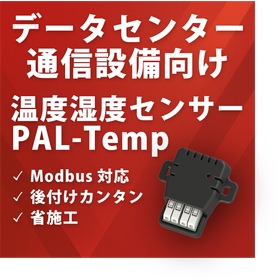
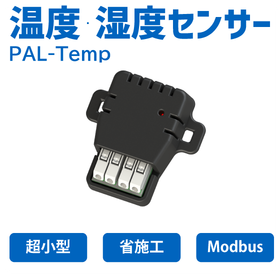
In data centers and server rooms, measuring only representative points indoors may not capture localized heat buildup and temperature variations around racks. PAL-Temp is a compact Modbus-compatible sensor that can measure temperature and humidity at multiple points. It can be placed in locations suitable for monitoring purposes, such as the intake and exhaust sides of racks, under the floor, and around air conditioning outlets. 【Usage Scenarios】 - Comparison of temperature and humidity between the intake and exhaust sides of racks - Environmental monitoring around the floor and air conditioning outlets - Multi-point measurement in communication equipment rooms and server rooms 【Implementation Benefits】 - Visualization of localized heat buildup and temperature variations - Acquisition of data to consider air conditioning settings and airflow improvements - Support for continuous monitoring of equipment environments and understanding changes For detailed specifications, system configurations, and implementation methods, please refer to the documentation.
Added to bookmarks
Bookmarks listBookmark has been removed
Bookmarks listYou can't add any more bookmarks
By registering as a member, you can increase the number of bookmarks you can save and organize them with labels.
Free membership registration
To streamline the inspection of disaster prevention wireless base stations and wireless relay stations, it is effective to identify equipment with changes from current history and prioritize them, rather than checking all circuits at the same frequency. The "iDC-SVS4" continuously measures direct current with sensors compatible with 30A, 50A, 100A, 250A, and 500A, and sends the measurement data to a monitoring server. Current values, load fluctuations, and past history can be checked remotely, and in combination with monitoring software, it can also respond to notifications based on set thresholds. A single relay device can accommodate up to 1,024 points, allowing for an expanded monitoring range from important circuits to numerous circuits. Usage scenarios: - Monitoring direct current at disaster prevention wireless base stations and wireless relay stations - Checking current values and history of direct circuits supplying power to communication equipment - Notifications based on set thresholds and checking history before and after notifications Expected effects from implementation: - Understanding current changes over time outside of patrols - Early detection of current changes that differ from normal conditions - Utilizing normal history as reference information for inspections and BCP verification We will propose configurations based on monitoring targets, number of circuits, cable diameter, and installation environment.
Added to bookmarks
Bookmarks listBookmark has been removed
Bookmarks listYou can't add any more bookmarks
By registering as a member, you can increase the number of bookmarks you can save and organize them with labels.
Free membership registration
PAL-Plus is an IoT sensor with built-in communication functionality that measures AC current up to 60A. Key Features Supports Modbus RTU for easy integration with existing systems. Split-clamp design allows safe and simple installation without stopping operations. Built-in communication enables ultra-compact size, making multi-point installation easy. Combined with the PAL-Plus Unit, a gateway that converts sensor signals to Modbus RTU and supplies power, you can build space-saving and cost-effective systems. For details, download the brochure or contact us. Rental units are also available. For sensors over 60A, please refer to the PAL-Plus High-Capacity Model page.
Added to bookmarks
Bookmarks listBookmark has been removed
Bookmarks listYou can't add any more bookmarks
By registering as a member, you can increase the number of bookmarks you can save and organize them with labels.
Free membership registration
When selecting PDUs for data centers, it is necessary to organize equipment requirements not only by capacity but also by input voltage, secondary voltage, transformer configuration, harmonic mitigation, and measurement and monitoring functions. This PDU supports three-phase 200V and 400V input and 100 to 600 kVA, and allows for custom designs incorporating transformers, measuring instruments, and monitoring systems according to power supply conditions. 【Usage Scenarios】 - PDU upgrades for medium to large data centers - Additional power capacity due to server equipment expansion - Construction of AC distribution equipment with power measurement and monitoring functions 【Implementation Effects】 - Building PDU specifications that fit input conditions and load configurations - Integrating large capacity power supply with power monitoring functions - Supporting equipment design with scalability considering future load expansions Specifications and configurations may vary based on equipment requirements. Please refer to the documentation for details.
Added to bookmarks
Bookmarks listBookmark has been removed
Bookmarks listYou can't add any more bookmarks
By registering as a member, you can increase the number of bookmarks you can save and organize them with labels.
Free membership registration
In 5G base stations and outdoor communication equipment, it is necessary to efficiently accommodate functions such as optical connector connections, fusion connections, and cable excess storage within limited installation space. This product is an outdoor optical termination box that supports 4 to 24 fibers. It consolidates the optical wiring around the base station and allows for integrated management of connection points and excess cable. 【Usage Scenarios】 - Optical cable entry points for 5G base stations and wireless communication equipment - Connection and fusion of optical cables around outdoor panels - Optical termination associated with the expansion or upgrade of base stations 【Implementation Benefits】 - Integration of optical connector connections, fusion connections, and excess storage - Consolidation and organization of optical wiring in confined spaces - Support for improved workability and maintainability of outdoor optical wiring construction For detailed specifications, housing configurations, and installation conditions, please refer to the documentation.
Added to bookmarks
Bookmarks listBookmark has been removed
Bookmarks listYou can't add any more bookmarks
By registering as a member, you can increase the number of bookmarks you can save and organize them with labels.
Free membership registration
Retrofitting current monitoring in high-density data centers requires site checks, mounting-position coordination, equipment procurement, installation, and software setup—often across multiple vendors. Our service supports sensor installation and monitoring-software launch for rack-area equipment, reducing deployment workload and organizing the steps through operational start-up. Use cases • Installing current sensors on data-center rack equipment • Deploying monitoring aligned with cable, rack, and tray plans • Building centralized visibility across multiple racks Business benefits • Integrated site survey, procurement, installation, and configuration • Reduced coordination burden across project stakeholders • Smoother operational start-up through functional testing
Added to bookmarks
Bookmarks listBookmark has been removed
Bookmarks listYou can't add any more bookmarks
By registering as a member, you can increase the number of bookmarks you can save and organize them with labels.
Free membership registration
Before the full-scale introduction of the equipment monitoring system, a Proof of Concept (PoC) will be conducted by limiting the target equipment and monitoring points, allowing for a concrete verification of the necessary measurement items, data utilization methods, and operational structure. The Gateway BOX is a gateway that combines the necessary functions for using PAL series sensors and the cloud, enabling the establishment of a small-scale equipment monitoring environment. 【Usage Scenarios】 - PoC for data center equipment monitoring - Preliminary verification of power visualization targeting critical circuits - Small-scale monitoring in communication equipment and edge locations 【Implementation Effects】 - Verification of monitoring effectiveness by limiting target equipment - Organization of monitoring points and operational methods necessary for full-scale implementation - Support for consideration of system configuration and implementation scale based on verification results For detailed specifications, system configuration, and cloud functions, please refer to the materials.
Added to bookmarks
Bookmarks listBookmark has been removed
Bookmarks listYou can't add any more bookmarks
By registering as a member, you can increase the number of bookmarks you can save and organize them with labels.
Free membership registration
In high-capacity circuits of data center PDUs and distribution boards, understanding not only the current values but also the simplified power consumption per circuit and the load imbalance between phases is fundamental to equipment capacity management. The PAL-Plus type E2 supports single-phase three-wire and three-phase three-wire circuits, measuring AC currents from 125A to 630A, as well as simplified power and simplified cumulative power consumption. The measurement data can be utilized for load analysis and equipment capacity planning. 【Usage Scenarios】 - Main and branch circuits of data center PDUs - Power monitoring of high-capacity distribution boards and equipment trunk lines - Load analysis of single-phase three-wire and three-phase three-wire circuits 【Benefits of Implementation】 - Visualization of power usage trends in high-capacity circuits - Support for understanding load imbalances between phases - Acquisition of data necessary for equipment capacity planning and expansion decisions For detailed specifications, system configuration, and implementation methods, please refer to the documentation.
Added to bookmarks
Bookmarks listBookmark has been removed
Bookmarks listYou can't add any more bookmarks
By registering as a member, you can increase the number of bookmarks you can save and organize them with labels.
Free membership registration
In factory equipment inspections, it is important to continuously monitor not only the current and operational status but also the temperature and humidity around the equipment. Even if no abnormalities are found during inspections, increases in temperature within the control panel, changes in air conditioning conditions, and localized increases in humidity may manifest in advance as changes in the equipment environment. "PAL-Temp" is a compact sensor with built-in communication functions that can measure temperature and humidity in control panels, around manufacturing equipment, and in machine rooms. It supports Modbus RTU, allowing for integration with existing monitoring software and gateways. Its compact design, which can be installed using cable ties, is also suitable for adding temperature and humidity measurement points to existing equipment. 【Challenges】 Want to continuously monitor the temperature and humidity around control panels and equipment. Temporary checks during patrols make it difficult to capture environmental changes. Want to check the temperature and humidity history around the equipment when abnormalities occur. 【Implementation Effects】 Confirm the temperature and humidity around control panels and equipment in numerical form. Capture temperature and humidity changes that occur outside of inspections as a history. Add information to check the equipment environment before and after abnormal occurrences. For more details, please download the PDF document or contact us.
Added to bookmarks
Bookmarks listBookmark has been removed
Bookmarks listYou can't add any more bookmarks
By registering as a member, you can increase the number of bookmarks you can save and organize them with labels.
Free membership registration
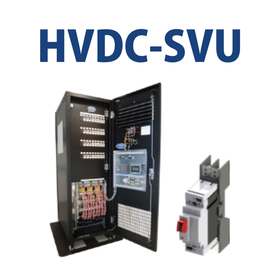
The direct current power supply equipment in data centers requires a branching configuration that considers not only power supply efficiency but also maintainability, protection coordination, and future load expansion. The HVDC-SVU is a distribution board compatible with high-voltage direct current power supply systems such as HVDC and DC380V. Depending on the equipment capacity and branching requirements, the number of branch circuits and the configuration of circuit breakers can be designed individually. 【Usage Scenarios】 - Data centers adopting HVDC power supply methods - New installation and renewal of DC380V power supply equipment - Addition of direct current branch circuits due to server equipment expansion 【Implementation Effects】 - Supports the construction of a highly efficient direct current power supply system - Achieves branching and protection configurations that meet equipment conditions - Ensures scalability considering future load expansion Detailed specifications vary depending on equipment requirements. Please check the materials and contact us for inquiries.
Added to bookmarks
Bookmarks listBookmark has been removed
Bookmarks listYou can't add any more bookmarks
By registering as a member, you can increase the number of bookmarks you can save and organize them with labels.
Free membership registration
In the data center industry, under the Energy Conservation Law's benchmark system, data center operators that meet certain requirements are required to report their PUE regularly, with a target level of PUE below 1.4 set for the fiscal year 2030. In response to this trend, the establishment of a monitoring system utilizing PUE visualization, power monitoring, and alarm notifications has become an essential effort to balance energy conservation promotion and stable operations. On the other hand, implementing a remote monitoring system in a data center requires a wide range of processes, including on-site surveys, proposals, sensor installation work, server and software configuration, and operational checks, which can often be a significant burden for those in charge of implementation. Hexacore Inc. provides a one-stop solution for this entire series of processes, significantly reducing the effort and adjustment load during implementation, and supporting a smooth and reliable startup.
Added to bookmarks
Bookmarks listBookmark has been removed
Bookmarks listYou can't add any more bookmarks
By registering as a member, you can increase the number of bookmarks you can save and organize them with labels.
Free membership registration
The PDU series is an AC distribution board for data centers that can accommodate a wide range of specifications, including the installation of various transformers and measuring instruments, as well as measures against harmonics. Based on our extensive design and manufacturing experience, we propose and provide customized products to meet your requirements, contributing to the construction of safe data centers. 【Three Key Points】 1. We have a proven track record of installing various transformers, from small capacities to large capacities of 600kVA, allowing us to respond broadly to your needs. Additionally, we offer options for shipping with our measurement and monitoring systems, PAL-Plus and iDC-SVS4, pre-installed or as retrofitting options, contributing to safe facility construction and labor-saving in on-site work. 2. As a measure against harmonics, we contribute to the construction of safe data centers by accommodating the installation of K-Factor transformers and increasing the size of electrical wires. 3. Based on the know-how gained from delivering products to numerous data centers, including major ones, we provide the most suitable products for our customers. We also have a robust system for regular inspections and aftercare after product delivery, ensuring that our products can be used for a long time. We can also ship and retrofit various sensors from our company! The "visualization of energy consumption" and "temperature and humidity management" of the distribution board can be comprehensively solved with Hexacore.
Added to bookmarks
Bookmarks listBookmark has been removed
Bookmarks listYou can't add any more bookmarks
By registering as a member, you can increase the number of bookmarks you can save and organize them with labels.
Free membership registration
When on-premises networks are relocated, expanded, or redesigned, monitoring targets, installation work, configuration, and testing must also be reviewed. This service coordinates equipment selection, on-site installation, setup, and verification to help visualize the condition of network and power infrastructure. Use cases • Adding monitoring during on-premises network reconstruction • Installing current sensors after network relocation or expansion • Initial monitoring-software setup for communications equipment • Standardizing on-site installation and setup across multiple locations Business benefits • Easier planning of monitoring equipment for relocation and expansion projects • Reduced coordination effort across hardware, installation, and software workstreams • Fewer rework issues through post-installation setup and functional testing
Added to bookmarks
Bookmarks listBookmark has been removed
Bookmarks listYou can't add any more bookmarks
By registering as a member, you can increase the number of bookmarks you can save and organize them with labels.
Free membership registration
We support the deployment, configuration, and verification of current sensors—including installation work—to visualize electrical conditions. From site survey through operational handover, our coordinated service helps customers introduce equipment monitoring even in environments where communications networks are difficult to interrupt. Use cases • Remote monitoring around optical communications equipment used for data-center interconnects • Establishing equipment monitoring to support communications continuity during disasters Business benefits • Streamlined project planning through coordinated equipment and installation support • Reduced rework through installation centered on our own monitoring products • Smooth handover to maintenance teams through testing and start-up support
Added to bookmarks
Bookmarks listBookmark has been removed
Bookmarks listYou can't add any more bookmarks
By registering as a member, you can increase the number of bookmarks you can save and organize them with labels.
Free membership registration
Remote operation and monitoring require not only an IoT sensor network and visibility into edge equipment, but also efficient on-site installation and configuration. This service provides coordinated support from current-sensor installation and monitoring-software setup through functional testing and operational start-up. Use cases • Deploying current sensors in IoT sensor-network environments • Launching remote monitoring for edge facilities and containerized data centers • Initial software setup for centralized multi-site management • Coordinating on-site work at unmanned or remote facilities Business benefits • One point of contact for installation, software setup, and testing • Reduced coordination effort for multi-site and remote-site projects • Better configuration consistency and fewer start-up rework issues
Added to bookmarks
Bookmarks listBookmark has been removed
Bookmarks listYou can't add any more bookmarks
By registering as a member, you can increase the number of bookmarks you can save and organize them with labels.
Free membership registration
PAL-Plus High-Capacity Model: IoT Sensor with Built-in Communication for AC Current Measurement We offer four sensor models supporting rated currents of 125A, 250A, 400A, and 630A. Key Features: Modbus RTU Communication Highly versatile and easily integrated into existing systems. Split-Type Clamp Sensor Enables safe and easy installation without stopping equipment operation. Ultra-Compact Design with Built-in Communication Ideal for installations with multiple measurement points, saving space and simplifying setup. Combine with the PAL-Plus Gateway, which converts sensor signals to Modbus TCP and supplies power to sensors, for a more space-efficient and cost-effective system configuration. For more details, please download the brochure or contact us. Demo units are available upon request. For small and medium-capacity sensors (up to 60A), please refer to the PAL-Plus product page.
Added to bookmarks
Bookmarks listBookmark has been removed
Bookmarks listYou can't add any more bookmarks
By registering as a member, you can increase the number of bookmarks you can save and organize them with labels.
Free membership registration
"Building a data center involves not only installing servers, routers, and communications equipment, but also coordinating the installation and start-up of current sensors and monitoring software. Our service supports equipment selection, on-site installation, configuration, testing, and operational start-up as one coordinated project. Use cases • New current monitoring for server racks • Retrofitting monitoring to existing distribution panels and rack equipment • Coordinating maintenance teams, contractors, and monitoring-system vendors Business benefits • Less workload from site survey and system proposal through procurement and installation • Easier coordination across multiple contractors and vendors • Better alignment between equipment and installation scope, helping reduce rework"
Added to bookmarks
Bookmarks listBookmark has been removed
Bookmarks listYou can't add any more bookmarks
By registering as a member, you can increase the number of bookmarks you can save and organize them with labels.
Free membership registration
This service is an implementation support service that comprehensively assists in the introduction of remote monitoring systems for data centers, from on-site surveys and proposals to construction, configuration, and operational verification. It supports the creation of a monitoring infrastructure aimed at stable operations, accommodating PUE visualization, power monitoring, and alarm notifications. 【Challenges】 - It is difficult to organize the approach to implementing data center monitoring. - We want to reduce the adjustment burden of multiple processes, including construction and configuration. - We want to incorporate PUE visualization and power monitoring into the operational infrastructure. 【Use Cases】 - Establishing a monitoring infrastructure for new data centers. - Adding remote monitoring capabilities to existing facilities. - Reviewing the monitoring, visualization, and notification systems during upgrades. 【Benefits】 - Proposing suitable products (sensors and software). - Making it easier to organize the steps from preparation to launch. - Reducing the adjustment burden with multiple vendors, contributing to a smooth launch. If you would like to organize the scope and approach for implementing remote monitoring for data centers, please check the materials or feel free to contact us.
Added to bookmarks
Bookmarks listBookmark has been removed
Bookmarks listYou can't add any more bookmarks
By registering as a member, you can increase the number of bookmarks you can save and organize them with labels.
Free membership registration
Power equipment, communications systems, and monitoring platforms are closely interrelated in data centers. Managing sensor installation, remote-monitoring configuration, and testing through separate vendors can create significant coordination overhead. HexaCore acts as the primary contact, supporting current-sensor installation, monitoring-environment setup, configuration, and commissioning for UPS and associated power equipment. Use cases • Current monitoring around data-center UPS systems • Additional power monitoring as part of outage-preparedness measures • Sensor installation and monitoring setup for communications power circuits • Coordination among power, construction, and software teams Business benefits • Improved consistency between power equipment and the monitoring system • Less multi-vendor coordination and easier schedule planning • Smooth monitoring start-up through testing and operational support
Added to bookmarks
Bookmarks listBookmark has been removed
Bookmarks listYou can't add any more bookmarks
By registering as a member, you can increase the number of bookmarks you can save and organize them with labels.
Free membership registration