1~13 item / All 13 items
Displayed results

Added to bookmarks
Bookmarks listBookmark has been removed
Bookmarks listYou can't add any more bookmarks
By registering as a member, you can increase the number of bookmarks you can save and organize them with labels.
Free membership registration
Contact this company
Inquiry FormBefore making an inquiry
Download Profile1~13 item / All 13 items

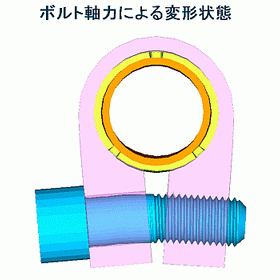
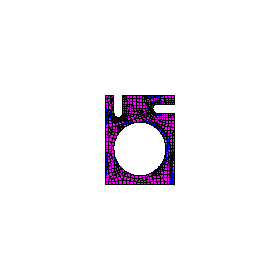
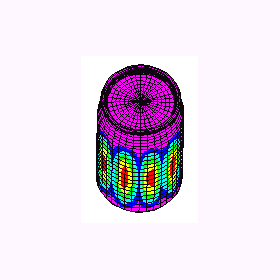
Our company undertakes strength calculations for static loads, vibrations, and heat for components and structures in electronics, electrical engineering, machinery, automotive, marine, and building equipment. Structural analysis utilizes the finite element method, which considers a structure as a collection of simple geometric elements, allowing calculations even for complex three-dimensional structures that cannot be analyzed through conventional structural calculations. 【Effects and Benefits】 ■ The calculation results are visual, making them easy to understand even for those not familiar with the products (providing persuasive evidence). ■ Savings in time and costs for prototypes and experiments. ■ Enhanced quantitative understanding of countermeasure effects and structural characteristics. ■ Evaluation is possible even when prototyping or experiments (actual measurements) cannot be conducted. *For more details, please feel free to contact us.
Added to bookmarks
Bookmarks listBookmark has been removed
Bookmarks listYou can't add any more bookmarks
By registering as a member, you can increase the number of bookmarks you can save and organize them with labels.
Free membership registration
Strength calculation (structural analysis) is a method for numerically evaluating the deformation and stress distribution of components or structures subjected to loads. Our company uses the finite element method (FEM) to conduct strength evaluations of mechanical parts, frames, supports, and fastening structures. We can handle everything from structural considerations in the early design phase to investigating the causes of insufficient strength and evaluating reinforcement proposals. We visualize stress concentrations and deformation behaviors that are difficult to grasp through prototypes or experiments, providing information that serves as the basis for design decisions.
Added to bookmarks
Bookmarks listBookmark has been removed
Bookmarks listYou can't add any more bookmarks
By registering as a member, you can increase the number of bookmarks you can save and organize them with labels.
Free membership registration
Strength calculation (structural analysis) is a method for numerically evaluating the deformation and stress distribution of components or structures subjected to loads. Our company uses the finite element method (FEM) to conduct strength evaluations of mechanical parts, frames, supports, and fastening structures. We can handle everything from structural considerations in the early design phase to investigating the causes of insufficient strength and evaluating reinforcement proposals. We visualize stress concentrations and deformation behaviors that are difficult to grasp through prototypes or experiments, providing information that serves as the basis for design decisions.
Added to bookmarks
Bookmarks listBookmark has been removed
Bookmarks listYou can't add any more bookmarks
By registering as a member, you can increase the number of bookmarks you can save and organize them with labels.
Free membership registration
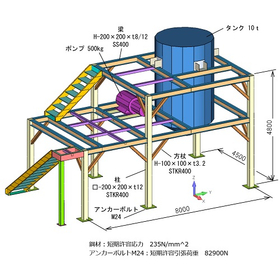
Seismic strength evaluation is an analysis conducted to confirm whether equipment and structures have sufficient strength and safety against loads acting on them during an earthquake. Our company performs seismic strength evaluations of equipment supports, tank support structures, machinery, and piping support structures using the finite element method (FEM). We assess stress, deformation, and safety factors against assumed seismic loads, which can be utilized for reinforcement considerations and verification of design validity.
Added to bookmarks
Bookmarks listBookmark has been removed
Bookmarks listYou can't add any more bookmarks
By registering as a member, you can increase the number of bookmarks you can save and organize them with labels.
Free membership registration
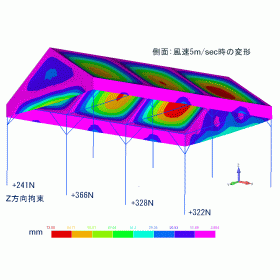
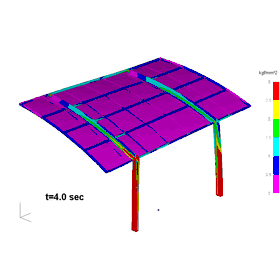
Wind resistance strength evaluation is an assessment method that analyzes the stress and deformation caused by wind pressure and wind loads to confirm the safety of structures. Our company conducts wind resistance strength evaluations using the finite element method (FEM) for equipment frames, support structures, steel structures, and various types of frames. We evaluate stress, displacement, and safety factors against anticipated wind loads, which can be utilized for design verification and reinforcement considerations.
Added to bookmarks
Bookmarks listBookmark has been removed
Bookmarks listYou can't add any more bookmarks
By registering as a member, you can increase the number of bookmarks you can save and organize them with labels.
Free membership registration
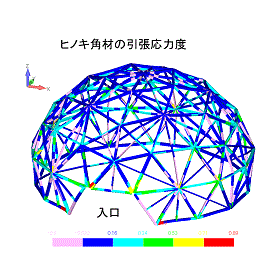
Wind resistance strength evaluation is an assessment method that analyzes the stresses and deformations caused by wind pressure and wind loads to confirm the safety of structures. Our company conducts wind resistance strength evaluations using the finite element method (FEM) for equipment frames, support structures, steel structures, and various types of frames. We evaluate the stress, displacement, and safety factor against anticipated wind loads, which can be utilized for design verification and reinforcement considerations.
Added to bookmarks
Bookmarks listBookmark has been removed
Bookmarks listYou can't add any more bookmarks
By registering as a member, you can increase the number of bookmarks you can save and organize them with labels.
Free membership registration
Buckling analysis is an analytical method used to evaluate the phenomenon where members or structures subjected to compressive loads become unstable and deform. Even if there are no issues with strength, structures can become unusable due to buckling. Our company uses the finite element method (FEM) to evaluate the buckling loads and deformation modes of columns, frames, supports, and thin-walled structures, and to conduct verification of structural stability and reinforcement considerations.
Added to bookmarks
Bookmarks listBookmark has been removed
Bookmarks listYou can't add any more bookmarks
By registering as a member, you can increase the number of bookmarks you can save and organize them with labels.
Free membership registration
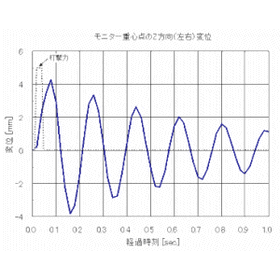
Resonance and vibration force response analysis evaluates the response of structures to external vibration loads, predicting the possibility of resonance occurrence and vibration levels. Our company uses the finite element method (FEM) to assess natural frequencies and response evaluations against vibration forces for equipment frames, machinery, supporting structures, and frame structures. This analysis can be utilized for investigating the causes of vibration issues, considering anti-vibration measures, and evaluating the impact during design changes.
Added to bookmarks
Bookmarks listBookmark has been removed
Bookmarks listYou can't add any more bookmarks
By registering as a member, you can increase the number of bookmarks you can save and organize them with labels.
Free membership registration
Earthquake response analysis is a analytical method that inputs actual seismic waves into structures to evaluate their behavior during an earthquake. Our company conducts earthquake response analysis using the finite element method (FEM) for equipment supports, tanks, piping support structures, and machinery. We evaluate the time variations of displacement, acceleration, and stress that occur during an earthquake, which can be utilized for confirming structural integrity and considering seismic measures.
Added to bookmarks
Bookmarks listBookmark has been removed
Bookmarks listYou can't add any more bookmarks
By registering as a member, you can increase the number of bookmarks you can save and organize them with labels.
Free membership registration
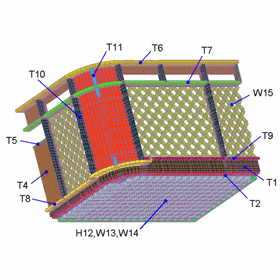
Lightweight design considerations involve analyses aimed at reducing the weight of structures and components while optimizing shape and thickness, confirming strength and rigidity. Our company evaluates stress distribution and deformation behavior using the finite element method (FEM) and our proprietary optimization program, conducting design studies that ensure necessary strength while reducing unnecessary materials. This can be utilized for design improvements aimed at cost reduction, material reduction, and performance enhancement.
Added to bookmarks
Bookmarks listBookmark has been removed
Bookmarks listYou can't add any more bookmarks
By registering as a member, you can increase the number of bookmarks you can save and organize them with labels.
Free membership registration
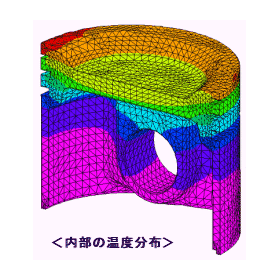
Temperature distribution analysis is a numerical evaluation method for temperature changes and heat transfer within components and structures. Our company uses the finite element method (FEM) to analyze heat conduction from heat sources, heat dissipation effects, temperature distribution, and more, to conduct thermal design and structural integrity assessments. It can be utilized for understanding temperature rise, evaluating heat dissipation performance, and examining thermal deformation.
Added to bookmarks
Bookmarks listBookmark has been removed
Bookmarks listYou can't add any more bookmarks
By registering as a member, you can increase the number of bookmarks you can save and organize them with labels.
Free membership registration
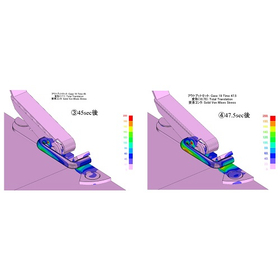
We evaluate the motion characteristics and behavior of movable mechanisms such as link mechanisms, cam mechanisms, and conveying devices using CAE. This includes checking for interference between parts, verifying the range of motion, and calculating speed, acceleration, and reaction forces, which can be utilized for design verification and performance improvement before prototyping.
Added to bookmarks
Bookmarks listBookmark has been removed
Bookmarks listYou can't add any more bookmarks
By registering as a member, you can increase the number of bookmarks you can save and organize them with labels.
Free membership registration
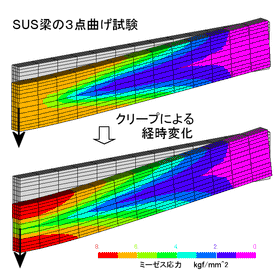
Creep deformation analysis is an evaluation of the deformation and stress changes over time for materials and structures subjected to continuous loads in high-temperature environments. Even if there are no issues with static strength calculations at high temperatures, deformation or damage may progress with prolonged use. Our company utilizes the finite element method (FEM) to assess the creep behavior of high-temperature equipment and various structures, which is used for confirming integrity and predicting lifespan during long-term use.
Added to bookmarks
Bookmarks listBookmark has been removed
Bookmarks listYou can't add any more bookmarks
By registering as a member, you can increase the number of bookmarks you can save and organize them with labels.
Free membership registration