1~45 item / All 592 items
Displayed results
Filter by category

Added to bookmarks
Bookmarks listBookmark has been removed
Bookmarks listYou can't add any more bookmarks
By registering as a member, you can increase the number of bookmarks you can save and organize them with labels.
Free membership registration
Contact this company
Inquiry Form1~45 item / All 592 items
Filter by category

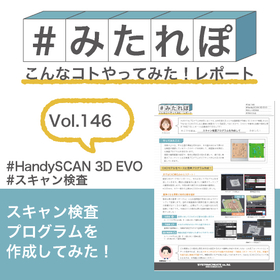
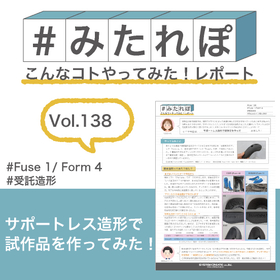
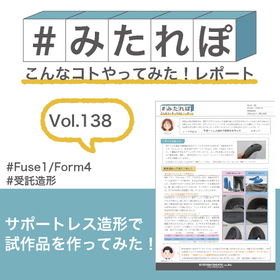
"Mitarepo" is a series that introduces what can be done using various products with the concept of "I tried doing this!" We deliver useful information each time from the wide range of product genres handled by System Create. In recent years, the manufacturing industry has been rapidly transitioning from traditional size tolerances to quality control based on geometric tolerances (GD&T). However, when trying to comprehensively evaluate "the overall waviness of the product" or "freeform surfaces," the inspection programs tend to become extensive and consume a significant amount of time. Therefore, this time, we challenged ourselves to set up an "inspection program" that automatically determines geometric tolerances by using the HandySCAN 3D EVO, which allows for high-precision 3D scanning while being handheld, to instantly capture the shape of the entire part! "Can I create a program before scanning?" "How do I format it for repeated inspections?" We will introduce points of interest in practical work, including actual numerical settings and the process of registering inspection points. *You can download the materials from the button below.
Added to bookmarks
Bookmarks listBookmark has been removed
Bookmarks listYou can't add any more bookmarks
By registering as a member, you can increase the number of bookmarks you can save and organize them with labels.
Free membership registration
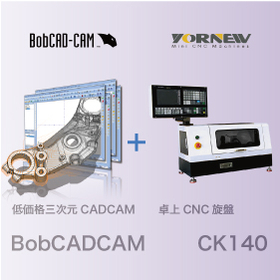
Small Fab refers to small-scale, decentralized microfactories. By setting up small labs in offices or research and development centers, it enables rapid and low-cost prototyping and small-scale production using tools such as CAD/CAM, 3D printers, CNC machining tools, and 3D scanners, without the need for factory-like facilities. It is a flexible and practical manufacturing system that directly addresses on-site challenges. The 3D digital tools are rarely operated with just one product. This time, by using the low-cost 3D CAD/CAM "BobCADCAM" and the desktop lathe "CK140," easy screw machining can be achieved. The desktop lathe CK140 supports fixed cycles. By combining it with CAM, in-house production of small diameter and small parts can be advanced. BobCADCAM, while low-cost, is equipped with basic functions and can automatically generate threading paths and groove machining. Therefore, it not only reduces errors compared to handwritten G-code but also accommodates dimension changes, enhancing work efficiency.
Added to bookmarks
Bookmarks listBookmark has been removed
Bookmarks listYou can't add any more bookmarks
By registering as a member, you can increase the number of bookmarks you can save and organize them with labels.
Free membership registration
Mitarepo is a series based on the concept of "Trying out things like this!" that introduces what can be done using various products. Recently, FFF-type 3D printers have become capable of using "super engineering plastics" that can serve as metal alternatives, attracting significant attention. However, the high-performance materials often come with a "price" that can be a barrier. While representative materials like PEEK offer outstanding performance, their cost makes it difficult to test them casually, and they tend to be reserved for critical applications in the field. In this context, the material we are introducing this time, 'PPS', is currently receiving a lot of attention for being "as tough as PEEK but more cost-effective!" "Can PPS, which is used in those harsh environments, really be 3D printed?" To answer that question, we conducted actual output tests for verification. For the verification, we used the FFF-type 3D printer "CreatBot PEEK-250," which is compatible with super engineering plastics, and thoroughly evaluated the actual output process and the critical dimensional accuracy. *You can download the materials from the button below.
Added to bookmarks
Bookmarks listBookmark has been removed
Bookmarks listYou can't add any more bookmarks
By registering as a member, you can increase the number of bookmarks you can save and organize them with labels.
Free membership registration
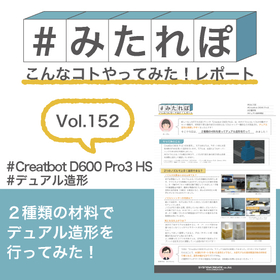
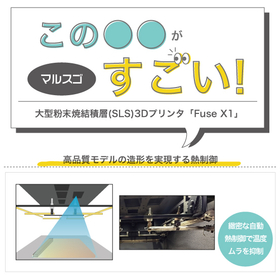
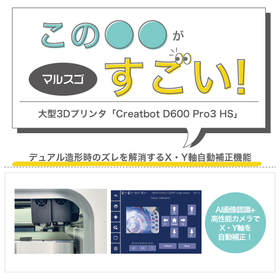
Marsgo is a document that picks up the functions and features of various products and introduces the "amazing" aspects of them. The large-format FFF 3D printer "CreatBot D600 Pro3 HS" supports "dual modeling," which allows for simultaneous operation of two nozzles. In addition to being able to tackle complex shapes using water-soluble support material, it is equipped with a backup function that automatically covers material shortages, enabling non-stop operation that can be entrusted for long hours of overnight printing. Since it can efficiently produce large models, it is suitable for use in manufacturing environments. However, the question arises: "Why can such a convenient operation be performed stably?" The answer lies in the newly equipped "X and Y axis automatic correction function," which controls the nozzle position in the background! The document provides a detailed explanation of how this automatic correction function works, so please take a moment to read it. *You can download the document using the button below.
Added to bookmarks
Bookmarks listBookmark has been removed
Bookmarks listYou can't add any more bookmarks
By registering as a member, you can increase the number of bookmarks you can save and organize them with labels.
Free membership registration
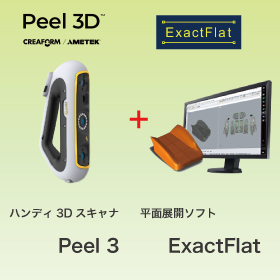
Small Fab refers to small-scale, decentralized microfactories. By setting up small labs in offices or research and development centers, it enables rapid and low-cost prototyping and small-scale production using tools like CAD/CAM, 3D printers, CNC machines, and 3D scanners, without the need for factory-like facilities. It is a flexible and practical manufacturing system that directly addresses on-site challenges. These 3D digital tools are rarely operated with just one product. In this case, we will easily create pattern data using the handheld 3D scanner "Peel 3" and the flat patterning software "ExactFlat." Previously, there were numerous steps involved, including manual measurements, pattern creation, modifications, and data conversion. All of these steps can be eliminated. First, we will create the model we want to unfold using the user-friendly handheld 3D scanner "Peel 3." After that, we will use the unfolding software "ExactFlat." ExactFlat allows for adjustments based on the stretch ratio and thickness of the material on the data before unfolding. This improves quality consistency and work efficiency.
Added to bookmarks
Bookmarks listBookmark has been removed
Bookmarks listYou can't add any more bookmarks
By registering as a member, you can increase the number of bookmarks you can save and organize them with labels.
Free membership registration
Mitarepo is a series that introduces what can be done using various products with the concept of "I tried doing this!" The "Tumaker NX 300 / BigFoot 500 Modular" allows for easy pellet modeling in a desktop size. Its biggest feature is that it is space-saving and very easy to introduce, but it also has an optional feature, the "pellet feeder," that can handle long-duration modeling effectively. Therefore, for long modeling sessions that consume a lot of material, "I want to avoid stopping the modeling due to running out of material..." "Checking repeatedly for refills is a hassle..." By switching to the hopper for the feeder, the sensor detects the remaining material, and pellets are automatically supplied using air pressure! With a large capacity of up to 10 liters, it enables continuous supply even during long modeling sessions! The results of the verification, along with actual supply conditions and modeling photos, are explained in detail in the materials. *You can download the materials from the button below.
Added to bookmarks
Bookmarks listBookmark has been removed
Bookmarks listYou can't add any more bookmarks
By registering as a member, you can increase the number of bookmarks you can save and organize them with labels.
Free membership registration
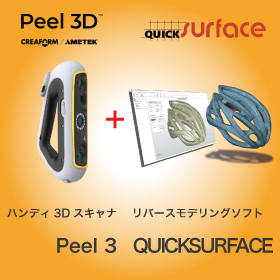
Small Fab refers to small-scale, decentralized microfactories. By setting up small labs in offices or research and development centers, it allows for rapid and low-cost prototyping and small-scale production using tools like CAD/CAM, 3D printers, CNC machines, and 3D scanners, even without factory-like facilities. It is a flexible and practical manufacturing system that directly addresses on-site challenges. These 3D digital tools are rarely operated with just one product. In this case, by using the handheld 3D scanner "Peel 3" and the reverse modeling software "QUICKSURFACE," product improvements and size modifications can be made. The "Peel 3" is designed based on ergonomic principles, making it easy for anyone to use and accommodating a wide range of work sizes. The scanned data is edited using the reverse modeling software "QUICKSURFACE." It can directly read mesh data, and its intuitive operation allows anyone to create accurately and efficiently. Therefore, even without data for items like art or statues, as long as the physical object is available, the time from design to improvement can be shortened, enhancing the production of manufacturing.
Added to bookmarks
Bookmarks listBookmark has been removed
Bookmarks listYou can't add any more bookmarks
By registering as a member, you can increase the number of bookmarks you can save and organize them with labels.
Free membership registration
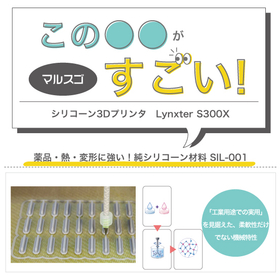
Marsugo is a document that picks up the functions and features of various products and introduces the "amazing!" aspects. The "Lynxter" series of 3D printers uses a method of layering liquids to create shapes. Its characteristic is that it can print using a high-performance material called "pure silicone." Moreover, it does so without compromising the inherent functional properties of the material. This time, we will focus on the mechanical properties of one of the standard materials in the Lynxter series, "SIL-001." 3D printer materials have been evolving year by year, becoming more high-performance. Many soft materials have also emerged. However, there are often cases where their applications are limited in terms of heat resistance, chemical resistance, elasticity, and durability. "SIL-001" is a material developed with a different approach from these soft materials. In fact, like general-purpose pure silicone products, it adopts a mechanism that hardens through the reaction of a base agent and a curing agent. This allows for 3D printing while maintaining the unique mechanical properties of pure silicone. *You can download the document from the button below.
Added to bookmarks
Bookmarks listBookmark has been removed
Bookmarks listYou can't add any more bookmarks
By registering as a member, you can increase the number of bookmarks you can save and organize them with labels.
Free membership registration
Small Fab refers to small-scale, decentralized microfactories. By setting up small labs in offices or research and development centers, it allows for rapid and low-cost prototyping and small-scale production using tools like CAD/CAM, 3D printers, CNC machines, and 3D scanners, without the need for factory-like facilities. It is a flexible and practical manufacturing system that directly addresses on-site challenges. These 3D digital tools are rarely operated with just one product. This time, by using the resin 3D printer "Form 4" and the vacuum forming machine "Vaquform," we will expand the scope of product development. We will create vacuum forming molds using the high-precision resin printer "Form 4." By making molds with the Form 4, we can produce high-quality molds. Subsequently, by shaping thin-walled structures, which are typically challenging for 3D printers, with the Vaquform, we can create models that leverage their characteristics. This combination allows us to shorten the production cycle while significantly broadening the scope of manufacturing.
Added to bookmarks
Bookmarks listBookmark has been removed
Bookmarks listYou can't add any more bookmarks
By registering as a member, you can increase the number of bookmarks you can save and organize them with labels.
Free membership registration
Mitarepo is a series based on the concept of "Trying out things like this!" where we introduce what can be done using various products. The "Vaquform," which has been gaining attention for its ability to perform vacuum forming on a tabletop, is an excellent tool that allows you to quickly turn ideas into reality as long as you have a mold and a sheet. There are various applications such as trays for transportation, exterior covers, and original products, but you might wonder, "How easy is it to make something?" and "How detailed can the expressions be?" To answer these questions, we attempted to create a braille nameplate this time! We made a mold using a resin 3D printer, and we will show you the quality of the completed nameplate. The results of our investigation, along with images, are explained, so please take a look. *You can download the materials from the button below.
Added to bookmarks
Bookmarks listBookmark has been removed
Bookmarks listYou can't add any more bookmarks
By registering as a member, you can increase the number of bookmarks you can save and organize them with labels.
Free membership registration
In practical training at educational institutions, it is important for students to have the opportunity to operate machines and learn the fundamentals of manufacturing. In particular, an environment that allows for safe and efficient experience with various parts processing is required. Our product "YORNEW CK210B" is designed to be space-saving while providing processing performance that meets practical needs, making it suitable for use in educational settings. 【Usage Scenarios】 - Practical classes in mechanical and engineering departments - Manufacturing clubs and technical research groups - Prototype production and processing of teaching materials 【Benefits of Implementation】 - Acquisition of practical skills by students - Adaptability to diverse parts processing - Installation and operation in limited spaces
Added to bookmarks
Bookmarks listBookmark has been removed
Bookmarks listYou can't add any more bookmarks
By registering as a member, you can increase the number of bookmarks you can save and organize them with labels.
Free membership registration
In the field of research and development, the production of prototypes is required to quickly turn ideas into reality. In particular, the ability to process a variety of materials and shapes, as well as the capability to install in limited spaces, are crucial. Insufficient processing capabilities or constraints on installation locations can lead to delays in the development cycle and increased costs. The compact CNC lathe "YORNEW CK210B" offers rigidity that can withstand continuous processing of steel materials while maintaining processing performance that meets practical needs, thereby supporting the efficiency of prototype production. 【Usage Scenarios】 - Verification of new part shapes - Production of parts for functional evaluation - Small-batch, diverse prototypes 【Benefits of Implementation】 - Reduction of development lead time - Rapid response to design changes - Cost-effective prototyping
Added to bookmarks
Bookmarks listBookmark has been removed
Bookmarks listYou can't add any more bookmarks
By registering as a member, you can increase the number of bookmarks you can save and organize them with labels.
Free membership registration
In the field of robotics, precise machining of small actuators directly impacts the performance and reliability of robots. Particularly for miniaturized actuators, achieving high-precision machining in limited spaces is essential. Insufficient machining accuracy can lead to actuator malfunctions and reduced lifespan. The compact CNC lathe "YORNEW CK210B" features a space-saving design while incorporating a 1.2kW high-torque spindle and full-axis servo control, providing the rigidity necessary for continuous machining of steel materials. This meets the precision machining needs of small actuators. 【Application Scenarios】 - Machining of parts such as gears, shafts, and housings for small actuators - Rapid production of prototypes - Support for low-volume, high-variety production 【Benefits of Implementation】 - Improved actuator performance through high-precision part machining - Flexibility in installation locations due to space-saving design - Cost reduction through low-cost implementation
Added to bookmarks
Bookmarks listBookmark has been removed
Bookmarks listYou can't add any more bookmarks
By registering as a member, you can increase the number of bookmarks you can save and organize them with labels.
Free membership registration
In the electronic components industry, particularly in the manufacturing of small connectors, precise machining accuracy and stable productivity are essential. The dimensional accuracy of fine parts and fitting sections directly affects the reliability and functionality of the products, making high-quality management indispensable. Improper machining can lead to contact failures or assembly issues, potentially resulting in decreased performance or product failures. The compact CNC lathe "YORNEW CK210B" achieves high rigidity capable of withstanding continuous processing of steel materials, thanks to its space-saving design, 1.2kW high-torque spindle, and full-axis servo control, addressing these challenges. 【Usage Scenarios】 - Precision machining of small connector parts - Small-scale production of prototypes - Space-saving upgrades of existing equipment - Cost-effective equipment introduction 【Benefits of Implementation】 - Stable production of high-precision small connector parts - Increased production capacity in limited space - Equipment updates with reduced initial investment - Response to diverse machining needs
Added to bookmarks
Bookmarks listBookmark has been removed
Bookmarks listYou can't add any more bookmarks
By registering as a member, you can increase the number of bookmarks you can save and organize them with labels.
Free membership registration
In the aerospace field, the manufacturing of components that require extremely high precision is essential. Particularly for parts that demand lightweight design and strength maintenance, precise dimensional control and stable processing quality are directly linked to the safety and performance of the products. Improper processing can lead to functional failures of components and, ultimately, serious issues related to the safety of aircraft. The compact CNC lathe "CK210B" features a space-saving design while incorporating a 1.2kW high-torque spindle and full-axis servo control, achieving high rigidity capable of withstanding continuous processing of steel materials. This supports stable processing of high-precision components required in the aerospace sector. 【Application Scenarios】 - Precision machining of aircraft engine components - Prototyping and small-scale production of satellite parts - Machining of lightweight structural components for drones - Manufacturing of precision measurement instrument parts 【Benefits of Implementation】 - Enables component machining with the required high dimensional accuracy - Improves productivity in limited space - Capable of processing a variety of materials - Achieves continuous processing with stable quality
Added to bookmarks
Bookmarks listBookmark has been removed
Bookmarks listYou can't add any more bookmarks
By registering as a member, you can increase the number of bookmarks you can save and organize them with labels.
Free membership registration
In the automotive parts industry, stable quality and efficient production are essential for the processing of precision parts that require high accuracy and reliability. Particularly for parts that demand complex shapes and fine tolerances, the rigidity of the machining equipment and control precision are directly linked to the product's performance. Our small CNC lathe, the 'YORNEW CK210B', has been developed to meet these demands. 【Usage Scenarios】 - Processing of automotive sensor parts - Precision machining of small gears and shafts - Prototype and small lot production 【Benefits of Implementation】 - Quality improvement through high-precision part processing - Efficiency of production lines through space-saving design - Equipment introduction with reduced initial investment
Added to bookmarks
Bookmarks listBookmark has been removed
Bookmarks listYou can't add any more bookmarks
By registering as a member, you can increase the number of bookmarks you can save and organize them with labels.
Free membership registration
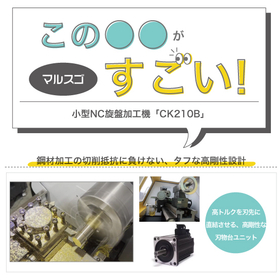
Marsugo is a document that picks up the functions and features of various products and introduces the "amazing!" aspects. Everyday tasks involving "slight processing of steel materials" are commonly performed on general-purpose lathes. Have you ever felt such concerns? "Recently, only specific skilled workers can use them..." "Manual processing is dangerous and doesn't fit with the digitalization of the workplace..." The solution to these anxieties is the compact CNC lathe "YORNEW CK210B," which maintains the ease of use of general-purpose lathes while adding the precision and safety of CNC technology. This machine features a very compact body with a footprint of 1170×700mm, packed with tough specifications capable of processing steel materials. With a high-torque servo motor of 1.2kW and a simple, high-rigidity tool post that effectively harnesses that power, it achieves stable processing that overturns the conventional wisdom that "small machines are only for resin or aluminum." The document provides a detailed explanation of why this size can effectively cut steel, focusing on the high-torque motor and the design of the tool post, so please take a moment to read it. *You can download the document using the button below.
Added to bookmarks
Bookmarks listBookmark has been removed
Bookmarks listYou can't add any more bookmarks
By registering as a member, you can increase the number of bookmarks you can save and organize them with labels.
Free membership registration
Small Fab refers to small-scale, decentralized microfactories. By setting up small labs in offices or research and development centers, it allows for rapid and low-cost prototyping and small-scale production using tools like CAD/CAM, 3D printers, CNC machines, and 3D scanners, without the need for factory-like facilities. It is a flexible and practical manufacturing system directly linked to solving on-site challenges. The 3D digital tools are rarely operated with just one product. This time, we will promote work efficiency by using the 3D CAD/CAM software "BobCADCAM" and the 5-axis machining center "Yornew MX220." Despite its overwhelmingly low price, this low-cost software comes with comprehensive features and offers a perpetual license with zero annual maintenance costs. It achieves significant cost reductions over long-term use while being equipped with rich functionalities. In addition to utilizing this software, using the compact indexing 5-axis machining machine "MX220," which can process multiple complex shapes at once, allows for the automatic generation of tool paths according to indexing angles, enabling efficient chamfering and deburring.
Added to bookmarks
Bookmarks listBookmark has been removed
Bookmarks listYou can't add any more bookmarks
By registering as a member, you can increase the number of bookmarks you can save and organize them with labels.
Free membership registration
Mitarepo is a series based on the concept of "trying things like this!" where we introduce what can be done using various products. There are various 3D scanners available, ranging from small to large models, tailored to different sizes, applications, and precision. Handheld 3D scanners are particularly easy to carry and are said to be suitable for large models. On the other hand, it is also true that you need to prepare a PC in advance and must be mindful of cables while scanning. "It's heavy and difficult to bring a PC to the work area..." "I want to reduce the number of work steps and increase efficiency..." The "Creality Sermoon P1" can make those wishes come true. This time, we scanned a large model! We scanned the interior of a car, which is difficult to scan, to see how well we could capture the quality! The results of our verification, along with images, are explained, so please take a look. *You can download the materials from the button below.
Added to bookmarks
Bookmarks listBookmark has been removed
Bookmarks listYou can't add any more bookmarks
By registering as a member, you can increase the number of bookmarks you can save and organize them with labels.
Free membership registration
Marsugo is a document that picks up the functions and features of various products and introduces the "amazing" aspects. There are many people who are considering efficient processing, such as complex machining with a 4-axis machining center and reducing setup time. There are several barriers to introducing machines, including: - High introduction/operational costs - Expensive CAM for 4-axis compatibility - Know-how considering rotational axes and interference If you have these concerns, they can be resolved☆ What we are introducing this time is "overwhelmingly low price & rich features BobCAD-CAM." Until now, we have mainly introduced 3-axis functions, but actually... it also supports 4-axis machining! The document provides a detailed explanation of the appeal of the 4Axis standard module development and the actual prices at which you can implement it, so please take a look. *You can download the document from the button below.
Added to bookmarks
Bookmarks listBookmark has been removed
Bookmarks listYou can't add any more bookmarks
By registering as a member, you can increase the number of bookmarks you can save and organize them with labels.
Free membership registration
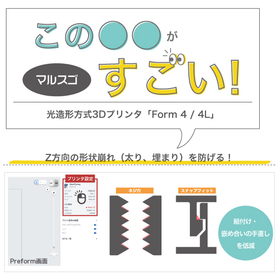
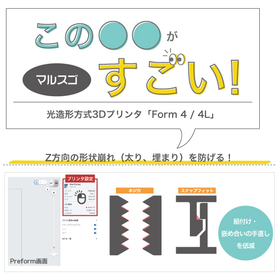
Marsgo is a document that picks up the functions and features of various products and introduces the "amazing" aspects of them. Stereolithography 3D printers create shapes by curing liquid resin with light. The latest Form 4 / 4L achieves "high precision and speed" in modeling through its unique LFD method, but it is actually packed with detailed innovations to ensure that "anyone can use it without failure." One of these innovations is the "Z-Bleed Correction" that we will introduce this time. In stereolithography, unintended light spreading can cause dimensional deviations (swelling) such as "holes becoming smaller" or "screws not turning." This not only leads to assembly issues but also causes unnecessary rework such as sanding or enlarging holes. In the Form 4 / 4L, the standard software "PreForm" automatically calculates this swelling and cancels it out in advance. This document clearly explains the causes of dimensional deviations and the mechanism of automatic correction with illustrations. If you are considering improving accuracy and reducing post-processing, please take a look. *You can download the document from the button below.
Added to bookmarks
Bookmarks listBookmark has been removed
Bookmarks listYou can't add any more bookmarks
By registering as a member, you can increase the number of bookmarks you can save and organize them with labels.
Free membership registration
Mitarepo is a series that introduces what can be done using various products with the concept of "I tried doing this!" In recent years, high-performance materials such as carbon (CFRP) that enhance the added value of products have become very attractive options due to their high strength and rigidity. However, when it comes time to machine them, one hesitation is the damage to the machinery caused by cutting chips. If fine carbon powder gets caught in the sliding parts, it can compromise the precision of the machine tool. The honest feeling on the shop floor might be, "I want to use this material, but I don't want to put a strain on the machine..." In this document, we equipped the tabletop CNC router "AM4036" with an optional "dust collection unit" and conducted an investigation into how much cutting chips it can effectively suck up. What kind of behavior does the dust collection unit exhibit when dealing with materials that generate fine cutting chips? We have compiled the details of the verification process, including the actual mechanism and the condition around the workpiece after processing, into this document, so please take a look. *You can download the document using the button below.
Added to bookmarks
Bookmarks listBookmark has been removed
Bookmarks listYou can't add any more bookmarks
By registering as a member, you can increase the number of bookmarks you can save and organize them with labels.
Free membership registration
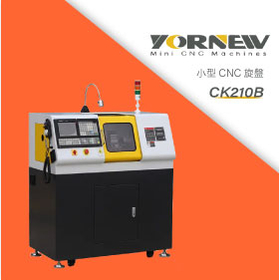
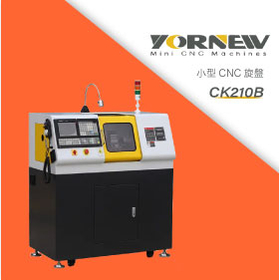
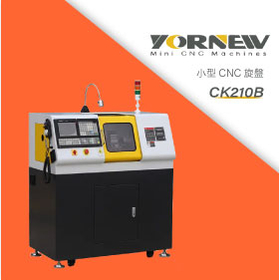
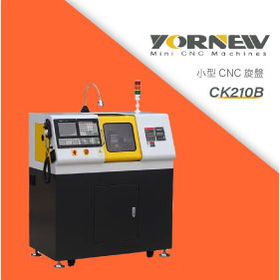
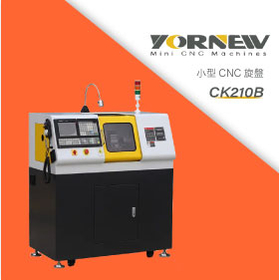
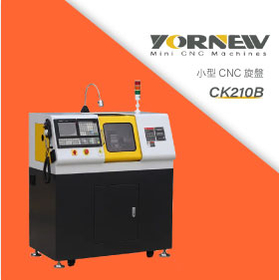
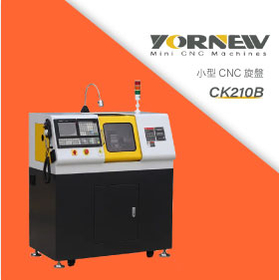
The compact CNC lathe "CK210B" is a machine that condenses a 1.2kW high-torque spindle and full-axis servo control into a space-saving design. By adopting a simple "tool post" as standard equipment, it achieves high rigidity capable of continuous processing of steel materials despite its small size. <Features of YORNEW CK210B> - Dimensions: Width 1170 × Depth 697 × Height 1350 mm - 1.2kW high-torque servo motor spindle - Feedback drive with full-axis servo control - Compatible with ISO standard G-code - Standard coolant equipment - 4-position tool post (orthogonal arrangement) - Optional: 8-station turret (spindle parallel arrangement)
Added to bookmarks
Bookmarks listBookmark has been removed
Bookmarks listYou can't add any more bookmarks
By registering as a member, you can increase the number of bookmarks you can save and organize them with labels.
Free membership registration
Mitarepo is a series based on the concept of "Trying out things like this!" that introduces what can be done using various products. In recent years, the demand for metal 3D printers has been increasing, but when considering their introduction, one cannot make a judgment based solely on catalog specifications. To be honest, there are likely many who wonder, "How much accuracy and quality are actually needed on-site?" Therefore, this time, we thoroughly examined the capabilities of the metal 3D printer "Avimetal," which excels in balancing cost and performance! Using cube models placed at five locations on the build table, we analyzed positional accuracy, dimensional accuracy, and internal density through CT scans. The materials summarize real information that cannot be seen from nominal values, such as whether the angle of laser irradiation affects dimensions and the filling conditions revealed by CT images. Please take a look. *You can download the materials from the button below.
Added to bookmarks
Bookmarks listBookmark has been removed
Bookmarks listYou can't add any more bookmarks
By registering as a member, you can increase the number of bookmarks you can save and organize them with labels.
Free membership registration
Marsugo is a document that picks up the functions and features of various products and introduces the "amazing" aspects. Creality has released its first standalone 3D scanner, the "Sermoon P1"! Until now, using a 3D scanner involved various steps such as connecting to a PC, preparation, editing, and cleanup, which took a lot of time and effort before you could actually scan. The "Sermoon P1" solves those problems. Remarkably, the software is built into the scanner itself! This means there is no need to connect to a PC! It’s an excellent device that allows you to edit immediately after scanning. In the first document, we introduce how easy the process is from scanning to editing thanks to the adoption of a standalone format. In the second document, we explain the structure designed for efficiently performing large scans, so please take a look. *You can download the document using the button below.
Added to bookmarks
Bookmarks listBookmark has been removed
Bookmarks listYou can't add any more bookmarks
By registering as a member, you can increase the number of bookmarks you can save and organize them with labels.
Free membership registration
Marsugo is a document that picks up the functions and features of various products and introduces the "amazing" aspects. Creality has launched its first standalone 3D scanner, the "Sermoon P1"! Until now, using a 3D scanner involved various steps such as connecting to a PC, preparation, editing, and cleanup, which took a lot of time and effort before you could actually scan. The "Sermoon P1" solves those problems. Remarkably, the software is built into the scanner itself! Therefore, there is no need to connect to a PC! It’s an excellent device that allows you to edit immediately after scanning. In the first document, we introduce how easy the process is from scanning to editing thanks to the adoption of a standalone format. In the second document, we explain the structure designed for efficient large-scale scanning, so please take a look. *You can download the document using the button below.
Added to bookmarks
Bookmarks listBookmark has been removed
Bookmarks listYou can't add any more bookmarks
By registering as a member, you can increase the number of bookmarks you can save and organize them with labels.
Free membership registration
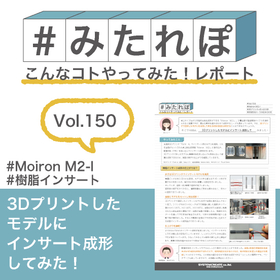
Small Fab refers to small-scale, decentralized microfactories. By setting up small labs in offices or research and development centers, it allows for rapid and low-cost prototyping and small-scale production using tools like CAD/CAM, 3D printers, CNC machines, and 3D scanners, without the need for factory-like facilities. It is a flexible and practical manufacturing system directly linked to solving on-site challenges. These 3D digital tools are rarely operated with just one product. This time, we will accelerate the development cycle by using the SLA 3D printer "Form 4" and the injection molding machine "M2-1." By using 3D printed models as molds, it becomes possible to quickly create prototypes from designed data. Unlike metal molds, this significantly reduces storage costs, production costs, and lead times.
Added to bookmarks
Bookmarks listBookmark has been removed
Bookmarks listYou can't add any more bookmarks
By registering as a member, you can increase the number of bookmarks you can save and organize them with labels.
Free membership registration
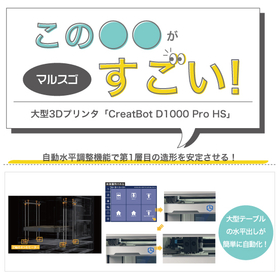
Marsgo is a document that picks up the functions and features of various products and introduces the "amazing!" aspects. In FFF-type 3D printers, the adhesion of the "first layer" can be considered a lifeline that determines the success or failure of the print. Issues such as warping and peeling that occur during printing are common challenges regardless of the print size, but their impact increases significantly with larger models. The feeling of loss when several days of effort go to waste is immeasurable. One of the major factors involved here is the "levelness of the table," and manual adjustments require both time and skill, which can undermine the inherent convenience of 3D printers. The "fate of the first layer," which can be seen as a risk, has been resolved in the "D1000 Pro HS" by automating the adjustments. With "4-axis independent leveling," where four independent motors correct the tilt, accurate setup can be completed in just a few minutes, even without skilled techniques. For more details on the specific mechanisms and adjustment methods, please check the document! *You can download the document using the button below.
Added to bookmarks
Bookmarks listBookmark has been removed
Bookmarks listYou can't add any more bookmarks
By registering as a member, you can increase the number of bookmarks you can save and organize them with labels.
Free membership registration
This document is a series that proposes solutions to various challenges faced in production sites. We will introduce the challenges of digitizing large wooden molds that are not progressing, along with their solutions. [Document Overview] Are you feeling challenged by the increasing inventory in the management of large wooden molds? As the amount of storage increases, the need for space and management effort also grows, and the burden of annual inventory handling accumulates. Although there are standards for storage periods under the Subcontract Act, there are often cases in the field where it is difficult to make judgments due to the possibility of "future reorders." As a result, "irreplaceable molds" pile up, and the invisible management costs become a factor that pressures the profits of the site. In this context, attention is being drawn to the operation of digitizing molds through 3D scanning and remaking them when needed. While it was previously considered to have a high barrier to entry, it is now possible to consider switching to digitization with a budget comparable to the "storage costs of maintaining physical items." This document not only introduces products that are optimal for digitization but also explains the comparison with current storage costs and guidelines for investment recovery. Please use it as a reference for your decision-making regarding implementation. *You can download the document using the button above.


Added to bookmarks
Bookmarks listBookmark has been removed
Bookmarks listYou can't add any more bookmarks
By registering as a member, you can increase the number of bookmarks you can save and organize them with labels.
Free membership registration
Marsgo is a document that highlights the impressive features and characteristics of various products. Dual extrusion utilizes two nozzles to create complex shapes using water-soluble supports, and it can also automatically switch nozzles to continue printing when material runs out. This expands the range of 3D printing using the FFF method even further. However, many may have experienced that during dual extrusion, the material that melts from the standby nozzle can dirty the surface of the model. After spending time creating a model, unintended colors of resin may mix in, or dripped resin may clump and adhere, compromising the quality of the finish. To solve these unique problems associated with dual extrusion, the "nozzle shutter function" has been incorporated into the D1000 Pro HS. By physically blocking the standby nozzle, it achieves high-quality prints without contamination or dirt. The document thoroughly explains the benefits of the "nozzle shutter function" and its detailed mechanism. We encourage you to read it. *You can download the document using the button below.
Added to bookmarks
Bookmarks listBookmark has been removed
Bookmarks listYou can't add any more bookmarks
By registering as a member, you can increase the number of bookmarks you can save and organize them with labels.
Free membership registration
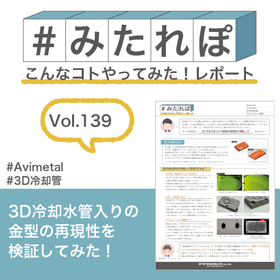
Mitarepo is a series based on the concept of "Trying out things like this!" that introduces what can be done using various products. The greatest strength of metal 3D printers is their ability to create "complex shapes" that were impossible with traditional machining. For example, designs that incorporate 3D water channels running internally to enhance the cooling efficiency of molds can be realized. However, because such complex shapes can be achieved, it also raises concerns such as: "Are the invisible internal cavities truly connected as designed?" "Is there any powder clogging or distortion of shape?" With that in mind, this time we created a model mimicking an injection molding mold and conducted thorough verification using CT scans to check the "invisible internal state." Are the water channels inside accurately reproduced? The results of this verification, along with a series of processes, are compiled in the materials. Please take a look. *You can download the materials using the button below.
Added to bookmarks
Bookmarks listBookmark has been removed
Bookmarks listYou can't add any more bookmarks
By registering as a member, you can increase the number of bookmarks you can save and organize them with labels.
Free membership registration
Mitarepo is a series based on the concept of "Trying out things like this!" where we introduce what can be done using various products. In the prototype stage of product development, 3D printed models have become an indispensable presence for shape verification. However, with commonly used printing methods like filament and resin printing, there are inevitably issues with surface support... right? So this time, we conducted a thorough investigation into the differences between support-free printing and resin models! "What kind of quality can we expect from the models?" "Aren't powder printing methods expensive?" We will address these points of interest by presenting actual images of model surfaces and realistic costs. *You can download the materials from the button below.
Added to bookmarks
Bookmarks listBookmark has been removed
Bookmarks listYou can't add any more bookmarks
By registering as a member, you can increase the number of bookmarks you can save and organize them with labels.
Free membership registration
In the home appliance industry, it is important to accurately verify whether the shape and dimensions of a product are realized as designed during the design review. Especially as design becomes more complex and diverse, there is a need to quickly and accurately assess the differences between 3D data and the actual product. The HandySCAN 3D EVO series facilitates comparison with CAD data and contributes to the efficiency of design reviews. 【Usage Scenarios】 - Design reviews of home appliances - Verification of prototype shapes - Shape confirmation before mold production 【Benefits of Implementation】 - Early detection of design modifications - Rapid confirmation of consistency between design and actual product - Reduction of product development time
Added to bookmarks
Bookmarks listBookmark has been removed
Bookmarks listYou can't add any more bookmarks
By registering as a member, you can increase the number of bookmarks you can save and organize them with labels.
Free membership registration
In the automotive industry, it is essential to quickly and accurately verify whether the prototype matches the design specifications. This is particularly crucial for parts with complex shapes and curves, where precise measurements are indispensable. Traditional measurement methods have posed challenges due to their time-consuming and labor-intensive nature, leading to longer lead times for prototypes. The HandySCAN 3D EVO series allows for simultaneous inspection during scanning by pre-loading CAD data, contributing to a reduction in inspection time during the prototyping process. 【Use Cases】 - Prototype inspection of automotive parts - Shape measurement of molds and jigs - Verification of design data 【Benefits of Implementation】 - Reduction in inspection time - Acceleration of the prototyping cycle - Improvement in design quality
Added to bookmarks
Bookmarks listBookmark has been removed
Bookmarks listYou can't add any more bookmarks
By registering as a member, you can increase the number of bookmarks you can save and organize them with labels.
Free membership registration
In the construction industry, high precision inspections are required to ensure that structures are built according to design plans and that components are placed with accurate dimensions. Especially in complex shapes and large-scale structures, even slight errors can impact the overall quality. The "HandySCAN 3D EVO series" facilitates easy comparison with CAD data and enables rapid inspections on-site. This helps reduce rework and contributes to shortening construction periods. 【Use Cases】 - Dimensional inspections of structures at construction sites - Shape measurements of existing structures in renovation projects - Interference checks through comparisons between CAD data and actual dimensions 【Benefits of Implementation】 - Reduced inspection time through comparisons with CAD data - Improved quality through highly accurate measurements - Reduced rework through immediate decision-making on-site
Added to bookmarks
Bookmarks listBookmark has been removed
Bookmarks listYou can't add any more bookmarks
By registering as a member, you can increase the number of bookmarks you can save and organize them with labels.
Free membership registration
Mitarepo is a series that introduces what can be done using various products with the concept of "I tried doing this!" From Formlabs, the new "Tough 1000 V1" has arrived from the Tough series, known for its strength and rigidity! In addition to the strengths of the series, this material features toughness, including resistance to cracking and durability. This time, to verify the capabilities of the "Tough 1000 resin," we created three types of hinge shapes with varying thicknesses and conducted tests to examine the finish and toughness after completion! What is the finish like for the thin model? How much toughness does it have? To answer such questions, we will explain the differences due to thickness and the appearance when bent, along with actual photos in the materials. *You can download the materials using the button below.
Added to bookmarks
Bookmarks listBookmark has been removed
Bookmarks listYou can't add any more bookmarks
By registering as a member, you can increase the number of bookmarks you can save and organize them with labels.
Free membership registration
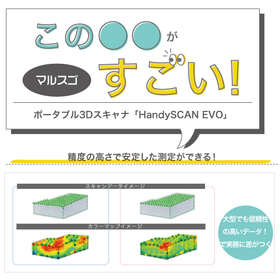
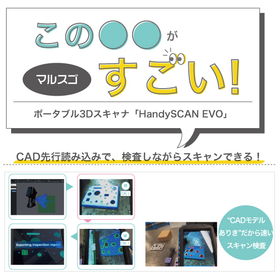
There are various types of 3D scanners, and point accuracy and specifications are important factors at the time of introduction. However, practicality in inspection is not determined by these factors alone. What we would like to introduce this time is the "HandySCAN 3D EVO series." Based on high accuracy and volumetric precision, it enables on-site inspection decisions and improved work efficiency through a unique scanning flow using AR! In the materials, we provide a detailed explanation of the reasons for the high accuracy unique to HandySCAN 3D EVO, its advantages, and the actual measurement flow that allows for simultaneous inspection while scanning, so please take a look. *You can download the materials from the button below.
Added to bookmarks
Bookmarks listBookmark has been removed
Bookmarks listYou can't add any more bookmarks
By registering as a member, you can increase the number of bookmarks you can save and organize them with labels.
Free membership registration
There are various types of 3D scanners, and point accuracy and specifications are important factors at the time of introduction. However, practicality in inspections is not determined by those alone. What we would like to introduce this time is the "HandySCAN 3D EVO series." Based on high accuracy and volumetric precision, it enables on-site inspection decisions and improves work efficiency through a unique scanning flow using AR! In the materials, we provide a detailed explanation of the reasons for the high accuracy unique to HandySCAN 3D EVO, its advantages, and the actual measurement flow that allows for simultaneous inspection while scanning, so please take a look. *You can download the materials from the button below.
Added to bookmarks
Bookmarks listBookmark has been removed
Bookmarks listYou can't add any more bookmarks
By registering as a member, you can increase the number of bookmarks you can save and organize them with labels.
Free membership registration
Mitarepo is a series that introduces what can be done using various products with the concept of "I tried doing this!" Among the many 3D printing methods, the pellet-based 3D printer is noted for its wide variety of usable materials. It attracts attention for its ability to use materials that are not filamentized, as well as recycled materials created through resource reuse and waste reduction, which are not available elsewhere. This time, we focused on ABS, which is considered to have a high level of difficulty in molding among such recycled materials, and we actually performed molding using the large pellet-based 3D printer "CreatBot P800"! In the materials provided, we will answer questions such as, "Can we mold beautifully even with recycled materials?" and "What are the specific considerations for ABS pellet molding?" We will explain the preparations needed for ABS molding and the finishing of the model after completion, along with actual photos. *You can download the materials using the button below.
Added to bookmarks
Bookmarks listBookmark has been removed
Bookmarks listYou can't add any more bookmarks
By registering as a member, you can increase the number of bookmarks you can save and organize them with labels.
Free membership registration
Mitarepo is a series based on the concept of "Trying out things like this!" that introduces what can be done using various products. When selecting a machining center, what is important is not only the initial cost but also whether it can be used stably after installation. This time, we examined the spindle rotation accuracy (runout) and the axis's repeat positioning accuracy, which affect machining quality and stable operation. Regarding points of concern such as, "The price is attractive, but what about the accuracy?" and "How much machining quality can we actually expect?" we will introduce the actual measurement process and results. *You can download the materials from the button below.
Added to bookmarks
Bookmarks listBookmark has been removed
Bookmarks listYou can't add any more bookmarks
By registering as a member, you can increase the number of bookmarks you can save and organize them with labels.
Free membership registration
Mitarepo is a series that introduces what can be done using various products with the concept of "I tried doing this!" The Form series of SLA 3D printers from Formlabs, which has received support for its ability to create high-resolution models, has been updated from V1 to V2 with the resin material "Tough 2000 Resin," which has ABS-like strength! "What is the actual finish of the model like?" "I'm curious if it can be used as a practical item..." To respond to such inquiries, we conducted an evaluation to verify the capabilities of Tough 2000 Resin V2. First, we focused on "warping," which is key to print quality. We printed a model with a thin thickness and a large area that is prone to warping using the Form4L, and checked the state before and after secondary curing and after support removal. Additionally, we performed tapping on the printed block with pilot holes and checked how much tightening torque it could withstand with two types: direct tapping and helicoil inserts. *You can download the materials from the button below.
Added to bookmarks
Bookmarks listBookmark has been removed
Bookmarks listYou can't add any more bookmarks
By registering as a member, you can increase the number of bookmarks you can save and organize them with labels.
Free membership registration
In the automotive prototyping industry, a rapid response to design changes and the production of high-quality parts are required. Particularly in prototyping using metal 3D printers, deformation due to residual stress poses challenges, which can lead to rework and increased costs. Amphyon simulates the factors of deformation in metal fabrication, specifically "residual stress," allowing for the detection of deformation amounts and fabrication errors in advance. This reduces the number of trial and error instances in prototyping and mitigates material costs and machine operating costs. Amphyon contributes to quality improvement and cost reduction in automotive prototyping. [Usage Scenarios] - Manufacturing prototypes using metal 3D printers - Optimizing the prototyping process due to design changes - Rapid production of high-quality parts [Effects of Implementation] - Shortened prototyping period - Reduced material costs - Decreased fabrication errors - Realization of near-net-shape manufacturing
Added to bookmarks
Bookmarks listBookmark has been removed
Bookmarks listYou can't add any more bookmarks
By registering as a member, you can increase the number of bookmarks you can save and organize them with labels.
Free membership registration
In the field of home appliance design, 3D scanning is essential for accurately capturing the shape and design of products. Particularly for complex shapes and glossy products, obtaining scan data can be cumbersome. AESUB eliminates the need for post-processing after scanning, thereby reducing time and effort in the design process and supporting efficient design work. 【Use Cases】 - Scanning prototype models of home appliances - Creating 3D data for design reviews - Reverse engineering 【Benefits of Implementation】 - Time savings through the reduction of post-processing steps - Increased efficiency in scanning tasks through marker application - Adaptability to various workpieces
Added to bookmarks
Bookmarks listBookmark has been removed
Bookmarks listYou can't add any more bookmarks
By registering as a member, you can increase the number of bookmarks you can save and organize them with labels.
Free membership registration
In educational institutions, 3D scanning materials require ease of use and safety. AESUB naturally sublimates after application, eliminating the need for post-processing such as wiping or cleaning. This allows students to experience 3D scanning more smoothly and focus on their learning. 【Usage Scenarios】 - 3D scanning materials - 3D model creation practice - 3D data conversion of physical objects 【Benefits of Implementation】 - Reduces post-processing effort - Can be used as a safe educational material - Provides a smooth learning experience
Added to bookmarks
Bookmarks listBookmark has been removed
Bookmarks listYou can't add any more bookmarks
By registering as a member, you can increase the number of bookmarks you can save and organize them with labels.
Free membership registration
In reverse engineering within the manufacturing industry, existing products or parts are often 3D scanned to create CAD data. During this process, glossy or transparent workpieces are difficult to scan, making surface treatment with spray essential. However, traditional powder sprays require considerable effort for removal after scanning, which can reduce work efficiency. AESUB contributes to the efficiency of reverse engineering as it eliminates the need for post-scanning removal work. 【Application Scenarios】 - 3D digitization of existing products - Duplication of damaged parts - Mold design 【Benefits of Implementation】 - Reduction of post-processing steps - Shortening of work time - Cost reduction
Added to bookmarks
Bookmarks listBookmark has been removed
Bookmarks listYou can't add any more bookmarks
By registering as a member, you can increase the number of bookmarks you can save and organize them with labels.
Free membership registration