- Publication year : 2026
1~12 item / All 12 items
Displayed results
Added to bookmarks
Bookmarks listBookmark has been removed
Bookmarks listYou can't add any more bookmarks
By registering as a member, you can increase the number of bookmarks you can save and organize them with labels.
Free membership registration
Contact this company
Inquiry Form1~12 item / All 12 items

In recent years, with the expansion of the health food market, including functional foods with labeling claims, there has been an increasing demand for safety and quality assurance. Due to the revision of food labeling standards, compliance with GMP standards will be mandatory for functional foods in supplement form starting September 1, 2026. In this webinar, we will welcome Masayuki Takahira, Director and Secretary General of the NPO-QA Center, as a speaker to clearly explain the background of the system revision, differences from pharmaceutical GMP, and practical points regarding shipment management, validation, deviation management, and change management. This is recommended for quality assurance, quality control, and manufacturing departments, as well as manufacturers and contract manufacturers. The event will be co-hosted with Hitachi Systems, Ltd. 【Program】 Part 1: 14:05–15:00 "Functional Food GMP ~Regarding the mandatory compliance with GMP standards starting September 1, 2026~" Masayuki Takahira, NPO-QA Center Part 2: 15:00–15:10 "Introduction to CSV Support Services for Cloud Services" Hitachi Systems, Ltd. Part 3: 15:10–15:15 "Introduction to Agatha" Agatha Co., Ltd. Part 4: 15:15–15:30 Q&A Session
Added to bookmarks
Bookmarks listBookmark has been removed
Bookmarks listYou can't add any more bookmarks
By registering as a member, you can increase the number of bookmarks you can save and organize them with labels.
Free membership registration
In January 2025, Okayama Medical Center introduced the digitization of clinical trial documents with the aim of improving operational efficiency. Furthermore, starting in April 2026, they began utilizing AI functions, and currently, they are advancing both traditional operations and those utilizing AI in parallel. In this presentation, we will candidly discuss the changes that have occurred in actual operations and workflows due to the use of AI functions, from the perspective of on-site personnel. We plan to share experiences gained in daily operations, including expectations before implementation, insights felt during actual use, and operational innovations and challenges. This will provide practical examples that will be useful not only for facilities considering digitization and AI utilization but also for those already operating these systems as they think about future applications. Additionally, the background of Okayama Medical Center's digitization implementation and operational structure will be introduced in a separate case article that will be published later. This webinar will focus on the actual use of AI functions and the real voices from the field, which may not be fully conveyed in the case article.
Added to bookmarks
Bookmarks listBookmark has been removed
Bookmarks listYou can't add any more bookmarks
By registering as a member, you can increase the number of bookmarks you can save and organize them with labels.
Free membership registration
As the utilization of generative AI in business progresses, the pharmaceutical and medical device industries are focusing on practical issues such as "Is generative AI subject to CSV (Computer System Validation)?" and "How should AI validation be conducted?" In this content, we present on-demand sessions that explain CSV compliance and AI risk management in generative AI systems, based on the concepts of FDA CSA (Computer Software Assurance) from previously well-received webinars. ■Content - Determining the applicability of CSV to generative AI systems - Methods for conducting AI validation - Key focus areas during inspections - Points for ensuring data integrity - AI literacy education and Human in the Loop - Considerations for internal controls in the utilization of generative AI *This content is based on information as of April 22, 2026. *The information provided is intended for general informational purposes and does not guarantee specific actions or compliance.
Added to bookmarks
Bookmarks listBookmark has been removed
Bookmarks listYou can't add any more bookmarks
By registering as a member, you can increase the number of bookmarks you can save and organize them with labels.
Free membership registration
In recent years, as the importance of data integrity (DI) compliance in GMP environments has increased, there has been a growing call to deepen understanding of 21 CFR Part 11. This content introduces an on-demand presentation that organizes the background of Part 11, its relationship with DI, and its positioning in CSA guidance, while explaining the basic concepts of electronic records and electronic signatures. ■Content - Background and basic concepts of Part 11 - Relationship with data integrity (DI) - Positioning in CSA guidance - Basic requirements for electronic records/electronic signatures *This content is based on information as of March 17, 2026. *The information provided is intended for general informational purposes and does not guarantee specific compliance or suitability.
Added to bookmarks
Bookmarks listBookmark has been removed
Bookmarks listYou can't add any more bookmarks
By registering as a member, you can increase the number of bookmarks you can save and organize them with labels.
Free membership registration
In recent years, as the importance of quality issues and inspection responses has increased in the pharmaceutical industry, there has also been a growing interest in the key points of GMP audits and the approach to addressing them. This content introduces an on-demand presentation that explains the fundamental concepts of audits and the perspectives for verification, based on the GMP audit manual (draft) from a previously well-received webinar. ■Content - Basic concepts of GMP audits - An example of points verified during audits - Considerations for verifying the quality assurance system - Evaluation of audit results and approaches for improvement *This content is based on information available at the time of distribution.
Added to bookmarks
Bookmarks listBookmark has been removed
Bookmarks listYou can't add any more bookmarks
By registering as a member, you can increase the number of bookmarks you can save and organize them with labels.
Free membership registration
We have published the 6th installment of our partner, CAC Corporation's contributed column series titled "Points Customers Tend to Overlook and Unexpected Challenges." The theme of the 6th installment is "Maintaining CSV and Continuous Improvement - To Keep a Validated State." ■ Overview The most important aspect of CSV is not the moment of system implementation. The essence lies in continuously maintaining the "validated state" while responding to changes in business, regulations, and technology over the years following system operation. This column focuses on the operational phase and explains the key strategies and practices for "maintaining" CSV. ■ Key Points - The concept of impact assessment and re-validation in change management - Risk management to avoid underestimating configuration changes - Preventing "logical degradation" through self-inspection and regular reviews - Points for operation and education to prevent the formalization of SOPs - The direction of efficiency and evolution of CSV in the CSA era ■ Column Agenda 1. The importance of change management 2. The importance of self-inspection and regular reviews 3. Compliance with SOPs and prevention of formalization 4. Continuous improvement of CSV 5. Summary: CSV is a "journey"
Added to bookmarks
Bookmarks listBookmark has been removed
Bookmarks listYou can't add any more bookmarks
By registering as a member, you can increase the number of bookmarks you can save and organize them with labels.
Free membership registration
We are currently publishing a case study on the introduction of Agatha by Triad Japan, Inc. The company implemented Agatha's facility document storage and IRB solutions to address the burdens and storage issues associated with managing clinical trial and IRB-related documents on paper, aiming to reduce paper materials and costs, as well as mitigate the risks of loss and information leakage. After the implementation, in addition to reducing expenses and labor costs, it has also led to a reduction in the time spent on storing paper materials and improved staff efficiency. To see how the field has changed with the introduction of Agatha, please check out the specific details in the case study.
Added to bookmarks
Bookmarks listBookmark has been removed
Bookmarks listYou can't add any more bookmarks
By registering as a member, you can increase the number of bookmarks you can save and organize them with labels.
Free membership registration
We are currently sharing a case study on the introduction of Agatha at Kitano Hospital, a public interest incorporated foundation, Tanuki Kofukai Medical Research Institute. At this hospital, while promoting clinical trials with an in-house team and four SMOs, Agatha's facility document storage and IRB were introduced to improve work efficiency and environmental conservation with limited manpower. This has facilitated smoother sharing of IRB documents and improved the work efficiency of the SMO administrative staff, leading to an increase in the number of new clinical trial contracts. To see how the introduction of Agatha has changed the on-site operations, please refer to the specific details in the case study.
Added to bookmarks
Bookmarks listBookmark has been removed
Bookmarks listYou can't add any more bookmarks
By registering as a member, you can increase the number of bookmarks you can save and organize them with labels.
Free membership registration
We have published the fifth installment of our partner, CAC Corporation's contributed column series, "Points Customers Often Overlook and Unexpected Challenges." The fifth installment focuses on the theme "Key Points and Efficiency in Document Management - Transforming Documents into Assets that Withstand Audits." In CSV (Computer System Validation), one cannot avoid the enormous task of document creation and management. Validation plans, User Requirement Specifications (URS), various specifications, PQ-related documents, reports... Is the act of "creating" becoming the objective itself? This column explains practical points for transforming CSV documents from mere deliverables into "assets" that support audit responses and are useful for future change management. ■ Key Points - Efficiency through the use of Word templates and styles - Design of version control and document numbering rules - Mechanisms to prevent delays in review/approval workflows - Management of finalized documents and assurance of authenticity - Concepts of document management that meet ER/ES and ALCOA+ requirements ■ Column Agenda 1. Breaking free from complicated document creation 2. Designing review and approval workflows 3. Key points for managing finalized documents and asset conversion 4. Utilizing document management systems that comply with GxP requirements
Added to bookmarks
Bookmarks listBookmark has been removed
Bookmarks listYou can't add any more bookmarks
By registering as a member, you can increase the number of bookmarks you can save and organize them with labels.
Free membership registration
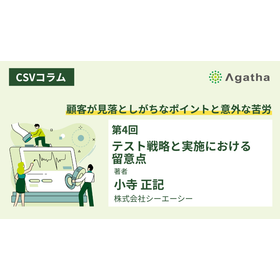
We have published the fourth installment of our partner company CAC's contributed column series titled "Points Customers Often Overlook and Unexpected Challenges." The fourth installment focuses on "Performance Qualification (PQ)." PQ (Performance Qualification) is the final quality confirmation process conducted before the start of operations to verify and demonstrate that the system can consistently operate as intended in accordance with actual business procedures and regulatory requirements. In this column, we will explain practical points to ensure that PQ goes beyond mere functional confirmation to appropriately demonstrate business suitability and quality. ■ Key Points - Considerations for PQ test planning based on business scenarios - Key aspects of validation including data integrity and ER/ES requirements - Realism of test data and the differentiation between positive and negative testing - Principles for maintaining test records that can withstand audits - How to assess and manage deviations that occur during PQ ■ Column Agenda 1. Test planning and evaluation policy in PQ 2. Importance of test data 3. Creation and maintenance of accurate test records 4. Pitfalls in deviation management 5. Summary
Added to bookmarks
Bookmarks listBookmark has been removed
Bookmarks listYou can't add any more bookmarks
By registering as a member, you can increase the number of bookmarks you can save and organize them with labels.
Free membership registration
We have published the fourth installment of our partner company CAC's contributed column series titled "Points Customers Often Overlook and Unexpected Challenges." The fourth installment focuses on "Performance Qualification (PQ)." ■ Key Points - Considerations for PQ test planning tailored to business scenarios - Key aspects of validation including data integrity and ER/ES requirements - Realism of test data and differentiation between positive and negative testing - Principles for maintaining test records that can withstand audits - How to assess and manage deviations that occur during PQ ■ Column Agenda 1. Test planning and evaluation policy in PQ: What and how to test? 2. Importance of test data: Creating realistic scenarios 3. Creating and maintaining accurate test records: Principles for audit-ready documentation 4. Pitfalls of deviation management: Responding to unexpected results 5. Summary
Added to bookmarks
Bookmarks listBookmark has been removed
Bookmarks listYou can't add any more bookmarks
By registering as a member, you can increase the number of bookmarks you can save and organize them with labels.
Free membership registration
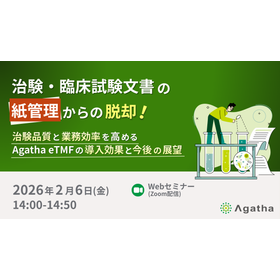
For companies managing clinical trial documents on paper, you may be facing challenges such as spending a lot of time searching for and verifying documents, or having to gather, file, and check for missing documents before audits and inspections. In this webinar, we will outline the unique challenges and future risks associated with paper management and introduce how companies operating with paper management can "gradually and effortlessly" improve by utilizing Agatha eTMF. We will provide feedback from companies currently using the system, specific implementation effects based on user surveys, and a demonstration to give you a clear image of on-site operations. 【Program】 Part 1: 14:00 - 14:20 "Implementation Effects and Future Developments of Agatha as Seen from the eTMF User Survey" Part 2: 14:20 - 14:40 "Introduction to Agatha eTMF Solutions and Demonstration" Agatha Inc. Sales & Marketing Department Life Sciences Group Part 3: 14:40 - 14:50 "Q&A Session" *We plan to collect questions during the webinar.
Added to bookmarks
Bookmarks listBookmark has been removed
Bookmarks listYou can't add any more bookmarks
By registering as a member, you can increase the number of bookmarks you can save and organize them with labels.
Free membership registration