iPROS Manufacturing
  • Search for products by classification category

    • Electronic Components and Modules
      Electronic Components and Modules
      59245items
    • Machinery Parts
      Machinery Parts
      74914items
    • Manufacturing and processing machinery
      Manufacturing and processing machinery
      99344items
    • Scientific and Physics Equipment
      Scientific and Physics Equipment
      34523items
    • Materials
      Materials
      36905items
    • Measurement and Analysis
      Measurement and Analysis
      54668items
    • Image Processing
      Image Processing
      15018items
    • Control and Electrical Equipment
      Control and Electrical Equipment
      52970items
    • Tools, consumables, and supplies
      Tools, consumables, and supplies
      64218items
    • Design and production support
      Design and production support
      12425items
    • IT/Network
      IT/Network
      43320items
    • Office
      Office
      13690items
    • Business support services
      Business support services
      33165items
    • Seminars and Skill Development
      Seminars and Skill Development
      6287items
    • Pharmaceutical and food related
      Pharmaceutical and food related
      29309items
    • others
      73409items
  • Search for companies by industry

    • Manufacturing and processing contract
      7343
    • others
      4999
    • Industrial Machinery
      4419
    • Machine elements and parts
      3284
    • Other manufacturing
      2888
    • IT/Telecommunications
      2553
    • Trading company/Wholesale
      2470
    • Industrial Electrical Equipment
      2298
    • Building materials, supplies and fixtures
      1809
    • software
      1634
    • Electronic Components and Semiconductors
      1567
    • Resin/Plastic
      1486
    • Service Industry
      1446
    • Testing, Analysis and Measurement
      1128
    • Ferrous/Non-ferrous metals
      983
    • environment
      700
    • Chemical
      630
    • Automobiles and Transportation Equipment
      563
    • Printing Industry
      508
    • Information and Communications
      456
    • Consumer Electronics
      416
    • Energy
      326
    • Rubber products
      312
    • Food Machinery
      306
    • Optical Instruments
      278
    • robot
      271
    • fiber
      250
    • Paper and pulp
      233
    • Electricity, Gas and Water Industry
      169
    • Pharmaceuticals and Biotechnology
      167
    • Warehousing and transport related industries
      144
    • Glass and clay products
      142
    • Food and Beverage
      128
    • CAD/CAM
      125
    • retail
      110
    • Educational and Research Institutions
      105
    • Medical Devices
      102
    • Ceramics
      98
    • wood
      89
    • Transportation
      84
    • Medical and Welfare
      63
    • Petroleum and coal products
      62
    • Shipbuilding and heavy machinery
      52
    • Aviation & Aerospace
      48
    • Fisheries, Agriculture and Forestry
      42
    • Public interest/special/independent administrative agency
      31
    • equipment
      29
    • self-employed
      24
    • Research and development equipment and devices
      23
    • Government
      22
    • Materials
      22
    • Mining
      17
    • Finance, securities and insurance
      13
    • cosmetics
      11
    • Individual
      10
    • Restaurants and accommodations
      9
    • Police, Fire Department, Self-Defense Forces
      7
    • Raw materials for reagents and chemicals
      3
    • Laboratory Equipment and Consumables
      3
    • Contracted research
      3
  • Special Features
  • Ranking

    • Overall Products Ranking
    • Overall Company Ranking
Search for Products
  • Search for products by classification category

  • Electronic Components and Modules
  • Machinery Parts
  • Manufacturing and processing machinery
  • Scientific and Physics Equipment
  • Materials
  • Measurement and Analysis
  • Image Processing
  • Control and Electrical Equipment
  • Tools, consumables, and supplies
  • Design and production support
  • IT/Network
  • Office
  • Business support services
  • Seminars and Skill Development
  • Pharmaceutical and food related
  • others
Search for Companies
  • Search for companies by industry

  • Manufacturing and processing contract
  • others
  • Industrial Machinery
  • Machine elements and parts
  • Other manufacturing
  • IT/Telecommunications
  • Trading company/Wholesale
  • Industrial Electrical Equipment
  • Building materials, supplies and fixtures
  • software
  • Electronic Components and Semiconductors
  • Resin/Plastic
  • Service Industry
  • Testing, Analysis and Measurement
  • Ferrous/Non-ferrous metals
  • environment
  • Chemical
  • Automobiles and Transportation Equipment
  • Printing Industry
  • Information and Communications
  • Consumer Electronics
  • Energy
  • Rubber products
  • Food Machinery
  • Optical Instruments
  • robot
  • fiber
  • Paper and pulp
  • Electricity, Gas and Water Industry
  • Pharmaceuticals and Biotechnology
  • Warehousing and transport related industries
  • Glass and clay products
  • Food and Beverage
  • CAD/CAM
  • retail
  • Educational and Research Institutions
  • Medical Devices
  • Ceramics
  • wood
  • Transportation
  • Medical and Welfare
  • Petroleum and coal products
  • Shipbuilding and heavy machinery
  • Aviation & Aerospace
  • Fisheries, Agriculture and Forestry
  • Public interest/special/independent administrative agency
  • equipment
  • self-employed
  • Research and development equipment and devices
  • Government
  • Materials
  • Mining
  • Finance, securities and insurance
  • cosmetics
  • Individual
  • Restaurants and accommodations
  • Police, Fire Department, Self-Defense Forces
  • Raw materials for reagents and chemicals
  • Laboratory Equipment and Consumables
  • Contracted research
Special Features
Ranking
  • Overall Products Ranking
  • Overall Company Ranking
  • privacy policy
  • terms of service
  • About Us
  • Careers
  • Advertising
  1. Home
  2. Service Industry
  3. StartupScaleup.jp
  4. Product/Service List
Service Industry
  • Added to bookmarks

    Bookmarks list

    Bookmark has been removed

    Bookmarks list

    You can't add any more bookmarks

    By registering as a member, you can increase the number of bookmarks you can save and organize them with labels.

    Free membership registration

StartupScaleup.jp

capital500Ten thousand
number of employees1
addressTokyo/Musashino-shi/2nd Floor, Sakurai Building, 1-1-1 Kitamachi, Kichijoji
phone050-8884-4979
  • Special site
  • Official site
last updated:Feb 06, 2026
  • Contact this company

    Inquiry Form
  • Before making an inquiry

    Download Profile
  • Company information
  • Products/Services(35)
  • catalog(2)
  • news(0)

StartupScaleup.jp Product Lineup

  • category

1~15 item / All 15 items

Displayed results

Filter by category

新規事業開発 新規事業開発
市場調査 市場調査
事業開発伴走支援 事業開発伴走支援
新規事業開発担当者のトレーニング 新規事業開発担当者のトレーニング
新規事業開発担当者のトレーニング

新規事業開発担当者のトレーニング

新規事業開発ノウハウ

Learn from the movie "Shin Godzilla"! Planning useful for new business development.

Breaking out of the framework of thought with Godzilla's attack! A method for generating business ideas through scenario planning.

This document explains how to utilize scenario planning in new business development, using the movie "Shin Godzilla" as a subject. It specifically outlines each step of scenario planning, from listing external environmental factors using STEEP, to four-quadrant mapping and setting scenario axes. It also introduces the significant strength of experts' status quo bias and the mindset needed to generate business ideas that are typically not conceived. 【Contents (partial)】 ■ "Shin Godzilla" is the story of developing the new business "Yashiori Operation." ■ Scenario planning was originally intended to prevent companies from becoming like boiled frogs. ■ Utilizing scenario planning at the start of a new business is to generate business ideas that are usually not conceived. ■ "Ambidextrous management" is a battle against status quo bias. ■ The conclusions drawn from following scenario planning are multiple scenarios. ■ Important note: Scenario planning ≠ future forecasting.

Added to bookmarks

Bookmarks list

Bookmark has been removed

Bookmarks list

You can't add any more bookmarks

By registering as a member, you can increase the number of bookmarks you can save and organize them with labels.

Free membership registration

Key Points for Successful Scenario Planning in New Business Proposal Creation

Don't try to predict and guess! Important points to keep in mind when implementing scenario planning.

Here are some important points to consider when conducting scenario planning for the creation of new business proposals. It is crucial not to work backward from the new business ideas in your mind based on external environmental factors, to set high levels of abstraction when establishing axes, and to constantly question assumptions in order to enhance creativity. Additionally, it is important to avoid spending too much time on the process and to not become overly fixated on formalities. 【Important Points (Partial)】 ■ Do not work backward from new business ideas based on external environmental factors. ■ When setting axes from external environmental factors, maintain a high level of abstraction. ■ To enhance creativity, always question assumptions. ■ This is not a competition to predict the future accurately or inaccurately. ■ Never say, "There’s no way such a case exists."

Added to bookmarks

Bookmarks list

Bookmark has been removed

Bookmarks list

You can't add any more bookmarks

By registering as a member, you can increase the number of bookmarks you can save and organize them with labels.

Free membership registration

What is the true way to use the business model canvas?

The business model is not a "finished product for internal agreement"! An explanation of how to use a paper-based pivot to create a sellable business canvas.

"What is the true way to use the Business Model Canvas?" is a document that explains the practical application of the Business Model Canvas not just as a tool for organizing business plans, but as a means to repeatedly test hypotheses with customers during the early stages of business development, facilitating "paper-based pivots." It clearly explains the common pitfalls and points of consideration for each of the nine boxes of the Business Model Canvas, using concrete examples from companies like Uber, Amazon, and Dropbox. The document points out the challenges faced by companies that consider new business development complete once a business model is approved, and teaches how to continuously use the canvas as a "checklist." [Contents (excerpt)] - The Business Model Canvas as a "checklist" - Points of consideration and examples for each box (KP, KA, KR, VP, CS, CR, CH, CS, RS) - Four conditions for reaching PMF - Analysis of cases that failed in actual business development *For more details, please download the document and check it.

Added to bookmarks

Bookmarks list

Bookmark has been removed

Bookmarks list

You can't add any more bookmarks

By registering as a member, you can increase the number of bookmarks you can save and organize them with labels.

Free membership registration

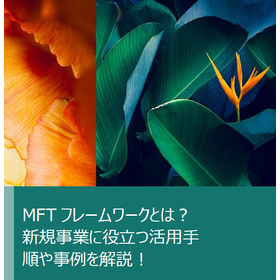
What is the MFT framework? An explanation of useful application procedures and examples for new business ventures!

Connecting technology and the market through "function"! A guide to utilizing the MFT framework to break down fixed ideas and unlock new possibilities for your company's technology.

"What is the MFT Framework? An explanation of useful application procedures and examples for new business!" is a document that systematically organizes the three elements of Market, Function, and Technology, and explains a way of thinking to connect company technology to new markets. The greatest feature of the MFT framework is that it does not directly link technology and market, but places the concept of "function" in between. By reinterpreting the essential value of technology as "function," it draws out the diverse possibilities of a single technology and allows for the discovery of entry opportunities into industries and niche markets that had not been considered before. It also introduces case studies from NEDO's "Innovation Outlook" and the Ministry of Education, Culture, Sports, Science and Technology's Innovative GX Technology Development Subcommittee, providing insights into methods that are actually used in the field of technology management. [Contents (excerpt)] ■ Basics of the MFT framework and its three components ■ Practical steps (inventory of technology → identification of functions → market exploration → concretization of business ideas) ■ Case studies from NEDO and the Ministry of Education, Culture, Sports, Science and Technology ■ Three key points for success *For more details, please download the document and check it.

Added to bookmarks

Bookmarks list

Bookmark has been removed

Bookmarks list

You can't add any more bookmarks

By registering as a member, you can increase the number of bookmarks you can save and organize them with labels.

Free membership registration

Customer Interview: 10 Questions to Avoid

That question won't reveal the true feelings! An explanation of 10 common bad question patterns and their failure mechanisms in customer interviews.

The '10 NG Questions for Customer Interviews' is a document that organizes 10 patterns of common communication pitfalls in customer interviews for new business development and product planning. It clearly explains why it is difficult to elicit honest opinions from interviewees. Questions that seem reasonable at first glance, such as 'What do you think of this service?' or 'How much would you pay for it?' can actually lead interviewees to hide their true feelings or fabricate responses. This structure is illustrated with humorous examples. For each NG question, the document contrasts the interviewee's statements, their true feelings, our interpretations, and the actual outcomes, clarifying the mechanism behind the occurrence of False Positives. This is an essential read for improving the quality of customer interviews and understanding true needs. [Contents (excerpt)] - Explanation of 10 NG question patterns - Diagram illustrating the structure of False Positive occurrences - Mechanism of the gap between the interviewee's statements and true feelings - Introduction to reference blog articles *For more details, please download the document and check it out.

Added to bookmarks

Bookmarks list

Bookmark has been removed

Bookmarks list

You can't add any more bookmarks

By registering as a member, you can increase the number of bookmarks you can save and organize them with labels.

Free membership registration

What is Lean Startup?

"Lean Startup = Agile" is a big mistake! Unraveling the true practice of Lean Startup from personal experience.

"The Lean Startup" is a document that corrects the widely misunderstood interpretation of "Lean Startup = a method of minimizing costs and repeatedly prototyping and improving in a short period" and explains the original definition and practical methods proposed by Eric Ries. Based on his own experience of nearly causing a startup to fail while using Agile development (Scrum), Ries presents the correct definition: "Lean Startup = Customer Development Model + Agile." It clarifies essential points that differ from common beliefs, such as the necessity of providing an MVP for a fee and that what should be measured is "how many people clicked the purchase button." The document includes a wealth of insights that can be immediately applied in new business development, such as case studies from DoorDash and Boom Technology, the dangers of vanity metrics, and the concept of Pivotious. [Contents (excerpt)] ■ The correct definition of Lean Startup ■ Benefits and precautions of implementation ■ Four steps for practice (Build-Measure-Learn-Iterate) ■ Six points learned from the IMVU episode *For more details, please download the document and check it.

Added to bookmarks

Bookmarks list

Bookmark has been removed

Bookmarks list

You can't add any more bookmarks

By registering as a member, you can increase the number of bookmarks you can save and organize them with labels.

Free membership registration

What is hypothesis thinking? An explanation of practical steps and ways to enhance the quality of work.

Dramatically improve the speed and quality of problem-solving! This book explains everything from the basics of hypothesis thinking to practical training methods.

"What is Hypothesis Thinking? An Explanation of Practical Steps and Training to Enhance Work Quality" is a systematic explanatory document on the thinking method of "hypothesis thinking," designed for making quick decisions based on limited information in the rapidly changing VUCA era. Hypothesis thinking involves establishing the most plausible "tentative answer (hypothesis)" from limited information and then verifying whether that hypothesis is correct. In contrast to comprehensive thinking, it allows for setting a goal first and then working backward to gather and analyze the necessary information, enabling efficient and rapid access to the essence of the problem. By mastering hypothesis thinking, one can gain benefits such as improved problem-solving speed, enhanced decision-making quality, and increased productivity in work. If you are interested, please feel free to download it. [Contents (Excerpt)] ■ Basic definition of hypothesis thinking ■ Three steps to practice hypothesis thinking ■ Points to enhance the accuracy of hypothesis thinking ■ Training methods to develop hypothesis thinking in daily operations ■ Success stories in companies (BCG, SoftBank) *For more details, please download the document and check it out.

Added to bookmarks

Bookmarks list

Bookmark has been removed

Bookmarks list

You can't add any more bookmarks

By registering as a member, you can increase the number of bookmarks you can save and organize them with labels.

Free membership registration

What is a technology seed? Differences from meaning and needs, and how to successfully commercialize it.

Transforming unique technologies lying dormant within the company into new value! A five-step explanation from the basics of technology seeds to commercialization, complete with successful case studies.

"What are Technology Seeds? An Explanation of Their Meaning, Differences from Needs, and How to Successfully Commercialize Them" is a systematic explanatory document that covers the concept of "technology seeds," which are essential for corporate growth strategies, as well as methodologies for commercialization. Technology seeds refer to the unique technologies, patents, know-how, and ideas that a company possesses, which are fundamental elements that hold the potential to create new products or services in the future. The document also clearly explains the differences from the often-confused term "needs," as well as the distinctions between product-out and market-in approaches through comparison tables. By adopting a strategy based on technology seeds, companies can expect to create markets with high competitive advantages and enhance their brand value. If you are interested, please feel free to download it. [Contents (Excerpt)] ■ What are technology seeds? Unique technologies that serve as the seeds for business ■ The decisive differences between technology seeds and needs ■ Advantages and disadvantages of strategies based on technology seeds ■ 5 steps to utilize technology seeds for new business ■ Case studies of companies that have succeeded in commercialization (Fujifilm) *For more details, please download the document and check it out.

Added to bookmarks

Bookmarks list

Bookmark has been removed

Bookmarks list

You can't add any more bookmarks

By registering as a member, you can increase the number of bookmarks you can save and organize them with labels.

Free membership registration

What are the steps to successfully commercialize a technology seed?

Break through the wall of not being able to sell despite having technology! A detailed process for commercializing technology seeds by crossing the valley of death.

"What are the steps to successfully commercialize technology seeds? An explanation of key points to cross the 'valley of death'" is a systematic explanatory document aimed at R&D departments and new business personnel, outlining a concrete process for guiding technology seeds toward commercialization. The commercialization of technology seeds involves creating a mechanism that connects the technical seeds owned by a company with customer needs—issues that customers are willing to pay to solve—thereby generating economic value. This document provides practical know-how to enhance the success rate of commercialization, addressing the common challenge faced by many companies: "the technology is excellent, but it doesn't sell." It discusses the risks of developing without customer involvement and methods to overcome the "valley of death." [Contents (excerpt)] - What exactly is the commercialization of technology seeds? - Reasons why many technology seeds fail to commercialize - Specific steps to achieve successful commercialization - The necessary structure to leverage technology seeds - Two points to be aware of to increase the likelihood of commercialization *For more details, please download the document and check it out.*

Added to bookmarks

Bookmarks list

Bookmark has been removed

Bookmarks list

You can't add any more bookmarks

By registering as a member, you can increase the number of bookmarks you can save and organize them with labels.

Free membership registration

How to Advance Technological Development: What are the Differences from Research and Development and the Roadmap to Success?

Comprehensive understanding from the basics of technology development to practical application! A thorough explanation of the differences between research and development, product development, and how to create a roadmap.

"How to Advance Technology Development" is a comprehensive explanatory document that clearly summarizes everything from the basic definition of technology development to specific processes that lead to success and how to create a roadmap. It organizes the differences between research and development and product development from the perspectives of purpose, phase, and deliverables, clarifying the role of technology development in "practical application and commercialization." If you are interested, please feel free to download it. [Contents (excerpt)] ■ What is technology development? An important process that supports corporate growth ■ Differences from research and development and product development ■ Specific job responsibilities in technology development and the four steps ■ How to create a roadmap that leads to success ■ Required personnel and skills in technology development ■ Utilization of external resources (open innovation) *For more details, please download the document and check it.

Added to bookmarks

Bookmarks list

Bookmark has been removed

Bookmarks list

You can't add any more bookmarks

By registering as a member, you can increase the number of bookmarks you can save and organize them with labels.

Free membership registration

What is Technology Management (MOT)? Key Points for Implementation from Benefits and Success Stories

A comprehensive guide explaining the management method "MOT" that transforms technology into profit, covering the basics, successful case studies, and implementation steps all in one book.

"What is Technology Management (MOT)? An Explanation of Points for Implementation from Benefits and Success Stories" is a comprehensive explanatory document that clearly summarizes the basics of technology management, differences from an MBA, benefits of implementation, and specific success stories. It systematically organizes the concept of MOT, which views technology as a management resource and generates economic value through innovation, along with the challenges and points of caution in its implementation. If you are interested, please feel free to download it. [Contents (excerpt)] ■ What is Technology Management (MOT)? ■ Why is MOT needed now? ■ Four benefits brought by MOT ■ Challenges and points of caution in implementation ■ Success stories (Fujifilm, Toyota Motor Corporation) ■ Four steps to implement and promote MOT *For more details, please download the document and check it.

Added to bookmarks

Bookmarks list

Bookmark has been removed

Bookmarks list

You can't add any more bookmarks

By registering as a member, you can increase the number of bookmarks you can save and organize them with labels.

Free membership registration

15 New Business Ideas for the Manufacturing Industry! Learning How to Create a Business from Successful Examples

Discover new business plans that leverage your company's strengths! A selection of 15 ideas focused on the manufacturing industry, along with success stories and startup procedures explained.

"15 New Business Ideas for the Manufacturing Industry! Learning from Successful Case Studies" is a comprehensive guide that presents 15 new business ideas specifically for the manufacturing sector, along with examples of companies that have succeeded and steps to ensure a successful launch. It introduces a wide range of ideas, from utilizing IoT and launching subscription services and DtoC brands to developing SDGs-compliant materials and technology consulting, highlighting the potential for business expansion through the redefinition of in-house technologies. If you are interested, please feel free to download it. [Contents (excerpt)] ■ Why should the manufacturing industry challenge itself with new businesses? ■ Where do new business ideas come from? ■ [2026 Edition] 15 New Business Ideas for the Manufacturing Industry ■ Case studies of successful companies (Komatsu, Hitachi, Fujifilm) ■ Points to consider to avoid failure in new businesses *For more details, please download the document and check it out.

Added to bookmarks

Bookmarks list

Bookmark has been removed

Bookmarks list

You can't add any more bookmarks

By registering as a member, you can increase the number of bookmarks you can save and organize them with labels.

Free membership registration

What is the product development process? An explanation of the 7 steps and precautions that lead to success.

A systematic explanation of the basic product development process in 7 steps, from idea generation to market launch.

"What is the product development process? This document systematically explains the seven steps and key points that lead to success." It outlines the series of steps from the birth of a new product idea to its market launch, divided into seven steps. By clearly defining the process rather than relying on spontaneous or ad-hoc development, it facilitates smooth collaboration between departments and improves the quality of decision-making. Since the goals and criteria for judgment at each step are clarified, it becomes possible to manage risks while increasing the likelihood of project success. Additionally, it includes a comparison of the features of frameworks such as the Stage-Gate method and Agile development, as well as development case studies from Apple and Toyota. [Contents (excerpt)] ■ The basic seven steps of product development (from idea generation to market launch) ■ Three key points for successful product development processes ■ Comparison of the Stage-Gate method and Agile development ■ Success stories from Apple and Toyota *For more details, please download the document and check it.

Added to bookmarks

Bookmarks list

Bookmark has been removed

Bookmarks list

You can't add any more bookmarks

By registering as a member, you can increase the number of bookmarks you can save and organize them with labels.

Free membership registration

What is application development? Steps for exploring new markets by leveraging technological strengths and tips for success.

Expanding existing technology from '1 to 10 and even to 100'! Explaining the approach to application development and the thinking framework.

"What is Application Development? A Systematic Guide to Leveraging Technological Strengths for New Market Exploration and Tips for Success" is a comprehensive explanatory document that outlines the steps and thought processes for finding new uses (markets) for existing technologies, materials, and products. Application development is not about creating new technologies but rather redefining the "value" that technology provides and delivering it to different customer segments that need it. Compared to new product development, it carries lower technical risks and allows for the utilization of existing technological assets, thereby securing new revenue sources while keeping investment costs down. Furthermore, by utilizing thought frameworks such as "function abstraction," "associations from attributes," and "customer proxy perspectives," it becomes possible to generate ideas that transcend industry boundaries. Successful case studies from Otsuka Chemical and Powder Tech are also introduced. [Contents (excerpt)] - Differences between application development and new product development (with comparison table) - How to proceed with application development without failure (from inventory of company technology to hypothesis verification) - Thought frameworks to expand ideas - Successful case studies in application development *For more details, please download the document and check it out.

Added to bookmarks

Bookmarks list

Bookmark has been removed

Bookmarks list

You can't add any more bookmarks

By registering as a member, you can increase the number of bookmarks you can save and organize them with labels.

Free membership registration

Five Successful Examples of Application Development! Explaining Specific Approaches to Creating New Businesses.

Learn from the success stories of famous companies like Nitto Denko, Asahi Kasei, and Daikin! An explanation of the practical 5 steps for application development.

"5 Successful Case Studies of Application Development! An Explanation of Specific Approaches to Creating New Businesses" is a detailed document that summarizes five concrete success stories from well-known companies and B2B enterprises, along with five practical steps for advancing application development from scratch. As many companies find it increasingly difficult to envision growth solely through the extension of existing businesses due to the slowdown in growth from market maturity and the acceleration of technological innovation, the importance of application development that leverages current technological assets to create new value is rising. In addition to specific success stories such as Nitto Denko's "Three New Activities," Asahi Kasei's exploration of new applications using generative AI, and Daikin Industries' expansion of fluorine applications, the document also provides a detailed explanation of three key points to avoid failures. [Contents (excerpt)] - Why is application development needed now? (Three factors) - Five successful case studies of application development from well-known companies - Five specific steps to lead application development to success - Three common failure patterns in application development *For more details, please download the document and check it out.

Added to bookmarks

Bookmarks list

Bookmark has been removed

Bookmarks list

You can't add any more bookmarks

By registering as a member, you can increase the number of bookmarks you can save and organize them with labels.

Free membership registration
Prev 1 Next
  • ダマになりやすい原料も1台で解砕 ふるい分け カスタマイズ可能な回転羽根形状で様々な原料に対応! 解砕機構付き佐藤式振動ふるい機 つばさ 活用イメージ動画を公開中!
  • 展示会に出展したいけど準備が大変 展示会の情報をまとめて知りたい そんな展示会のお悩み 展サポで解決! ブース装飾で実績豊富 展示会情報を多数掲載 出展前~後まで支援
    • Contact this company

      Inquiry Form
    • Before making an inquiry

      Download Profile

    Products

    • Search for Products

    Company

    • Search for Companies

    Special Features

    • Special Features

    Ranking

    • Overall Products Ranking
    • Overall Company Ranking

    support

    • site map
    IPROS
    • privacy policy Regarding external transmission of information
    • terms of service
    • About Us
    • Careers
    • Advertising
    COPYRIGHT © 2001-2026 IPROS CORPORATION ALL RIGHTS RESERVED.
    Please note that the English text on this page is automatically translated and may contain inaccuracies.