1~45 item / All 59 items
Displayed results
Filter by category

Added to bookmarks
Bookmarks listBookmark has been removed
Bookmarks listYou can't add any more bookmarks
By registering as a member, you can increase the number of bookmarks you can save and organize them with labels.
Free membership registrationContact this company
Inquiry FormBefore making an inquiry
Download Profile1~45 item / All 59 items
Filter by category


This document summarizes the basics of "the secrets of customer interviews," which can be useful for launching new businesses. It provides a detailed explanation of the structure for hypothesis testing, common misconceptions about interviews, and the limitations of research using generative AI. Additionally, it introduces the essentials of problem interviews and typical question examples, so please take a moment to read it. [Contents] ■ What it means to validate a hypothesis ■ Types of interviews ■ Common misconceptions ■ Purpose of interviews ■ Introduction to various methods *For more details, please download the PDF or feel free to contact us.
Added to bookmarks
Bookmarks listBookmark has been removed
Bookmarks listYou can't add any more bookmarks
By registering as a member, you can increase the number of bookmarks you can save and organize them with labels.
Free membership registration
This document summarizes the "Stakeholder Canvas" for building a business model that allows all stakeholders to benefit. It introduces examples such as a system where AI suggests optimal delivery routes for packages based on usage data from smart power meters installed in homes. Additionally, it includes the stakeholder canvas for the service "Dr's Prime," which introduces skilled part-time doctors to emergency medical wards that are understaffed and unable to accept many ambulances. [Contents] ■ The need to gather voices from non-customers ■ Stakeholder Canvas Template ■ Dr's Prime Service ■ Dr's Prime Stakeholder Canvas *For more details, please download the PDF or feel free to contact us.
Added to bookmarks
Bookmarks listBookmark has been removed
Bookmarks listYou can't add any more bookmarks
By registering as a member, you can increase the number of bookmarks you can save and organize them with labels.
Free membership registration
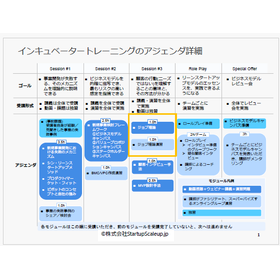
This document is training material for incubators that explains the "Job Theory" in new business development. It introduces examples related to the "need" for milkshakes to be sold at specific times, the discovery of latent needs, and cases where general consumer goods became huge hits by being "translated" into jobs. It also explains what a job (a Job to be done) is, along with detailed illustrations, so please take a moment to read it. 【Contents】 ■01 No Use for Needs ■02 Goods, Wants, Needs, Jobs ■03 What is a Job (a Job to be done) ■04 Details of Job Theory *For more information, please download the PDF or feel free to contact us.

Added to bookmarks
Bookmarks listBookmark has been removed
Bookmarks listYou can't add any more bookmarks
By registering as a member, you can increase the number of bookmarks you can save and organize them with labels.
Free membership registration
We would like to introduce a case where Mitsubishi Chemical participated in our "Product Rediscovery Training." In the company's new business team, the belief that "if I don't come up with a good hypothesis, I can't go meet customers" was a significant barrier. After taking this training, the option of going to learn from customers before development or internal approval has begun to be recognized as one way the field can choose to operate. [Mind Change After Training] - The absolute premise that one cannot go interview customers without coming up with a great hypothesis or plan has been eliminated. - Participants expressed that there was such a change that they felt "a weight has been lifted off their shoulders." *For more details, please download the PDF or feel free to contact us.


Added to bookmarks
Bookmarks listBookmark has been removed
Bookmarks listYou can't add any more bookmarks
By registering as a member, you can increase the number of bookmarks you can save and organize them with labels.
Free membership registration
This document is a white paper that organizes the concepts for connecting research and development outcomes to commercialization. It explains the meaning of elemental technologies, specific examples, and the differences between core technologies, technology seeds, and patented technologies. It discusses methods for proposing elemental technologies that should be pursued in development in a manner feasible for humans. 【Contents】 ■ What are elemental technologies: Specific examples ■ How to determine the development policy for elemental technologies ■ Methods for selecting development themes for elemental technologies without relying on future predictions ■ How to design an elemental technology portfolio ■ Conclusion *For more details, please download the PDF or feel free to contact us.
Added to bookmarks
Bookmarks listBookmark has been removed
Bookmarks listYou can't add any more bookmarks
By registering as a member, you can increase the number of bookmarks you can save and organize them with labels.
Free membership registration
This document is a white paper that introduces how to define the "real job" of your company's products and how to create ads with a CTR of over 10%. It provides a thorough explanation of reasons why ads are not read, methods to attract the subconscious of social media users, and a simple three-step cycle for creating web ads. This content is recommended for those who are struggling with ads that do not lead to results, such as clicks and reads, despite spending on advertising. 【Contents (partial)】 ■ Ads are not read because they lack the customer's perspective ■ Social media users pay a cognitive cost to view ads ■ Attract the subconscious of social media users and hook them with headlines ■ The order of visitor movement and creation is generally reversed ■ A simple three-step cycle for creating web ads *For more details, please download the PDF or feel free to contact us.
Added to bookmarks
Bookmarks listBookmark has been removed
Bookmarks listYou can't add any more bookmarks
By registering as a member, you can increase the number of bookmarks you can save and organize them with labels.
Free membership registration
This document is a white paper that explains the basics, applications, limitations of expert interviews, and the traps that are easy to fall into in new business development. It introduces the differences between expert/knowledgeable person/customer interviews and how to differentiate their use, the types of application scenes such as collecting technical information and understanding market overviews, and the four limitations of "expert opinions can be off the mark" along with real examples. Our company provides support from hypothesis formulation based on expert interviews to the design and implementation of customer interviews, which are the main focus. [Contents (partial)] ■ What is an expert interview ■ Types and application scenes of expert interviews ■ Limitations of expert interviews ■ How to conduct expert interviews ■ Questions that can be used in expert interviews *For more details, please download the PDF or feel free to contact us.
Added to bookmarks
Bookmarks listBookmark has been removed
Bookmarks listYou can't add any more bookmarks
By registering as a member, you can increase the number of bookmarks you can save and organize them with labels.
Free membership registration
This document is a white paper that presents specific principles of action in new business development. Regarding Motorola's satellite phone project "Iridium," it systematically dissects the case from the perspective that the failure was not due to a lack of technology, but rather because the very way of creating the business plan was structurally flawed. It reveals the full picture of a "perfect failure" where technology and funding succeeded, but the market was the only missing element. [Contents] ■ What happened: The "perfect failure" of Iridium ■ Structural diagnosis: Why did "perfect technology" fail as a business? ■ Root cause: The structural trap of "linear product development" ■ Prescription: Talk to customers "before completing" the business plan ■ Summary: Lessons learned from Iridium *For more details, please download the PDF or feel free to contact us.
Added to bookmarks
Bookmarks listBookmark has been removed
Bookmarks listYou can't add any more bookmarks
By registering as a member, you can increase the number of bookmarks you can save and organize them with labels.
Free membership registration
This document is a white paper that unravels the background and reasons behind the perception that agile development is outdated. It explains the current accurate position of software development and the trends of new development methodologies that are expected to emerge next. For those who feel challenges in their company's development structure, it provides information that will serve as a compass for future strategic planning. [Contents (partial)] ■ Is agile development really outdated? An explanation of the current situation and trends ■ Reasons why agile is considered outdated ■ Three projects that, despite being developed using Scrum, did not succeed as services ■ Three drawbacks of Scrum (agile) ■ Trends of development methodologies that will follow agile *For more details, please download the PDF or feel free to contact us.
Added to bookmarks
Bookmarks listBookmark has been removed
Bookmarks listYou can't add any more bookmarks
By registering as a member, you can increase the number of bookmarks you can save and organize them with labels.
Free membership registration
StartupScaleup.jp Co., Ltd. will hold a free online seminar titled "Introduction to Rediscovering Product Market Value." What is important for generating sales in a new market is not the skillfulness of the sales method. "Being technically excellent" and "having value in the market" are two different things. What we should really ask is which market our current technology or product can create value in. This is "rediscovery of applications." In this seminar, we will introduce a method to realize a reproducible framework for application development, which has been subjective until now, along with case studies. [Event Overview] ■ Date and Time - July 17 (Friday) 12:00 PM - 1:00 PM - July 18 (Saturday) 11:00 AM - 12:00 PM - July 21 (Tuesday) 6:00 PM - 7:00 PM ■ Free Participation ■ Online Event *For more details, please download the PDF or feel free to contact us.
Added to bookmarks
Bookmarks listBookmark has been removed
Bookmarks listYou can't add any more bookmarks
By registering as a member, you can increase the number of bookmarks you can save and organize them with labels.
Free membership registration
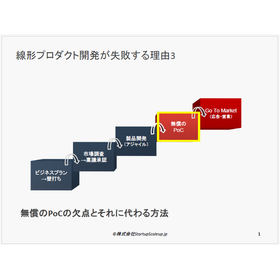
"The disadvantages of free PoC and alternative methods" is a document summarizing the drawbacks of free PoCs and alternative approaches. It explains how the mindset of "I created something like this, but can it be of any use?" can lead to high-risk business development failures. If you are interested, please feel free to download it. 【Contents (excerpt)】 ■ Ways to absolutely avoid failing in PoC ■ Disadvantages of free PoC ■ Conditions for MVP in the early stages of business development ■ List of items that can be validated with MVP
Added to bookmarks
Bookmarks listBookmark has been removed
Bookmarks listYou can't add any more bookmarks
By registering as a member, you can increase the number of bookmarks you can save and organize them with labels.
Free membership registration
"What are the reasons for the failure of linear product development?" is a document summarizing the reasons for the failure of linear product development. It explains cases where business plans were "discarded" and overwhelmingly successful. Feel free to download it if you're interested. 【Contents (excerpt)】 ■ The tragedy of new business development: Why does this happen? ■ Typical steps in linear product development ■ Business plans that are disconnected from reality lead to business failure.
Added to bookmarks
Bookmarks listBookmark has been removed
Bookmarks listYou can't add any more bookmarks
By registering as a member, you can increase the number of bookmarks you can save and organize them with labels.
Free membership registration
What is the importance of the 3Cs in new business development?" is a document summarizing issues such as the "competition strategy dilemma" encountered during new business ventures. It explains that when a decision is made to enter the market based on the strategy of "the grass is greener on the other side," it inevitably becomes difficult to differentiate. If you are interested, please feel free to download it. [Contents (excerpt)] ■ A modified Lanchester strategy that does not consider the 3Cs ■ The "competition strategy dilemma" in new business ventures ■ Four methods to avoid the "competition strategy dilemma
Added to bookmarks
Bookmarks listBookmark has been removed
Bookmarks listYou can't add any more bookmarks
By registering as a member, you can increase the number of bookmarks you can save and organize them with labels.
Free membership registration
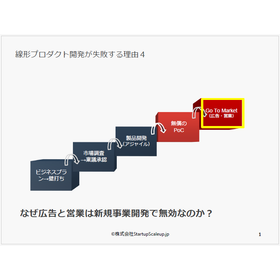
"Why do advertising and sales for new venue development fail?" is a document summarizing why advertising and sales are ineffective in new business development. It explains that if the product is attractive, there is not necessarily a need to focus heavily on sales. Feel free to download it if you are interested. [Contents (excerpt)] ■ Requirements definition for Pepper ■ Many companies have reached PMF (product-market fit) without much sales presence ■ Sales become a bottleneck in the funnel when the business tries to scale
Added to bookmarks
Bookmarks listBookmark has been removed
Bookmarks listYou can't add any more bookmarks
By registering as a member, you can increase the number of bookmarks you can save and organize them with labels.
Free membership registration
"Why doesn't business development progress according to the business plan?" is a document summarizing the reasons why linear product development fails. It explains how the mindset of "I ended up creating something like this, but could it be of any use?" leads to business development with a high likelihood of failure. If you are interested, please feel free to download it. [Contents (excerpt)] ■ The tragedy of new business development: Why does this happen? ■ Examples of major failures by renowned innovators/innovation companies ■ Typical steps in linear product development
Added to bookmarks
Bookmarks listBookmark has been removed
Bookmarks listYou can't add any more bookmarks
By registering as a member, you can increase the number of bookmarks you can save and organize them with labels.
Free membership registration
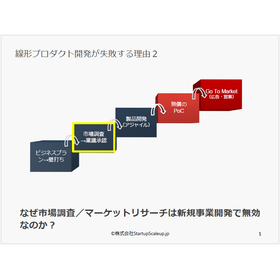
"Why do market research and market surveys fail in new business development?" is a document summarizing various insights about market research, including famous quotes from celebrities who deny its value. It explains that conducting needs assessments before market research and product development does not provide reliable predictions about whether a business will grow in the future. If you are interested, please feel free to download it. [Contents (excerpt)] ■ Famous quotes from celebrities who deny market research ■ Market research is a snapshot at that moment ■ Investigative Interviewing (interviews for criminal investigations)
Added to bookmarks
Bookmarks listBookmark has been removed
Bookmarks listYou can't add any more bookmarks
By registering as a member, you can increase the number of bookmarks you can save and organize them with labels.
Free membership registration
This document introduces the features and usage of the appraisal tool "Mekiki Scope" powered by generative AI. It consists of three modules: an instant report that forecasts the future of specific industries, customer behavior analysis that examines unexpected actions of customers, and risk detection analysis by a first-class business architect. Examples of test reports are also included, allowing you to review specific analysis content. [Contents (partial)] ■ Developer self-introduction ■ What is "negative appraisal"? ■ Future forecasting ■ Analysis of customers' "unexpected behaviors" ■ Risk detection analysis in business models *For more details, please download the PDF or feel free to contact us.
Added to bookmarks
Bookmarks listBookmark has been removed
Bookmarks listYou can't add any more bookmarks
By registering as a member, you can increase the number of bookmarks you can save and organize them with labels.
Free membership registration
This document is a white paper that explains the creation method of a "strategic story," which serves as a common language between approvers and proposers. It includes a three-step process for creating a strategic story that resolves uncertainties through three questions, as well as sample timetables and workflows. It also features voices from actual customers, including Toho Gas and major materials manufacturers, allowing you to confirm the implementation effects. [Contents (partial)] ■ Wouldn't it be great if your company's new business development looked like this? ■ Promise ■ Does your company currently have any of these problems? ■ If this continues, ultimately ■ Holding a business contest will yield good ideas ■ If left as is *For more details, please download the PDF or feel free to contact us.
Added to bookmarks
Bookmarks listBookmark has been removed
Bookmarks listYou can't add any more bookmarks
By registering as a member, you can increase the number of bookmarks you can save and organize them with labels.
Free membership registration
This document is a white paper for creating a proposal aimed at those entrusted with launching new businesses. It covers essential components such as alignment with corporate philosophy and vision, issues to be addressed and target audience, revenue plans, and risk management. It also includes common failure examples and specific steps for creation, making it a useful resource for developing proposals to gain approval. [Contents (partial)] ■ Introduction ■ What is a new business proposal? ■ Essential components of a new business proposal ■ Key points for creating a persuasive proposal ■ Common failure examples *For more details, please download the PDF or feel free to contact us.
Added to bookmarks
Bookmarks listBookmark has been removed
Bookmarks listYou can't add any more bookmarks
By registering as a member, you can increase the number of bookmarks you can save and organize them with labels.
Free membership registration
This document is a white paper that logically explains the reasons why market research does not function in new business development. Through historical and contemporary examples, such as the case of potatoes in Imperial Russia and feature phone manufacturers' responses to the iPhone, it reveals the fundamental limitations of market research. It also includes insights on market creation from companies that "create" rather than "research" the market, as well as what should be done instead of market research. [Contents (partial)] ■ Introduction ■ Reasons why market research cannot predict the "future" ■ Market research continues to miss the mark in modern times ■ Learning from companies that "create" rather than "research" the market ■ What should be done "instead of market research" in new business development *For more details, please download the PDF or feel free to contact us.
Added to bookmarks
Bookmarks listBookmark has been removed
Bookmarks listYou can't add any more bookmarks
By registering as a member, you can increase the number of bookmarks you can save and organize them with labels.
Free membership registration
This document is a white paper that systematically explains the correct definitions and roles of hypothesis testing in new business development, as well as practical interview techniques. It includes three essential steps before the interview, principles for designing effective questions, and a framework categorizing seven types of interview methods. It also provides a wide range of information useful for business development, such as ways to improve hypothesis testing skills and lessons common to successful and failed cases. [Contents (partial)] ■ Introduction ■ What is hypothesis testing? ■ Preparation and practice of interview research ■ Framework of interview methods ■ Reflecting interview results in business plans *For more details, please download the PDF or feel free to contact us.
Added to bookmarks
Bookmarks listBookmark has been removed
Bookmarks listYou can't add any more bookmarks
By registering as a member, you can increase the number of bookmarks you can save and organize them with labels.
Free membership registration
This document is a white paper that explains a paid Proof of Concept (PoC) that can simultaneously verify marketability and feasibility. It discusses the structural reasons why free PoCs often fail and typical failure patterns, while also providing practical steps for implementing paid PoCs, incorporating specific domestic and international case studies. It includes useful content for new business development, such as pre-setting withdrawal criteria, the concept of Minimum Viable Product (MVP), and methods for discovering early evangelists. 【Contents (partial)】 ■ Introduction ■ What is PoC (Proof of Concept)? ■ Structural reasons why free PoCs fail ■ Paid PoC as a solution ■ Practical steps for implementing paid PoCs ■ Criteria that differentiate the success or failure of paid PoCs *For more details, please download the PDF or feel free to contact us.
Added to bookmarks
Bookmarks listBookmark has been removed
Bookmarks listYou can't add any more bookmarks
By registering as a member, you can increase the number of bookmarks you can save and organize them with labels.
Free membership registration
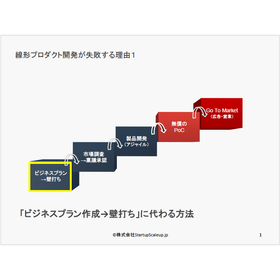
This document explains an alternative method to "creating a business plan → wall hitting" in linear product development. It specifically addresses the analysis of major failure cases such as Iridium and the structural issues that cause business plans to deviate from reality. Practical methods, such as the approach of "visit customers 300 times," are also included, so please make use of it. 【Contents (partial)】 ■ With traditional business development methods ■ The tragedy of new business development: Why does this happen? ■ "Fix the business plan after the service sells like hotcakes" ■ Typical steps in linear product development ■ Iridium as a landmark case of major failure due to linear product development *For more details, please download the PDF or feel free to contact us.
Added to bookmarks
Bookmarks listBookmark has been removed
Bookmarks listYou can't add any more bookmarks
By registering as a member, you can increase the number of bookmarks you can save and organize them with labels.
Free membership registration
StartupScaleup.jp Co., Ltd. will hold an online seminar titled "The 1 Trillion Yen Company Finally Discovered Winning Strategies: Advanced Market Exploration Methods." The purpose of this seminar is to answer the question, "How can we sell developed products/technologies to which markets and which people using what kind of business model to achieve success?" This seminar is recommended for those considering how to sell developed products or those involved in commercializing developed technologies. 【Event Overview】 ■ Location: Online ■ Dates and Times - May 12 (Tue) 6:00 PM - 7:00 PM - May 15 (Fri) 12:00 PM - 1:00 PM - May 16 (Sat) 10:00 AM - 11:00 AM ■ Participation Fee: Free *For more details, please refer to the related links or feel free to contact us.
Added to bookmarks
Bookmarks listBookmark has been removed
Bookmarks listYou can't add any more bookmarks
By registering as a member, you can increase the number of bookmarks you can save and organize them with labels.
Free membership registration
"5 Successful Case Studies of Application Development! An Explanation of Specific Approaches to Creating New Businesses" is a detailed document that summarizes five concrete success stories from well-known companies and B2B enterprises, along with five practical steps for advancing application development from scratch. As many companies find it increasingly difficult to envision growth solely through the extension of existing businesses due to the slowdown in growth from market maturity and the acceleration of technological innovation, the importance of application development that leverages current technological assets to create new value is rising. In addition to specific success stories such as Nitto Denko's "Three New Activities," Asahi Kasei's exploration of new applications using generative AI, and Daikin Industries' expansion of fluorine applications, the document also provides a detailed explanation of three key points to avoid failures. [Contents (excerpt)] - Why is application development needed now? (Three factors) - Five successful case studies of application development from well-known companies - Five specific steps to lead application development to success - Three common failure patterns in application development *For more details, please download the document and check it out.
Added to bookmarks
Bookmarks listBookmark has been removed
Bookmarks listYou can't add any more bookmarks
By registering as a member, you can increase the number of bookmarks you can save and organize them with labels.
Free membership registration
"What is Application Development? A Systematic Guide to Leveraging Technological Strengths for New Market Exploration and Tips for Success" is a comprehensive explanatory document that outlines the steps and thought processes for finding new uses (markets) for existing technologies, materials, and products. Application development is not about creating new technologies but rather redefining the "value" that technology provides and delivering it to different customer segments that need it. Compared to new product development, it carries lower technical risks and allows for the utilization of existing technological assets, thereby securing new revenue sources while keeping investment costs down. Furthermore, by utilizing thought frameworks such as "function abstraction," "associations from attributes," and "customer proxy perspectives," it becomes possible to generate ideas that transcend industry boundaries. Successful case studies from Otsuka Chemical and Powder Tech are also introduced. [Contents (excerpt)] - Differences between application development and new product development (with comparison table) - How to proceed with application development without failure (from inventory of company technology to hypothesis verification) - Thought frameworks to expand ideas - Successful case studies in application development *For more details, please download the document and check it out.
Added to bookmarks
Bookmarks listBookmark has been removed
Bookmarks listYou can't add any more bookmarks
By registering as a member, you can increase the number of bookmarks you can save and organize them with labels.
Free membership registration
"What is the product development process? This document systematically explains the seven steps and key points that lead to success." It outlines the series of steps from the birth of a new product idea to its market launch, divided into seven steps. By clearly defining the process rather than relying on spontaneous or ad-hoc development, it facilitates smooth collaboration between departments and improves the quality of decision-making. Since the goals and criteria for judgment at each step are clarified, it becomes possible to manage risks while increasing the likelihood of project success. Additionally, it includes a comparison of the features of frameworks such as the Stage-Gate method and Agile development, as well as development case studies from Apple and Toyota. [Contents (excerpt)] ■ The basic seven steps of product development (from idea generation to market launch) ■ Three key points for successful product development processes ■ Comparison of the Stage-Gate method and Agile development ■ Success stories from Apple and Toyota *For more details, please download the document and check it.
Added to bookmarks
Bookmarks listBookmark has been removed
Bookmarks listYou can't add any more bookmarks
By registering as a member, you can increase the number of bookmarks you can save and organize them with labels.
Free membership registration
"15 New Business Ideas for the Manufacturing Industry! Learning from Successful Case Studies" is a comprehensive guide that presents 15 new business ideas specifically for the manufacturing sector, along with examples of companies that have succeeded and steps to ensure a successful launch. It introduces a wide range of ideas, from utilizing IoT and launching subscription services and DtoC brands to developing SDGs-compliant materials and technology consulting, highlighting the potential for business expansion through the redefinition of in-house technologies. If you are interested, please feel free to download it. [Contents (excerpt)] ■ Why should the manufacturing industry challenge itself with new businesses? ■ Where do new business ideas come from? ■ [2026 Edition] 15 New Business Ideas for the Manufacturing Industry ■ Case studies of successful companies (Komatsu, Hitachi, Fujifilm) ■ Points to consider to avoid failure in new businesses *For more details, please download the document and check it out.
Added to bookmarks
Bookmarks listBookmark has been removed
Bookmarks listYou can't add any more bookmarks
By registering as a member, you can increase the number of bookmarks you can save and organize them with labels.
Free membership registration
"What is Technology Management (MOT)? An Explanation of Points for Implementation from Benefits and Success Stories" is a comprehensive explanatory document that clearly summarizes the basics of technology management, differences from an MBA, benefits of implementation, and specific success stories. It systematically organizes the concept of MOT, which views technology as a management resource and generates economic value through innovation, along with the challenges and points of caution in its implementation. If you are interested, please feel free to download it. [Contents (excerpt)] ■ What is Technology Management (MOT)? ■ Why is MOT needed now? ■ Four benefits brought by MOT ■ Challenges and points of caution in implementation ■ Success stories (Fujifilm, Toyota Motor Corporation) ■ Four steps to implement and promote MOT *For more details, please download the document and check it.
Added to bookmarks
Bookmarks listBookmark has been removed
Bookmarks listYou can't add any more bookmarks
By registering as a member, you can increase the number of bookmarks you can save and organize them with labels.
Free membership registration
"How to Advance Technology Development" is a comprehensive explanatory document that clearly summarizes everything from the basic definition of technology development to specific processes that lead to success and how to create a roadmap. It organizes the differences between research and development and product development from the perspectives of purpose, phase, and deliverables, clarifying the role of technology development in "practical application and commercialization." If you are interested, please feel free to download it. [Contents (excerpt)] ■ What is technology development? An important process that supports corporate growth ■ Differences from research and development and product development ■ Specific job responsibilities in technology development and the four steps ■ How to create a roadmap that leads to success ■ Required personnel and skills in technology development ■ Utilization of external resources (open innovation) *For more details, please download the document and check it.
Added to bookmarks
Bookmarks listBookmark has been removed
Bookmarks listYou can't add any more bookmarks
By registering as a member, you can increase the number of bookmarks you can save and organize them with labels.
Free membership registration
"What are the steps to successfully commercialize technology seeds? An explanation of key points to cross the 'valley of death'" is a systematic explanatory document aimed at R&D departments and new business personnel, outlining a concrete process for guiding technology seeds toward commercialization. The commercialization of technology seeds involves creating a mechanism that connects the technical seeds owned by a company with customer needs—issues that customers are willing to pay to solve—thereby generating economic value. This document provides practical know-how to enhance the success rate of commercialization, addressing the common challenge faced by many companies: "the technology is excellent, but it doesn't sell." It discusses the risks of developing without customer involvement and methods to overcome the "valley of death." [Contents (excerpt)] - What exactly is the commercialization of technology seeds? - Reasons why many technology seeds fail to commercialize - Specific steps to achieve successful commercialization - The necessary structure to leverage technology seeds - Two points to be aware of to increase the likelihood of commercialization *For more details, please download the document and check it out.*
Added to bookmarks
Bookmarks listBookmark has been removed
Bookmarks listYou can't add any more bookmarks
By registering as a member, you can increase the number of bookmarks you can save and organize them with labels.
Free membership registration
"What are Technology Seeds? An Explanation of Their Meaning, Differences from Needs, and How to Successfully Commercialize Them" is a systematic explanatory document that covers the concept of "technology seeds," which are essential for corporate growth strategies, as well as methodologies for commercialization. Technology seeds refer to the unique technologies, patents, know-how, and ideas that a company possesses, which are fundamental elements that hold the potential to create new products or services in the future. The document also clearly explains the differences from the often-confused term "needs," as well as the distinctions between product-out and market-in approaches through comparison tables. By adopting a strategy based on technology seeds, companies can expect to create markets with high competitive advantages and enhance their brand value. If you are interested, please feel free to download it. [Contents (Excerpt)] ■ What are technology seeds? Unique technologies that serve as the seeds for business ■ The decisive differences between technology seeds and needs ■ Advantages and disadvantages of strategies based on technology seeds ■ 5 steps to utilize technology seeds for new business ■ Case studies of companies that have succeeded in commercialization (Fujifilm) *For more details, please download the document and check it out.
Added to bookmarks
Bookmarks listBookmark has been removed
Bookmarks listYou can't add any more bookmarks
By registering as a member, you can increase the number of bookmarks you can save and organize them with labels.
Free membership registration
"What is Hypothesis Thinking? An Explanation of Practical Steps and Training to Enhance Work Quality" is a systematic explanatory document on the thinking method of "hypothesis thinking," designed for making quick decisions based on limited information in the rapidly changing VUCA era. Hypothesis thinking involves establishing the most plausible "tentative answer (hypothesis)" from limited information and then verifying whether that hypothesis is correct. In contrast to comprehensive thinking, it allows for setting a goal first and then working backward to gather and analyze the necessary information, enabling efficient and rapid access to the essence of the problem. By mastering hypothesis thinking, one can gain benefits such as improved problem-solving speed, enhanced decision-making quality, and increased productivity in work. If you are interested, please feel free to download it. [Contents (Excerpt)] ■ Basic definition of hypothesis thinking ■ Three steps to practice hypothesis thinking ■ Points to enhance the accuracy of hypothesis thinking ■ Training methods to develop hypothesis thinking in daily operations ■ Success stories in companies (BCG, SoftBank) *For more details, please download the document and check it out.
Added to bookmarks
Bookmarks listBookmark has been removed
Bookmarks listYou can't add any more bookmarks
By registering as a member, you can increase the number of bookmarks you can save and organize them with labels.
Free membership registration
"The Lean Startup" is a document that corrects the widely misunderstood interpretation of "Lean Startup = a method of minimizing costs and repeatedly prototyping and improving in a short period" and explains the original definition and practical methods proposed by Eric Ries. Based on his own experience of nearly causing a startup to fail while using Agile development (Scrum), Ries presents the correct definition: "Lean Startup = Customer Development Model + Agile." It clarifies essential points that differ from common beliefs, such as the necessity of providing an MVP for a fee and that what should be measured is "how many people clicked the purchase button." The document includes a wealth of insights that can be immediately applied in new business development, such as case studies from DoorDash and Boom Technology, the dangers of vanity metrics, and the concept of Pivotious. [Contents (excerpt)] ■ The correct definition of Lean Startup ■ Benefits and precautions of implementation ■ Four steps for practice (Build-Measure-Learn-Iterate) ■ Six points learned from the IMVU episode *For more details, please download the document and check it.
Added to bookmarks
Bookmarks listBookmark has been removed
Bookmarks listYou can't add any more bookmarks
By registering as a member, you can increase the number of bookmarks you can save and organize them with labels.
Free membership registration
The '10 NG Questions for Customer Interviews' is a document that organizes 10 patterns of common communication pitfalls in customer interviews for new business development and product planning. It clearly explains why it is difficult to elicit honest opinions from interviewees. Questions that seem reasonable at first glance, such as 'What do you think of this service?' or 'How much would you pay for it?' can actually lead interviewees to hide their true feelings or fabricate responses. This structure is illustrated with humorous examples. For each NG question, the document contrasts the interviewee's statements, their true feelings, our interpretations, and the actual outcomes, clarifying the mechanism behind the occurrence of False Positives. This is an essential read for improving the quality of customer interviews and understanding true needs. [Contents (excerpt)] - Explanation of 10 NG question patterns - Diagram illustrating the structure of False Positive occurrences - Mechanism of the gap between the interviewee's statements and true feelings - Introduction to reference blog articles *For more details, please download the document and check it out.
Added to bookmarks
Bookmarks listBookmark has been removed
Bookmarks listYou can't add any more bookmarks
By registering as a member, you can increase the number of bookmarks you can save and organize them with labels.
Free membership registration
"What is the MFT Framework? An explanation of useful application procedures and examples for new business!" is a document that systematically organizes the three elements of Market, Function, and Technology, and explains a way of thinking to connect company technology to new markets. The greatest feature of the MFT framework is that it does not directly link technology and market, but places the concept of "function" in between. By reinterpreting the essential value of technology as "function," it draws out the diverse possibilities of a single technology and allows for the discovery of entry opportunities into industries and niche markets that had not been considered before. It also introduces case studies from NEDO's "Innovation Outlook" and the Ministry of Education, Culture, Sports, Science and Technology's Innovative GX Technology Development Subcommittee, providing insights into methods that are actually used in the field of technology management. [Contents (excerpt)] ■ Basics of the MFT framework and its three components ■ Practical steps (inventory of technology → identification of functions → market exploration → concretization of business ideas) ■ Case studies from NEDO and the Ministry of Education, Culture, Sports, Science and Technology ■ Three key points for success *For more details, please download the document and check it.
Added to bookmarks
Bookmarks listBookmark has been removed
Bookmarks listYou can't add any more bookmarks
By registering as a member, you can increase the number of bookmarks you can save and organize them with labels.
Free membership registration
"What is the true way to use the Business Model Canvas?" is a document that explains the practical application of the Business Model Canvas not just as a tool for organizing business plans, but as a means to repeatedly test hypotheses with customers during the early stages of business development, facilitating "paper-based pivots." It clearly explains the common pitfalls and points of consideration for each of the nine boxes of the Business Model Canvas, using concrete examples from companies like Uber, Amazon, and Dropbox. The document points out the challenges faced by companies that consider new business development complete once a business model is approved, and teaches how to continuously use the canvas as a "checklist." [Contents (excerpt)] - The Business Model Canvas as a "checklist" - Points of consideration and examples for each box (KP, KA, KR, VP, CS, CR, CH, CS, RS) - Four conditions for reaching PMF - Analysis of cases that failed in actual business development *For more details, please download the document and check it.
Added to bookmarks
Bookmarks listBookmark has been removed
Bookmarks listYou can't add any more bookmarks
By registering as a member, you can increase the number of bookmarks you can save and organize them with labels.
Free membership registration
A roadmap is not something that is "made and done." Rather, it is not an exaggeration to say that obsolescence begins the moment it is created. In this rapidly changing era, we will explain the operational points to continue using the roadmap as a living tool. Market environments and technological trends are changing daily. If the initial assumptions change, it is only natural that the roadmap needs to be revised. *For more details, please download the PDF or feel free to contact us.
Added to bookmarks
Bookmarks listBookmark has been removed
Bookmarks listYou can't add any more bookmarks
By registering as a member, you can increase the number of bookmarks you can save and organize them with labels.
Free membership registration
To create an effective technology roadmap, it is essential to follow the correct procedures. Simply listing technologies that come to mind will not result in something that can be utilized on-site. Here, we will explain the standard and practical creation process divided into seven steps. *For more details, please download the PDF or feel free to contact us.*
Added to bookmarks
Bookmarks listBookmark has been removed
Bookmarks listYou can't add any more bookmarks
By registering as a member, you can increase the number of bookmarks you can save and organize them with labels.
Free membership registration
Creating a technology roadmap requires a significant amount of effort, but there are clear benefits that justify this investment. It is important to understand what effects you expect to achieve rather than just creating it for the sake of it. Here, we will explain the three main benefits that an organization can gain. *For more details, please download the PDF or feel free to contact us.*
Added to bookmarks
Bookmarks listBookmark has been removed
Bookmarks listYou can't add any more bookmarks
By registering as a member, you can increase the number of bookmarks you can save and organize them with labels.
Free membership registration
A technology roadmap is a document that visualizes the path of technology development necessary to achieve the future vision and business goals that a company aims for, along a timeline. This is not merely a list of technical schedules; it is characterized by being drawn in conjunction with market changes and product development plans. Here, we will explain the essential meaning and role of a technology roadmap. *For more details, please download the PDF or feel free to contact us.*
Added to bookmarks
Bookmarks listBookmark has been removed
Bookmarks listYou can't add any more bookmarks
By registering as a member, you can increase the number of bookmarks you can save and organize them with labels.
Free membership registration
This document is a powerful tool for clarifying an organization's technology strategy, summarizing the "Technology Roadmap." It provides a detailed explanation of the original purpose of creating a technology roadmap, specific steps for practical implementation, and key points for ensuring it does not become a mere formality after creation. If you are interested, please feel free to download it. 【Contents】 ■ What is a Technology Development Roadmap ■ Benefits of Creating a Technology Development Roadmap ■ Seven Steps to Create a Technology Development Roadmap ■ Key Points for Successful Operation of a Technology Development Roadmap ■ Specific Examples of Technology Development Roadmaps ■ Summary *For more details, please download the PDF or feel free to contact us.
Added to bookmarks
Bookmarks listBookmark has been removed
Bookmarks listYou can't add any more bookmarks
By registering as a member, you can increase the number of bookmarks you can save and organize them with labels.
Free membership registration
Here are some important points to consider when conducting scenario planning for the creation of new business proposals. It is crucial not to work backward from the new business ideas in your mind based on external environmental factors, to set high levels of abstraction when establishing axes, and to constantly question assumptions in order to enhance creativity. Additionally, it is important to avoid spending too much time on the process and to not become overly fixated on formalities. 【Important Points (Partial)】 ■ Do not work backward from new business ideas based on external environmental factors. ■ When setting axes from external environmental factors, maintain a high level of abstraction. ■ To enhance creativity, always question assumptions. ■ This is not a competition to predict the future accurately or inaccurately. ■ Never say, "There’s no way such a case exists."
Added to bookmarks
Bookmarks listBookmark has been removed
Bookmarks listYou can't add any more bookmarks
By registering as a member, you can increase the number of bookmarks you can save and organize them with labels.
Free membership registration
This document explains how to utilize scenario planning in new business development, using the movie "Shin Godzilla" as a subject. It specifically outlines each step of scenario planning, from listing external environmental factors using STEEP, to four-quadrant mapping and setting scenario axes. It also introduces the significant strength of experts' status quo bias and the mindset needed to generate business ideas that are typically not conceived. 【Contents (partial)】 ■ "Shin Godzilla" is the story of developing the new business "Yashiori Operation." ■ Scenario planning was originally intended to prevent companies from becoming like boiled frogs. ■ Utilizing scenario planning at the start of a new business is to generate business ideas that are usually not conceived. ■ "Ambidextrous management" is a battle against status quo bias. ■ The conclusions drawn from following scenario planning are multiple scenarios. ■ Important note: Scenario planning ≠ future forecasting.
Added to bookmarks
Bookmarks listBookmark has been removed
Bookmarks listYou can't add any more bookmarks
By registering as a member, you can increase the number of bookmarks you can save and organize them with labels.
Free membership registration
In the IT industry, the speed of technological innovation is rapid, and there is a constant demand for the creation of business ideas that utilize new technologies. In particular, it is important to improve development efficiency and shorten the time to market. However, finding business ideas that leverage technological seeds has become a challenge for many companies. AI Deason generates business ideas that align with the needs of the IT market based on your company's technological seeds, contributing to the efficiency of development. [Utilization Scenarios] - Development of new services utilizing existing technologies - Business expansion in line with new technological trends - Streamlining of the development process [Effects of Implementation] - Rapid generation of business ideas - Discovery of ideas that meet market needs - Reduction of development time
Added to bookmarks
Bookmarks listBookmark has been removed
Bookmarks listYou can't add any more bookmarks
By registering as a member, you can increase the number of bookmarks you can save and organize them with labels.
Free membership registration