1~12 item / All 12 items
Displayed results
Filter by category

Added to bookmarks
Bookmarks listBookmark has been removed
Bookmarks listYou can't add any more bookmarks
By registering as a member, you can increase the number of bookmarks you can save and organize them with labels.
Free membership registrationContact this company
Contact Us OnlineBefore making an inquiry
Download PDF1~12 item / All 12 items
Filter by category

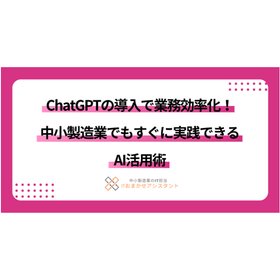
For small and medium-sized manufacturing businesses, streamlining operations is essential to maintaining competitiveness. Among recent technological innovations, the use of AI tools, particularly ChatGPT, has garnered significant attention. ChatGPT holds great potential as an easily accessible AI, allowing users to ask questions and seek advice as if conversing with a friend. It can be used easily without special skills or knowledge, making it a reassuring option for those who may feel apprehensive about AI. For example, it can be helpful in various scenarios such as automating tasks, customer support, and data analysis. This enables daily operations to run more smoothly and allows for more efficient use of limited resources. In this article, we will discuss how small and medium-sized manufacturing businesses can utilize ChatGPT, detailing specific benefits and implementation methods. *For more detailed content of the column, please refer to the related links. For further information, feel free to download the PDF or contact us.*
Added to bookmarks
Bookmarks listBookmark has been removed
Bookmarks listYou can't add any more bookmarks
By registering as a member, you can increase the number of bookmarks you can save and organize them with labels.
Free membership registration
The manual is not just "educational material." It is a "company commitment" to maintain quality, nurture people, and connect technology to the future. The essence of the manual is "a tool for nurturing people." Its purpose is to transform the tacit knowledge (intuition and tips) of skilled workers into explicit knowledge that anyone can replicate. For example, the appropriate amount of tightening force, how to hold parts and at what angle, and the sensory perception to detect abnormalities through sound or vibration—these "worlds of sensation" cannot be fully conveyed through paper or text. That is why now is the time to reconsider the very role of the manual. *For more details on the column, please refer to the related links. Feel free to contact us for more information.
Added to bookmarks
Bookmarks listBookmark has been removed
Bookmarks listYou can't add any more bookmarks
By registering as a member, you can increase the number of bookmarks you can save and organize them with labels.
Free membership registration
The wave of IT adoption in the manufacturing industry goes beyond mere efficiency improvements and cost reductions. Today, IT has become a key strategy for shaping the future of manufacturing. In particular, for small and medium-sized manufacturers, the benefits of IT adoption are expanding significantly, not only to enhance on-site production efficiency but also to alleviate the burden of back-office operations and address labor shortages. By introducing advanced technologies such as digital tools and generative AI, it is possible to improve efficiency and quality with fewer personnel. This article will delve into the benefits of IT adoption, specific ways to utilize it, as well as the challenges that come with implementation and their solutions, using examples from small and medium-sized manufacturing businesses. Let’s leverage IT to aim for a sustainable evolution in manufacturing. *For more details on the column, please refer to the related links. Feel free to contact us for more information.*
Added to bookmarks
Bookmarks listBookmark has been removed
Bookmarks listYou can't add any more bookmarks
By registering as a member, you can increase the number of bookmarks you can save and organize them with labels.
Free membership registration
First, let's focus on the "on-site support for inquiries." Whenever voices are raised in the manufacturing site saying, "The computer isn't working!" or "The printer can't print!", it is the internal IT staff who rush to respond (i.e., help desk duties). In small and medium-sized manufacturing companies, this role is often taken on not by a specialized department, but by personnel from general affairs, production management, or development. It is the IT staff, the "unsung heroes" of the site, who handle various "troubles," including issues with business PCs, internal networks, printers, business systems, and even IoT devices. However, in recent years, due to an increase in the number of inquiries and the complexity of technology, we have begun to hear voices saying, "It's just not manageable anymore." In this article, we will clearly explain the background of how internal IT staff responsible for help desk duties are reaching their limits, and provide specific measures that management can take immediately to reduce their burden and ensure that operations do not come to a halt. *For more details on the column, please refer to the related links. Feel free to contact us for more information.
Added to bookmarks
Bookmarks listBookmark has been removed
Bookmarks listYou can't add any more bookmarks
By registering as a member, you can increase the number of bookmarks you can save and organize them with labels.
Free membership registration
The work in front of me is somehow managing to get done. However, that "somehow" may be at its limit. The site is supported by veteran employees nearing retirement and a few mid-level members. Amidst the exchange of paper and FAX, everyone is working to the best of their ability. But don't you feel anxious about how long this situation can continue? Orders are placed via FAX, work instructions are on paper, and communication is done through phone calls or verbally. At first glance, it seems to be functioning well in a traditional manner, but this system only works because there are "experienced people" in place. But what happens when those "experienced people" are no longer around? In that moment, the site could come to a halt, carrying the risk of confusion. *For more details on the column, please refer to the related link. Feel free to contact us for more information.
Added to bookmarks
Bookmarks listBookmark has been removed
Bookmarks listYou can't add any more bookmarks
By registering as a member, you can increase the number of bookmarks you can save and organize them with labels.
Free membership registration
"How far along is today's production?" If the president doesn't show up on-site, they won't understand the situation. Such scenes are not uncommon in small and medium-sized manufacturing industries. When information is scattered, the president and managers cannot see the "big picture," leading to delays in decision-making. Instead of focusing on judgment, which should be the role of the "brain of the company," they end up spending time searching for information. This is the inefficiency of the workplace and a significant risk for management. This is where MES (Manufacturing Execution System) comes into play. MES is regarded as an important system in manufacturing for "visualizing the factory in real-time." *For more details on the column, please refer to the related links. Feel free to contact us for more information.*
Added to bookmarks
Bookmarks listBookmark has been removed
Bookmarks listYou can't add any more bookmarks
By registering as a member, you can increase the number of bookmarks you can save and organize them with labels.
Free membership registration
I am confident in my skills. In the past, my work never stopped just from referrals. However, recently, inquiries have decreased, and the response from exhibitions has also become lukewarm. I am hearing more and more voices expressing this concern. The sales team is operating at full capacity every day. Customer interactions, preparing estimates, and coordinating with manufacturing make the day fly by. We are in a situation where we have no choice but to lower the priority of either new sales, internal follow-ups, or customer interactions. The background behind many companies saying "sales are weak" is not an individual issue but rather an organizational structural problem where information is not organized. Customer information, estimates, and transaction history are all contained within individuals, and not even the administrative staff can grasp the overall picture of the company. *For more details on the column, you can view it through the related link. Please feel free to contact us for more information.
Added to bookmarks
Bookmarks listBookmark has been removed
Bookmarks listYou can't add any more bookmarks
By registering as a member, you can increase the number of bookmarks you can save and organize them with labels.
Free membership registration
In the manufacturing industry, there are still many analog processes such as communication via fax, paper slips, and phone confirmations of production status. Additionally, even when computers are used, data is often manually entered into Excel or Access, raising concerns about the long-term sustainability of many companies. "We've always done it this way," or "There's no particular problem, so we don't need to change," are common sentiments. However, these familiar methods may actually be causing a decrease in productivity. Input errors, communication lapses, and the minor inconveniences that arise with each confirmation can accumulate, ultimately leading to delays in delivery and increased overtime. On the other hand, recently, companies in the same industry have begun to focus on visualization and automation, gradually transforming workplaces that can no longer rely on human intuition and perseverance. *For more details on the column, please refer to the related link. Feel free to contact us for more information.*
Added to bookmarks
Bookmarks listBookmark has been removed
Bookmarks listYou can't add any more bookmarks
By registering as a member, you can increase the number of bookmarks you can save and organize them with labels.
Free membership registration
The "IT Omakase Assistant" is a support service for IT personnel in small and medium-sized manufacturing companies. It can handle a variety of business areas and levels of difficulty. Originally a group of experts in business improvement, we excel at improving and standardizing operations to better fit IT. We provide support tailored to our clients' actual situations for a wide range of issues, including business improvement, IT development and implementation support, help desk services, IT infrastructure support, and security measures. 【Supported Services】 ■ General IT Consultation - Help desk (consultation on software, PCs, smartphones, etc.), - Security, IT tools, marketing using IT, AI utilization consultation, etc. ■ IT Implementation and Operation from the Company’s Perspective - Selection, implementation, and operation of software (such as SaaS services), RPA, and groupware - Building security frameworks and creating manuals, etc. ■ Business Improvement for IT Integration - Simplification and standardization of production management and process management - Establishing systems for sales management and cost management - Quality improvement and development of quality control methods - Setting manufacturing KPIs (management indicators), etc. *For more details, please download the PDF or feel free to contact us.
Added to bookmarks
Bookmarks listBookmark has been removed
Bookmarks listYou can't add any more bookmarks
By registering as a member, you can increase the number of bookmarks you can save and organize them with labels.
Free membership registration
"Corporate Transformation Support" is a consulting service aimed at enhancing performance and corporate transformation capabilities. It is important to improve the ability to continuously change on a medium- to long-term basis while solving various challenges such as resolving business issues, accelerating corporate transformation, and systematizing corporate transformation. If you wish to solve your company's challenges and become capable of self-sufficiently and autonomously addressing issues, please feel free to consult with us. 【Features】 ■ Act as a strategist for corporate transformation ■ Develop transformation leaders and create a system for continuity ■ Introduce methodologies for corporate transformation ■ Set appropriate hurdles and become a coach to help overcome them ■ Implement efficient, effective, and continuous transformations using IT and tools *For more details, please feel free to contact us.
Added to bookmarks
Bookmarks listBookmark has been removed
Bookmarks listYou can't add any more bookmarks
By registering as a member, you can increase the number of bookmarks you can save and organize them with labels.
Free membership registration
In our "Online Consulting" course, you will practice problem-solving using the DMAIC steps, which are based on the world-standard methodology for problem-solving known as "Lean/Six Sigma." DMAIC is a fundamental step in problem-solving, and by having the entire organization understand it, the organization's problem-solving capability will improve, leading to enhanced corporate transformation ability. This course is suitable for those who aim to embed problem-solving within their organization and enhance their corporate transformation capability. Additionally, since various standards such as ITIL and IATF16949 are based on Lean/Six Sigma, it is also appropriate for those who have already implemented or are considering these standards to understand the overview of Lean/Six Sigma. 【What happens after the consulting ends】 ■ You will grasp the concepts and steps of problem-solving. ■ You will be able to solve small problems in practice. ■ You will understand the overview of Lean/Six Sigma. ■ You will recognize the importance of problem-solving within the organization and what is specifically needed. *For more details, please download the PDF or feel free to contact us.
Added to bookmarks
Bookmarks listBookmark has been removed
Bookmarks listYou can't add any more bookmarks
By registering as a member, you can increase the number of bookmarks you can save and organize them with labels.
Free membership registration
In our "Online Consulting" course, you will learn why "failures" occur and the methodologies to turn those "failures" into "successes" through practical exercises. For example, the 8D is a fundamental step in problem-solving, but many organizations repeat "failures" in improvement because they focus too much on this 8D process. There are also reasons behind the failures in the "5 Whys" approach. Additionally, to clarify the causes of failures and guide you toward success, you will engage in structured group discussions to tackle issues step by step, allowing you to recognize the reasons yourself. 【What happens after the consulting ends】 ■ You will feel the concepts and steps of problem-solving. ■ You will be able to solve actual on-site issues. ■ Everyone will solve problems following the same methodology. ■ Understanding of IATF will progress, and methodologies for stable on-site operations can be proposed. *For more details, please download the PDF or feel free to contact us.
Added to bookmarks
Bookmarks listBookmark has been removed
Bookmarks listYou can't add any more bookmarks
By registering as a member, you can increase the number of bookmarks you can save and organize them with labels.
Free membership registration