1~45 item / All 74 items
Displayed results
Filter by category
Added to bookmarks
Bookmarks listBookmark has been removed
Bookmarks listYou can't add any more bookmarks
By registering as a member, you can increase the number of bookmarks you can save and organize them with labels.
Free membership registration
Contact this company
Inquiry Form1~45 item / All 74 items
Filter by category

This is a report analyzing how the large-scale investments in data centers progressing domestically will affect demand for equipment, materials, and services, and what business opportunities will arise for companies. It organizes the demand structure for construction, power, cooling, computing, storage, communication, monitoring and protection, and maintenance, and explains the functions and supply structures of key equipment such as substations, liquid cooling, servers, and optical communication. Furthermore, it analyzes how technological changes such as liquid cooling, high-voltage direct current power supply, CPO, and distributed operations will alter the demand for equipment, parts, materials, construction, and maintenance. Based on domestic development plans and related company data, it organizes demand by development process, maintenance and renewal demand following operation, and hiring conditions when entering from different industries. This can be utilized for market research, new business development, sales planning, management planning, and corporate analysis by financial institutions.
Added to bookmarks
Bookmarks listBookmark has been removed
Bookmarks listYou can't add any more bookmarks
By registering as a member, you can increase the number of bookmarks you can save and organize them with labels.
Free membership registration
This is a corporate database that organizes the industrial sectors and related companies where demand spreads from capital investment, starting with large investments in data centers progressing within Japan. It categorizes the demand necessary for the establishment and operation of data centers into eight fields and 31 classifications: construction and installation, power, cooling, computing, storage, communication, monitoring and protection, and maintenance. The investigation covers not only buildings and major equipment but also power transformation equipment, UPS, liquid cooling systems, servers, GPUs, storage, optical communication equipment, as well as the components and materials that make them up, precision processing, transportation and installation, and testing and maintenance. For each company, it organizes the products and services offered, related demand, position in supply, and relationship with data centers. Additionally, it includes 56 plans for the establishment and expansion of data centers in Japan, which can be utilized for market research, exploring sales and collaboration opportunities, new business development, and regional business development.
Added to bookmarks
Bookmarks listBookmark has been removed
Bookmarks listYou can't add any more bookmarks
By registering as a member, you can increase the number of bookmarks you can save and organize them with labels.
Free membership registration
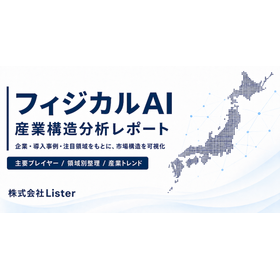
This is an analytical report comparing the differences in corporate composition, technological domains, social implementation, and inter-company collaboration in the physical AI industries of Japan, the United States, and China. Based on a proprietary corporate database developed by Lister Inc., it compares 669 companies in Japan, 142 in the United States, and 180 in China across common technology categories. The corporate composition in areas such as robotics and field automation, AI and software, components and mechanisms, autonomous driving and drones, and recognition and sensing is visualized. Furthermore, it organizes the role composition of 896 supply companies in Japan, the business domains of 142 companies in the United States, and the product domains of 180 companies in China. It examines social implementation in manufacturing, logistics, and construction, as well as the division of roles in technology supply, system integration, sales, and operational support, considering entry and collaboration opportunities where Japanese companies can leverage their strengths. A PDF report and a detailed version of the source corporate database are provided for free.
Added to bookmarks
Bookmarks listBookmark has been removed
Bookmarks listYou can't add any more bookmarks
By registering as a member, you can increase the number of bookmarks you can save and organize them with labels.
Free membership registration
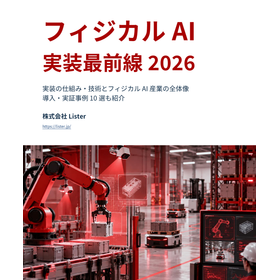
To introduce physical AI into the field, it is necessary to consider not only the AI model but also sensing, recognition, motion planning, control, the physical body, learning data, connection with existing equipment, and operations and maintenance as an integrated whole. The report "Frontline Implementation of Physical AI 2026" by Lister Inc. organizes the mechanisms of implementation from recognition to action, the roles of companies responsible for implementation, the technology stack, learning data, industry-specific applications, and the implementation stages as of 2026. In the latter half, it includes 10 domestic and international case studies from sectors such as manufacturing, logistics, construction, agriculture, energy, and public services. For each case, it outlines the background of the implementation, recognition technology, robot actions, confirmed results, and reference points for companies facing similar challenges.
Added to bookmarks
Bookmarks listBookmark has been removed
Bookmarks listYou can't add any more bookmarks
By registering as a member, you can increase the number of bookmarks you can save and organize them with labels.
Free membership registration
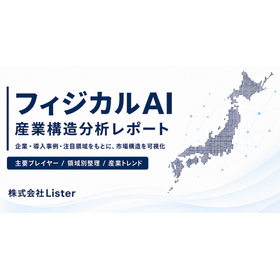
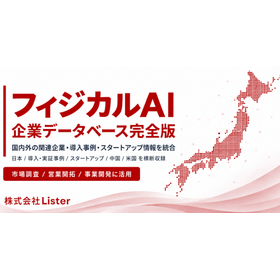
This is the "Complete Physical AI Company Database," which integrates company information related to the physical AI industry in Japan, the United States, and China. It organizes not only basic information about companies and organizations but also their roles in the industry, value chains, technology classifications, target industries, stages of relationships with the industry, implementation and demonstration records, and inter-company relationships. A total of 2,088 company data points from Japan, the U.S., and China can be cross-referenced. For Japanese companies, roles and value chain classifications have been assigned to 1,030 companies and organizations, with 1,220 relationships with 15 industries for 797 companies, and the industry coverage has been organized for 896 companies. Additionally, it includes 1,074 records of implementation and demonstration in Japan, the U.S., and China, as well as 2,304 inter-company relationships related to technology supply, partnerships, and investments. This Excel database can be utilized for market research, new business development, sales strategies, exploring collaboration partners, and competitive analysis. An analysis report explaining the industrial structure and entry areas is also provided.
Added to bookmarks
Bookmarks listBookmark has been removed
Bookmarks listYou can't add any more bookmarks
By registering as a member, you can increase the number of bookmarks you can save and organize them with labels.
Free membership registration
To introduce physical AI into the field, it is important to have a group of companies that connect technology with the utilization site, not only including robot and AI development companies but also those involved in system integration, sales and distribution, operation and maintenance, and specialized services. The "Physical AI Implementation Ecosystem Analysis Report 2026" by Lister Inc. is a report based on foundational data from 896 technology supply-side companies, analyzing the roles of implementation-related companies, industry developments, and related industries and technologies. It compares 234 system integrators, 100 sales and distribution companies, 39 operation and maintenance companies, 38 specialized service companies, and 89 automation and material handling companies. For example, in general manufacturing, 74.8% of system integrator companies are confirmed to be related, in logistics and warehousing, 58.4% of automation companies, and in construction and infrastructure, 42.1% of specialized service companies, visualizing the different compositions of implementation companies by industry. A 26-page PDF report and a detailed company database that served as the basis for the analysis are provided for free.
Added to bookmarks
Bookmarks listBookmark has been removed
Bookmarks listYou can't add any more bookmarks
By registering as a member, you can increase the number of bookmarks you can save and organize them with labels.
Free membership registration
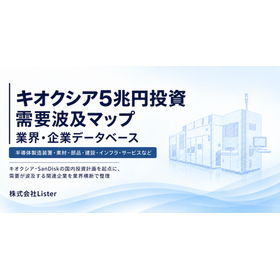
This report analyzes the demand generated from semiconductor equipment investment, starting from Kioxia and SanDisk's domestic investment plan of approximately 5 trillion yen, and identifies where companies can find entry opportunities. It breaks down the pathways of demand generation, including factory construction, factory infrastructure, semiconductor manufacturing equipment, components and materials that make up the equipment, materials, and maintenance and operational support. It organizes the decision-making criteria for considering sales and collaboration partners by tracing the manufacturing processes, equipment functions, and the relationships of decision-makers and purchasers. Furthermore, it discusses the points of consideration when expanding technologies cultivated in different industries, such as precision processing, materials and formulations, fluids and piping, maintenance and repair, and measurement and control, into semiconductor applications, as well as the adoption conditions for progressing from prototyping to continuous supply. It also includes the narrowing down of candidate companies using actual data from a corporate database, source verification, and preparation for initial meetings.
Added to bookmarks
Bookmarks listBookmark has been removed
Bookmarks listYou can't add any more bookmarks
By registering as a member, you can increase the number of bookmarks you can save and organize them with labels.
Free membership registration
This is a corporate database that organizes the industrial areas and related companies that could benefit from demand stemming from the approximately 5 trillion yen domestic investment plan announced by Kioxia and SanDisk, focusing on capital investment in semiconductor factories. The demand necessary for the establishment and operation of semiconductor factories is broken down into six functions and 35 demand areas: land, design, construction, factory infrastructure, manufacturing, transportation, inspection equipment, supporting devices and parts, manufacturing materials and upstream raw materials, and logistics and operational support. Additionally, related companies are investigated down to secondary and tertiary demand sources such as vacuum pumps, valves, seals, chemical-resistant materials, and precision machining. For each company, information is organized regarding their connection to the semiconductor field, related products and services, demand categories, position in the supply chain, publicly available records related to Kioxia and other semiconductor fabs, and reference URLs. This information can be utilized for sales, market research, and corporate exploration in semiconductor capital investment.
Added to bookmarks
Bookmarks listBookmark has been removed
Bookmarks listYou can't add any more bookmarks
By registering as a member, you can increase the number of bookmarks you can save and organize them with labels.
Free membership registration
Physical AI is being utilized across a wide range of industries, including manufacturing, logistics, construction, healthcare, agriculture, and mobility, but the required technologies and the roles of companies vary by industry. The "Industry-Specific Physical AI Industry Structure Analysis Report 2026" by Lister Inc. is an analytical report that compares data from 734 companies and 1,105 instances of "company × industry" relationships, based on a unique database of 896 companies related to Physical AI. The report organizes each company by target industry, main role, position in the value chain, owned technologies, and form of provision, analyzing the industry-specific supply structure from 18 value chain classifications and 9 technology classifications. It visualizes how, even when industry names differ, the composition of supply companies is similar in areas where on-site operations are close, such as general manufacturing and food & beverage, construction and energy, facility management and retail, and how the layers where value is generated differ in agriculture, logistics, construction, and transportation. A PDF report and a detailed company database are provided for free.
Added to bookmarks
Bookmarks listBookmark has been removed
Bookmarks listYou can't add any more bookmarks
By registering as a member, you can increase the number of bookmarks you can save and organize them with labels.
Free membership registration
The physical AI industry in the United States is formed through a complex interconnection not only of robotics and AI companies but also of venture investment, AI computing infrastructure, government and defense procurement, and technological collaboration and commercialization with large corporations. The "U.S. Physical AI Industry Structure Analysis Report 2026" by Lister Inc. is a report that analyzes the relationships of 142 major related companies in the U.S., 1,742 inter-company relationships, and 429 cases of implementation, demonstration, and operation, focusing on capital and investment, inter-company networks, commercialization, government and defense, and relationships with the Japanese market. Capital and investment account for 63.3% of inter-company relationships, with NVIDIA connected to 34 companies across 11 categories. Out of the 429 cases of implementation, demonstration, and operation, 334 have been completed, and 220 are classified as commercial or operational. Additionally, among the 78 commercially mature companies, 49 have unconfirmed or early-stage connections with Japan, highlighting opportunities for collaboration, sales, and exploration of implementation for Japanese companies. We provide the PDF report and a detailed company database for free.
Added to bookmarks
Bookmarks listBookmark has been removed
Bookmarks listYou can't add any more bookmarks
By registering as a member, you can increase the number of bookmarks you can save and organize them with labels.
Free membership registration
In the United States, a group of companies supporting physical AI, including humanoids, robot foundation models, AMRs, autonomous driving, drones, sensors, AI computing, and simulation, is rapidly expanding. The "U.S. Physical AI Company Chaos Map" by Lister Inc. is a unique database that organizes 142 major related companies in the U.S. into 12 categories based on independent research. The public page features 50 notable companies, showcasing their representative products, commercialization and implementation status, and connections to the Japanese market. Additionally, it organizes 1,742 pieces of inter-company relationship data, including investments, customers, partnerships, and technological collaborations, along with 429 pieces of company activity data related to PoCs, commercial implementations, and actual operations. Companies can be compared across commercialization stages M0 to M5 and Japan-related stages J0 to J4, and key investors and partners can also be identified. For those interested in a detailed version, please download the catalog from the page. After confirming your registration information, we will send you the Google Sheets version via email.
Added to bookmarks
Bookmarks listBookmark has been removed
Bookmarks listYou can't add any more bookmarks
By registering as a member, you can increase the number of bookmarks you can save and organize them with labels.
Free membership registration
Physical AI is advancing in social implementation through a combination of various technologies, not only cutting-edge technologies like humanoids and VLA, but also industrial robots, image recognition, sensors, control, semiconductors, edge AI, AMR, AGV, and SI. The "Physical AI Technology Stack Analysis Report 2026" by Lister Inc. is a report that analyzes the current technology supply structure by targeting 896 supply companies related to physical AI, combining 34 technology codes and 19 value chain layers. It visualizes the distribution of companies by major technologies, including 249 companies in industrial robotic arms, 132 companies in image recognition and computer vision, 123 companies in appearance inspection AI, 105 companies in sensors and perception systems, and 91 companies in AMR and AGV. Furthermore, it analyzes the connections between technologies and industrial functions, such as SI × industrial robots, AMR and AGV × automation and material handling, and edge AI × computing infrastructure. The PDF report and detailed company database are available for free.
Added to bookmarks
Bookmarks listBookmark has been removed
Bookmarks listYou can't add any more bookmarks
By registering as a member, you can increase the number of bookmarks you can save and organize them with labels.
Free membership registration
Physical AI is not an industry that can exist solely with humanoids or AI-equipped robots. The social implementation progresses through the collaboration of diverse companies and technologies, including AI and foundational models, sensors, recognition technologies, semiconductors, control software, actuators, the robots themselves, system integration, and operation and maintenance. The "Physical AI Industry Structure Analysis and Value Chain Report 2026" by Lister Inc. classifies 1,030 related companies into 15 corporate roles and 19 value chain layers, visualizing the supply-side industrial structure. The analysis confirms that 247 companies in recognition and sensing, and 227 system integration companies exceed the 147 companies that produce the robots themselves, with 42.5% of the 896 supply companies involved in implementation, distribution, and peripheral support. Additionally, it was revealed that 95.2% of the total is concentrated in 1-2 layers, indicating that the industry is structured around a combination of specialized companies. We provide a PDF report and a detailed company database for free, which can be utilized for market research, new business development, collaboration partner and system integrator exploration, competitive analysis, and investment and policy considerations.
Added to bookmarks
Bookmarks listBookmark has been removed
Bookmarks listYou can't add any more bookmarks
By registering as a member, you can increase the number of bookmarks you can save and organize them with labels.
Free membership registration
In the field of drug discovery support, it is important to grasp the latest technological trends and identify relevant companies and technologies. In particular, to accelerate in-house research and development, it is essential to efficiently find companies with promising technologies and partners along the value chain. Obtaining this information is crucial for determining the direction of research and development and optimally allocating resources. This report analyzes the industrial structure of the 17 fields in which the Japanese government is making key investments and visualizes the major players and technological trends in the drug discovery and advanced medical fields to support the resolution of these challenges. 【Use Cases】 - Research on companies with key technologies that are targets for drug discovery - Discovery of companies that could be candidates for joint research or M&A - Identification of market opportunities in new business development - Understanding the trends of competitors 【Benefits of Implementation】 - Reduction of development time through efficient company and technology research - Promotion of strategic partnership building - Discovery of new business opportunities - Clarification of the company's position in the market
Added to bookmarks
Bookmarks listBookmark has been removed
Bookmarks listYou can't add any more bookmarks
By registering as a member, you can increase the number of bookmarks you can save and organize them with labels.
Free membership registration
In the field of GX (Green Transformation), there is a demand for technological development and supply chain construction aimed at decarbonization. In particular, investment decisions regarding new technologies and the identification of partner companies for collaboration are crucial elements in business promotion. However, grasping the overall picture of players across a wide range of technological areas and understanding the roles of each company is not easy. This report focuses on the GX field within the "17 Areas of Japan's Growth Strategy and 62 Key Technologies," which the Japanese government is prioritizing for investment, and analyzes related company data to visualize the industrial structure and key players, thereby supporting your company's decision-making in its decarbonization strategy. 【Use Cases】 - Investment decisions related to GX technologies - Exploration of partner companies for new business development - Discovery of collaboration opportunities within the supply chain - Understanding trends of competitors 【Benefits of Implementation】 - Promotion of understanding the industrial structure in the GX field - Support for planning strategic business development - Realization of efficient corporate collaboration
Added to bookmarks
Bookmarks listBookmark has been removed
Bookmarks listYou can't add any more bookmarks
By registering as a member, you can increase the number of bookmarks you can save and organize them with labels.
Free membership registration
In the transportation industry, particularly in the field of autonomous driving, there is a demand for advanced recognition technologies, control systems, and the infrastructure to support them. Achieving safe and efficient autonomous driving requires collaboration with companies that possess cutting-edge AI and robotics technologies. This list has been comprehensively organized to respond to these needs, based on the government's AI robotics strategy, covering companies related to autonomous driving. This will effectively support your market research, new business development, sales activities, and exploration of collaboration partners. 【Usage Scenarios】 - Exploring collaboration partners in autonomous driving technology development - Discovering startups with relevant technologies - Understanding market trends and identifying new business opportunities
Added to bookmarks
Bookmarks listBookmark has been removed
Bookmarks listYou can't add any more bookmarks
By registering as a member, you can increase the number of bookmarks you can save and organize them with labels.
Free membership registration
In the service industry, improving customer satisfaction and increasing operational efficiency are essential. Particularly, providing quick and accurate information and offering personalized services are crucial. To meet these needs, it is indispensable to understand the latest technological trends and find suitable partners. Our product, "List of Companies Related to National Strategy AI Robotics Strategy," organizes company information based on government strategies in the AI robotics field and is useful for exploring new possibilities for customer engagement in the service industry. 【Usage Scenarios】 - Exploring collaboration partners for new service development - Researching companies with technologies that enhance customer experience for existing services - Understanding the trends of competitors 【Benefits of Implementation】 - Discovering collaboration opportunities with specialized companies in the AI robotics field - Planning new services or solutions that align with customer needs - Supporting the formulation of business strategies that respond to market changes
Added to bookmarks
Bookmarks listBookmark has been removed
Bookmarks listYou can't add any more bookmarks
By registering as a member, you can increase the number of bookmarks you can save and organize them with labels.
Free membership registration
In the infrastructure industry, measures against aging, rapid recovery during disasters, and efficient inspection and maintenance work are required. Particularly in the maintenance and management of extensive infrastructure facilities, securing human resources, ensuring work safety, and improving cost efficiency are important challenges. The utilization of AI robotics technology holds the potential to contribute to solving these issues. Our product organizes related companies in the AI robotics strategy and supports the exploration of companies that can be utilized in the infrastructure sector. 【Use Cases】 - Inspection and maintenance of infrastructure facilities - Rapid situation assessment and recovery work in disaster response - Streamlining infrastructure maintenance management tasks - Exploring collaboration partners with new maintenance management technologies 【Benefits of Implementation】 - Increased efficiency and cost reduction in maintenance management tasks - Improved safety in inspection and maintenance work - Promotion of collaboration with companies possessing the latest AI robotics technology - Enhanced longevity and reliability of infrastructure
Added to bookmarks
Bookmarks listBookmark has been removed
Bookmarks listYou can't add any more bookmarks
By registering as a member, you can increase the number of bookmarks you can save and organize them with labels.
Free membership registration
In the field of disaster prevention, particularly in disaster response, rapid and effective on-site support is required. The utilization of AI robotics technology is expected to address a wide range of challenges, including understanding the damage situation, supporting disaster victims, and restoring infrastructure. Collaboration with companies that possess the latest AI robotics technology is crucial for solving these challenges. 【Utilization Scenarios】 - Rapid information gathering and situation analysis during disasters - Support for life-saving activities in disaster-stricken areas - Efficiency improvements in infrastructure inspection and recovery work - Support for the operation of evacuation centers 【Effects of Implementation】 - Improvement of disaster response capabilities - Optimization of human resources - Realization of rapid recovery activities
Added to bookmarks
Bookmarks listBookmark has been removed
Bookmarks listYou can't add any more bookmarks
By registering as a member, you can increase the number of bookmarks you can save and organize them with labels.
Free membership registration
In the retail industry, efficient inventory management is directly linked to improving customer satisfaction and reducing costs. In particular, there is a demand for improved accuracy in demand forecasting, rapid product replenishment within stores and warehouses, and real-time understanding of inventory status. Utilizing AI and robotics technology is essential to solving these challenges. Our product, "National Strategy AI Robotics Strategy Related Companies List," visualizes the companies and technologies that meet these needs and supports your company's development of inventory management solutions and exploration of collaboration partners. 【Usage Scenarios】 - Consideration of introducing automated transport robots in stores and warehouses - Strengthening AI integration in inventory management systems - Technical research to improve demand forecasting accuracy - Exploration of collaboration partners for automated picking and inventory robots 【Benefits of Implementation】 - Streamlining inventory management operations - Reducing human errors - Decreasing opportunity loss through rapid product replenishment - Data-driven inventory optimization
Added to bookmarks
Bookmarks listBookmark has been removed
Bookmarks listYou can't add any more bookmarks
By registering as a member, you can increase the number of bookmarks you can save and organize them with labels.
Free membership registration
In the construction industry, safety management at the site requires reducing the burden on workers, monitoring hazardous areas, and preventing accidents before they occur. Particularly in situations with high potential risks, such as working at heights, operating heavy machinery, and working on uneven terrain, the use of the latest technologies becomes crucial. Our product supports the search for optimal solutions by comprehensively understanding related companies in the field of AI robotics to address these challenges. 【Usage Scenarios】 - Strengthening safety management systems at construction sites - Automation and labor-saving of hazardous tasks - Reducing accident risks through remote monitoring and inspections - Improving productivity through the introduction of new technologies 【Benefits of Implementation】 - Reduction of safety management costs - Ensuring worker safety - Decrease in accident occurrence rates - Increased efficiency at the site
Added to bookmarks
Bookmarks listBookmark has been removed
Bookmarks listYou can't add any more bookmarks
By registering as a member, you can increase the number of bookmarks you can save and organize them with labels.
Free membership registration
In the logistics industry, there is a demand for the use of AI robotics to improve operational efficiency, such as optimizing delivery routes and automating transportation within warehouses. In particular, collaboration with companies that possess advanced technologies is crucial for addressing labor shortages and achieving fast and accurate deliveries. Our product helps identify companies related to AI robotics strategies that contribute to solving these challenges. 【Usage Scenarios】 - Searching for companies with autonomous driving technology for delivery route optimization - Researching companies related to autonomous mobile robots (AMR) for in-warehouse transportation - Discovering potential partners for promoting logistics digital transformation (DX) 【Benefits of Implementation】 - Improved delivery efficiency through collaboration with companies that have the latest AI robotics technology - Reduction in labor costs and decrease in operational errors through the introduction of automation technologies - Understanding market trends and utilizing them for new business development
Added to bookmarks
Bookmarks listBookmark has been removed
Bookmarks listYou can't add any more bookmarks
By registering as a member, you can increase the number of bookmarks you can save and organize them with labels.
Free membership registration
In the agricultural sector, there is a demand for the efficiency and labor-saving of harvesting operations. In particular, automating harvesting tasks that tend to rely on skilled techniques and manual labor is essential for addressing labor shortages and improving productivity. However, finding the optimal harvesting methods based on the type of crops and their growth conditions is not easy. This list helps identify companies that can contribute to harvesting automation from the field of "agriculture and forestry," which is one of the implementation areas in AI robotics strategy, as well as related common tasks and corporate technology categories. 【Usage Scenarios】 - Exploring companies that develop harvesting robots - Searching for collaboration partners for the introduction of automated harvesting systems - Selecting technology partners to promote agricultural digital transformation (DX) 【Effects of Implementation】 - Labor-saving through the automation of harvesting operations - Increased productivity and cost reduction - Promotion of the introduction of new agricultural technologies
Added to bookmarks
Bookmarks listBookmark has been removed
Bookmarks listYou can't add any more bookmarks
By registering as a member, you can increase the number of bookmarks you can save and organize them with labels.
Free membership registration
In the manufacturing industry, there is a demand for the construction of efficient production lines utilizing the latest AI robotics technology to enhance productivity. In particular, the introduction of automation and advanced control technologies is essential for improving production capacity and reducing costs. However, it is not easy to find out which companies possess which technologies and what solutions align with their own challenges. Our product, "National Strategy AI Robotics Strategy Related Companies List," organizes and visualizes companies related to AI robotics strategies along three axes: policy implementation areas, common tasks, and corporate technology categories, thereby supporting the search for optimal partners. 【Usage Scenarios】 - Market research on AI robotics-related companies - Exploration of collaboration partners for new business development - Identification of target companies for sales activities - Examination of potential collaboration with in-house technologies 【Benefits of Implementation】 - Understanding trends of companies in the AI robotics field - Discovering companies with technologies that contribute to productivity improvement - Achieving efficient business development and sales activities - Strategic planning based on the latest technology trends
Added to bookmarks
Bookmarks listBookmark has been removed
Bookmarks listYou can't add any more bookmarks
By registering as a member, you can increase the number of bookmarks you can save and organize them with labels.
Free membership registration
This is a report analyzing the structure of Japan's AI robotics industry and the current state of social implementation based on data from 443 related companies and 408 products, as promoted by the Japanese government's "AI Robotics Strategy." The report visualizes the market from the perspectives of 18 implementation fields, 8 common tasks, 9 technical challenges, the value chain, commercialization status, startups, and cross-industry applicability. Among the corporate layers, "implementation, production, and operation" had the highest number of companies at 162, while the manufacturing sector had the most companies at 120 in the implementation fields, and handling was the most common task with 59 companies. Additionally, 76.5% of the 408 products are broadly commercialized, while many next-generation areas such as humanoids, robot platform models, and VLA are still in research and demonstration stages. A PDF report and a detailed database that can be used for market research, new business development, collaboration, sales, investment, and policy considerations are provided for free.
Added to bookmarks
Bookmarks listBookmark has been removed
Bookmarks listYou can't add any more bookmarks
By registering as a member, you can increase the number of bookmarks you can save and organize them with labels.
Free membership registration
This is a chaos map that organizes companies related to the "AI Robotics Strategy" promoted by the Japanese government along three axes: policy implementation fields, common tasks, and corporate technology categories. Lister Inc. conducted an independent survey of 443 AI robotics-related companies based on government documents, official company websites, press releases, and publicly available information from public institutions. The special website features 93 notable companies selected from this list. You can explore companies across 18 implementation fields, including manufacturing, logistics, construction and civil engineering, infrastructure maintenance, healthcare, nursing care, security, agriculture and forestry, and defense, as well as 8 common tasks such as transportation, inspection, cleaning, handling, and welding/painting/processing. Additionally, you can gain an overview of the industrial structure across 13 corporate and technology categories, including humanoid robots, industrial robots, AMRs, autonomous driving, VLAs, recognition AI, and simulation. If you would like a detailed version of the database, please download the catalog on the page. After confirming your registration information, we will send you the Google Sheets version via email.
Added to bookmarks
Bookmarks listBookmark has been removed
Bookmarks listYou can't add any more bookmarks
By registering as a member, you can increase the number of bookmarks you can save and organize them with labels.
Free membership registration
In the new materials industry, collaboration with companies that possess innovative technologies is essential to achieve high functionality in products. Particularly in the development and application of advanced materials, understanding the latest technological trends and finding appropriate partners is crucial for establishing a competitive advantage. Delays in collaboration with suitable companies can lead to delays in market entry and missed opportunities in technology development. This list organizes key companies in strategic fields where the Japanese government is focusing its investment, providing information to promote high functionality in the new materials sector. 【Usage Scenarios】 - Exploring potential collaboration partners in new material development - Identifying companies with technologies that contribute to high functionality - Market research and new business development - Discovering potential sales and investment candidates 【Benefits of Implementation】 - Comprehensive understanding of leading companies in strategic fields - Understanding the roles of specific products, services, and companies - Supporting the efficient establishment of partnerships
Added to bookmarks
Bookmarks listBookmark has been removed
Bookmarks listYou can't add any more bookmarks
By registering as a member, you can increase the number of bookmarks you can save and organize them with labels.
Free membership registration
In the field of quantum technology, particularly in the advancement of the computing revolution, it is important to understand the trends of companies responsible for innovative technology development and commercialization. The realization of next-generation computing requires collaboration among a wide range of players, from fundamental research to applied development and infrastructure construction. This list organizes the key companies that are actually involved in the development, manufacturing, commercialization, and infrastructure operation of products, technologies, and services in the field of quantum technology, which is one of the strategic areas that the Japanese government is focusing on for investment. 【Usage Scenarios】 - Research and development companies related to quantum computing technologies - Companies developing quantum sensors and quantum communication systems - Planning new businesses utilizing quantum technology - Research institutions and companies aiming to enhance computing capabilities - Exploration of collaboration and investment candidates 【Benefits of Implementation】 - Understanding the overall landscape of key players in the field of quantum technology - Discovering collaboration opportunities with companies contributing to the advancement of the computing revolution - Deepening understanding of market trends and supporting strategic decision-making - Achieving efficient exploration of sales and collaboration partners
Added to bookmarks
Bookmarks listBookmark has been removed
Bookmarks listYou can't add any more bookmarks
By registering as a member, you can increase the number of bookmarks you can save and organize them with labels.
Free membership registration
In the fields of cybersecurity and information protection, it is crucial to understand the latest technological trends and collaborate with companies that support them. Especially in the protection of confidential information and the enhancement of system security, cooperation with companies that possess advanced technologies and the selection of reliable suppliers are essential. Inadequate information management or delays in security measures can lead to serious risks such as information leaks and system downtimes. The "List of Related Companies in 17 Growth Areas of Japan's Growth Strategy" organizes key companies in growth sectors that the government is focusing on and helps identify companies with technologies and services related to information protection. 【Usage Scenarios】 - Researching companies with cybersecurity-related technologies - Considering collaboration with companies that provide information protection solutions - Searching for security measure partners in new business ventures - Identifying advanced technology companies as potential investment candidates 【Benefits of Implementation】 - Comprehensive understanding of cybersecurity-related companies in growth strategy sectors - Creating connections with companies that have technologies and services contributing to enhanced information protection - Supporting the selection of reliable partners to reduce business risks
Added to bookmarks
Bookmarks listBookmark has been removed
Bookmarks listYou can't add any more bookmarks
By registering as a member, you can increase the number of bookmarks you can save and organize them with labels.
Free membership registration
In the construction of next-generation communications, particularly high-speed networks, it is important to understand the trends of companies responsible for the development and dissemination of related technologies. Achieving a high-speed and stable communication network requires collaboration with companies possessing advanced technologies and a comprehensive understanding of the entire market. This list organizes major companies in strategic fields that the Japanese government is focusing on for investment, supporting the identification of companies and technologies involved in high-speed network construction. 【Usage Scenarios】 - Exploration of next-generation communication infrastructure-related companies - Discovery of potential partners and investment candidates for high-speed network construction - Market research and new business development 【Benefits of Implementation】 - Efficient identification of companies with the necessary technologies for high-speed network construction - Discovery of new business opportunities - Understanding the trends of competitors
Added to bookmarks
Bookmarks listBookmark has been removed
Bookmarks listYou can't add any more bookmarks
By registering as a member, you can increase the number of bookmarks you can save and organize them with labels.
Free membership registration
In the life sciences industry, particularly in the field of drug discovery, it is essential to grasp the latest technological trends and information about related companies for innovative pharmaceutical development. The development of new therapies and the application of existing technologies require collaboration with reliable partners and companies that possess promising technologies. Efficiently collecting and analyzing this information leads to accelerated research and development and an increased probability of success. Our product, "List of Related Companies in 17 Strategic Areas of Japan's Growth Strategy," organizes the major companies in strategic fields that the Japanese government is focusing on for investment, supporting market research, new business development, and the exploration of collaboration opportunities in the drug discovery sector. [Usage Scenarios] - Exploration of new technology seeds in drug discovery - Identification of potential collaboration and partnership candidates with pharmaceutical companies - Discovery of research and development partners and investment candidates - Understanding the trends of competing companies [Effects of Implementation] - Increased efficiency in drug discovery research and development - Discovery of new business opportunities - Promotion of innovation through business collaboration - Support for product development that meets market needs
Added to bookmarks
Bookmarks listBookmark has been removed
Bookmarks listYou can't add any more bookmarks
By registering as a member, you can increase the number of bookmarks you can save and organize them with labels.
Free membership registration
In promoting DX, it is important to understand the latest technological trends and identify partner companies that can utilize them. In particular, to successfully achieve digital transformation, it is essential to understand and collaborate with key players in growth strategy areas such as AI, semiconductors, GX, and logistics. Our product is a curated list of major companies that are actually involved in the development and commercialization of products, technologies, and services in these fields, supporting the planning and execution of DX strategies. 【Usage Scenarios】 - Exploring collaboration partners for new business development - Identifying target companies for sales strategies - Market research and competitive analysis - Searching for potential investment candidates 【Benefits of Implementation】 - Promoting the establishment of strategic partnerships - Early detection of business opportunities - Efficient resource allocation
Added to bookmarks
Bookmarks listBookmark has been removed
Bookmarks listYou can't add any more bookmarks
By registering as a member, you can increase the number of bookmarks you can save and organize them with labels.
Free membership registration
In the GX and environmental technology field, innovative technology development aimed at realizing a sustainable society and its social implementation are required. In particular, technology development in areas such as renewable energy, energy conservation, and resource circulation, as well as collaboration with companies that promote these areas, is becoming increasingly important. To identify new business opportunities in these fields and enhance competitiveness, it is essential to grasp the latest technological trends and key players. The "List of Related Companies in 17 Fields of Japan's Growth Strategy" is a chaos map that organizes major companies in the GX field, which the Japanese government is focusing on for investment. By comprehensively understanding the companies involved in the development, manufacturing, and commercialization of environmental technologies, it can assist in market research, new business planning, sales activities, and exploring collaboration partners. [Usage Scenarios] - Market research in the GX and environmental technology field - Generating ideas for new businesses - Exploring candidates for collaboration, investment, and sales - Understanding trends of competing companies [Benefits of Implementation] - Efficiently identify major players in the GX and environmental technology field - Obtain objective data that aids in formulating your company's business strategy - Make it easier to discover new business opportunities - Serve as an information foundation that supports rapid decision-making
Added to bookmarks
Bookmarks listBookmark has been removed
Bookmarks listYou can't add any more bookmarks
By registering as a member, you can increase the number of bookmarks you can save and organize them with labels.
Free membership registration
In the mobility industry, particularly in the field of autonomous driving, the speed of technological innovation is rapid, and the development of new technologies and services, as well as collaboration with other companies, are key to business growth. Understanding future market trends and finding the right partners is crucial for establishing a competitive advantage. Our product, "List of Related Companies in 17 Growth Areas of Japan's Growth Strategy," organizes major companies in growth areas that the Japanese government is focusing on, and helps efficiently research and identify technologies and companies related to autonomous driving. 【Usage Scenarios】 - Identifying companies and startups related to autonomous driving technology - Exploring potential collaboration partners for new business development - Market research and competitive analysis - Listing potential sales and investment targets 【Benefits of Implementation】 - Time savings through efficient information gathering - Discovery of new business opportunities - Support for strategic decision-making
Added to bookmarks
Bookmarks listBookmark has been removed
Bookmarks listYou can't add any more bookmarks
By registering as a member, you can increase the number of bookmarks you can save and organize them with labels.
Free membership registration
To achieve labor-saving through robotics, it is important to collaborate with companies that possess relevant technologies and to stay informed about the latest technological trends. In particular, finding reliable partners and solutions is essential for solving challenges such as automation, efficiency, and productivity improvement. Our product organizes major companies in the growth strategy areas promoted by the Japanese government and supports the exploration of robot development and labor-saving solutions. 【Usage Scenarios】 - Exploring collaboration partners in robot development - Conducting corporate research for the introduction of labor-saving solutions - Searching for technology partners in new business ventures - Identifying potential sales targets 【Benefits of Implementation】 - Efficient collection of corporate and technology information - Creation of opportunities for new business and collaboration - Support for understanding market trends and strategic planning
Added to bookmarks
Bookmarks listBookmark has been removed
Bookmarks listYou can't add any more bookmarks
By registering as a member, you can increase the number of bookmarks you can save and organize them with labels.
Free membership registration
In the biotech industry, understanding trends in relevant strategic fields is crucial for advancing technology development and business expansion that contribute to extending healthy life expectancy. In particular, grasping the latest technologies in drug discovery and healthcare, as well as the activities of companies involved in these areas, is essential for discovering new business opportunities and exploring collaboration partners. Our product, "List of Related Companies in 17 Strategic Fields of Japan's Growth Strategy," organizes major companies in strategic fields that the Japanese government is focusing on for investment, serving as an information foundation for those in the biotech industry to promote innovative initiatives that lead to extending healthy life expectancy. 【Usage Scenarios】 - Searching for new development partners in the drug discovery field - Identifying companies with healthcare-related technologies - Discovering startups that contribute to extending healthy life expectancy - Market research and competitive analysis 【Benefits of Implementation】 - Creating connections with promising technologies and companies that contribute to extending healthy life expectancy - Accelerating new business development - Efficiently discovering collaboration and investment opportunities
Added to bookmarks
Bookmarks listBookmark has been removed
Bookmarks listYou can't add any more bookmarks
By registering as a member, you can increase the number of bookmarks you can save and organize them with labels.
Free membership registration
In the space industry and new frontier fields, innovative technology development and the creation of new businesses are required. In particular, collaboration with companies that will lead future space development and those with related technologies is essential for business success. Without encounters with such companies, it is difficult to seize new business opportunities. Our product, "List of Related Companies in 17 Strategic Fields of Japan's Growth Strategy," organizes major companies in strategic fields that the Japanese government is focusing on for investment, supporting the exploration of new frontiers in the space sector. 【Usage Scenarios】 - Exploring collaboration opportunities with companies that have space-related technologies - Generating ideas for new businesses in the space sector - Researching companies participating in space development projects - Considering investment opportunities in space-related startups 【Benefits of Implementation】 - Time savings through efficient company research - Creation of encounters with new business partners - Understanding market trends in the space sector - Formulating concrete action plans for business expansion
Added to bookmarks
Bookmarks listBookmark has been removed
Bookmarks listYou can't add any more bookmarks
By registering as a member, you can increase the number of bookmarks you can save and organize them with labels.
Free membership registration
In the development of an AI and intelligent society, it is important to understand the trends of the group of companies responsible for the development and dissemination of related technologies. In particular, the evolution of AI technology and its social implementation require collaboration among a wide range of players, including foundational technology development, the deployment of application services, and infrastructure development. Accurately understanding these groups of companies is essential for market research, planning new businesses, or exploring collaboration partners. The "List of Related Companies in 17 Fields of Japan's Growth Strategy" organizes the major companies in strategic fields that the Japanese government is focusing on for investment. It covers a wide range of strategic areas, including AI and semiconductors, allowing for the identification of companies' roles and specific products and services. [Utilization Scenarios] - Planning new businesses utilizing AI technology - Exploring collaboration and investment opportunities for realizing an intelligent society - Investigating trends in the AI-related market [Effects of Implementation] - Gain an overall understanding of the major companies related to AI and the intelligent society - Efficiently collect the necessary company information for business strategy planning - Obtain clues to discover new business opportunities
Added to bookmarks
Bookmarks listBookmark has been removed
Bookmarks listYou can't add any more bookmarks
By registering as a member, you can increase the number of bookmarks you can save and organize them with labels.
Free membership registration
In the semiconductor industry, particularly in the next-generation manufacturing sector, the speed of technological innovation is rapid, making it important to understand the movements of new players. Especially in the development of cutting-edge technologies and the establishment of supply chains, accurately grasping information about reliable partners and competitors is essential for the success of business strategies. Insufficient information gathering can lead to missed opportunities and increased risks. This list organizes major companies related to the 17 growth strategy areas and 62 key technologies that the Japanese government is focusing on, helping to understand the trends of companies in the semiconductor sector that will drive next-generation manufacturing. 【Usage Scenarios】 - Research and development of next-generation semiconductor manufacturing technologies - Exploring collaboration and investment opportunities in new businesses - Analyzing competitor trends - Formulating sales strategies 【Benefits of Implementation】 - Efficient market research and information gathering - Discovery of business opportunities and risk reduction - Support for strategic decision-making
Added to bookmarks
Bookmarks listBookmark has been removed
Bookmarks listYou can't add any more bookmarks
By registering as a member, you can increase the number of bookmarks you can save and organize them with labels.
Free membership registration
When considering the social implementation of physical AI, it is important to understand not only the technology itself but also "which sites and operations have progressed to actual implementation." The "Physical AI Implementation and Verification Trend Report 2026" by Lister Inc. is a report that conducts a cross-analysis of 595 implementation and verification cases, not limited to explicitly stated physical AI projects, but also including broadly defined robotics and automation such as industrial robots, AMRs, AGVs, serving and cleaning robots. The report organizes the data from the perspectives of industry, implementation environment, target operations, robot types, core technologies, and stages of implementation, visualizing the differences between areas where actual operations are progressing and areas where proof of concepts (PoCs) are ongoing. Among the recorded cases, there are 308 instances at the operational stage that combine full-scale implementation across multiple locations, while only 35 cases are limited to multiple locations and full-scale implementation, highlighting the challenges of horizontal deployment. The report also analyzes trends in implementation within controlled environments such as factories, warehouses, and hospitals, as well as the current status of advanced fields like humanoid robots, quadrupedal robots, and VLAs. A PDF report and a detailed database are provided for free.
Added to bookmarks
Bookmarks listBookmark has been removed
Bookmarks listYou can't add any more bookmarks
By registering as a member, you can increase the number of bookmarks you can save and organize them with labels.
Free membership registration
China's physical AI industry is rapidly expanding from mature areas such as industrial robots, AMRs, and service robots to advanced fields like humanoids, foundational models, and robotic hands. The "China Physical AI Industry Analysis Report 2026" is based on data from 180 major related companies in China and analyzes the commercialization status, product categories, value chains, regional clusters, and entry into the Japanese market. It is not just a list of companies; it organizes each company by commercialization stage (M2 to M5) and Japan-related stage (J0 to J4). It visualizes companies that are already commercialized in China but have limited connections to Japan, as well as those that are already advancing in the domestic market, helping Japanese companies identify potential procurement sources, collaboration partners, sales agents, and potential competitors. This report can be utilized for market research and business planning by manufacturers, trading companies, financial institutions, consulting firms, and new business divisions.
Added to bookmarks
Bookmarks listBookmark has been removed
Bookmarks listYou can't add any more bookmarks
By registering as a member, you can increase the number of bookmarks you can save and organize them with labels.
Free membership registration
In China, a group of companies supporting physical AI, including humanoids, AMR, autonomous driving, drones, and industrial robots, as well as robotic hands, sensors, AI chips, and simulation platforms, is rapidly expanding. The "China Physical AI Company Chaos Map" by Lister Inc. is a corporate database that investigates 180 major physical AI-related companies in China and organizes 36 noteworthy companies into 12 categories. It provides an overview of the entire Chinese physical AI industry, covering not only finished product manufacturers but also components, sensors, computing infrastructure, and development environments. The public chaos map selects noteworthy companies based on commercialization status, market impact, technological uniqueness, and importance to Japanese companies. Additionally, the commercialization status of each company is organized in M stages, and their relationship with the Japanese market is categorized in J stages, allowing for the identification of connections such as Japanese subsidiaries, sales agents, partnerships, domestic demonstrations, and paid sales. If you would like a detailed version, please download the catalog on the page. After confirming your registration information, we will send you the Google Sheets version via email.
Added to bookmarks
Bookmarks listBookmark has been removed
Bookmarks listYou can't add any more bookmarks
By registering as a member, you can increase the number of bookmarks you can save and organize them with labels.
Free membership registration
When financial institutions and consulting firms analyze the physical AI market, it is important to capture not only the corporate groups but also the implementation records and emerging players. The "Physical AI Market Information for Finance and Consulting" by Lister Inc. is a corporate database that organizes research information from the Physical AI Chaos Map series in a user-friendly manner based on themes. It provides information that allows for the investigation of market structure, technology trends, and the progress of social implementation by cross-organizing related companies, implementation and demonstration cases, and startups. Companies can be identified by industry and field, which can be useful for hypothesis building in the early stages of projects and for selecting research targets. It streamlines the understanding of players necessary for market research, investment decision support, and business strategy formulation. You can view the entire market on the public page, and in the detailed version, you can search and compare companies that fit your objectives. If you would like the detailed version, please download the catalog within the page. After confirming your registration information, we will send you the Google Spreadsheet version via email.
Added to bookmarks
Bookmarks listBookmark has been removed
Bookmarks listYou can't add any more bookmarks
By registering as a member, you can increase the number of bookmarks you can save and organize them with labels.
Free membership registration
When trading companies and businesses look for business opportunities in the physical AI field, it is necessary to understand not only technology companies but also the industries implementing the technology and the players responsible for sales and implementation. The "Physical AI Companies for Trading Companies and Businesses" by Lister Inc. is a corporate database that organizes research information from the Physical AI Chaos Map series in an easy-to-use manner according to themes. It organizes related companies and implementation cases in areas such as robotics, AI, factory automation, logistics automation, and sensors, making it easier to consider candidates for sales collaboration, business investment, and joint development. By matching technology fields with applications, companies can explore areas where they can leverage their own assets. It can be used for designing new business flows, considering handled products, and selecting business partners. You can check the entire market on the public page, and in the detailed version, you can search and compare companies that fit your objectives. If you would like the detailed version, please download the catalog from the page. After confirming your registration information, we will send you the Google Spreadsheet version via email.
Added to bookmarks
Bookmarks listBookmark has been removed
Bookmarks listYou can't add any more bookmarks
By registering as a member, you can increase the number of bookmarks you can save and organize them with labels.
Free membership registration
In exploring research and development themes, it is necessary to track not only the finished products but also the AI, sensors, drive systems, control, and simulation technologies that support their performance. Lister Inc.'s "Physical AI for Research and Development and Technology Exploration" is a corporate database that organizes research information from the Physical AI Chaos Map series in a user-friendly manner according to themes. It cross-organizes technology companies that constitute Physical AI, including robot AI, foundational models, image recognition, SLAM, edge AI, hands, and actuators. You can check companies by technology category, which can be used to explore potential collaborative research partners and candidates for technology adoption. It streamlines information gathering across specialized fields and supports the setting of research themes and the selection of external collaboration partners. You can view the entire market on the public page, and in the detailed version, you can search and compare companies that fit your objectives. If you would like the detailed version, please download the catalog from the page. After confirming your registration information, we will send you the Google Sheets version via email.
Added to bookmarks
Bookmarks listBookmark has been removed
Bookmarks listYou can't add any more bookmarks
By registering as a member, you can increase the number of bookmarks you can save and organize them with labels.
Free membership registration