46~90 item / All 222 items
Displayed results

Added to bookmarks
Bookmarks listBookmark has been removed
Bookmarks listYou can't add any more bookmarks
By registering as a member, you can increase the number of bookmarks you can save and organize them with labels.
Free membership registration
Contact this company
Inquiry Form46~90 item / All 222 items
In the field of physics experiments, it is essential to accurately analyze and visualize vast amounts of time series and discrete data. A consistent environment that can handle everything from data import to analysis, graphing, and result layout is crucial for a precise understanding of experimental results and the subsequent advancement of research. Inadequate analysis or visualization can lead to incorrect conclusions and potential delays in research. "Igor Pro" addresses these challenges, enabling efficient processing of experimental data and advanced visualization. 【Use Cases】 - Importing and preprocessing experimental data - Statistical analysis, signal processing, image analysis - Creating publication-quality graphs and reports - Automating data collection through integration with external devices 【Benefits of Implementation】 - Rapid and accurate analysis of experimental data - Clear visualization of research outcomes - Increased productivity through automation of tasks - Shortened research and development cycles
Added to bookmarks
Bookmarks listBookmark has been removed
Bookmarks listYou can't add any more bookmarks
By registering as a member, you can increase the number of bookmarks you can save and organize them with labels.
Free membership registration
In the field of materials science, accurate analysis of experimental data and clear visualization are essential for property evaluation. In particular, tools that can handle diverse data formats and perform advanced analyses are indispensable for thoroughly understanding material properties and advancing research and development. Inadequate analysis or graph creation can lead to incorrect conclusions and potential delays in research. Igor Pro supports research and development in materials science by importing vast amounts of experimental data, performing a wide range of analyses such as statistical analysis, signal processing, image analysis, and curve fitting, and creating publication-quality graphs. 【Usage Scenarios】 - Evaluation of material properties such as mechanical, thermal, and electrical characteristics - Statistical analysis and trend analysis of experimental data - Evaluation of material structures through image analysis - Comparison of simulation results with experimental data 【Benefits of Implementation】 - Rapid and accurate analysis of property evaluation data - Promotion of information sharing among stakeholders through clear graphing of research results - Streamlining of the entire process from data collection to report creation through automation
Added to bookmarks
Bookmarks listBookmark has been removed
Bookmarks listYou can't add any more bookmarks
By registering as a member, you can increase the number of bookmarks you can save and organize them with labels.
Free membership registration
In the field of chemistry, particularly in reaction rate analysis, the accurate acquisition of experimental data, detailed analysis, and visualization of results are essential for elucidating reaction mechanisms and optimizing conditions. Inadequate analysis or inappropriate graphical representation can lead to incorrect conclusions and potentially delay research and development. Igor Pro supports the calculation of reaction rates and the analysis of temporal changes by importing vast amounts of experimental data and utilizing a variety of analytical functions such as statistical analysis, signal processing, and curve fitting. This enables researchers to understand reactions more deeply and accurately. 【Use Cases】 - Calculation of reaction rate constants - Estimation of reaction mechanisms - Evaluation of catalytic activity - Analysis of the effects of temperature and concentration conditions 【Benefits of Implementation】 - Improved accuracy of reaction rate analysis - Shortened research and development cycles - Objective evaluation of experimental results - Creation of graphs suitable for publication in papers and presentations at conferences
Added to bookmarks
Bookmarks listBookmark has been removed
Bookmarks listYou can't add any more bookmarks
By registering as a member, you can increase the number of bookmarks you can save and organize them with labels.
Free membership registration
In the pharmaceutical industry, pharmacokinetic analysis requires the accurate import of vast experimental data from subjects, detailed analysis, and the visual representation of results in easily understandable graphs. In particular, the accuracy of the analysis results and the rapid process leading to report creation are emphasized as they are directly linked to the speed of new drug development. Our software, 'Igor Pro,' integratively supports the entire workflow from data processing to analysis, graph creation, and report generation, contributing to the efficiency of research and development. 【Usage Scenarios】 - Calculation and graphing of pharmacokinetic parameters - Analysis of blood concentration trends - Automation of the process from data collection to analysis and report creation - Data acquisition through integration with external devices 【Benefits of Implementation】 - Increased efficiency and time savings in analysis tasks - Improved quality of graph creation - Enhanced productivity through automation of report generation - Improved accuracy of data analysis
Added to bookmarks
Bookmarks listBookmark has been removed
Bookmarks listYou can't add any more bookmarks
By registering as a member, you can increase the number of bookmarks you can save and organize them with labels.
Free membership registration
In the field of energy, particularly in the research and development of batteries, structural analysis of materials is essential for performance improvement. The performance of batteries is greatly influenced by the crystal structures of electrode materials and electrolytes, necessitating precise structural analysis using powder diffraction data. CrystalDiffract is a powerful tool for accurately understanding the structures of battery materials and aiding in material design. 【Use Cases】 - Crystal structure analysis of battery materials - Phase analysis of electrode materials - Structural evaluation of electrolytes 【Benefits of Implementation】 - Clarification of the relationship between material structure and performance - Contribution to the improvement of battery performance - Increased efficiency in research and development
Added to bookmarks
Bookmarks listBookmark has been removed
Bookmarks listYou can't add any more bookmarks
By registering as a member, you can increase the number of bookmarks you can save and organize them with labels.
Free membership registration
In the field of environmental science, the identification and quantitative analysis of pollutants such as soil and water quality are essential. Particularly in the analysis of trace components, high-precision data analysis is required. Inaccurate analysis can lead to misguided measures, potentially exacerbating the impact on the environment. CrystalDiffract supports accurate analysis of pollutant powder diffraction data through its refinement function using the Rietveld method, facilitating rapid problem-solving. 【Use Cases】 - Analysis of mineral composition in soil - Identification of trace substances in water quality - Identification of hazardous substances in waste 【Benefits of Implementation】 - Accurate identification of pollutants through high-precision data analysis - Reduction in problem-solving time through rapid analysis - Comprehensive understanding of pollution conditions through analysis of multiphase mixtures
Added to bookmarks
Bookmarks listBookmark has been removed
Bookmarks listYou can't add any more bookmarks
By registering as a member, you can increase the number of bookmarks you can save and organize them with labels.
Free membership registration
In the field of semiconductor thin films, structural analysis of thin films is a crucial factor that influences product quality and performance. In particular, accurately understanding the crystal structure and composition of thin films is essential for comprehending device characteristics and conducting optimal designs. Powder diffraction data is an important source of information for analyzing the structure of thin films, but refining the data requires advanced technology and expertise. CrystalDiffract was developed to address this challenge. 【Usage Scenarios】 - Crystal structure analysis of thin films - Structural evaluation of multilayer films - Composition analysis of thin film materials 【Benefits of Implementation】 - Accurate information regarding the structure of thin films - Optimization of device design - Increased efficiency in research and development
Added to bookmarks
Bookmarks listBookmark has been removed
Bookmarks listYou can't add any more bookmarks
By registering as a member, you can increase the number of bookmarks you can save and organize them with labels.
Free membership registration
In the ceramics industry, understanding the properties of materials through crystal structure and phase identification is crucial. Particularly when phases change due to sintering processes or heat treatment, accurately grasping these changes is essential for quality control and product development. Inaccurate phase analysis can lead to misjudgment in material performance evaluation and may result in product defects. CrystalDiffract supports phase analysis of ceramic materials by refining powder diffraction data using the Rietveld method. 【Use Cases】 - Phase composition analysis of ceramic materials - Optimization of sintering processes - Tracking phase changes due to heat treatment 【Benefits of Implementation】 - Enhanced understanding of material properties through accurate phase identification - Improvement in product quality - Increased efficiency in research and development
Added to bookmarks
Bookmarks listBookmark has been removed
Bookmarks listYou can't add any more bookmarks
By registering as a member, you can increase the number of bookmarks you can save and organize them with labels.
Free membership registration
In the pharmaceutical industry, the crystal form of a drug significantly affects its efficacy and stability. Accurate identification of crystal forms and precise structural analysis are essential for the success of drug development. Crystal structure analysis using powder diffraction data plays a crucial role in quality control and formulation design of pharmaceuticals. CrystalDiffract supports the refinement of data in the crystal structure analysis of drugs. 【Use Cases】 - Analysis of polymorphism in active pharmaceutical ingredients - Identification of crystal forms in formulations - Evaluation of crystallinity in quality control 【Benefits of Implementation】 - Improvement in drug quality - Reduction in development time - Enhancement of research efficiency
Added to bookmarks
Bookmarks listBookmark has been removed
Bookmarks listYou can't add any more bookmarks
By registering as a member, you can increase the number of bookmarks you can save and organize them with labels.
Free membership registration
In the field of materials science, the identification of substances is an important challenge in the development of new materials and quality control. Powder diffraction data is a crucial source of information for determining the crystal structure of substances, but analyzing the data requires specialized knowledge and time. In particular, advanced analytical techniques are needed for samples containing multiple substances or for the identification of trace components. CrystalDiffract supports efficient analysis of powder diffraction data with its refinement capabilities using the Rietveld method. 【Use Cases】 - Identification of crystal structures in the research and development of new materials - Detection of foreign matter in quality control - Composition analysis of multiphase mixtures 【Benefits of Implementation】 - Accelerated substance identification through high-precision crystal structure analysis - Easy data analysis without the need for specialized knowledge - Quantitative analysis of each component in multiphase mixtures
Added to bookmarks
Bookmarks listBookmark has been removed
Bookmarks listYou can't add any more bookmarks
By registering as a member, you can increase the number of bookmarks you can save and organize them with labels.
Free membership registration
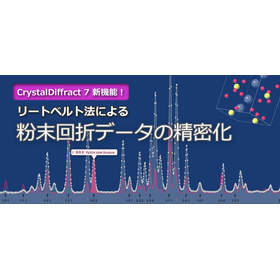
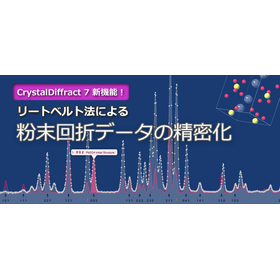
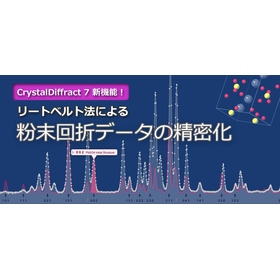
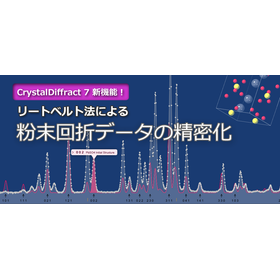
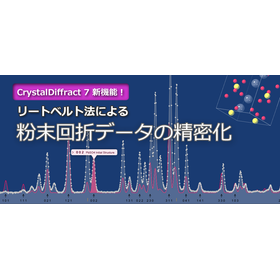
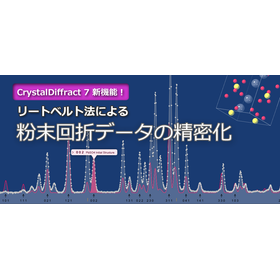
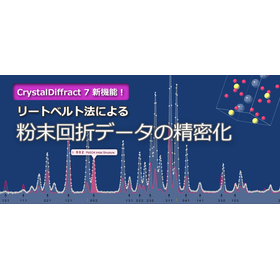
The long-awaited Rietveld refinement feature for powder diffraction data has been implemented in CrystalDiffract 7. Observed powder diffraction data can be read in xy data format or Rigaku ASC format, and refined using the Rietveld method based on an initial structure. The initial structure used as a reference for the Rietveld method can be selected from approximately 1,000 libraries included in CrystalDiffract or imported from an external CIF file. Additionally, diffraction patterns of mixtures consisting of multiple phases can also be refined while calculating the weight fractions of each component. CrystalDiffract is a self-contained powder diffraction program. It is equipped with optimal graphing tools, advanced simulations, interactive real-time parameter control, and intuitive measurement functions all in one program. The new features include not only Rietveld refinement but also automatic background removal, phase identification, and various other functions that assist in data analysis in the fields of crystallography and materials science.
Added to bookmarks
Bookmarks listBookmark has been removed
Bookmarks listYou can't add any more bookmarks
By registering as a member, you can increase the number of bookmarks you can save and organize them with labels.
Free membership registration
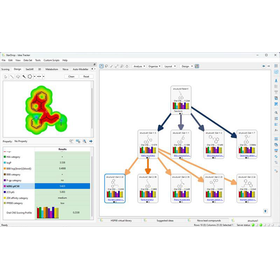
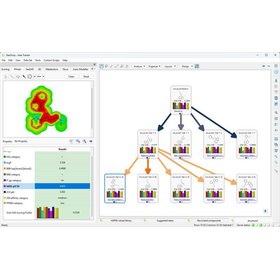
In the cosmetics industry, the development of skincare and makeup products is a complex process that requires the simultaneous optimization of various characteristics such as skin permeability, safety (low irritation), stability of active ingredients, and user experience. The decision support platform StarDrop contributes to the efficiency of cosmetics R&D by efficiently evaluating and predicting the chemical properties of beauty ingredients and raw compounds, allowing for the rapid identification of optimal formulations. 【Main Use Cases】 - Skin Permeability and ADME Prediction: Predicting whether active ingredients can pass through the skin barrier and reach the targeted layers (skin permeability) before synthesis and formulation. - Toxicity and Low Irritation Prediction: Screening the skin sensitization (allergic reactions) and eye irritation risks of raw materials and additives at an early stage. - Auto-Modeller: Building unique product evaluation prediction models from the company's experimental data (sensory evaluation, texture, stability tests, etc.). 【Implementation Effects】 By digitally narrowing down to a "golden formulation" that meets high safety, proven efficacy, and excellent user experience, we achieve a "dramatic reduction in development time" and "reduction in prototype costs." This accelerates the market launch of clean beauty and personalized cosmetics.
Added to bookmarks
Bookmarks listBookmark has been removed
Bookmarks listYou can't add any more bookmarks
By registering as a member, you can increase the number of bookmarks you can save and organize them with labels.
Free membership registration
In the food science industry, the development of new products and quality design is a complex process involving multifaceted evaluations such as taste, aroma, texture, nutritional components, and safety. The decision support platform StarDrop contributes to the efficiency of food R&D by evaluating and predicting the chemical properties of food ingredients and functional materials based on data, quickly identifying optimal blends and formulations. 【Main Use Cases】 - QSAR Property Prediction: Predicting the in vivo behavior (such as absorption and metabolism) and physical properties of specific components before synthesis and formulation. - Toxicity and Safety Prediction: Screening the toxicity risks (such as skin sensitization and mutagenicity) of raw materials and additives at an early stage. - Auto-Modeller: Building unique quality prediction models from the company's experimental data (such as sensory evaluation and shelf life). 【Implementation Effects】 By simultaneously optimizing blends that balance taste, safety, and health functions, the number of prototypes is minimized, achieving a "dramatic reduction in development time" and "reduction in prototype costs." This accelerates the market introduction of advanced health foods and new materials that meet consumer needs.
Added to bookmarks
Bookmarks listBookmark has been removed
Bookmarks listYou can't add any more bookmarks
By registering as a member, you can increase the number of bookmarks you can save and organize them with labels.
Free membership registration
In the biotechnology industry's drug discovery research, the multifaceted evaluation of compound properties is an extremely important process that determines the success or failure of the research. The decision support platform StarDrop significantly contributes to the efficiency of drug discovery by efficiently evaluating candidate compounds before synthesis and quickly identifying the optimal lead compounds. 【Main Use Cases】 - ADME QSAR: High-precision prediction of absorption, distribution, metabolism, and excretion properties of compounds before synthesis. - Derek Nexus Integration: Reliable toxicity predictions that ensure safety in the early stages. - Auto-Modeller: Automatic generation of unique predictive models that maximize the use of in-house data. 【Implementation Effects】 By simultaneously optimizing compounds with a balanced array of properties (efficacy, ADME, toxicity), unnecessary prototyping is eliminated, achieving "shortened drug discovery periods" and "dramatic reductions in research and development costs." This maximizes the speed of bringing safer and more effective pharmaceuticals to market.
Added to bookmarks
Bookmarks listBookmark has been removed
Bookmarks listYou can't add any more bookmarks
By registering as a member, you can increase the number of bookmarks you can save and organize them with labels.
Free membership registration
In the pharmaceutical industry, the drug discovery process is a complex one that requires significant time and cost. Particularly, finding the optimal compound is a crucial challenge that determines the success of new drug development. StarDrop addresses this challenge by quickly extracting a diverse range of excellent compounds, dramatically reducing the time required for drug discovery. It evaluates complex data and supports the determination of research direction and compound prioritization. As a result, researchers can make decisions more efficiently and with greater confidence. 【Use Cases】 - Exploration of lead compounds - Selection of candidate drugs - Optimization of compound properties 【Effects of Implementation】 - Reduction of drug discovery time - Decrease in research and development costs - Development of more effective pharmaceuticals
Added to bookmarks
Bookmarks listBookmark has been removed
Bookmarks listYou can't add any more bookmarks
By registering as a member, you can increase the number of bookmarks you can save and organize them with labels.
Free membership registration
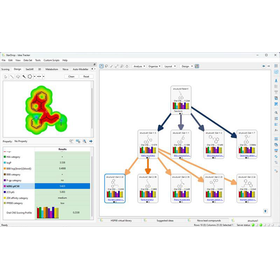
By quickly extracting diverse and excellent compounds, StarDrop operates while evaluating complex data, dramatically reducing the time required for effective lead compound exploration. In evaluating this data, it provides confidence and intuitive clarity for decision-making, guiding and validating the direction of research and which compounds to prioritize. This interactive tool enables you to efficiently open pathways to enhance your chosen chemical properties. 〇 Advantages of StarDrop - Development of more effective drugs By highlighting excellent chemical properties, it leads you to target areas with the greatest potential for multifaceted optimization and success in your research. - Confident decision-making It assists in managing uncertain data specific to drug discovery that arises from experimental variability and predictive errors. - Speeding up compound selection It significantly reduces the time needed to navigate the maze of possibilities and identify excellent lead compounds and candidate drugs. - More results from your research It helps you get the best from all your resources, delivering true value.
Added to bookmarks
Bookmarks listBookmark has been removed
Bookmarks listYou can't add any more bookmarks
By registering as a member, you can increase the number of bookmarks you can save and organize them with labels.
Free membership registration
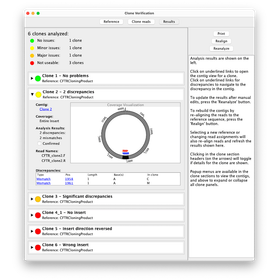
This is a program for Windows and macOS that helps with DNA barcoding, sequence assembly and contig editing, and mutation detection. Version 13.0 has newly added features such as clone verification, mutation detection for NGS data, cloning history verification, and a new cloning method called virtual HiFi DNA Assembly. □Product Page□ (To the IPROS manufacturing page) https://mono.ipros.com/product/detail/2001539474/ (To the Hulinks page) https://www.hulinks.co.jp/software/codoncode-aligner/
Added to bookmarks
Bookmarks listBookmark has been removed
Bookmarks listYou can't add any more bookmarks
By registering as a member, you can increase the number of bookmarks you can save and organize them with labels.
Free membership registration
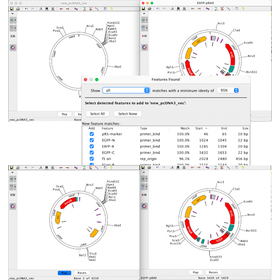
This is a program for Windows and macOS that helps with DNA barcoding, sequence assembly, contig editing, and mutation detection. It features a user-friendly and easy-to-understand interface, while also fully supporting quality scores for sequences compatible with Phred-Phrap.
Added to bookmarks
Bookmarks listBookmark has been removed
Bookmarks listYou can't add any more bookmarks
By registering as a member, you can increase the number of bookmarks you can save and organize them with labels.
Free membership registration
Canto's digital asset management platform is a next-generation content hub equipped with AI. It consolidates content management, collaboration, and distribution to maximize your team's creativity. With Canto connecting people, tools, and workflows, managing digital assets becomes smarter and safer. It centralizes the content lifecycle, making your brand shine at every touchpoint. Quickly access the assets you need and effortlessly optimize content that fits your brand. Expand your reach, gain insights that evolve your strategy, and infinitely enhance your brand's potential.
Added to bookmarks
Bookmarks listBookmark has been removed
Bookmarks listYou can't add any more bookmarks
By registering as a member, you can increase the number of bookmarks you can save and organize them with labels.
Free membership registration
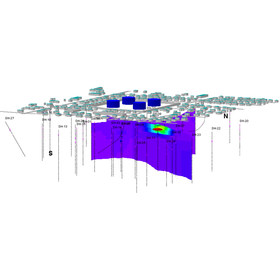
"RockWorks" is a comprehensive software program for creating 2D/3D maps, logs (column diagrams), cross-sections, geological models, volume reports, and general geological maps for the environmental, geotechnical, mining, and petroleum industries.
Added to bookmarks
Bookmarks listBookmark has been removed
Bookmarks listYou can't add any more bookmarks
By registering as a member, you can increase the number of bookmarks you can save and organize them with labels.
Free membership registration
In the GIS industry, accurate visualization of topographic data is essential for map creation. Contours and 3D models are crucial elements for understanding and analyzing land shapes. Surfer supports various data sources, including LiDAR data, and meets these needs using advanced interpolation algorithms. 【Use Cases】 * Creation of topographic maps * Creation of 3D models * Geological surveys * Environmental assessments 【Benefits of Implementation】 * Visualization of accurate topographic data * Streamlining of data analysis * Acceleration of decision-making
Added to bookmarks
Bookmarks listBookmark has been removed
Bookmarks listYou can't add any more bookmarks
By registering as a member, you can increase the number of bookmarks you can save and organize them with labels.
Free membership registration
In the tourism industry, attractive maps and topographic maps are essential for attracting tourists and enhancing their satisfaction. By visually representing natural landscapes and tourist routes, they capture travelers' interest and lead to the discovery of new tourist resources. However, traditional map-making has faced challenges such as high time and cost requirements, as well as difficulties in reflecting the latest information. Surfer addresses these challenges and allows for the easy creation of high-precision 2D and 3D topographic maps. 【Usage Scenarios】 - Creation of guide maps for tourist destinations - Mapping of trekking and hiking courses - Visualization of tourist routes - Application in dioramas and VR content 【Benefits of Implementation】 - Increased appeal to tourists - Discovery of new tourist resources - Strengthened information dissemination - Cost reduction and increased efficiency
Added to bookmarks
Bookmarks listBookmark has been removed
Bookmarks listYou can't add any more bookmarks
By registering as a member, you can increase the number of bookmarks you can save and organize them with labels.
Free membership registration
In the construction industry, earth volume calculation is a crucial factor that influences project costs and timelines. To perform accurate earth volume calculations, it is essential to create high-precision 3D models based on terrain data. However, traditional earth volume calculation methods have faced challenges due to the need for manual measurements and complex calculations, which require significant time and effort. Surfer can easily create accurate 2D and 3D topographic maps from various data sources, including LiDAR data. With advanced data interpolation algorithms, it enables precise earth volume calculations and contributes to the efficiency of construction projects. 【Use Cases】 - Earth volume calculation in land development projects - Earth volume calculation in road construction - Earth volume calculation in dam construction 【Benefits of Implementation】 - Improved accuracy of earth volume calculations - Reduced working time - Cost savings - Overall project efficiency enhancement
Added to bookmarks
Bookmarks listBookmark has been removed
Bookmarks listYou can't add any more bookmarks
By registering as a member, you can increase the number of bookmarks you can save and organize them with labels.
Free membership registration
In the real estate industry, sunlight conditions are a crucial factor that significantly affects property value. Insufficient sunlight can compromise residents' comfort and potentially lead to a decrease in asset value. Surfer addresses these challenges by creating accurate 3D terrain maps and conducting sunlight simulations. It visualizes the impact of building placement and height on sunlight, supporting optimal design. 【Use Cases】 - Sunlight simulation for new condominiums - Sunlight surveys for existing buildings - Consideration of effective land use 【Benefits of Implementation】 - Optimal property design considering sunlight conditions - Persuasive information provision to clients - Enhancement of real estate value
Added to bookmarks
Bookmarks listBookmark has been removed
Bookmarks listYou can't add any more bookmarks
By registering as a member, you can increase the number of bookmarks you can save and organize them with labels.
Free membership registration
In the solar power generation industry, optimizing panel layout and maximizing generation efficiency are essential. In particular, designs that take into account sunlight conditions and terrain influences are crucial for improving power output. Inadequate designs can lead to decreased generation efficiency and increased installation costs. Surfer can utilize LiDAR data and geographic information to create highly accurate 2D and 3D topographic maps. This supports the analysis needed to consider the optimal arrangement of solar panels and maximize generation efficiency. 【Use Cases】 - Design of solar power plants - Sunlight simulation - Visualization of terrain data 【Benefits of Implementation】 - Improved generation efficiency - Optimization of installation costs - Streamlining of the design process
Added to bookmarks
Bookmarks listBookmark has been removed
Bookmarks listYou can't add any more bookmarks
By registering as a member, you can increase the number of bookmarks you can save and organize them with labels.
Free membership registration
In the field of disaster prevention, accurately understanding flood risk is essential. Particularly in urban areas and regions near rivers, detailed flood simulations based on topographical data are helpful in formulating effective disaster prevention plans. Low-accuracy topographical data and complex data processing can lead to incorrect risk assessments, potentially hindering appropriate measures. Surfer supports various data sources, including LiDAR data, and uses advanced interpolation algorithms to create high-precision 2D and 3D topographic maps. This enables the visualization of flood risk and supports more effective disaster prevention measures. 【Use Cases】 - River flood simulation - Creation of flood hazard maps for urban areas - Consideration of evacuation routes - Identification of areas with high flood risk 【Benefits of Implementation】 - Rapid formulation of evacuation plans through the visualization of flood risk - Accurate information provision to residents through the creation of high-precision hazard maps - Efficient resource allocation by prioritizing disaster prevention measures - Smooth information sharing with relevant agencies
Added to bookmarks
Bookmarks listBookmark has been removed
Bookmarks listYou can't add any more bookmarks
By registering as a member, you can increase the number of bookmarks you can save and organize them with labels.
Free membership registration
In the agricultural sector, accurate understanding of terrain data is essential to optimize the growing environment for crops. In particular, differences in slope and elevation affect drainage and sunlight conditions, which significantly impact yields. Surfer visualizes this terrain data, making analysis easier. By creating contour maps and 3D surface maps, it allows for an intuitive grasp of field conditions, aiding in the development of optimal planting plans and irrigation system designs. 【Use Cases】 - Terrain analysis of fields - Development of planting plans - Design of irrigation systems - Drainage measures - Effective use of farmland 【Benefits of Implementation】 - More efficient agricultural management based on terrain data - Increased yields - Improved work efficiency - Cost reduction - Data-driven decision-making
Added to bookmarks
Bookmarks listBookmark has been removed
Bookmarks listYou can't add any more bookmarks
By registering as a member, you can increase the number of bookmarks you can save and organize them with labels.
Free membership registration
In forestry, the efficient management of forest resources is essential for sustainable forest management. Accurately understanding the shape and quantity of resources in forests forms the basis for logging plans, reforestation plans, and forest conservation activities. However, traditional survey methods have made it difficult to efficiently collect and analyze information from vast forests. Surfer utilizes LiDAR data and other geospatial data to easily create 3D models and contour maps of forests. This allows for a detailed understanding of the terrain and resource distribution in forests, enabling more accurate forest management. 【Use Cases】 - Creation of forest topographic maps - Development of logging plans - Estimation of forest resource quantities - Assessment of sediment disaster risk 【Benefits of Implementation】 - Increased efficiency in forest management - Effective utilization of resources - Risk reduction - Faster decision-making


Added to bookmarks
Bookmarks listBookmark has been removed
Bookmarks listYou can't add any more bookmarks
By registering as a member, you can increase the number of bookmarks you can save and organize them with labels.
Free membership registration
In the field of urban planning, the creation of accurate 3D models based on topographical data is essential for landscape studies. In particular, visual information plays a crucial role in environmental impact assessments and sunlight simulations related to urban development and infrastructure projects. Surfer meets these needs by supporting various data formats, including LiDAR data, and allows for the easy creation of high-precision 2D and 3D maps. 【Use Cases】 - Landscape simulation in urban development - Environmental impact assessment in infrastructure planning - Sunlight simulation - Topographical representation in park design 【Benefits of Implementation】 - Improved planning accuracy through high-precision topographical data visualization - Clear information provision to stakeholders - Early detection of issues during the planning phase - Support for efficient decision-making
Added to bookmarks
Bookmarks listBookmark has been removed
Bookmarks listYou can't add any more bookmarks
By registering as a member, you can increase the number of bookmarks you can save and organize them with labels.
Free membership registration
In the field of archaeology, it is important to grasp the accurate topographical information of archaeological sites and to plan excavation surveys. In particular, understanding slight surface undulations and underground structures is essential for comprehending the scale and structure of the site. However, traditional survey methods have been time-consuming and labor-intensive, and the information obtained has been limited. Surfer utilizes LiDAR data and other geospatial data to easily create 3D models and contour maps of archaeological sites. This is expected to enhance the efficiency and accuracy of surveys. 【Application Scenarios】 - Creation of a 3D model of the entire archaeological site - Terrain simulation before excavation surveys - Creation of distribution maps of artifacts - Visualization of environmental changes around the archaeological site 【Effects of Implementation】 - Increased efficiency of excavation surveys - Improved survey accuracy - Smoother information sharing through the visualization of survey results - Enhanced potential for new discoveries
Added to bookmarks
Bookmarks listBookmark has been removed
Bookmarks listYou can't add any more bookmarks
By registering as a member, you can increase the number of bookmarks you can save and organize them with labels.
Free membership registration
In the geological survey industry, accurately understanding strata and geological structures influences the precision and efficiency of investigations. In particular, visualizing geological structures such as faults and folds is essential for exploring underground resources and assessing ground stability. Traditional analytical methods have posed challenges due to the time and effort required for data interpretation. Surfer allows for the easy creation of detailed 2D and 3D maps and models that represent geological structures by utilizing various data, including LiDAR data. This enhances the efficiency of geological surveys and enables more accurate structural analysis. 【Application Scenarios】 - Visualization of geological structures such as faults and folds - Understanding stratigraphic structures in underground resource exploration - Creating topographic models for ground stability assessment 【Benefits of Implementation】 - Increased efficiency of surveys through visualization of geological structures - Compatibility with diverse data sources such as LiDAR data - Intuitive structural understanding through 3D models - High-precision analysis using advanced data interpolation algorithms
Added to bookmarks
Bookmarks listBookmark has been removed
Bookmarks listYou can't add any more bookmarks
By registering as a member, you can increase the number of bookmarks you can save and organize them with labels.
Free membership registration
In the field of environmental surveys, it is essential to accurately grasp the diffusion status and impact range of pollutants. In investigations of soil and water pollution, visualizing and analyzing the concentration distribution of pollutants and the flow of groundwater leads to the formulation of countermeasures. Surfer contributes to these challenges by creating high-precision 2D and 3D maps and models based on collected data, transforming complex geospatial datasets into clear and understandable models. 【Application Scenarios】 - Creating distribution maps of pollutants in soil contamination surveys - Simulating groundwater contamination - Environmental impact assessments of waste disposal sites - Building predictive models for pollutant diffusion 【Effects of Implementation】 - Rapid understanding of the situation through visualization of contamination - Accurate countermeasure planning based on data - Clear information sharing with stakeholders - Increased efficiency in survey and analysis tasks
Added to bookmarks
Bookmarks listBookmark has been removed
Bookmarks listYou can't add any more bookmarks
By registering as a member, you can increase the number of bookmarks you can save and organize them with labels.
Free membership registration
In the field of civil engineering design, accurate understanding of topographical data and efficient design based on that data are required. Particularly in the design of varied terrain and complex structures, the visualization of the terrain significantly affects the precision of the design. Surfer supports various data formats, including LiDAR data, and uses advanced interpolation algorithms to easily create accurate topographic maps. This deepens the understanding of the terrain in the early stages of design, enabling more precise designs. 【Use Cases】 - Visualization of topographical survey data in civil engineering projects - Creation of 3D models for land development planning - Generation of longitudinal and cross-sectional diagrams in road design - Topographical representation in river and dam design 【Benefits of Implementation】 - Increased efficiency in design through visualization of topographical data - Improved design accuracy based on precise topographical models - Enhanced visual information sharing among stakeholders - Strengthened presentations using 3D models
Added to bookmarks
Bookmarks listBookmark has been removed
Bookmarks listYou can't add any more bookmarks
By registering as a member, you can increase the number of bookmarks you can save and organize them with labels.
Free membership registration
In the field of mining, accurately understanding resource quantities is essential. To conduct precise resource evaluations, it is necessary to accurately visualize and analyze terrain data from both the surface and underground. Inaccurate terrain data or inappropriate analyses can lead to underestimation or overestimation of resource quantities, significantly impacting mining plans and investment decisions. Surfer supports resource evaluations by creating accurate 2D and 3D maps and models from various data sources, including LiDAR data. 【Use Cases】 - Visualization of mineral deposits - Planning of mining operations - Estimation of resource quantities 【Benefits of Implementation】 - Realization of accurate resource evaluations - Improvement of mining efficiency - Enhanced accuracy of investment decisions
Added to bookmarks
Bookmarks listBookmark has been removed
Bookmarks listYou can't add any more bookmarks
By registering as a member, you can increase the number of bookmarks you can save and organize them with labels.
Free membership registration
Surfer is a flexible and user-friendly tool for creating contour and 3D surface maps. Collected data can be displayed as high-quality 2D and 3D maps or models while maintaining accuracy and precision by utilizing a wealth of tools. It interprets complex geospatial datasets and transforms them into clear and understandable models. 【Features】 ■ Equipped with advanced data interpolation algorithms, including Kriging, CoKriging, Inverse Distance to a Power, and Polynomial Regression. ■ A wide variety of map types, including Base Map, Contour, Post/Classed Post, 3D Surface, and Vector. ■ 3D display of 2D/3D grid data. ■ Overlaying aerial photos and planning maps on surfaces, taking geographic information into account. ■ Creation, editing, and recording of fly-through videos. ■ Exporting models to 3D PDF and VRML files.
Added to bookmarks
Bookmarks listBookmark has been removed
Bookmarks listYou can't add any more bookmarks
By registering as a member, you can increase the number of bookmarks you can save and organize them with labels.
Free membership registration
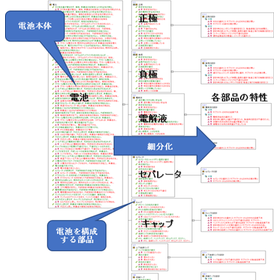
[Steps in APIS IQ] FMEA consists of seven steps. Here, we will focus on the three most important and fundamental steps for conducting FMEA: structural analysis, functional analysis, and failure analysis. 1. Planning and Preparation: FMEA Scope Analysis 2. Structural Analysis: Create a structure tree from the selected system elements 3. Functional Analysis: Describe the "functions" of the system elements and create a function network 4. Failure Analysis: Describe the "failures" corresponding to the functions of the system elements and create a failure network 5. Risk Analysis: Management responsibilities, failure ranking: AIAG/VDA form / AP correspondence 6. Optimization: Measures to mitigate risks: AIAG/VDA form / AP correspondence 7. Documentation: Output and communication of results: AIAG/VDA form For more details, please check below. https://www.hulinks.co.jp/support/apis/gs/index.html
Added to bookmarks
Bookmarks listBookmark has been removed
Bookmarks listYou can't add any more bookmarks
By registering as a member, you can increase the number of bookmarks you can save and organize them with labels.
Free membership registration
Lithium-ion batteries are high-energy-density secondary batteries used in various fields such as onboard applications for HEVs and EVs, backup for power systems, and storage for renewable energy. As their range of use expands, safety has also become a focus of attention. Particularly, due to the high energy density of the batteries, caution is necessary as internal short circuits and thermal runaway can lead to major accidents. Against this backdrop, the quality of onboard batteries is regulated by the automotive-related standard IATF16949, and when exporting, the submission of documents (FMEA sheets) in accordance with the IATF16949 standard is mandatory. Additionally, for stationary secondary batteries, the safety standard IEC 62619 has been established. There are several shapes of lithium-ion batteries, but here we will explain cylindrical lithium-ion secondary batteries. The components of cylindrical lithium-ion secondary batteries can be broadly classified into eight elements.
Added to bookmarks
Bookmarks listBookmark has been removed
Bookmarks listYou can't add any more bookmarks
By registering as a member, you can increase the number of bookmarks you can save and organize them with labels.
Free membership registration
In the automotive industry, paint development requires a wide range of performance characteristics, including durability, weather resistance, and aesthetic appeal. Particularly in the evaluation of new pigments and additives, as well as the improvement of existing paints, understanding molecular-level behavior and reaction pathways is crucial. Optimizing chemical structures and predicting physical properties in response to these challenges is essential for reducing development time and costs. The chemical calculation software "Gaussian" provides advanced computational chemistry methods to meet these demands. 【Application Scenarios】 - Prediction of color development and weather resistance through electronic state calculations of new pigments - Molecular design and functionality evaluation of additives - Analysis of the degradation mechanisms of paint films - Optimization of formulation design 【Benefits of Implementation】 - Shortened development cycles - Cost reduction through fewer experiments - Improved paint performance - Development of new functional paints
Added to bookmarks
Bookmarks listBookmark has been removed
Bookmarks listYou can't add any more bookmarks
By registering as a member, you can increase the number of bookmarks you can save and organize them with labels.
Free membership registration
In the field of biotechnology, particularly in the analysis of biomolecules, it is essential to accurately understand the structure and reactivity of molecules. High-precision computational chemistry methods are indispensable for elucidating the complex interactions and dynamics of biomolecules. Inadequate analysis can lead to delays in research and incorrect conclusions. The chemical computation software 'Gaussian' provides cutting-edge electronic state calculation techniques to support the precise analysis of biomolecules. 【Application Scenarios】 - Structural analysis of biomacromolecules such as proteins and nucleic acids - Simulation of interactions between drugs and biomolecules - Elucidation of enzyme reaction mechanisms - Evaluation of the physical properties of biomolecules 【Effects of Implementation】 - Deepening understanding of biomolecular behavior - Streamlining research and development - Contributing to new discoveries and technological advancements
Added to bookmarks
Bookmarks listBookmark has been removed
Bookmarks listYou can't add any more bookmarks
By registering as a member, you can increase the number of bookmarks you can save and organize them with labels.
Free membership registration
In the field of environmental science, particularly in the analysis of pollutants, it is essential to accurately understand the chemical behavior of substances, as well as their diffusion and degradation processes in the environment. Unraveling these mechanisms is crucial for identifying sources of pollution and formulating effective countermeasures. Inadequate analysis can lead to errors in assessing environmental impacts and a decrease in the effectiveness of measures taken. The chemical calculation software 'Gaussian' contributes to solving environmental issues by providing detailed analysis of these complex chemical processes through cutting-edge electronic state calculation technology. 【Application Scenarios】 - Analysis of reaction mechanisms of air pollutants - Prediction of degradation pathways of water pollutants - Evaluation of adsorption and desorption characteristics of soil pollutants - Support for the development of new environmental purification technologies 【Effects of Implementation】 - Provision of scientific evidence regarding the behavior of pollutants - Improvement of accuracy in environmental impact assessments - Support for the formulation of effective pollution countermeasures - Increased efficiency in research and development
Added to bookmarks
Bookmarks listBookmark has been removed
Bookmarks listYou can't add any more bookmarks
By registering as a member, you can increase the number of bookmarks you can save and organize them with labels.
Free membership registration
In the cosmetics industry, precise molecular design and property prediction are required for the exploration of functional ingredients and the elucidation of their mechanisms of action. Particularly in the development of new ingredients and the improvement of existing ones, it is crucial to deeply understand their chemical properties and to find safe and effective usage methods. Inadequate preliminary evaluations can lead to delays in development and unexpected issues. The chemical calculation software 'Gaussian' provides cutting-edge methods for electronic state calculations and computational chemistry models, supporting the research and development of functional ingredients. 【Usage Scenarios】 - Molecular structure design of new functional ingredients - Prediction of ingredient stability and reactivity - Analysis of interactions with biomolecules - Structural modifications aimed at improving the performance of existing ingredients 【Benefits of Implementation】 - Shortened development time - Reduced research and development costs - Enhanced performance of functional ingredients - Support for safety evaluations
Added to bookmarks
Bookmarks listBookmark has been removed
Bookmarks listYou can't add any more bookmarks
By registering as a member, you can increase the number of bookmarks you can save and organize them with labels.
Free membership registration
In the food industry, particularly in fragrance design, it is essential to understand the relationship between molecular structure and scent, requiring precise calculations to create new fragrances. Grasping the molecular-level behaviors related to the quality, persistence, and safety of scents is crucial for high-quality fragrance development. The chemical calculation software 'Gaussian' provides cutting-edge methods and technologies to meet these needs. 【Application Scenarios】 - Molecular structure analysis of new fragrance components - Physical property prediction of existing fragrances - Stability evaluation of fragrances - Elucidation of scent mechanisms 【Benefits of Implementation】 - Increased efficiency in fragrance development - Discovery of new scents - Improvement in product quality - Reduction in research and development costs
Added to bookmarks
Bookmarks listBookmark has been removed
Bookmarks listYou can't add any more bookmarks
By registering as a member, you can increase the number of bookmarks you can save and organize them with labels.
Free membership registration
In pesticide development, molecular design that considers the effects on target organisms and the impact on non-target organisms is required. In particular, detailed analysis at the molecular level is essential to predict the activity and toxicity of compounds and to develop safe and effective pesticides. The chemical calculation software "Gaussian" provides cutting-edge electronic state calculations and computational chemistry models to address these complex challenges in pesticide development and supports research and development. 【Application Scenarios】 - Structural optimization of new pesticide candidate compounds - Prediction of compound reactivity and stability - Interaction analysis with target proteins - Molecular property predictions for toxicity assessment 【Benefits of Implementation】 - Narrowing down candidate compounds in the early stages of development - Reduction in the number of experiments and shortening of the development period - Development of safer and more effective pesticides
Added to bookmarks
Bookmarks listBookmark has been removed
Bookmarks listYou can't add any more bookmarks
By registering as a member, you can increase the number of bookmarks you can save and organize them with labels.
Free membership registration
In the energy industry, particularly in the development of battery materials, it is essential to accurately predict the properties of materials and link them to performance improvements. Understanding molecular-level behavior is crucial for designing new battery materials and improving existing ones, with particular emphasis on evaluating the stability and ionic conductivity of electrode materials and electrolytes. The chemical calculation software 'Gaussian' provides cutting-edge methods and technologies to support research and development. 【Application Scenarios】 - Molecular design of new battery materials - Structural optimization of electrode materials - Analysis of ionic conductivity of electrolytes - Evaluation of material stability 【Benefits of Implementation】 - Shortening of development cycles - Improved accuracy in predicting material properties - Reduction of experimental costs - Promotion of innovative battery material development
Added to bookmarks
Bookmarks listBookmark has been removed
Bookmarks listYou can't add any more bookmarks
By registering as a member, you can increase the number of bookmarks you can save and organize them with labels.
Free membership registration
In the field of semiconductors, molecular design requires precise prediction of material properties to advance innovative device development. Particularly in the exploration of new materials and the enhancement of existing materials' performance, it is essential to accurately understand behavior at the molecular level. Inadequate molecular design can lead to delays in the development cycle and risks of not achieving the expected performance. The chemical calculation software 'Gaussian' provides cutting-edge methods for electronic state calculations and computational chemistry models, supporting research and development in the semiconductor field. [Application Scenarios] - Molecular structure analysis of new semiconductor materials - Simulation of material properties - Elucidation of catalytic reaction mechanisms - Structural optimization in molecular design [Effects of Implementation] - Shortening of the development cycle - Improvement in the accuracy of material property predictions - Increased efficiency in research and development
Added to bookmarks
Bookmarks listBookmark has been removed
Bookmarks listYou can't add any more bookmarks
By registering as a member, you can increase the number of bookmarks you can save and organize them with labels.
Free membership registration