Should we pursue lightness, compactness, and brevity? Or should we prioritize rigidity and strength?
 HEADWAY 本社
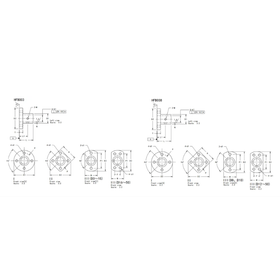
Selection and Comparison Guide for HFB003 and HFB008
Vibrations and minor precision drifts of end effectors that occur during the trial operation of automated equipment are primarily caused by insufficient rigidity of the guide shaft holder. Although both models have similar appearances, their design philosophies and application areas differ significantly.
HFB003 (Extreme Space Optimization): Minimizes the outer diameter and flange width of the main body, eliminating constraints in narrow spaces where motors and sensors are densely packed. It is optimal for micro-stroke and small precision mechanisms, including very small diameters (less than ∅8), and primarily adopts two-hole fixation for medium and small sizes.
HFB008 (Dynamic High Rigidity): Expands the outer shape and base span for medium to heavy loads. By increasing the thickness of the boss section, it maintains roundness of the inner diameter even under high tightening torque, preventing shaft binding, galling, and displacement due to impact. It fully adopts four-hole fixation from medium diameters, significantly enhancing resistance to tipping and torsional rigidity. Even in aluminum, it demonstrates sufficient thread support strength.
Selection Points: If space-saving and low load are the top priorities, HFB003 is recommended. For dynamic mechanisms that experience frequent acceleration and deceleration or cantilever loads, HFB008 is recommended (Note: Since HFB008 has a larger outer dimension, it is necessary to check for 3D interference in advance).
Inquiry about this news
Contact Us OnlineMore Details & Registration
Details & Registration
Related Links
Distributors