Visualize 3D Land-Use Conditions in 2D!
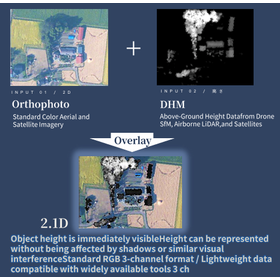
In recent years, drone (UAV)-based surveying has increasingly used Structure from Motion (SfM) to derive three-dimensional information from multi-view images for assessing terrain and vegetation conditions. However, directly handling elevation data may require specialized processing environments and the capacity to manage large datasets, making it difficult to integrate such data into existing image-analysis workflows. This invention provides a method for generating a surface composite image that utilizes acquired elevation information to facilitate an intuitive understanding of land-surface use and conditions. With this technology, height information derived from three-dimensional data can be represented as a widely compatible three-channel RGB image. As a result, the data can retain elevation information while remaining lightweight and easy to handle, enabling use in conventional image-processing environments and with a variety of freely available software tools. In a comparative example of estate woodland extraction, the Dice coefficient was 0.64 when using orthophotos alone, whereas it increased to 0.80 when using the composite image, confirming improved extraction accuracy. These features make the technology promising as a practical means of seamlessly incorporating elevation information into existing image-based workflows, including vegetation assessment, visualization of land-surface use, and condition monitoring around disaster-affected areas and infrastructure.
Inquire About This Product
basic information
For details, please contact us or refer to the PDF.
Price range
Delivery Time
Applications/Examples of results
For details, please contact us or refer to the PDF.
catalog(1)
Download All Catalogs
Company information

The revenue generated from technology transfer is reinvested into universities and researchers as new research funding, which is used to create further research outcomes. To ensure the smooth operation of this cycle, known as the "Intellectual Creation Cycle," we will actively promote technology transfer. The types of seeds we handle include patents, know-how, databases, and programs. We have established a collaborative framework by concluding basic technology transfer agreements with the following universities (as of April 1, 2026): - Tohoku University - Hirosaki University - Iwate University - Akita University - Fukushima University - Yamagata University - Tohoku Gakuin University - Iwate Medical University - Fukushima Medical University - Aizu University - Miyagi University - Hokkaido University - Muroran Institute of Technology - Showa Medical University - Asahikawa Medical University