

Now is the time to review from the basics towards the establishment of a logistics management supervisor.
If production and logistics are managed separately in the factory, it can lead to negative consequences. This is the "key point of logistics improvement." For example, standard work procedures, standard times, and productivity management. What is commonly done in the production process is not implemented in logistics. As a result, logistics can become a bottleneck, and it is not uncommon for the overall efficiency of the factory to decline. Why is "in-house logistics" important now? The government is promoting the optimization and efficiency of logistics as a social theme, and as part of this, the establishment of "logistics coordinators" is beginning to be required, starting with large businesses. It is predicted that this will eventually extend to medium and small enterprises as well. It is necessary to start improving in-house logistics now and to establish a strategic logistics management system. This course will discuss what in-house logistics should do to achieve "overall efficiency in the factory." There is an order to logistics improvement. By incorporating exercises and thinking and discussing together, please remember how to improve in-house logistics through experience. *For more details, please download the PDF or contact us.

Inquire About This Product
basic information
【Lecture Content】 1. What is in-house logistics? - What is the "logistics improvement" that manufacturing companies should first tackle? ■ 'Exercise: The first logistics improvement to address' 2. Current status of in-house logistics initiatives 3. Steps for improvement - The significance of starting improvements from the later processes - Insights gained from analyzing production line operations - The ideal way to supply parts to the production line ■ 'Exercise: Examination of parts supply methods' 4. What is the primary role of in-house logistics? - Let's confirm the direction that the manufacturing industry should aim for ■ 'Exercise: What logistics can do to eliminate waste from overproduction' 5. What is the secondary role of in-house logistics? - In-house logistics has the function of delivering goods and information - How logistics can contribute to eliminating waste from overproduction 6. What is the tertiary role of in-house logistics? - What IE methods can be used for logistics improvement - The three steps for implementing in-house logistics improvement - The role of efficient logistics and what constitutes waste ■ 'Exercise: Implementation of work sampling' *For more details, please download the PDF or contact us.*
Price information
Participation fee per person: 37,950 yen (tax included)
Price range
P2
Delivery Time
Applications/Examples of results
Date and Time August 1, 2025 (Friday) 10:00 AM - 4:30 PM Instructor Kein Logistics Improvement Institute, Representative Keiichi Sengoku *For more details, please download the PDF or contact us. - To participate in the seminar, you will need a computer with internet access, a microphone, speakers, and a camera. (This is an online seminar using ZOOM meetings) - After your application is received, a simple connection test will be conducted, so even first-time participants can feel at ease.
catalog(2)
Download All Catalogs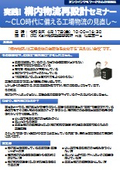

News about this product(1)

Company information

Our company was established 30 years ago, inspired by the teachings of Mr. Taiichi Ohno, the father of the Toyota Production System and former Vice President of Toyota Motor Corporation. The previous president, Shigehiko Sugawara, learned the methods of on-site improvement based on the Toyota Production System, as well as the supporting PM. After Mr. Ohno's passing, we established T.M.A. Co., Ltd. in 1992 to carry on his legacy. Manufacturing is about developing people. It involves creating sellable products based on the fundamental concepts of the Toyota Production System: "Just-In-Time" and "Jidoka." This means producing only what can be sold, when it can be sold, with a waste-free combination of people, machines, and materials, all within the shortest lead time. To achieve this, it is essential for the manufacturing, sales, and development departments to work together as one cohesive unit. We aim to realize manufacturing and human development that challenges together, leverages for the future, and creates the next stage. As a result, people grow, and a resilient corporate culture emerges. Our company strongly supports these initiatives. We operate six business areas: 1. On-site improvement consulting and seminar instructor dispatch 2. Online seminars and group seminars 3. T-Mate system 4. Book publishing and sales 5. Correspondence education 6. Video distribution




![[DX Promotion and AI Utilization] 59th DX Business Restructuring Manager Training Course](https://image.mono.ipros.com/public/default/object/noimage_l.gif?w=280&h=280)