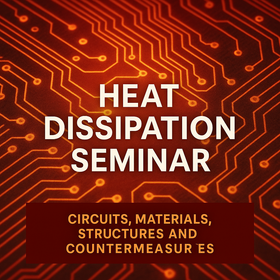
[Seminar] Thermal Management and Heat Dissipation Design Addressing Both Mechanical Design and Circuit Design

Transform "thermal issues" into "design quality." Master thermal management for electronic devices from the basics to practical applications in one day!
In recent years, with the miniaturization and high performance of electronic devices, "heat" has become a critical issue that affects product performance and reliability. This seminar is aimed at hardware development designers and project managers who are troubled by issues such as "components generating more heat than expected" and "frequent failures due to heat." It will systematically explain the fundamentals of thermal design and thermal countermeasures for electronic devices, from basic principles to practical applications. We will introduce foundational knowledge such as the three principles of heat, specific countermeasures at the circuit and board levels, appropriate selection methods for thermal interface materials (TIM), and how to utilize thermal simulations, all presented in an easy-to-understand manner with a wealth of failure case studies. Take this opportunity to learn the key points of thermal design and acquire the skills to solve problems in the early stages of product development. We look forward to your participation.
Inquire About This Product
basic information
1. Three Principles of Heat and Trends in Thermal Design for Electronic Devices 2. Thermal Design and Countermeasures by Circuit/Board 2-1. Heat Generation in Electronic Circuits and Its Mechanism 2-2. Designing for Reliability - Heat Generation, Failure, and Derating 2-3. Heat Reduction Technologies 2-4. Heat Dissipation Design for Semiconductors - Heat Dissipation and Thermal Resistance 3. Circuit Failure Case Studies 3-1. Temperature Rise of Peripheral Components Due to Heat Generation in Power Circuit Elements 3-2. Changes in ON Resistance and Heat Generation in Power ON/OFF Circuits 3-3. Heat Dissipation and Temperature Rise in Surface-Mount Power ICs with Heat Dissipation Pads 4. Confirmation of Heat Generation 5. Key Points in Structural Thermal Design 5-1. Types and Characteristics of TIMs and Tips for Their Use 5-2. Positioning of TIM: Gap Filler Materials 5-3. Heat Dissipation Materials: Specific Materials 5-4. Heat Dissipation Components, Insulation, Heat Resistance, Heat Shielding 5-5. Be Careful of Low-Temperature Burns 5-6. Areas for Heat Dissipation Consideration and Their Key Points (Appropriate Use) 6. Failure Case Studies Due to Thermal Structural Design 7. Thermal Simulation (CAE) 7-1. Thermal Resistance (Calculation) 7-2. Tips for Simulation and Methods for Analyzing Results 7-2-1. Simplified Thermal CAE (Thermal Distribution) 7-2-2. Power Module Thermal CAE
Price range
Delivery Time
Applications/Examples of results
You can systematize your approach to thermal issues. From the three principles of heat to the latest trends, you can relearn the fragmented knowledge you have from the basics in a systematic way. This enables a logical thermal design approach rather than relying on intuitive measures. You will understand specific measures that can be used starting tomorrow. You can acquire practical know-how that can be immediately applied in your work, such as techniques for suppressing heat generation in circuit and board design, and the proper selection and usage of TIM (thermal interface materials) and heat dissipation components. You can reduce rework and cut development costs. By learning from a wealth of failure cases, you can prevent common mistakes that tend to occur in the early stages of design. This reduces sudden specification changes and rework in the later stages of development, ultimately leading to a reduction in development costs and man-hours. You can ask experts directly. Through the Q&A session during the seminar, you have a valuable opportunity to gain insights and advice from experts regarding your daily thermal-related questions and specific challenges related to your products. You can learn efficiently. Since the format is online, you can participate without being restricted by location. Additionally, you can watch the recorded sessions later, allowing you to review parts you didn't fully understand in one go and progress your learning according to your work schedule.
catalog(1)
Download All Catalogs
Company information

We are a technical consulting partner that aims to rebuild "design quality" and "compliance" in the manufacturing industry from the upstream. Kamikami Corporation prioritizes three specialized areas: waterproofing, thermal and mechanical design, compliance with quality management standards, and green procurement and chemical substance regulation compliance. Additionally, we provide AI utilization support services for the manufacturing industry. Our representative, Takashi Suzuki, is a mechanical design expert who has worked on world-class ultra-thin smartphone waterproof designs at Fujitsu. He has supported over 100 manufacturing companies in improving design quality, mass production yield, regulatory compliance, and on-site AI implementation. The year 2026 saw significant changes in regulations and systems surrounding the manufacturing industry, including the addition of chemical substance regulations (with the number of SVHC candidate substances increasing to 253 as of February 2026) and the revision of AI-related guidelines (AI business operator guidelines version 1.2 in March 2026). Our company continuously keeps up with these developments and provides support based on the latest information to ensure that our clients do not experience "unintentional compliance gaps." "Our stance is to fundamentally improve design quality and mass production yield." We invite you to start with a free consultation (60 minutes) and feel free to reach out to us. Updated June 2026.

![[Series Volume 4] Thermal Design Consultant Naoki Kunimine's Column](https://image.mono.ipros.com/public/product/image/24b/2000841741/IPROS86466095253875529367.png?w=280&h=280)
![[Book] High Heat-Resistant Materials for Next-Generation Power Devices (No. 2260)](https://image.mono.ipros.com/public/product/image/08c/2001440591/IPROS40565002714052496557.jpeg?w=280&h=280)