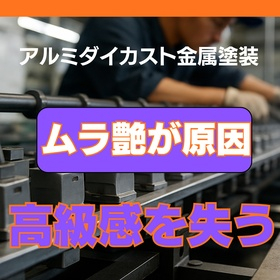
The uneven gloss of aluminum die-cast painting was a defect that diminished its sense of luxury.

The cause of gloss unevenness is the difference in film thickness and drying speed. By managing the drying time within plus or minus 5 minutes, the improvement rate is 80 percent.
Gloss unevenness is a defect where the gloss of the coating surface varies by location, appearing as a mottled pattern. Particularly in automotive interior components, it diminishes the sense of luxury, with data indicating that customer satisfaction can decrease by 30-40 percent. Variation in gloss due to film thickness: When the film thickness changes by plus or minus 30 microns, the angle of light reflection changes, resulting in a 10-15 percent fluctuation in gloss. Strict control within plus or minus 20 microns can reduce gloss unevenness by 90 percent. Optimization of the drying environment: The optimal drying time is in an environment with a temperature of 25 degrees and humidity of 50 percent (30 minutes). Higher temperatures and lower humidity lead to excessively fast drying, causing uneven solvent evaporation and lower gloss in certain areas. Conversely, lower temperatures and higher humidity result in slower drying and sedimentation. Fine-tuning the baking temperature: Raising the baking temperature from 170 degrees to 180 degrees changes the curing speed of the resin, resulting in more uniform gloss. However, if raised too much, drips can occur, necessitating strict control within plus or minus 5 degrees. With our constant temperature and humidity chamber and temperature management system, we achieve a gloss unevenness occurrence rate of 0.1 percent, guaranteeing a luxurious paint finish.
Inquire About This Product
Related Videos
basic information
Film thickness management, dry environment, curing temperature, gloss measurement.
Price range
Delivery Time
Applications/Examples of results
Prevention of gloss unevenness, enhancement of luxury feel.
catalog(3)
Download All Catalogs
Company information

We are not just a "subcontracted painting factory." Established in 1958, our company has a foundation of painting technology and also specializes in chemical treatment, stripping, and cleaning, functioning as the "external surface treatment department" in your organizational chart. Based on our philosophy of "preparation is eight-tenths of the work," we emphasize participation from the "upstream process" before the drawings are finalized. We conduct test painting on a wide range of metals and difficult materials, and we produce the entire process from assembly, packaging, to delivery, thereby reducing your management workload. Additionally, by being able to perform zinc phosphate treatment in-house, we achieve stable painting quality. Furthermore, our micro-heating stripping technology, which does not use chemicals, maintains the electrical state of the "jigs (hangers)" that influence painting quality. Our approach of "pre-treatment determines painting quality" ensures the stability of the paint film during mass production. Rather than simply "applying specified standards," we work backwards to achieve optimal painting specifications and prevent scratches during transportation, sparing no effort in thorough discussions from the outset. This diligent preparation is the shortest path to preventing rework and minimizing total costs. From the development stage, please utilize the expertise of our specialists as part of your production line.