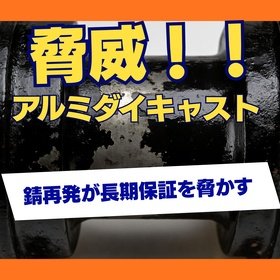
Aluminum die-cast coating was a threat that jeopardized long-term warranty due to rust reoccurrence.

The cause of rust reoccurrence is the thinness of the chemical treatment film. Ensuring a thickness of 8-12 microns allows for 5 years of corrosion resistance.
Reoccurrence of rust is a phenomenon where rust occurs beneath the paint film 3 to 6 months after painting, causing the paint film to swell. This is particularly common in pressed and cast products, and if it leads to a return claim within the quality assurance period, the cost for replacement or repair amounts to 150,000 to 250,000 yen per case. Importance of conversion coating thickness: When managing the conversion coating at 5 microns, 15-20 percent rust reoccurrence occurs within 2 years. If the thickness is increased to 8-10 microns, the rust reoccurrence rate during the same period is reduced to below 2 percent. Crystal structure of phosphate treatment: The larger the crystals in the conversion treatment, the higher the corrosion resistance. By managing the crystal diameter between 5-15 microns, it is possible to clear 1000 hours in the salt spray test (JIS Z 2371). Combination effect with pretreatment: Optimizing the three stages of degreasing, oxide film removal, and conversion treatment improves corrosion resistance by more than three times compared to just conversion treatment alone. Similar measures are necessary even for stainless materials. Our company manages the conversion coating thickness within plus or minus 1 micron and offers a 5-year rust-free guarantee. We have also achieved no rust generation even after 1500 hours in the salt spray test.
Inquire About This Product
Related Videos
basic information
Conversion treatment film thickness, degreasing optimization, coating management, corrosion resistance.
Price range
Delivery Time
Applications/Examples of results
Rust recurrence prevention, long-term quality assurance
catalog(3)
Download All Catalogs
Company information

We are not just a "subcontracted painting factory." Established in 1958, our company has a foundation of painting technology and also specializes in chemical treatment, stripping, and cleaning, functioning as the "external surface treatment department" in your organizational chart. Based on our philosophy of "preparation is eight-tenths of the work," we emphasize participation from the "upstream process" before the drawings are finalized. We conduct test painting on a wide range of metals and difficult materials, and we produce the entire process from assembly, packaging, to delivery, thereby reducing your management workload. Additionally, by being able to perform zinc phosphate treatment in-house, we achieve stable painting quality. Furthermore, our micro-heating stripping technology, which does not use chemicals, maintains the electrical state of the "jigs (hangers)" that influence painting quality. Our approach of "pre-treatment determines painting quality" ensures the stability of the paint film during mass production. Rather than simply "applying specified standards," we work backwards to achieve optimal painting specifications and prevent scratches during transportation, sparing no effort in thorough discussions from the outset. This diligent preparation is the shortest path to preventing rework and minimizing total costs. From the development stage, please utilize the expertise of our specialists as part of your production line.