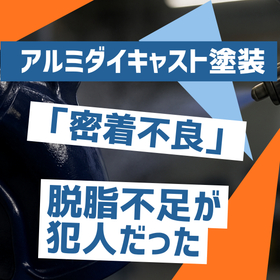
Identify the poor adhesion caused by insufficient degreasing. Explanation of the important process.
In the hull of marine parts, durability and reliability under harsh environments are required. In particular, the painting of aluminum die-cast parts poses a significant challenge, as poor adhesion of the paint film can directly affect product lifespan and safety. Paint peeling can be caused by various factors such as salt damage, water pressure, and physical impacts, but one of the root causes is inadequate degreasing processes. Residual release agents and processing oils on the material surface hinder direct adhesion between the paint and the material, and even trace amounts of oil that are not visible can compromise long-term durability. While there may be no issues immediately after painting, peeling can occur over time, often leading to additional costs such as re-coating or handling complaints. The first step in addressing poor adhesion is to standardize the degreasing process and review management conditions. 【Application Scenarios】 - Painting of hull parts for ships - Use in harsh marine environments - Ensuring long-term durability of the paint film 【Benefits of Implementation】 - Reduction of paint peeling risks - Improvement of product reliability - Reduction of re-coating costs
Inquire About This Product
Related Videos
basic information
【Features】 - Explanation of the causes of poor adhesion due to insufficient degreasing - Description of the impact of oil residues that cannot be visually confirmed - Identification of insufficient degreasing as a factor in the occurrence of blisters and pinholes - Presentation of the trade-off between productivity improvement and cost increase - Emphasis on the importance of standardizing the degreasing process and reviewing management conditions 【Our Strengths】 Eiwa Kogei has been dedicated to metal surface treatment since its founding in 1958, providing a one-stop solution from pre-treatment to painting, stripping, and delivery. By in-house production of zinc phosphate treatment, we complete degreasing, chemical treatment, painting, inspection, and packaging in-house, consolidating management into a single point of contact. By consolidating processes that were previously spread across multiple vendors, including coating stripping and cleaning by group companies, we contribute to shorter delivery times and cost reductions. Even in the event of painting defects, we can respond to re-coating of 5,000 pieces within three days using our own stripping equipment. With a monthly production capacity of 300,000 pieces and the ability to handle 100 varieties in 30 colors, we meet the diverse needs of our customers. If you bring a physical item or a drawing, we can provide a rough estimate on the same day. Please feel free to consult with us.
Price range
Delivery Time
Applications/Examples of results
De-fatting process improvement, defect reduction.
catalog(3)
Download All Catalogs
Company information

We are not just a "subcontracted painting factory." Established in 1958, our company has a foundation of painting technology and also specializes in chemical treatment, stripping, and cleaning, functioning as the "external surface treatment department" in your organizational chart. Based on our philosophy of "preparation is eight-tenths of the work," we emphasize participation from the "upstream process" before the drawings are finalized. We conduct test painting on a wide range of metals and difficult materials, and we produce the entire process from assembly, packaging, to delivery, thereby reducing your management workload. Additionally, by being able to perform zinc phosphate treatment in-house, we achieve stable painting quality. Furthermore, our micro-heating stripping technology, which does not use chemicals, maintains the electrical state of the "jigs (hangers)" that influence painting quality. Our approach of "pre-treatment determines painting quality" ensures the stability of the paint film during mass production. Rather than simply "applying specified standards," we work backwards to achieve optimal painting specifications and prevent scratches during transportation, sparing no effort in thorough discussions from the outset. This diligent preparation is the shortest path to preventing rework and minimizing total costs. From the development stage, please utilize the expertise of our specialists as part of your production line.