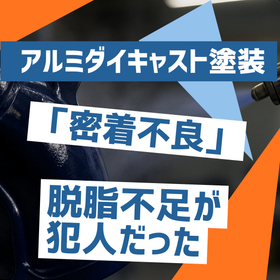
Countermeasures for Poor Adhesion of Coating on Aluminum Die Castings for Communication Equipment

Identify adhesion failures caused by insufficient degreasing. Explain the importance of the often-overlooked degreasing process.
In the telecommunications equipment industry, particularly for components like antenna bases, the adhesion of paint is crucial for maintaining product reliability. Residual release agents and processing oils on the material surface can hinder paint adhesion and lead to coating delamination. Even trace amounts of oil, which are difficult to detect visually, can result in reduced adhesion after painting and potential peeling weeks later. Additionally, insufficient degreasing can also lead to the occurrence of blisters and pinholes. When the degreasing process is shortened to improve productivity, it is not uncommon for the costs of re-coating or handling complaints to increase as a result. The first step in addressing poor adhesion issues is to standardize the degreasing process and review management conditions. Our technology addresses these challenges and provides stable painting quality. 【Application Scenarios】 - Painting of telecommunications equipment and antenna bases - Painting of components that are prone to adhesion of release agents and processing oils - Products requiring long-term coating reliability 【Benefits of Implementation】 - Reduction in complaints due to poor paint adhesion - Decrease in re-coating costs - Improvement in product reliability
Inquire About This Product
Related Videos
basic information
**Features** - Identify the causes of poor adhesion due to insufficient degreasing and propose improvement measures. - Explain insufficient degreasing as a factor in the occurrence of blisters and pinholes. - Emphasize the importance of standardizing the degreasing process and reviewing management conditions. **Our Strengths** We handle "pre-treatment, stripping, and delivery" at our painting facility. From zinc phosphate treatment (in-house) to baking paint, inspection, packaging, and delivery, we provide comprehensive surface treatment for metal products. We can consolidate processes that were previously spread across multiple vendors, including paint stripping and cleaning. If you are facing issues such as deadlines being "when it's done," difficulties in managing pre-treatment and painting with different vendors, slow responses to painting defects, or unresponsive cost review consultations, we can help. By bringing in the actual product or drawings, we can quickly respond to re-coating needs due to poor finishes or specification changes, as we have our own stripping equipment (chemicals, heating, blasting). We can also accommodate urgent requests for re-coating. Utilizing our automatic electrostatic painting line and approximately 100 types of dedicated jigs, we can flexibly handle everything from small-batch, diverse products to mass production. For products the size of 3 cm squares, we have a production capacity of 20,000 pieces per hour, meeting a wide range of lot and color requests.
Price range
Delivery Time
Applications/Examples of results
De-fatting process improvement, defect reduction
catalog(3)
Download All Catalogs
Company information

We are not just a "subcontracted painting factory." Established in 1958, our company has a foundation of painting technology and also specializes in chemical treatment, stripping, and cleaning, functioning as the "external surface treatment department" in your organizational chart. Based on our philosophy of "preparation is eight-tenths of the work," we emphasize participation from the "upstream process" before the drawings are finalized. We conduct test painting on a wide range of metals and difficult materials, and we produce the entire process from assembly, packaging, to delivery, thereby reducing your management workload. Additionally, by being able to perform zinc phosphate treatment in-house, we achieve stable painting quality. Furthermore, our micro-heating stripping technology, which does not use chemicals, maintains the electrical state of the "jigs (hangers)" that influence painting quality. Our approach of "pre-treatment determines painting quality" ensures the stability of the paint film during mass production. Rather than simply "applying specified standards," we work backwards to achieve optimal painting specifications and prevent scratches during transportation, sparing no effort in thorough discussions from the outset. This diligent preparation is the shortest path to preventing rework and minimizing total costs. From the development stage, please utilize the expertise of our specialists as part of your production line.