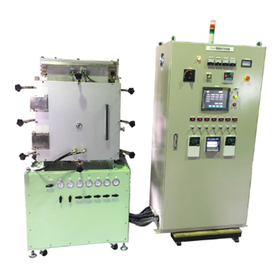
Multi-atmosphere furnace | Thermal CVD coating furnace for vaporizing liquid raw materials

Consideration of thermal CVD coating for narrow gaps, inner surfaces, and recesses using a vaporizer and multi-atmosphere furnace.
In conventional coating methods, it is common to apply a raw material solution to the surface of the component and then fire it in an electric furnace after drying. However, for components with narrow gaps, inner surfaces, recesses, and steps, uneven application and uncoated areas are likely to occur, leading to issues with variations in application amount, drying shrinkage, and post-firing film thickness. Our multi-atmosphere furnace can be configured not only for the Wetter method but also to introduce liquid raw materials and organometallic precursors through a vaporizer, functioning as a thermal CVD furnace. By stably supplying the raw materials with the vaporizer and introducing them into the furnace with a carrier gas, it can be utilized for process development involving film formation and coating on the component surface through gas-phase reactions. 【Features】 ■ Supports vapor introduction of liquid raw materials and organometallic precursors ■ Allows for examination of thermal CVD, surface modification, and coating conditions ■ Enables consideration of film formation on components with narrow gaps, inner surfaces, recesses, and steps ■ Expected to shorten processes by omitting application and drying steps *For more details, please download the materials or contact us.
Inquire About This Product
basic information
【Basic Configuration】 ■ Furnace: Multi-atmosphere furnace ■ Raw Material Supply: Liquid raw material and precursor supply via vaporizer ■ Carrier Gas: Selected according to application, such as Ar, N2 ■ Atmosphere: Adaptable to conditions such as inert, reducing, reactive gases ■ Exhaust and Emission Control: Scrubbers and other methods considered based on raw materials and by-products 【Capabilities】 ■ Thermal CVD processing with vaporized liquid raw materials ■ Bulk coating of entire components ■ Film formation evaluation in narrow gaps, recesses, inner surfaces, and contact areas ■ Confirmation of film thickness, adhesion, surface condition, and reproducibility ■ Consideration of replacing coating methods with vapor phase deposition methods 【Advantages of Vaporizer Method】 ■ Easier control of raw material supply quantity ■ Reduced risk of coating unevenness and uncoated areas ■ Contributes to the reduction of contamination from work processes ■ Potential to simplify processes that were previously divided into coating, drying, and firing ■ Easier consideration for uniform treatment of complex-shaped components *Specifications can be customized according to raw material type, vaporization temperature, processing temperature, atmosphere, and exhaust treatment conditions.
Price information
*The price may vary depending on the internal dimensions, maximum temperature, compatible gas types, vaporizer specifications, raw material supply system, exhaust and emission control specifications, and safety equipment configuration. Please contact us for more details.*
Delivery Time
※*The price varies depending on the internal dimensions, maximum temperature, compatible gas types, vaporizer specifications, raw material supply system, exhaust and emission control specifications, and safety equipment configuration. Please contact us for more details.*
Applications/Examples of results
【Applications】 ■ Coating of components with powder contact areas, inner surfaces, recesses, and narrow gaps ■ Surface modification of jigs for semiconductor and ceramics manufacturing ■ Research on improving corrosion and wear resistance of powder contact components, sleeves, trays, and holders ■ Exploration of thermal CVD conditions using liquid precursors and organometallic solutions ■ Evaluation of process replacement from coating method to vaporizer method 【For such challenges】 ■ Difficult to apply in narrow gaps and inner surfaces ■ Uncoated areas occur at powder contact points and step areas ■ Variability in film thickness due to coating amount and drying shrinkage ■ Multiple processes for coating, drying, and firing, leading to increased labor ■ Desire to coat the entire component at once Even at a stage where raw materials, component materials, processing temperatures, target film thickness, and exhaust/decontamination conditions are not yet determined, we welcome inquiries based on your application needs.
catalog(2)
Download All Catalogs
![[Data] Multi-atmosphere furnace](https://image.mono.ipros.com/public/catalog/image/2116976/IPROS12190686598089889796.jpeg?w=120&h=170)
Company information

Our company integrates three technologies: "electricity," "equipment," and "chemistry," using our unique know-how to develop innovative heating furnaces and other equipment. We handle various electric furnaces (heating furnaces) such as carbon furnaces, multi-atmosphere furnaces, metal furnaces, and chlorine furnaces, leveraging our proprietary high-temperature electric furnace technology. We are not just an equipment manufacturer; we are a strategic development partner that supports innovative manufacturing with advanced heating, looking ahead to the standards of the next decade alongside our customers.