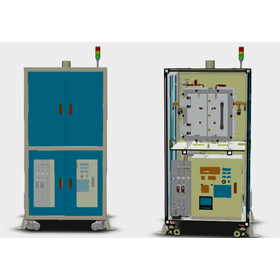
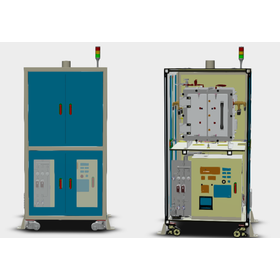
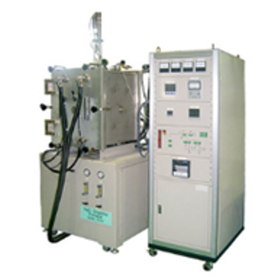
1~45 item / All 75 items
Displayed results
Filter by category

Added to bookmarks
Bookmarks listBookmark has been removed
Bookmarks listYou can't add any more bookmarks
By registering as a member, you can increase the number of bookmarks you can save and organize them with labels.
Free membership registrationContact this company
Inquiry Form1~45 item / All 75 items
Filter by category
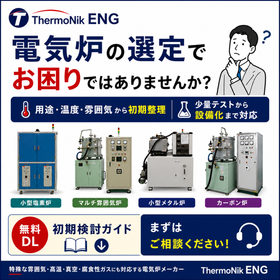
There are many types of electric furnaces, including tubular furnaces, box-type furnaces, vacuum furnaces, atmosphere furnaces, metal furnaces, carbon furnaces, and chlorine furnaces. Selecting the appropriate furnace that matches the application and conditions requires specialized organization. At our company, we can work together from the initial stages to determine which furnace type may be suitable by confirming the temperature, atmosphere gas, processing volume, sample shape, and purpose. We can consult even if the specifications are not yet finalized. You can discuss questions such as "Can it be processed at this temperature?" "Can this gas be used?" "Can it be handled with existing furnaces?" and "Can we conduct a test first?" It is also possible to conduct tests and condition setting with small samples before introducing the equipment to confirm the feasibility of the process. For treatments involving special atmospheres, high temperatures, vacuum, corrosive gases, and reactive gases, which are difficult to handle with standard furnaces, we can consider custom specifications. 【Features】 ■ You can consult from the stage where you are unsure about the type of electric furnace that suits your application, even after researching online. ■ We can respond from the initial organization stage, even if the temperature, atmosphere, processing volume, and sample shape are not yet determined. *For more details, please download the PDF or feel free to contact us.
Added to bookmarks
Bookmarks listBookmark has been removed
Bookmarks listYou can't add any more bookmarks
By registering as a member, you can increase the number of bookmarks you can save and organize them with labels.
Free membership registration
Are you considering sintering, chlorination reactions, and corrosion evaluation in a special atmosphere such as Cl₂ and HCl? In sintering using corrosive and reactive gases like Cl₂ and HCl, it is necessary to consider specifications not only for temperature and gas concentration but also for materials inside the furnace, jig materials, sealing materials, piping, valves, exhaust piping, pollution control devices, and safety interlocks. In particular, for chlorination reactions and volatile separation, the volatility of the generated chlorides, condensation location, recovery methods, insulation of exhaust piping, and pollution control capabilities are important. Additionally, since corrosive gases are handled, leak prevention measures, gas detection, exhaust routes, and safety shutdown conditions significantly impact equipment specifications. This document organizes the treatment objectives, gas conditions, furnace type selection, and key points for confirming jigs, piping, exhaust, pollution control, and safety measures in Cl₂ and HCl special atmosphere sintering. - For sintering and reaction evaluation in Cl₂ and HCl atmospheres - For consideration of chlorination reactions, volatile separation, and impurity removal - For removal of deposits from jigs and components, and evaluation of corrosion and durability - For insulation of exhaust, condensation measures, and specification review of pollution control devices - For sintering tests and condition exploration before equipment installation
Added to bookmarks
Bookmarks listBookmark has been removed
Bookmarks listYou can't add any more bookmarks
By registering as a member, you can increase the number of bookmarks you can save and organize them with labels.
Free membership registration
Are you considering thermal treatment and firing evaluation in an H₂ reduction atmosphere? In processing under an H₂ reduction atmosphere, it is important to first clarify "what you want to reduce." Depending on the objective—such as the reduction of oxides, removal of surface oxide films, reduction of metallic impurities and residues, or treatment of powders, substrates, jigs, and components—the required temperature, H₂ concentration, holding time, and evaluation criteria will vary. Additionally, when processing with 100% H₂, high reduction power can be expected; however, it is crucial to consider specifications for replacement procedures, leak management, exhaust dilution, decontamination, and safety interlocks. When processing with diluted H₂ below the explosion limit, it is easier to lean towards safety, but there may be a risk of insufficient reducing power, necessitating verification of temperature, time, flow rate, and dilution ratio. This document organizes the reduction objectives, H₂ concentration, dilution gas, furnace configuration, safety measures, and points for reflecting on equipment specifications in H₂ reduction atmosphere thermal treatment. - For thermal treatment and firing evaluation in an H₂ reduction atmosphere - For comparative examination of 100% H₂ and diluted H₂ conditions - For oxide reduction, deoxygenation, and removal of surface oxide films - For organizing specifications of H₂ gas replacement, exhaust dilution, and safety interlocks - For firing tests and furnace type selection before equipment installation
Added to bookmarks
Bookmarks listBookmark has been removed
Bookmarks listYou can't add any more bookmarks
By registering as a member, you can increase the number of bookmarks you can save and organize them with labels.
Free membership registration
Are you considering sintering and heat treatment with N₂・Ar atmosphere to suppress oxidation? Simply flowing inert gas is not sufficient to suppress oxidation. It is necessary to determine conditions that include the introduction of oxygen and moisture into the furnace, replacement procedures, gas flow rates, dew point, residual O₂, sample shape, jig material, and re-oxidation during cooling. Additionally, while N₂ is relatively low-cost and easy to use for general oxidation suppression, there is a possibility of nitriding or reactions depending on the material. Ar/He has low reactivity and is suitable for high-purity processing and high-temperature treatments, but it is important to consider gas costs, replacement amounts, and leak management. This document organizes the differentiation of gas types in N₂・Ar/He atmosphere sintering, furnace selection, and confirmation items such as dew point, residual O₂, and replacement procedures. ■ For oxidation suppression in N₂・Ar atmosphere ■ For sintering and heat treatment in inert atmosphere ■ For confirming the differentiation between N₂ and Ar/He ■ For organizing conditions of dew point, residual O₂, and replacement procedures ■ For sintering tests and furnace type selection before equipment installation
Added to bookmarks
Bookmarks listBookmark has been removed
Bookmarks listYou can't add any more bookmarks
By registering as a member, you can increase the number of bookmarks you can save and organize them with labels.
Free membership registration
Are you considering firing in an NH₃ and nitriding atmosphere, nitriding treatment, and evaluation of generated gases? In treatments in an NH₃ atmosphere, the appropriate furnace configuration and safety measures vary depending on whether NH₃ is supplied externally, whether gases such as NH₃ are generated during treatment, or whether you want to nitrify the material. In evaluating NH₃ supply and generated gases, it is important to consider specifications that include gas flow control, exhaust dilution, decontamination, leak management, purging, and backflow prevention. On the other hand, for nitriding treatment, multi-atmosphere furnaces or carbon furnaces are selected based on temperature range, atmosphere, sample quantity, and reactivity. This document organizes the objectives of NH₃ and nitriding atmosphere firing, furnace type selection, gas conditions, safety measures, and points for reflecting in equipment specifications. ■ For firing and reaction evaluation in an NH₃ atmosphere ■ For confirming nitriding treatment and compositional changes ■ For evaluating NH₃ generated gases and considering exhaust safety measures ■ For confirming the differentiation between multi-atmosphere furnaces and carbon furnaces ■ For firing tests and condition exploration before equipment installation
Added to bookmarks
Bookmarks listBookmark has been removed
Bookmarks listYou can't add any more bookmarks
By registering as a member, you can increase the number of bookmarks you can save and organize them with labels.
Free membership registration
Are you considering evaluating oxidation firing, debinding, and thermal decomposition in an O₂・Air atmosphere? For processing in an O₂・Air atmosphere, we focus on using tube furnaces for confirming the reaction behavior of small samples, while multi-atmosphere furnaces are primarily used for evaluating a variety of samples such as powders, substrates, and components with significant debinding amounts. In particular, for debinding and thermal decomposition, it is important to consider the generation of organic components, CO/CO₂, moisture, odors, and dust, and to include specifications that cover not only the furnace body but also the exhaust line, safety measures, and treatment of generated gases. This document organizes the differentiation between tube furnaces and multi-atmosphere furnaces for O₂・Air atmosphere firing, items to be confirmed in advance, and considerations for exhaust and safety measures. ■ For selecting furnace types for oxidation firing, debinding, and thermal decomposition evaluation ■ For confirming the differentiation between tube furnaces and multi-atmosphere furnaces ■ For confirming the reaction behavior of small samples ■ For evaluating the debinding of powders, substrates, and components ■ For firing tests and condition exploration before equipment installation
Added to bookmarks
Bookmarks listBookmark has been removed
Bookmarks listYou can't add any more bookmarks
By registering as a member, you can increase the number of bookmarks you can save and organize them with labels.
Free membership registration
Are you considering evaluating firing in a humid atmosphere as well as a dry atmosphere? Typically, firing is conducted in a dry atmosphere, but depending on the materials, water vapor can influence reaction behavior, thermal decomposition, redox reactions, gas generation, and surface conditions. Therefore, it is important to compare dry and humid conditions to confirm the effects of water vapor. This document organizes the evaluation items to be checked in a humid atmosphere, the distinction between the Wetter/bubbler and vaporizer, and the points to be confirmed in equipment specifications. - For comparing reaction behavior under dry and humid conditions - To confirm the effects of water vapor on decomposition, oxidation, and reduction reactions - For evaluating gas generation, hydrolysis, color, weight, and compositional changes - For comparing the Wetter/bubbler method and vaporizer method - For discussing specifications of humidification units, heating pipes, and exhaust/drain treatment
Added to bookmarks
Bookmarks listBookmark has been removed
Bookmarks listYou can't add any more bookmarks
By registering as a member, you can increase the number of bookmarks you can save and organize them with labels.
Free membership registration
Are you selecting electric furnaces for research and development solely based on maximum temperature? In research and development, particularly in material development, there are cases where you want to compare multiple conditions of temperature, time, and atmosphere while the firing conditions are not yet established. Additionally, challenges may arise such as having a small sample size, wanting to use atmospheres like N₂, Ar, H₂, NH₃, O₂, vacuum, or humidified air, and needing to check safety aspects like powder dispersion, gas generation, corrosion, and explosion limits. This document organizes the specifications that should be confirmed when considering electric furnaces for research and development, as well as guidelines for selecting furnace types based on purpose. ■ For selecting electric furnaces in the research and development and material development stages ■ For initial considerations in prototyping, condition exploration, and small-scale firing ■ For considering firing tests in multiple atmospheres ■ For organizing specifications before requesting estimates ■ Can be used as internal discussion material before equipment introduction Even at a stage where conditions are not yet determined, we will propose ways to proceed with firing tests and equipment specifications based on sample shape, temperature range, and atmospheric conditions.
Added to bookmarks
Bookmarks listBookmark has been removed
Bookmarks listYou can't add any more bookmarks
By registering as a member, you can increase the number of bookmarks you can save and organize them with labels.
Free membership registration
Are you having trouble determining firing temperature, holding time, and atmospheric conditions in material development? In the early stages of material development, there are often many cases where firing temperature, holding time, atmosphere, type of furnace, sample quantity, and recovery methods are not yet determined. Additionally, there may be instances where you want to compare multiple atmospheres such as N₂, Ar, H₂, NH₃, vacuum, humidification, Cl₂, HCl, or check the furnace configuration suitable for powders, molded bodies, substrates, jigs, and components. At Thermonik ENG, we assist from the stage where conditions are not yet finalized by organizing objectives and sample conditions, and we support prototype evaluations by varying temperature, time, and atmosphere in a small furnace. The results obtained are reflected in the specifications of the equipment and furnace design, including internal dimensions, heaters, insulation, gas systems, and exhaust safety design. - For exploring firing conditions in the material development stage - For prototype evaluation and reactivity confirmation in a small furnace - For cross-examination of multiple atmospheres and furnace types - For specification and furnace design considerations before equipment installation
Added to bookmarks
Bookmarks listBookmark has been removed
Bookmarks listYou can't add any more bookmarks
By registering as a member, you can increase the number of bookmarks you can save and organize them with labels.
Free membership registration
Are you considering firing tests of small sample sizes in the research and development or prototype stage? In the early stages of material development, there are often cases where large sample sizes cannot be prepared. Even in such cases, by using small samples and varying factors such as temperature, holding time, heating rate, atmosphere, and pressure, you can identify issues related to firing feasibility, reactivity, recoverability, and equipment implementation. At Thermonik ENG, we select the appropriate type of furnace from options such as multi-atmosphere furnaces, tube furnaces, metal furnaces, carbon furnaces, and chlorine furnaces based on the sample size, shape, and processing purpose, and connect the test results to the consideration of equipment specifications. - For exploring conditions in the research and development or prototype stage - For firing evaluation of small powders, molded bodies, substrates, jigs, and components - For initial considerations of temperature, atmosphere, and processing time - For confirming firing feasibility before equipment installation
Added to bookmarks
Bookmarks listBookmark has been removed
Bookmarks listYou can't add any more bookmarks
By registering as a member, you can increase the number of bookmarks you can save and organize them with labels.
Free membership registration
Are you able to organize the differences between firing, heat treatment, degreasing, and reduction? Even with the same "heat treatment," the necessary temperature range, atmosphere, exhaust gas measures, safety measures, temperature distribution, and sample collection methods change depending on the purpose. For example, in firing, reaction completion and temperature distribution are important; in degreasing, generated gases, tar, and rapid reactions are critical; in reduction, H₂ concentration, substitution management, and explosion limits are key; and in heat treatment, uniformity, cooling conditions, and high-purity atmosphere are essential. This document organizes the representative conditions, main atmospheres, key points, suitable types of furnaces, and pre-check items for firing, heat treatment, degreasing, and reduction in a list format. ■ For selecting electric furnaces and atmosphere furnaces that match the treatment purpose ■ For organizing conditions before equipment installation ■ For preliminary consideration of firing tests and condition exploration ■ Can be used as internal confirmation materials before requesting estimates
Added to bookmarks
Bookmarks listBookmark has been removed
Bookmarks listYou can't add any more bookmarks
By registering as a member, you can increase the number of bookmarks you can save and organize them with labels.
Free membership registration
In vacuum atmosphere sintering, the required pressure and furnace configuration vary depending on the purpose. For degassing and drying, a pressure range of several Pa to several hundred Pa is sufficient, while for oxidation suppression, vacuum pumping and N₂/Ar replacement are necessary, and for high-purity processing, high vacuum levels of 10⁻³ to 10⁻⁴ Pa may be required. Therefore, it is important to consider not only the simple condition of wanting to sinter in a vacuum but also the processing purpose, temperature range, residual O₂, amount of generated gas, materials inside the furnace, heater materials, exhaust system, and safety measures. This document organizes the necessary pressure guidelines, furnace type selection, and confirmation points that affect equipment specifications based on the purposes of vacuum atmosphere sintering. - For considerations of degassing, drying, and oxidation suppression - For considerations of sintering in high vacuum and high-purity atmospheres - For differentiating between metal furnaces, multi-furnaces, carbon furnaces, and tube furnaces - For organizing specifications and considering sintering tests before equipment installation
Added to bookmarks
Bookmarks listBookmark has been removed
Bookmarks listYou can't add any more bookmarks
By registering as a member, you can increase the number of bookmarks you can save and organize them with labels.
Free membership registration
Before deciding on the specifications for electric furnaces and atmosphere furnaces, have you organized the conditions that should be confirmed through firing tests? In firing tests conducted before equipment installation, it is important to verify whether "the desired reaction occurs," "it can be processed safely," and "it can be scaled up to mass production conditions" using small sample sizes. This document organizes the planning items for confirming reactivity, safety, and reproducibility by varying temperature, atmosphere, processing time, flow rate, and pressure, focusing on processes such as firing, debinding, reduction, oxidation, nitriding, degassing, and impurity removal. ■ For exploring conditions before equipment installation ■ To prevent omissions in firing test planning ■ For consideration of furnace volume, gas systems, exhaust gas treatment, and jig specifications ■ For making scale-up decisions to mass production furnaces
Added to bookmarks
Bookmarks listBookmark has been removed
Bookmarks listYou can't add any more bookmarks
By registering as a member, you can increase the number of bookmarks you can save and organize them with labels.
Free membership registration
Before introducing an electric furnace, are there any omissions in the specification review? It is necessary to organize the specifications not only for the maximum temperature but also for the processing purpose, atmosphere gas, pressure conditions, sample conditions, containers and fixtures, exhaust gas treatment, safety measures, and installation conditions. This document organizes 10 items to check before the introduction of electric furnaces and atmosphere furnaces in a checklist format. ■ For organizing specifications before equipment introduction ■ For confirming conditions before firing tests ■ For initial considerations of special atmospheres, vacuum, reduction, and nitriding treatments ■ Can be used as internal confirmation materials before requesting estimates Please feel free to consult us even if you are at the stage of "not knowing which conditions to communicate to the manufacturer."
Added to bookmarks
Bookmarks listBookmark has been removed
Bookmarks listYou can't add any more bookmarks
By registering as a member, you can increase the number of bookmarks you can save and organize them with labels.
Free membership registration
In firing tests, the type of furnace, fixtures, containers, and recovery methods vary depending on "what is being fired." The points to be checked and the items to be evaluated differ for powders, substrates and plates, fixtures and parts, and molded bodies and pellets. For example, with powders, it is important to check for dispersibility, moisture absorption, and recovery methods; for substrates, warping, distortion, and in-plane temperature differences; for fixtures and parts, gas flow and dead spots; and for molded bodies, cracks, shrinkage, and contact marks. This document organizes the items to be checked before firing tests by sample type, considerations for selecting fixtures and containers, and perspectives for selecting furnace types in a list format. ■ For consideration of firing tests before equipment introduction ■ For organizing conditions of powders, substrates, fixtures, and parts ■ For initial considerations in selecting furnace types, fixtures, and containers
Added to bookmarks
Bookmarks listBookmark has been removed
Bookmarks listYou can't add any more bookmarks
By registering as a member, you can increase the number of bookmarks you can save and organize them with labels.
Free membership registration
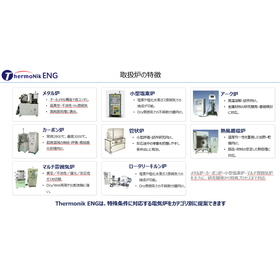
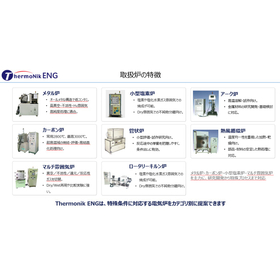
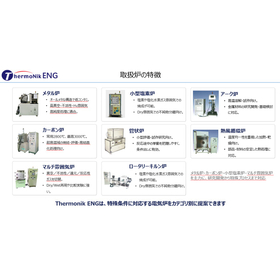
Are you having trouble selecting a furnace or electric furnace? If you choose an electric furnace based solely on maximum temperature, mismatches may occur in terms of operating atmosphere, vacuum level, gas flow, sample size, safety measures, and exhaust gas treatment. This document compares multi-atmosphere furnaces, tube furnaces, metal furnaces, carbon furnaces, and small chlorine furnaces in terms of temperature range, compatible atmospheres, preferred applications, and points to note. ■ Quickly understand the differences between furnace types ■ Useful for specification discussions before equipment installation ■ Effective for preliminary organization of firing tests and condition exploration ■ Also addresses confirmation of firing feasibility in special atmospheres
Added to bookmarks
Bookmarks listBookmark has been removed
Bookmarks listYou can't add any more bookmarks
By registering as a member, you can increase the number of bookmarks you can save and organize them with labels.
Free membership registration
When introducing an electric furnace, it can be difficult to determine the equipment specifications if conditions such as temperature, atmosphere gas, processing time, pressure, sample amount, exhaust gas, and safety measures are still uncertain. Small-scale tests under special conditions that are difficult to accommodate in general electric furnaces, such as corrosive gases like Cl2/HCl, reducing atmospheres like H2, oxidizing atmospheres like O2/Air, NH3 atmospheres, humidified atmospheres, and vacuum/N2/Ar atmospheres, are possible. 【Examples of tests that can be conducted】 ■ Dry removal of metal impurities and selective chlorination using Cl2/HCl ■ Reduction firing and deoxidation treatment using H2 ■ Oxidation firing and surface oxidation treatment using O2/Air ■ Nitriding treatment and reactivity confirmation using NH3 You can consult us even at the stage where conditions are uncertain, such as "Can firing be done under these conditions?", "Can this gas atmosphere be accommodated?", and "Can we consider the generated gases and exhaust treatment?" Even if the material name, processing temperature, atmosphere gas, and processing purpose are not determined, we will support the examination of furnace types, test conditions, and safety configurations at our company. *For examples of tests that can be conducted and the approach, please download the materials or contact us.
Added to bookmarks
Bookmarks listBookmark has been removed
Bookmarks listYou can't add any more bookmarks
By registering as a member, you can increase the number of bookmarks you can save and organize them with labels.
Free membership registration
In conventional coating methods, it is common to apply a raw material solution to the surface of the component and then fire it in an electric furnace after drying. However, for components with narrow gaps, inner surfaces, recesses, and steps, uneven application and uncoated areas are likely to occur, leading to issues with variations in application amount, drying shrinkage, and post-firing film thickness. Our multi-atmosphere furnace can be configured not only for the Wetter method but also to introduce liquid raw materials and organometallic precursors through a vaporizer, functioning as a thermal CVD furnace. By stably supplying the raw materials with the vaporizer and introducing them into the furnace with a carrier gas, it can be utilized for process development involving film formation and coating on the component surface through gas-phase reactions. 【Features】 ■ Supports vapor introduction of liquid raw materials and organometallic precursors ■ Allows for examination of thermal CVD, surface modification, and coating conditions ■ Enables consideration of film formation on components with narrow gaps, inner surfaces, recesses, and steps ■ Expected to shorten processes by omitting application and drying steps *For more details, please download the materials or contact us.
Added to bookmarks
Bookmarks listBookmark has been removed
Bookmarks listYou can't add any more bookmarks
By registering as a member, you can increase the number of bookmarks you can save and organize them with labels.
Free membership registration
This is a high-temperature sintering furnace with atmosphere control designed for electrostatic chucks (ESC) and the firing, reduction treatment, and binder removal of ceramic components. It supports operation in N₂ and N₂ + H₂ reduction atmospheres, enabling high-temperature processing up to 1000°C for regular use and a maximum of 1650°C. Additionally, with optional features, it can accommodate wet gas introduction, dew point control, and dry/wet switching, making it useful for examining conditions related to the firing quality, densification, insulation properties, surface condition, and internal electrode state of materials. Since it allows for processing while switching atmospheres within the same chamber, it helps reduce movement between processes and exposure to outside air, contributing to improved reproducibility of firing conditions, reduced variation, and increased efficiency in prototype evaluation. If you are facing challenges with firing conditions for ESCs, N₂ + H₂ reduction treatment, or dew point management in ceramic firing, please feel free to consult us.
Added to bookmarks
Bookmarks listBookmark has been removed
Bookmarks listYou can't add any more bookmarks
By registering as a member, you can increase the number of bookmarks you can save and organize them with labels.
Free membership registration
The carbon furnace is an electric furnace designed to handle high-temperature processes exceeding 2000°C, such as carbonization treatment, graphitization treatment, high-temperature sintering, debinding treatment, powder metallurgy, and ceramics sintering. By using carbon materials for the in-furnace heater, it can accommodate high-temperature treatments from atmospheric pressure up to a maximum of 3000°C. Additionally, after vacuuming, it can be replaced with inert gases such as Ar or N2, allowing for sintering while suppressing the oxidation of materials. It is particularly suitable for customers with the following challenges: ■ Wanting to perform high-temperature sintering above 2000°C ■ Wanting to sinter carbon materials, C/C composites, SiC, and ceramics ■ Wanting to carry out carbonization and graphitization treatment consistently after debinding ■ Wanting to process in atmospheres containing Ar, N2, vacuum, or H2 as needed ■ Wanting to sinter in a low-oxygen atmosphere that suppresses oxidation ■ Wanting to consider everything from lab tests to mass production equipment We design and manufacture custom carbon furnaces according to the size of the materials being processed, processing temperature, atmosphere gas, target oxygen concentration, heating patterns, and cooling conditions.
Added to bookmarks
Bookmarks listBookmark has been removed
Bookmarks listYou can't add any more bookmarks
By registering as a member, you can increase the number of bookmarks you can save and organize them with labels.
Free membership registration
In the densification of ceramic materials, it is necessary to examine the optimal heat treatment conditions for each material, including debinding, pre-sintering, sintering, pressure sintering, and atmosphere control. In particular, when high-temperature processing is desired while suppressing oxidation, or when the temperature, atmosphere, and furnace dimensions of a conventional electric furnace do not meet requirements, the use of a carbon furnace is effective. Our carbon furnace supports high-temperature heating up to 3000°C and enables firing in a low-oxygen atmosphere by replacing the environment with inert gases such as Ar or N2 after vacuum pumping. Custom designs tailored to specific purposes are possible, ranging from research and development to mass production equipment, for applications such as densification of ceramics, promotion of sintering, phase formation, and high-temperature processing after debinding. We can address challenges such as the following: ■ I want to increase the density of ceramics. ■ I want to consider high sintering temperatures. ■ I want to consistently perform firing and densification after debinding. ■ I want to fire while suppressing oxidation and compositional changes. ■ I want to process in atmospheres such as Ar, N2, or vacuum. ■ The dimensions and temperature conditions of off-the-shelf furnaces do not meet my needs. ■ I want to consult from lab testing to mass production furnaces.
Added to bookmarks
Bookmarks listBookmark has been removed
Bookmarks listYou can't add any more bookmarks
By registering as a member, you can increase the number of bookmarks you can save and organize them with labels.
Free membership registration
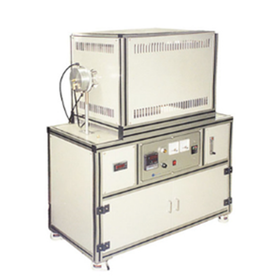
In the development of new materials and research applications, a high-temperature furnace that can extensively examine the thermal treatment conditions of materials is essential. In particular, for high-temperature sintering above 2000°C, carbonization and graphitization, ceramic sintering, and thermal treatment of powder materials, atmosphere control such as vacuum, inert gas, and low-oxygen environments becomes crucial. Our carbon furnace supports high-temperature heating up to 3000°C and enables high-temperature processing with reduced oxidation by replacing the atmosphere with inert gases such as Ar and N2 after vacuum pumping. We offer custom designs based on the size, temperature, atmosphere, and processing volume of the materials, ranging from small furnaces for research and development to equipment for prototype evaluation and pre-mass production studies. We can accommodate research and development themes such as the following: ■ High-temperature sintering and thermal treatment of new materials ■ Examination of high-temperature processes above 2000°C ■ Carbonization and graphitization of carbon materials ■ Sintering of non-oxide ceramics such as SiC, AlN, and BN ■ Sintering of battery materials, negative electrode materials, and conductive materials ■ Evaluation of powder molded bodies, pellets, and sintered bodies ■ Sintering under atmosphere control with vacuum, Ar, N2, etc. ■ Scale-up studies from laboratory scale to pre-mass production evaluation
Added to bookmarks
Bookmarks listBookmark has been removed
Bookmarks listYou can't add any more bookmarks
By registering as a member, you can increase the number of bookmarks you can save and organize them with labels.
Free membership registration
In the aerospace field, the quality stability of heat-resistant components and composite materials used in high-temperature environments is crucial. For the firing of turbine parts, rocket-related components, C/C composites, and ceramic materials, not only temperature conditions but also vacuum and inert atmosphere control to suppress oxidation are required. Our carbon furnace supports high-temperature heating up to 3000°C and enables high-temperature firing in a low-oxygen atmosphere by replacing the environment with Ar, N2, etc., after vacuuming. We offer custom designs based on the material, size, temperature, and atmosphere of the items being processed, including firing, carbonization, graphitization, sintering, and heat treatment conditions for heat-resistant components. ■ I want to consider firing conditions for heat-resistant components for aerospace applications. ■ I want to perform high-temperature processing above 2000°C. ■ I want to process C/C composites and ceramic materials. ■ I want to fire in a vacuum or inert atmosphere that suppresses oxidation. ■ I would like to consult from research and development to prototype and pre-mass production evaluation.
Added to bookmarks
Bookmarks listBookmark has been removed
Bookmarks listYou can't add any more bookmarks
By registering as a member, you can increase the number of bookmarks you can save and organize them with labels.
Free membership registration
In the manufacturing of optical components, it is important to process materials while minimizing oxidation and contamination, under stable temperature and atmospheric conditions. In particular, the cleanliness of the furnace atmosphere and temperature uniformity significantly affect the quality in processes such as hermetic sealing of ceramics and metals, glass sealing, brazing, annealing, and sintering. Our metal furnace is a high-temperature atmosphere furnace that uses metal heaters such as Mo and W, and can accommodate atmospheres like vacuum, N2, Ar, and H2. We offer custom designs based on the material, size, temperature, and atmosphere of the items being processed, including optical components, sensor components, electronic components, and ceramic components. ■ I want to perform hermetic sealing of ceramics and metals. ■ I want to consider brazing and annealing conditions for optical components. ■ I want to conduct heat treatment in an atmosphere that minimizes oxidation and contamination. ■ I want to process in vacuum, N2, Ar, or H2 atmospheres. ■ The temperature, internal dimensions, and atmospheric conditions of off-the-shelf furnaces do not meet my needs.
Added to bookmarks
Bookmarks listBookmark has been removed
Bookmarks listYou can't add any more bookmarks
By registering as a member, you can increase the number of bookmarks you can save and organize them with labels.
Free membership registration
In research and development as well as prototype evaluation, a high-temperature furnace that can meticulously examine temperature, atmosphere, and processing time for each material is essential. Particularly in the bonding of ceramics and metals, brazing, annealing, firing, and reduction atmosphere treatments, the cleanliness and atmosphere control within the furnace significantly affect quality. Our metal furnace is a high-temperature atmosphere furnace that uses metal heaters such as Mo and W, and it can accommodate atmospheres like vacuum, N2, Ar, and H2. We offer custom designs based on the material, size, temperature, and atmosphere of the items being processed, suitable for material evaluation, prototyping, and pre-production studies at universities, research institutions, and corporate research labs. ■ Looking for a high-temperature furnace for research and development ■ Want to consider bonding and sealing of ceramics and metals ■ Want to evaluate brazing, annealing, and firing conditions ■ Want to process in vacuum, N2, Ar, and H2 atmospheres ■ Standard furnaces do not meet temperature, internal dimensions, and atmosphere conditions
Added to bookmarks
Bookmarks listBookmark has been removed
Bookmarks listYou can't add any more bookmarks
By registering as a member, you can increase the number of bookmarks you can save and organize them with labels.
Free membership registration
In analysis and evaluation, factors such as oxidation of the sample surface, adsorbed moisture, residual gases, organic components, and contamination by impurities can affect the measurement results. Particularly before conducting high-precision analysis, surface analysis, or material evaluation, it is important to thermally treat the analytical sample under high vacuum and high purity conditions to stabilize its state. Our metal furnace is constructed with metal components, which makes it easier to minimize the influence of dust and impurities from insulation materials, allowing for cleaner high-purity atmospheres for firing and heat treatment compared to other types of furnaces. Additionally, it is easier to achieve high vacuum compared to conventional insulated furnaces, enabling degassing, oxidation prevention, reduction treatment, annealing, and consideration of heat treatment conditions for samples in vacuum, N2, Ar, H2, and other atmospheres. ■ I want to degas the sample in high vacuum before analysis. ■ I want to minimize the effects of surface oxidation and adsorbed moisture. ■ I want to thermally treat the analytical sample in a high-purity atmosphere. ■ I want to perform sample pretreatment in vacuum, N2, Ar, H2 atmospheres. ■ The existing furnaces do not meet the required vacuum level, cleanliness, or internal dimensions.
Added to bookmarks
Bookmarks listBookmark has been removed
Bookmarks listYou can't add any more bookmarks
By registering as a member, you can increase the number of bookmarks you can save and organize them with labels.
Free membership registration
In semiconductor components, ensuring long-term reliability requires airtightness during the sealing process and the suppression of oxidation and contamination. In particular, the sealing of ceramics and metals, brazing, annealing, and firing are influenced by the cleanliness of the furnace and the control of vacuum and atmosphere. Our metal furnace is constructed with metal components, making it easier to minimize the impact of dust and impurities from insulation materials, and it is suitable for heat treatment in a clean, high-purity atmosphere. Additionally, it can be easily reduced to high vacuum compared to conventional insulation furnaces, allowing for the sealing, brazing, oxidation prevention, and annealing of semiconductor components in vacuum, N2, Ar, and H2 atmospheres. ■ I want to consider the airtight sealing conditions for semiconductor components. ■ I want to stabilize the bonding and sealing quality of ceramics and metals. ■ I want to process in a high-purity atmosphere that suppresses oxidation and contamination. ■ I want to perform heat treatment in high vacuum, N2, Ar, and H2 atmospheres. ■ The vacuum level, cleanliness, and internal dimensions of off-the-shelf furnaces do not meet my requirements.
Added to bookmarks
Bookmarks listBookmark has been removed
Bookmarks listYou can't add any more bookmarks
By registering as a member, you can increase the number of bookmarks you can save and organize them with labels.
Free membership registration
In the development of environmental purification materials and catalyst materials, the atmosphere, temperature, and exhaust gas components during firing can affect material performance. Particularly in the firing of materials containing organic components, the activation of catalysts, and treatments involving the generation of gases such as NH3 and CO, controlling the furnace atmosphere and considering exhaust gas treatment equipment are crucial. Our multi-atmosphere furnace can accommodate multiple atmospheres such as vacuum, air, N2, Ar, and NH3, and can be custom-designed according to the firing conditions and exhaust gas generation conditions of the materials. For the firing and heat treatment of environmental purification materials, catalyst materials, adsorbents, and ceramic materials, we can provide a comprehensive examination from the furnace body to gas supply, exhaust, and pollution control equipment. ■ I want to examine the firing conditions for environmental purification materials and catalyst materials. ■ I want to consider exhaust equipment assuming the generation of gases such as NH3 and CO. ■ I want to process in multiple atmospheres such as vacuum, air, N2, Ar, and NH3. ■ The existing furnaces do not match the gas types, furnace dimensions, and exhaust gas treatment conditions. ■ I would like to consult from research and development to prototype and pre-mass production evaluation. * The materials include points for consideration such as the basic configuration of the multi-atmosphere furnace, compatible atmospheres, temperature specifications, gas supply and exhaust equipment, and exhaust gas treatment.
Added to bookmarks
Bookmarks listBookmark has been removed
Bookmarks listYou can't add any more bookmarks
By registering as a member, you can increase the number of bookmarks you can save and organize them with labels.
Free membership registration
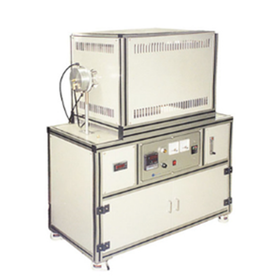
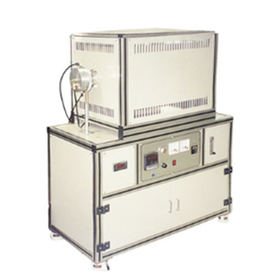
In the development of chemical reaction processes, the reaction efficiency and safety can vary significantly due to factors such as temperature, ambient gases, and the exhaust gas components generated during the reaction. Particularly in reactions involving gases like NH3 and CO, as well as in the examination of reaction conditions under multiple atmospheres such as Air, N2, Ar, vacuum, and ammonia, it is crucial to design not only the furnace itself but also the gas supply, exhaust, and emission control systems. Our multi-atmosphere furnace can be custom-designed to match the material inside the furnace, gas supply lines, exhaust systems, emission control equipment, and safety measures according to the treated materials and reaction gases. We can accommodate everything from research and development to prototype and pre-mass production evaluations for chemical reactions, thermal decomposition, reduction reactions, oxidation reactions, and ammonia atmosphere treatments. ■ I want to examine the reaction conditions for chemical reaction processes. ■ I want to consider exhaust equipment assuming the generation of gases like NH3 and CO. ■ I want to process under multiple atmospheres such as Air, N2, Ar, vacuum, and ammonia. ■ I want to examine the internal material and sealing structure of the furnace according to the reaction gas. ■ The existing furnaces do not match the gas types, exhaust specifications, and safety measures. * The materials include the basic configuration of the multi-atmosphere furnace, compatible atmospheres, gas supply and exhaust systems, and design points when handling reactive gases.
Added to bookmarks
Bookmarks listBookmark has been removed
Bookmarks listYou can't add any more bookmarks
By registering as a member, you can increase the number of bookmarks you can save and organize them with labels.
Free membership registration
In the surface treatment of metal parts and powder materials, not only temperature but also ambient gas, dew point, oxygen concentration, and treatment time significantly affect the surface condition and quality. In particular, for oxidation prevention, surface modification, coating pretreatment, and hydrophilization/hydrophobicity treatment, it is important to reproducibly examine conditions while switching between dry, humid, and reducing atmospheres. Our multi-atmosphere furnace can switch between various ambient gases such as N2, Ar, Air, H2, and NH3 after displacing the air in the furnace through vacuum replacement. Additionally, by connecting a Wetter, it is possible to manage surface treatment conditions with controlled humid atmospheres and dew points. 【Features】 ■ Capable of switching to various gas atmospheres after vacuum replacement ■ Supports humid atmosphere and dew point control through Wetter connection ■ Can manage atmosphere history such as dry → humid → dry ■ Applicable for oxidation prevention, surface modification, and pretreatment of metal surfaces ■ Condition management combining dew point meters and O2 meters can also be considered *For more details, please download the materials or contact us.
Added to bookmarks
Bookmarks listBookmark has been removed
Bookmarks listYou can't add any more bookmarks
By registering as a member, you can increase the number of bookmarks you can save and organize them with labels.
Free membership registration
In the sintering and densification of ceramics, not only temperature but also atmospheric gas, dew point, oxygen concentration, and heating conditions affect density, porosity, grain growth, and surface condition. In particular, when managing firing in a humid atmosphere, switching between oxidizing and reducing atmospheres, or controlling atmospheric history such as drying → humidifying → drying, it can be difficult to reproduce conditions with conventional electric furnaces or tube furnaces. Our multi-atmosphere furnace can switch to various atmospheric gases such as N2, Ar, Air, H2, and NH3 after displacing the air in the furnace through vacuum replacement. Additionally, by connecting a Wetter, it is possible to examine ceramic firing conditions that manage humid atmospheres and dew points. 【Features】 ■ Capable of switching to various gas atmospheres after vacuum replacement ■ Supports humid atmosphere and dew point control through Wetter connection ■ Can manage atmospheric history such as drying → humidifying → drying ■ Enables examination of sintering, densification, and high-density conditions for ceramics ■ Condition management combining dew point meters and O2 meters can also be considered *For more details, please download the materials or contact us.
Added to bookmarks
Bookmarks listBookmark has been removed
Bookmarks listYou can't add any more bookmarks
By registering as a member, you can increase the number of bookmarks you can save and organize them with labels.
Free membership registration
We handle "tubular furnaces" suitable for examining heat treatment conditions of metal and alloy materials. In the firing and heat treatment of metals and alloys, temperature, pressure, gas flow rate, and atmospheric conditions affect alloy composition, microstructural changes, oxidation/reduction behavior, and quality variations. General-purpose tubular furnaces may only evaluate before and after firing, making it difficult to grasp temperature changes, pressure fluctuations, and gas flow during heat treatment. This equipment incorporates MFCs, pressure gauges, thermocouples, and sampling lines according to the application, allowing for the recording of temperature, flow rate, and pressure during heat treatment with the same timestamp. 【Features】 ■ Synchronized logging of temperature, flow rate, and pressure ■ Implementation of MFCs, pressure gauges, and thermocouples according to application ■ Design of sampling ports and exhaust lines ■ Compatible with various atmospheres such as vacuum, inert gas, and H2 ■ Suitable for comparing and verifying the reproducibility of heat treatment conditions for metals and alloys *For more details, please download the materials or contact us.
Added to bookmarks
Bookmarks listBookmark has been removed
Bookmarks listYou can't add any more bookmarks
By registering as a member, you can increase the number of bookmarks you can save and organize them with labels.
Free membership registration
We handle a "tubular furnace" suitable for investigating firing conditions of battery electrode materials. In the firing of electrode materials, temperature, pressure, gas flow rate, and atmospheric conditions affect uniformity, property variation, and defect occurrence. General-purpose tubular furnaces often only evaluate before and after firing, making it difficult to understand the reaction behavior and condition changes during firing. This equipment incorporates MFCs, pressure gauges, thermocouples, sampling lines, and other components as needed, allowing for the recording of temperature, flow rate, and pressure during firing with the same timestamp. 【Features】 ■ Synchronized logging of temperature, flow rate, and pressure ■ Implementation of MFCs, pressure gauges, and thermocouples as needed ■ Design of sampling ports and exhaust lines ■ Compatible with various atmospheres such as vacuum, inert gas, and H2 ■ Ideal for comparing and confirming reproducibility of electrode firing conditions *For more details, please download the materials or contact us.
Added to bookmarks
Bookmarks listBookmark has been removed
Bookmarks listYou can't add any more bookmarks
By registering as a member, you can increase the number of bookmarks you can save and organize them with labels.
Free membership registration
We handle a "tubular furnace" suitable for examining the conditions of the ceramics firing process. In ceramics firing, temperature, pressure, atmosphere gas, and flow conditions significantly affect the firing results. General-purpose tubular furnaces may only evaluate before and after firing, making it difficult to grasp temperature changes, pressure fluctuations, and gas flow during firing. This equipment incorporates MFCs, pressure gauges, thermocouples, sampling lines, and other components according to the application, allowing for the recording of temperature, flow, and pressure during firing with the same timestamp. 【Features】 ■ Synchronized logging of temperature, flow, and pressure ■ Implementation of MFCs, pressure gauges, and thermocouples according to application ■ Design of sampling ports and exhaust lines ■ Compatible with various atmospheres such as vacuum, inert gas, and H2 ■ Ideal for comparing ceramics firing conditions and verifying reproducibility *For more details, please download the materials or contact us.
Added to bookmarks
Bookmarks listBookmark has been removed
Bookmarks listYou can't add any more bookmarks
By registering as a member, you can increase the number of bookmarks you can save and organize them with labels.
Free membership registration
We offer a "tubular furnace" suitable for catalyst activation and reaction behavior evaluation. In catalyst processing, slight differences in temperature, pressure, gas flow rate, and atmosphere switching can affect activity and reproducibility. General-purpose tubular furnaces may only analyze before and after firing, making it difficult to grasp the timing of reaction start and end, as well as gas generation behavior. This equipment incorporates MFCs, pressure gauges, thermocouples, sampling lines, and more according to the application, allowing for synchronized logging of temperature, flow rate, pressure, and exhaust data. 【Features】 ■ Simultaneous recording of temperature, flow rate, pressure, and exhaust data ■ Understanding the timing of reaction start, end, and gas generation ■ Implementation of MFCs, pressure gauges, and thermocouples according to application ■ Design of sampling ports and exhaust analysis lines ■ Ideal for comparing catalyst activation conditions and confirming reproducibility *For more details, please download the materials or contact us.
Added to bookmarks
Bookmarks listBookmark has been removed
Bookmarks listYou can't add any more bookmarks
By registering as a member, you can increase the number of bookmarks you can save and organize them with labels.
Free membership registration
In high-temperature processes involving halogen gases (such as F and Cl series), common electric furnaces may face issues with corrosion and degradation of heaters, furnace materials, piping, and sealing materials. Particularly in surface treatment, etching, cleaning, and reaction evaluation using fluorine or chlorine gases, it is crucial to design equipment that includes corrosion resistance of furnace materials, exhaust and emission control, and gas leakage prevention. Our small halogen-compatible furnace is a test furnace designed to examine high-temperature processing using corrosive gases on a small scale. We can consider configurations tailored to applications, including corrosion-resistant materials, scrubber integration, interlocks, and safety equipment. **Features** - Compatible with halogen gas atmospheres such as F and Cl series - Consideration of furnace materials, piping, and sealing configurations for corrosive gases - Integration with scrubbers, gas detection, and emergency shutdown systems is possible - Pre-evaluation of temperature, gas concentration, and processing time in a small furnace - Support for process feasibility confirmation before mass production furnace introduction *For more details, please download the materials or contact us.*
Added to bookmarks
Bookmarks listBookmark has been removed
Bookmarks listYou can't add any more bookmarks
By registering as a member, you can increase the number of bookmarks you can save and organize them with labels.
Free membership registration
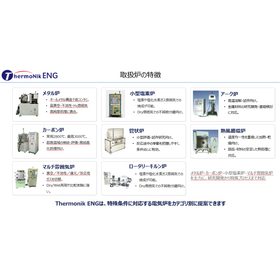
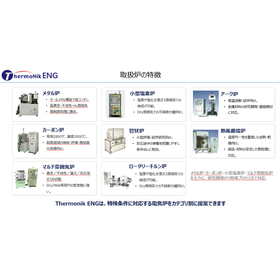
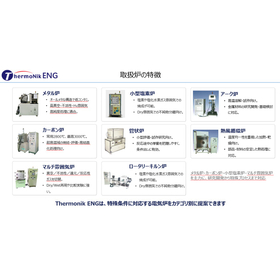
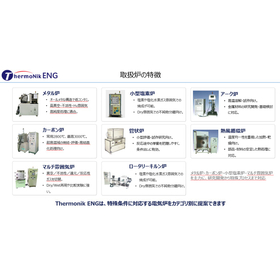
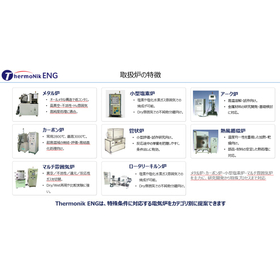
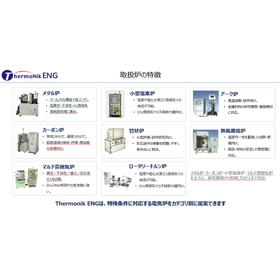
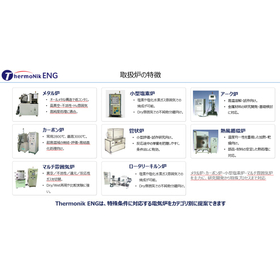
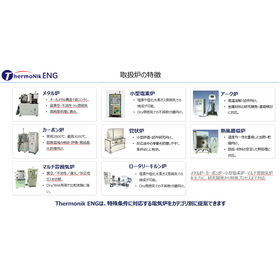
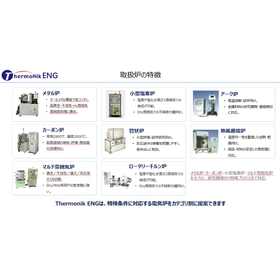
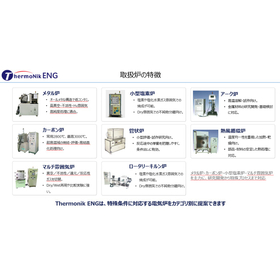
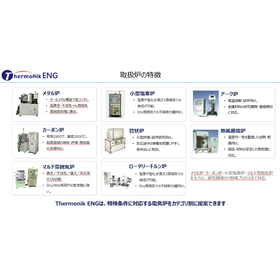
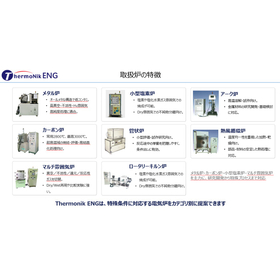
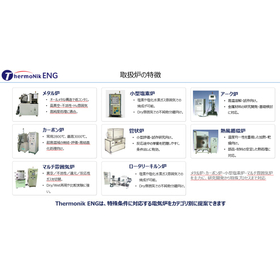
We would like to introduce the five types of furnaces we handle, including their atmospheric compatibility, temperature ranges, and representative applications. Starting with the "Chlorine Furnace," which is compatible with halogens such as Cl2/HCl, we also offer the "Carbon Furnace" for ultra-low oxygen and high temperatures, the clean and agile "Metal Furnace," the versatile "Multi-Atmosphere Furnace" that includes humid conditions, and the small-scale "Tubular Furnace" for initial testing. We also have test equipment available. In addition to small-scale units, we have experience in manufacturing furnaces for mass production. 【Features】 ■ Chlorine Furnace - Compatible Atmospheres: Cl2/HCl/Inert (N2/Ar) - Temperature: Up to around 1800°C (depending on model and material) - Main Applications: Chlorination/Chloride Volatilization/Halogen Purification/Surface Modification ■ Metal Furnace - Compatible Atmospheres: Vacuum/Air/N2/Ar/Small amounts of H2 - Temperature Range: Approximately up to 1800°C (depending on model) - Main Applications: Sintering/Diffusion Bonding/Oxidation/Reduction Annealing/Crystallization of Metals and Ceramics *For more details, please feel free to contact us.
Added to bookmarks
Bookmarks listBookmark has been removed
Bookmarks listYou can't add any more bookmarks
By registering as a member, you can increase the number of bookmarks you can save and organize them with labels.
Free membership registration
We handle "tubular furnaces" that are suitable for visualizing reaction behavior. In general-purpose tubular furnaces, it is often difficult to grasp the timing of reaction start and end, as well as the behavior of gas generation, changes in pressure, and flow rate, as only pre- and post-firing analyses can be performed. This equipment can be configured to synchronize logging of data during the reaction by combining flow meters, pressure gauges, temperature measurements, sampling ports, and exhaust analysis lines according to the customer's objectives. 【Features】 ■ Simultaneous recording of flow, pressure, temperature, and exhaust data ■ Understanding of the timing of reaction start, end, and gas generation ■ Design of sampling ports, bypass lines, etc. ■ Compatible with various atmospheres such as vacuum, inert gas, and H2 ■ Suitable for small-scale tests for exhaust evaluation and condition examination *For more details, please download the materials or contact us.
Added to bookmarks
Bookmarks listBookmark has been removed
Bookmarks listYou can't add any more bookmarks
By registering as a member, you can increase the number of bookmarks you can save and organize them with labels.
Free membership registration
Our company offers a "Multi-Atmosphere Furnace" that is precisely designed for material evaluation and phase transition testing in oxidation/reduction atmospheres, utilizing a dual-axis of "atmosphere x temperature." It features a built-in vacuum system that allows for vacuum replacement before and after processing, followed by replacement with the specified gas, thereby reducing the risk of residual gas during furnace opening. Additionally, the high degree of freedom in tray design allows for parallel DOE (Design of Experiments) under the same conditions and multiple samples, enabling the extraction of optimal conditions for scale-up in a short cycle. [Reasons why our carbon furnace is effective for graphitization] - Compatible with generated gases such as NH3 and CO: Designed with materials, piping temperature control, and instrumentation tailored to gas characteristics. - Built-in vacuum system: Allows for vacuum replacement before and after processing, followed by replacement with the specified gas, reducing the risk of residual gas during furnace opening. - Rectangular casing x stacked design: High flexibility in tray design allows for parallel DOE under the same conditions and multiple samples, enabling the extraction of optimal conditions for scale-up in a short cycle. *For more detailed information, please download the materials or feel free to contact us.
Added to bookmarks
Bookmarks listBookmark has been removed
Bookmarks listYou can't add any more bookmarks
By registering as a member, you can increase the number of bookmarks you can save and organize them with labels.
Free membership registration
Our company offers a "Multi-Atmosphere Furnace" designed to handle the firing process that generates harmful gases such as NH3, CO, and NOx. During the firing of raw materials containing organic substances, resin-based materials, catalyst carriers, and battery materials, gases such as NH3, CO, NOx, HCN, and hydrocarbon gases may be emitted during heating and holding. Gases that were not an issue in small tubular furnaces or small-scale tests can become significant challenges in terms of exhaust concentration, emission volume, corrosiveness, and safety measures as the number of tray layers and processing volume increase. Our Multi-Atmosphere Furnace can design the entire firing process, including vacuum replacement, atmosphere control, heating, exhaust, and coordination with emission treatment equipment. 【Features】 ■ Furnace design considering the generation of gases such as NH3, CO, and NOx ■ Gas replacement in the furnace before and after processing through vacuum replacement ■ Compatibility with various atmospheres such as N2, Ar, Air, and NH3 ■ Consideration of emission treatment methods such as scrubbers, catalytic oxidation, and thermal oxidation ■ Support for scale-up considerations anticipating increased tray layers and processing volume *For more details, please download the materials or contact us.
Added to bookmarks
Bookmarks listBookmark has been removed
Bookmarks listYou can't add any more bookmarks
By registering as a member, you can increase the number of bookmarks you can save and organize them with labels.
Free membership registration
We offer a "Multi-Atmosphere Furnace" that allows for flexible design of dew point and oxygen partial pressure. This product addresses challenges such as unstable humidity, slow switching leading to lack of reproducibility, fears of condensation, backflow, contamination, and corrosion, as well as low parallel freedom and time-consuming condition setting in tube furnaces. Additionally, specifications can be customized according to customer requests, so please consult us for details. [Reasons Why Our Carbon Furnace is Effective] ■ Humidity system independent of gas type: Directly connected to Wetter for setting humidity levels in N2/Ar/air (small amounts of H2 also acceptable) ■ Vacuum replacement → gas replacement: Pre-removal of air inside the sample, achieving the desired humid atmosphere from startup ■ Speed of switching: Easily switch between dry/humid and N2/Ar/air (small amounts of H2) ■ Stacked shelves × rectangular sleeves: Short cycle parallel testing with multiple samples under the same conditions *For more detailed information, please download our materials or feel free to contact us.
Added to bookmarks
Bookmarks listBookmark has been removed
Bookmarks listYou can't add any more bookmarks
By registering as a member, you can increase the number of bookmarks you can save and organize them with labels.
Free membership registration
In metals, alloys, ceramics, and coatings used in high-temperature environments, corrosive atmospheres such as Cl2, HCl, oxidizing gases, and water vapor may lead to surface reactions, oxidation, chlorination, delamination, and embrittlement. Our small chlorine furnace is a test furnace for high-temperature corrosion evaluation that can replicate corrosion behavior in chlorine and hydrochloric acid atmospheres. It can be widely used for reproducing high-temperature corrosive atmospheres, comparing corrosion-resistant materials, evaluating surface treatments and coatings, and analyzing corrosion mechanisms, from material development to equipment component selection. Additionally, by operating under constant negative pressure, it reduces the risk of corrosive gas leakage and establishes a safe testing environment combined with exhaust and detoxification equipment. 【Features】 ■ Supports high-temperature corrosion evaluation in corrosive gas atmospheres such as Cl2 and HCl ■ Allows comparison of corrosion resistance for metals, alloys, ceramics, and coatings ■ Accommodates corrosion tests with varying temperature, gas type, concentration, and treatment time ■ Reduces the risk of corrosive gas leakage through constant negative pressure operation ■ Enables consideration of testing environments that include exhaust, detoxification, and safety equipment *For more details, please download the materials or contact us.
Added to bookmarks
Bookmarks listBookmark has been removed
Bookmarks listYou can't add any more bookmarks
By registering as a member, you can increase the number of bookmarks you can save and organize them with labels.
Free membership registration
Urban mines contain a complex mixture of valuable metals and base metals such as Au, Cu, Sn, Fe, and Ni. When separating and recovering these through wet processing, challenges may arise related to the use of reagents, waste liquid treatment, pretreatment processes, and drying processes. Our small chlorine furnace can selectively separate and recover metal components by converting them into volatile chlorides through dry chlorination using Cl2/HCl, while controlling temperature, chlorine partial pressure, and pressure. For example, in the low-temperature range, easily volatile chlorides such as FeCl3 and SnCl4 can be removed first, and in the mid-temperature range, the separation of precious metals can be considered using the vapor pressure differences of AuCl3 and others. 【Features】 ■ Supports dry chlorination and chloride volatilization using Cl2/HCl ■ Allows for selective separation of multiple metals such as Au, Cu, Sn, Fe, and Ni ■ Accommodates staged processing with controlled temperature, chlorine partial pressure, and pressure ■ Reduces waste liquid and drying processes associated with wet processing ■ Enables exploration of urban mine recycling conditions with small sample sizes *For more details, please download the materials or contact us.
Added to bookmarks
Bookmarks listBookmark has been removed
Bookmarks listYou can't add any more bookmarks
By registering as a member, you can increase the number of bookmarks you can save and organize them with labels.
Free membership registration
In processes using corrosive gases such as Cl2 and HCl, safety design is crucial to address issues like gas leaks, corrosion of piping and furnace materials, exhaust of unreacted gases, and waste treatment. Our company offers a "small chlorine furnace" for research and development purposes. This equipment is a compact furnace that can safely and controllably handle chlorine and hydrogen chloride, and it can be used for condition testing in material testing with corrosive gases, removal of metal impurities, selective chlorination, and jig cleaning. By combining a furnace and piping structure made of corrosion-resistant materials, scrubber interlocks, corrosive gas monitors, emergency shutdowns, and interlocks, we can consider configurations that make it easier to safely conduct Cl2/HCl processing even for research applications. 【Features】 ■ Compatible with corrosive gas processing such as Cl2/HCl ■ Reduces the risk of gas leakage outside the furnace through continuous negative pressure operation ■ Furnace and piping structure made of corrosion-resistant materials ■ Possible integration with scrubbers, corrosive gas monitors, and emergency shutdowns *For more details, please download the materials or contact us.
Added to bookmarks
Bookmarks listBookmark has been removed
Bookmarks listYou can't add any more bookmarks
By registering as a member, you can increase the number of bookmarks you can save and organize them with labels.
Free membership registration
The "carbon furnace" we handle is an electric furnace designed for high-temperature processing at around 3000°C in an extremely low-oxygen atmosphere. By using vacuum replacement, the air inside the furnace is preemptively expelled, and the getter effect of the carbon material reduces residual oxygen and oxidizing components. It is structured to suppress oxidation, decarburization, and re-oxidation in high-temperature regions, making it easier to reproduce processing conditions such as graphitization, carbonization, nitridation, and high-temperature modification. It can be applied to high-temperature processing of carbon materials, carbon black, CNT, CNF, graphite sheets, ceramics, powder metallurgy materials, semiconductor fixtures, and more. 【Features】 ■ High-temperature sintering in an extremely low-oxygen atmosphere ■ Usable at a constant 2800°C, with a maximum of 3000°C ■ Reduction of residual air in the furnace through vacuum replacement ■ Oxygen getter effect from the carbon material ■ Design allows for simultaneous processing of multiple samples with a saya-tray configuration *For more details, please download the materials or contact us.
Added to bookmarks
Bookmarks listBookmark has been removed
Bookmarks listYou can't add any more bookmarks
By registering as a member, you can increase the number of bookmarks you can save and organize them with labels.
Free membership registration