

Confirm the feasibility of firing in a special atmosphere such as chlorine, reduction, oxidation, NH3, and humidification before equipment installation.
When introducing an electric furnace, it can be difficult to determine the equipment specifications if conditions such as temperature, atmosphere gas, processing time, pressure, sample amount, exhaust gas, and safety measures are still uncertain. Small-scale tests under special conditions that are difficult to accommodate in general electric furnaces, such as corrosive gases like Cl2/HCl, reducing atmospheres like H2, oxidizing atmospheres like O2/Air, NH3 atmospheres, humidified atmospheres, and vacuum/N2/Ar atmospheres, are possible. 【Examples of tests that can be conducted】 ■ Dry removal of metal impurities and selective chlorination using Cl2/HCl ■ Reduction firing and deoxidation treatment using H2 ■ Oxidation firing and surface oxidation treatment using O2/Air ■ Nitriding treatment and reactivity confirmation using NH3 You can consult us even at the stage where conditions are uncertain, such as "Can firing be done under these conditions?", "Can this gas atmosphere be accommodated?", and "Can we consider the generated gases and exhaust treatment?" Even if the material name, processing temperature, atmosphere gas, and processing purpose are not determined, we will support the examination of furnace types, test conditions, and safety configurations at our company. *For examples of tests that can be conducted and the approach, please download the materials or contact us.
Inquire About This Product
basic information
■ Confirmation of Process Feasibility Before Equipment Introduction - Confirm whether the materials react at the target temperature and atmosphere. - Check the appearance, weight changes, reactivity, and presence of residues after firing. - Obtain guidelines for processing temperature, holding time, and heating conditions. ■ Confirmation of Atmospheric Conditions - Accommodate gases such as Cl2/HCl, H2, NH3, O2, Air, N2, Ar, and humidified gas. - Compare gas concentration, flow rate, pressure, and processing time. - Confirm the necessity of vacuum replacement or inert gas replacement. ■ Confirmation of Exhaust and Safety Conditions - Check for the presence of corrosive gases, harmful gases, and reaction by-products. - Consider scrubbers, exhaust lines, gas detection, and interlock configurations. - Utilize for organizing necessary safety specifications during mass production furnace design. ■ Reflection in Equipment Specifications - Based on test results, consider furnace type, internal dimensions, temperature specifications, and gas lines. - Proposals can include trays, fixtures, collection methods, and exhaust treatment equipment. - Consider the transition from small-scale tests to dedicated furnace and mass production furnace specifications. *This test is not contract processing but a preliminary evaluation for equipment specification consideration.
Price information
*The price varies depending on the test content, type of furnace used, processing temperature, atmosphere gas, number of samples, and exhaust/decontamination conditions. Please contact us for more details.*
Delivery Time
※The implementation timing will vary depending on the test conditions, furnace availability, sample preparation, gas type, and safety confirmation.
Applications/Examples of results
【Regarding such issues】 ■ I don't know which type of furnace to choose. ■ The temperature and atmosphere conditions have not yet been decided. ■ I want to confirm the reactivity of the materials before introducing the equipment. ■ I am unsure about exhaust gas and safety measures, so I cannot determine the equipment specifications. ■ I want to confirm whether processing is possible in special atmospheres such as Cl2, H2, NH3, O2, and humidification. ■ I would like to consider the specifications for mass production furnaces based on the results of small-scale tests. 【Please consult with us first】 ■ I want to confirm whether this material can be sintered. ■ I want to know if it can handle this temperature and atmosphere. ■ I am concerned about generated gases, corrosive gases, and toxic gases. ■ I don't know which type of furnace to choose. ■ I want to confirm the conditions with small-scale tests before introducing the equipment. It is perfectly fine to ask questions like, "Is this test possible?" or "Can it be sintered under these conditions?" You can consult with us even if the material name, processing purpose, desired temperature, and atmosphere conditions are not yet determined.
catalog(1)
Download All Catalogs
Company information

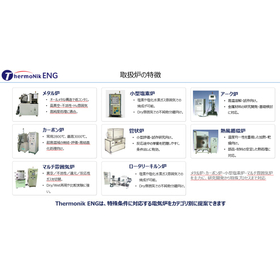
Our company integrates three technologies: "electricity," "equipment," and "chemistry," using our unique know-how to develop innovative heating furnaces and other equipment. We handle various electric furnaces (heating furnaces) such as carbon furnaces, multi-atmosphere furnaces, metal furnaces, and chlorine furnaces, leveraging our proprietary high-temperature electric furnace technology. We are not just an equipment manufacturer; we are a strategic development partner that supports innovative manufacturing with advanced heating, looking ahead to the standards of the next decade alongside our customers.


